Biological Sciences

Ciliates
Ciliates are a diverse group of single-celled organisms characterized by the presence of hair-like structures called cilia, which they use for movement and feeding. They are found in various aquatic environments and play important roles in nutrient cycling and food webs. Ciliates exhibit complex behaviors and have unique cellular structures, making them a fascinating subject of study in biological sciences.
Written by Perlego with AI-assistance
8 Key excerpts on "Ciliates"
 eBook - PDF
- Richard G. Botzler, Richard N. Brown(Authors)
- 2014(Publication Date)
- University of California Press(Publisher)
All members have cilia as organelles of motility; species are distinguished on the basis of their pattern of kingdom protista 177 cilia and associated cortical structure, and on the basis of their nuclear structure and func-tion (Bush et al. 2001). Ciliates commonly divide by binary fission, although conjuga-tion can occur (Bush et al. 2001). In contrast to the Apicomplexa, there are very few Ciliates that cause disease among vertebrates (Bush et al. 2001). All Ciliates have a direct (monox-enous) life cycle. Among wildlife, only Balan-tidium coli has been reported to cause disease with any regularity (Lucius and Loos-Frank 1997, Kocan 2001a). Some Ciliates, including B. coli, produce resistant cyst stages (Bush et al. 2001). Excavata (Flagellates) A diverse variety of eukaryotic single-celled organisms have a life history stage using one or more flagellae as organelles of motility. Parasitic flagellates infect most animal phyla and occupy a variety of host habitats, including the intestines, reproductive tract, deep body tissues, as well as intracellularly and extracellularly in the blood vascular sys-tem (Bush et al. 2001). Until recently, flagellates were believed to be closely related to amebae (Bush et al. 2001). However, most flagellates currently are classi-fied within the Supergroup Excavata (Adl et al. 2005). Further, within the Excavata, flagellates are broadly distributed among three of the six First Rank subgroups, including Fornicata, Parabasilia, and Euglenozoa. From a clinical perspective, flagellates often have been dis-tinguished as intestinal flagellates (included in Fornicata and Parabasilia) or hemoflagel-lates (in Euglenozoa) (Chandler and Read 1961, Kocan 2001a). Intestinal Flagellates Most intestinal flagellates of concern to wildlife fall within the Trichomonadida subgroup of the Parabasilia (Adl et al. 2005). Important genera include Histomonas and Trichomonas. Their flagellae are often associated with a lamellar undulating membrane. eBook - PDF
- Joseph Gall(Author)
- 2012(Publication Date)
- Academic Press(Publisher)
The Ciliates were not recognized as representative eukaryotes, but only as beasts deviating from simple prokaryotic generalizations—which were being projected with more enthusiasm than prudence upon the phenomena of higher organisms. ι THE MOLECULAR BIOLOGY Copyright © 1986 by Academic Press, Inc. OF CILIATED PROTOZOA All rights of reproduction in any form reserved. 2 David L. Nanney Only when the distinctiveness of eukaryotic mechanisms was recognized could the difficulties of the ciliate analyses be placed in proper perspective. And only now, as technological developments allow the ciliate mechanisms to be convincingly interpreted on a molecular basis, is their relevance to higher orga-nisms firmly established. The Ciliates are sufficiently distinctive, however, that a direct immersion in their phenomena can be confusing. Our present understanding is based upon a long history of patient studies that has produced a rich heritage of special meth-ods and useful terminology. The major methods papers of T. M. Sonneborn (1950, 1970) will continue to instruct investigators for some time to come. The methods developed and described by Orias and Bruns (1976) for mutational analysis in Tetrahymena brought this organism into a central position among the Ciliates and must still be mastered. Ciliate molecular genetics, however, came of age in Gall's term with the union of the technologies of ciliate genetics with those of molecular biology. It is that union which this volume in a sense cele-brates. We cannot in a short monograph acquaint the reader with the enormous range of ciliate phenomena, or deal adequately with a large and rapidly expand-ing literature, but we can touch on some major themes, develop a limited vocab-ulary, and provide a bibliographic start for those interested in further explor-ations. II. NUCLEAR DIMORPHISM Although Ciliates are unicellular (some would say noncellular), they are large organisms easily seen with low magnification.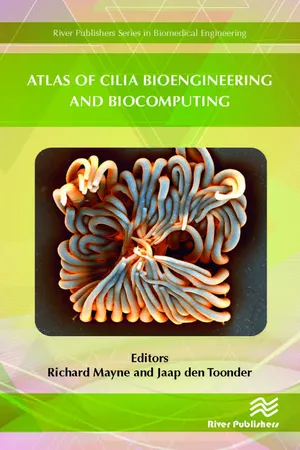
- Richard Mayne, Jaap den Toonder(Authors)
- 2018(Publication Date)
- River Publishers(Publisher)
PART I Biology 1 Biological Preliminaries for Cilia Study Richard Mayne 1 and Gabrielle Wheway 2 1 Unconventional Computing Laboratory, University of the West of England, Bristol BS16 1QY, United Kingdom 2 Centre for Research in Biosciences, Faculty of Health and Applied Sciences, University of the West of England, Bristol BS16 1QY, United Kingdom E-mail: [email protected]; [email protected] “Those I saw, I could nowdiscern to be furnish’t with very thin legs, which was very pleasant to behold.” – Antoni van Leeuwenhoek, 1677 1.1 Introduction Cilia (singular “cilium”) were the first cellular organelle to be identified and were first described circa 1675 by the first microscopist, Antoni van Leeuwenhoek, who wrote of them as a component of an unknown flat “animalcule” (a pre-Linnean term for what we now call the protozoa); he isolated from rainwater what appeared as “incredibly thin feet, or little legs, which were moved very nimbly” [1]. Cilia were not named as such until 1786, however, by Otto M¨ uller [2], although whether this was the first attribution of the term (which means “eyelash” in Latin) is debatable. For centuries, the functions of cilia were attributed to motility, or more specifically as providing motive force to ciliated protozoa or otherwise cre-ating fluid currents in adjacent media when a component of epithelia in multi-cellular organisms. In 1898, however, Zimmerman defined a second, “solitary” variety of cilium possessed by mammalian cells which he named the “central flagella” and described as “[a single] connecting thread con-tinuing above the superficially-located body and extending freely into the 3 4 Biological Preliminaries for Cilia Study lumen [of epithelial cells of the human seminal vesicle]” before proceeding to hypothesize that they had a sensory role [3].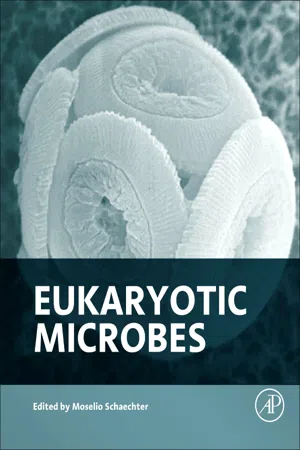 eBook - PDF
- Moselio Schaechter(Author)
- 2011(Publication Date)
- Academic Press(Publisher)
It serves primarily as the germ line reserve of the Ciliates; it can be likened to the nuclei of spermatogonia or oogonia in animals. Moreover, some Ciliates, like Tetrahymena and Paramecium , can grow and reproduce without a micronucleus, but they cannot survive without a macronucleus. The second characteristic feature of Ciliates is that they typically propel themselves through the medium by cilia, which are essentially identical to eukaryotic flagella, but present in abundance and arranged in rows. Only one group of Ciliates, the suctorians, lack cilia in their ‘adult’ stage, but their dispersing swarmer stage does have cilia. The basal bodies or kinetosomes of these cilia are distinguished by having three rootlets that together make up a complex infra-ciliature, which is part of the ciliate cytoskeleton that also includes cortical filamentous systems. These three ciliary rootlets include a striated rootlet and two microtubular root-lets (Figure 1). The character and arrangement of these three fibrillar structures varies from one major group of cil-iates to another (Figure 2), and it was these differences in pattern that enabled electron microscopists in the 1980s to realign many Ciliates into more natural or monophyletic groups. The third characteristic that distinguishes Ciliates is their sexual process, referred to as conjugation. This is typically a temporary fusion of cells, during which each cell can donate and receive a gametic nucleus. The gametic nuclei are derived by meiosis from the micronucleus and are thus hap-loid. A complex cytoskeletal structure called the conjuga-tion basket forms in some species to enable the transfer of gametic nuclei from one partner to another. In order to conjugate, Ciliates must be sexually mature, a process that may take hundreds of fissions from the time of the last conjugation. eBook - PDF
Cilia, Ciliated Epithelium, and Ciliary Activity
International Series of Monographs on Pure and Applied Biology: Modern Trends in Physiological Sciences
- José A. Rivera, P. Alexander, Z. M. Bacq(Authors)
- 2013(Publication Date)
- Pergamon(Publisher)
SECTION A: GENERAL CONSIDERATIONS CHAPTER I Introduction THE term cilia refers to vibratile and nonvibratile, threadlike protoplasmic structures which project from the free surface of certain epithelial cells. Cilia are primordial structures, and their existence was discovered early in the history of biology as a scientific discipline. They arise early in the evolutionary scale of differentiated tissue and were studied long before epithelium was discovered. Cilia are present in all groups of the animal kingdom except the Nematodes and typical Arthropods. They are also PARASPHENOID ^-ORBITAL CURRENT CURRENT (STRONG) (WEAK) FIG. 1. Ciliary currents on the roof of the frog's mouth. After Merton [767]. From Gray [411]. present in plants. In many very primitive unicellular organisms they are present in large numbers. So simple a protozoan as Paramecium caudatum is equipped with 2500 cilia, and they number 10,000 in Balantidium elongatum, the largest (approximately 70 /x by 100 /x) known protozoal parasite of man. In very small animals, or in the invertebrates, cilia have an important function in contraction and locomotion. In the frog (Fig. 1), cilia and ciliary currents help to propel small particles of food and other material into the 1 2 GENERAL CONSIDERATIONS alimentary canal. In mammals, cilia are involved in the normal physiology of the entire respiratory tract, especially in the mechanism of lubrication and clearance of its surface, and in body defenses against foreign particulate matter. In the genital tract, ciliary action is a vital function in the passage of spermatozoa and in the conduction of ova. The normal ciliated epithelial cells perform the mechanical function of moving complete structures in currents of fluid medium or minute particles along surfaces. In the fallopian tubes, the cilia of the epithelial cells lining their inner surface move the ova toward the uterus and help propel spermatozoa toward the ova. eBook - ePub
The Liver
Biology and Pathobiology
- Irwin M. Arias, Harvey J. Alter, James L. Boyer, David E. Cohen, David A. Shafritz, Snorri S. Thorgeirsson, Allan W. Wolkoff(Authors)
- 2020(Publication Date)
- Wiley-Blackwell(Publisher)
5 Primary Cilia Carolyn M. OttJanelia Research Campus, Ashburn, VA, USAINTRODUCTION
A multicellular organism has a need to coordinate multiple processes in space and time. During development, multiple cell lineages migrate and differentiate simultaneously. Individual organ function, though physically isolated, must be coordinated with the activity of other organs. Similarly, each specialized cell coordinates with neighboring cells. Coordination is achieved as individual cells respond to messages from other cells and the environment, and transmit signals about their own state and needs. Amid the cacophony of potential messages, individual cells must discern which messages are relevant. Cilia project away from the cell surface and function as a tunable sensing organelle. Because cilia are continuous with both the cellular cytoplasm and plasma membrane, specialized barriers restrict entry and exit so that cells can form and adjust the composition of cilia to sense and respond to signals.The term “cilia” has been generalized to encompass all types of ciliated structures, including flagella, and motile and non‐motile cilia. Cilia and flagella, present throughout the eukaryotic lineage, are distinct in structure and composition from prokaryotic flagella. In eukaryotes, microtubules provide both structural support and a transportation highway within cilia. Unicellular eukaryotes use cilia to process responses to stimuli from the environment, mate, and feed. In mice and other mammals, genetic ablation of primary cilia terminates development. In adults, ciliary loss leads to disease [1 ]. Primary cilia are typically solitary projections from the cell surface and they lack the structural components that facilitate active beating in motile cilia and flagella. However, primary cilia are not stationary, but can move with the extracellular environment or pivot due to forces from the intracellular actin cytoskeleton [2 eBook - ePub
Cell Movements
From Molecules to Motility
- Dennis Bray(Author)
- 2000(Publication Date)
- Garland Science(Publisher)
Trypanosoma brucei, the parasitic protozoan that causes African sleeping sickness, is similarly attached to the margin of a delicately undulating membrane. This apparatus is capable of swift reversals, equipping the parasite for movements in the swiftly flowing bloodstream of a mammalian host. In a different stage of its life cycle the trypanosome is confined to the mouthparts of the tsetse fly and the flagellum changes from being a motile organelle to one that provides anchorage to the lining of the insect proboscis. Elsewhere among the protozoa, flagella are found that act as rudders for steerage or act as sensory whiskers, or feelers.Many protozoa move by the coordinated beating of cilia on their surfaceCilia are a form of hairlike motile appendage found on a wide variety of eucaryotic cells. They closely resemble eucaryotic flagella in internal structure and mode of action, as discussed in Chapter 14 , but they are typically shorter than flagella and are present in larger numbers arrayed over the cell surface. Their waveform is also more complex consisting of a planar power stroke and a three-dimensional recovery stroke, the shape of which appears to be adapted to the cell’s particular hydrodynamic environment (Figure 1-13 ). A major phylum of protozoa, the Ciliophora or Ciliates, is characterized by cilia covering large portions of surface.Figure 1-12 A trichomonad. One of a large family of parasitic flagellates, in this case taken from a termite gut. The cell has several flagella, one of which curves around the cell body and is attached to it by an undulating membrane. (Courtesy of A.V. Grimstone.)Ciliates of the genus Paramecium are free-living, freshwater protozoa, typically slipper-shaped and 100–200 μm in length. Their surface is covered by thousands of cilia, each about 10 μm long, that beat at a frequency of about 20 cycles per second. They work like small oars to drive water over the cell surface, enabling the cell to swim. Cilia on the surface of paramecia, and indeed most cells, work in near synchrony, showing a slight time lag between the beating of successive rows of cilia, which produces a large-scale ripple pattern on the surface of the cell, the metachronal wave. As the cell swims forward, metachronal waves sweep from the posterior left up to the anterior right of the cell (Figure 1-14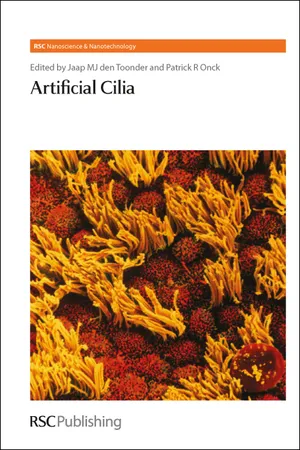 eBook - PDF
- Jaap den Toonder, Patrick Onck, Jaap den Toonder, Patrick Onck(Authors)
- 2013(Publication Date)
- Royal Society of Chemistry(Publisher)
areas that have received less attention from theoreticians: (1) understanding the chemosensory capabilities of cilia-like structures, and (2) probing the ways in which cilial structures could be harnessed to propel microscopic particles. Both these areas relate to the ability of cilia to interact with species in solution in ‘smart’ or meaningful ways. The first of these topics is quite intriguing since organisms from bacteria to mammals use cilia to sense local variations in the environment, amplify this local perturbation to a widespread ‘message’ and consequently, promote a large-scale, collective action. For example, motile cilia in the respiratory tract sense bitter compounds entering the airways and subsequently beat faster to eliminate the offensive substance. 1 Non-motile primary cilia also perform vital chemosensory functions. 2,3 Researchers have designed a range of artificial cilia in attempts to reproduce some of the sensory capabilities of these biological entities. 4–19 Driven by various applied fields and forces, these synthetic filaments have revealed remarkable dynamic behavior. What remains unclear, however, is how a flexible, cilium-like structure senses and transmits information about local chemical changes to a neighboring cilium and how this information is then propagated across multiple cilia. Addressing this issue can open new routes to controlling the self-organization and functionality of synthetic cilia, as well as provide insight into physico-chemical processes that play a role in the biological systems. The second topic noted above also poses interesting challenges. It is worth recalling that a number of organisms harness cilia to propel microscopic particles, and thereby perform functions vital to their survival. For instance, marine suspension feeders use cilia to propel food into their bodies.
Index pages curate the most relevant extracts from our library of academic textbooks. They’ve been created using an in-house natural language model (NLM), each adding context and meaning to key research topics.

