Biological Sciences

Fatty Acids
Fatty acids are organic molecules that serve as a major source of energy for the body. They are essential components of lipids, such as triglycerides and phospholipids, which are crucial for cell structure and function. Fatty acids can be saturated or unsaturated, and their varying chain lengths and structures contribute to their diverse biological roles.
Written by Perlego with AI-assistance
Related key terms
1 of 5

11 Key excerpts on "Fatty Acids"

- Viduranga Waisundara(Author)
- 2018(Publication Date)
- IntechOpen(Publisher)
1 Section 1 Biochemistry of Fatty Acids 3 Chapter 1 Introductory Chapter: Fatty Acids in Modern Times Viduranga Y. Waisundara 1. Introduction to lipids and Fatty Acids Before going into the chemical structure and properties of Fatty Acids, it is important to mention that they are merely one component of the major nutri-ent group commonly known as lipids. Lipids are biological compounds, which are soluble only in nonpolar solvents. They are typically known as fats and oils as well. However, fats and oil differ from each other based on their physical characteristics. The term “fats” is used to refer solid lipids at room temperature such as lard and butter, while “oils” are liquid lipids at room temperature such as sunflower oil, olive oil, etc. The classification of lipids is shown in Figure 1 . Fatty Acids appear under “triglycerides” since it is a component of this particular category of lipids. To provide a brief introduction on Fatty Acids at a very basic level, they are the building blocks of the fat, which is physiologically present and obtained from the food we eat. During digestion, the body breaks down fats in the food products into Fatty Acids, which are subsequently absorbed into the blood. Upon absorption, fatty acid molecules are typically joined in groups of three, forming a molecule called a triglyceride. It has to be noted in this instance that triglycerides can even be made up from the carbohydrates in the food that we consume. There are several important functions of Fatty Acids in the body, including being a medium of storing energy and being involved in the cellular composition in the forms of phospholipids and Figure 1. Major types of lipids: Fatty Acids come under triglycerides according to this classification. Biochemistry and Health Benefits of Fatty Acids 4 cholesterol esters. When glucose is unavailable for generation of energy in the cel-lular mechanism, the body uses Fatty Acids as fuel instead. eBook - PDF
Handbook of Food Analysis
Volume 1: Physical Characterization and Nutrient Analysis
- Leo M.L. Nollet(Author)
- 2004(Publication Date)
- CRC Press(Publisher)
9 Fatty Acids Rosario Zamora and Francisco J. Hidalgo Instituto de la Grasa, CSIC, Seville, Spain I. INTRODUCTION Lipids consist of a broad group of compounds that are generally soluble in organic solvents but only sparingly soluble in water. They are major constituents of adipose tissue, and together with proteins and carbo-hydrates, they constitute the principal structural com-ponents of all living cells. Glycerol esters of Fatty Acids, which account for about 98% of the lipids in our foods and over 90% of the fat in the body, have been traditionally called fats and oils, based solely on whether the material is solid or liquid at room temperature (1–4). Food lipids are either consumed in the form of isolated fats or as constituents of basic foods. Worldwide, food lipids’ intake varies considerably from some countries to others. In general, the con-sumption of food lipids increases with increasing per capita income. Thus, in developing countries food lipids’ intake is, and has been for many generations, 10 to 20% of the energy intake, while in developed countries dietary food lipids’ intake ranges from 35 to 45% of the total energy intake (5–8). Fatty Acids are key components of lipids. They are the aliphatic monocarboxylic acids that can be liber-ated by hydrolysis from naturally occurring fats. Although more than 1000 acids have been identified, the number occurring frequently in most common lipids is much fewer than this and most food analysts will probably encounter not more than a few tens of different acids. II. STRUCTURE, OCCURRENCE, AND PROPERTIES A. Chemical Structure Because Fatty Acids are made biosynthetically from a limited number of substrates by a limited number of pathways certain structural features recur frequently. Thus, most Fatty Acids are straight-chain compounds with an even number of carbon atoms in each molecule. eBook - PDF
- (Author)
- 2009(Publication Date)
- Academic Press(Publisher)
F Fatty Acids Contents Metabolism Monounsaturated Omega-3 Polyunsaturated Omega-6 Polyunsaturated Saturated Trans Fatty Acids Metabolism P A Watkins , Kennedy Krieger Institute and Johns Hopkins University School of Medicine, Baltimore, MD, USA ª 2009 Elsevier Ltd. All rights reserved. Introduction Fatty Acids and glucose are the primary metabolic fuels used by higher organisms, including man. As such, Fatty Acids occupy a central position in human nutrition. Fat, carbohydrate, and protein comprise the macronutrients. When nutritionists speak of fat, they are referring mainly to triacylgly-cerol (triglyceride), which consists of three fatty-acid molecules covalently linked to a backbone of glycerol. Several properties of Fatty Acids and tria-cylglycerol make them highly suited to the storage and provision of energy. When a gram of fatty acid is burned as fuel, about 9 kcal of energy is recov-ered – more than twice that yielded when a gram of carbohydrate or protein is utilized. Unlike carbohy-drates, fat can be stored in an anhydrous compact state, allowing the organism to amass large quanti-ties of fuel reserves in times of plenty. This property can have unfortunate consequences in prosperous societies, as evidenced by the increasing incidence of obesity. Fatty Acids are also fundamen-tal building blocks for the synthesis of most biolo-gically important lipids, including phospholipids, sphingolipids, and cholesterol esters. They are the precursors of bioactive molecules such as prostaglandins and other eicosanoids. In addition, Fatty Acids and their coenzyme A derivatives have many metabolic regulatory roles. Fatty-Acid Nomenclature Conventions In this article, Fatty Acids will be identified by their chain length, the number of double bonds present, and the position of the first double bond from the methyl end of the molecule. eBook - PDF
- H. Stephen Stoker(Author)
- 2015(Publication Date)
- Cengage Learning EMEA(Publisher)
The most frequently encountered lipid building block is the structural unit called a fatty acid. Consideration of the structural characteristics and physical properties of Fatty Acids is the starting point for development of the subject of lipid chemistry. All energy-storage lipids, the most abundant type of lipid, contain fatty acid building blocks. Most membrane lipids, the second most abundant type of lipid, also contain this building block. 1. A lipid is any substance of biochemical origin that is a. soluble in water but insoluble in nonpolar solvents b. insoluble in water but soluble in nonpolar solvents c. soluble in both water and nonpolar solvents d. no correct response 2. Which of the following is not a biochemical function classification for lipids? a. membrane lipid b. messenger lipid c. emulsification lipid d. no correct response 3. The saponifiable/nonsaponifiable classification system for lipids is based on a. lipid behavior in acidic solution b. lipid behavior in basic solution c. ability of lipids to react with alcohols d. no correct response Section 8-1 Quick Quiz Answers: 1. b; 2. d; 3. b 8-2 Types of Fatty Acids L E A R N I N G F O C U S Be familiar with the generalized definition for a fatty acid; be able to classify Fatty Acids in terms of structural characteristics of their carbon chains. A fatty acid is a naturally occurring monocarboxylic acid. Because of the pathway by which they are biosynthesized (Section 14-7), Fatty Acids nearly always contain an even number of carbon atoms and have a carbon chain that is unbranched. In terms of carbon chain length, Fatty Acids are characterized as long-chain Fatty Acids (C 12 to C 26 ), medium-chain Fatty Acids (C 8 and C 10 ), or short-chain Fatty Acids (C 4 and C 6 ). ◀ Fatty Acids are rarely found free in nature but rather occur as part of the structure of more complex lipid molecules.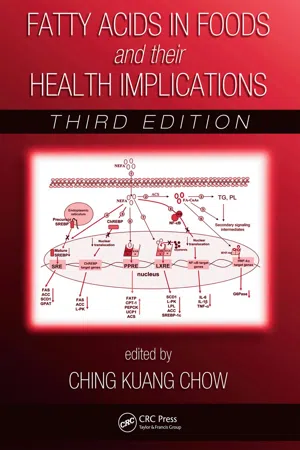
- Ching Kuang Chow(Author)
- 2007(Publication Date)
- CRC Press(Publisher)
1 I. INTRODUCTION Fats or lipids consist of numerous chemical compounds, including monoglycerides, diglycerides, triglycerides, phosphatides, cerebrosides, sterols, terpenes, fatty alcohols, and Fatty Acids. Fatty Acids constitute the main component of phospholipids, triglycerides, diglycerides, monoglycerides, and sterol esters. Fatty Acids consist of elements, such as carbon, hydrogen, and oxygen, that are arranged as a linear carbon chain skeleton of variable length with a carboxyl group at one end. Fatty Acids can be saturated (no double bond), monounsaturated (one double bond), or polyunsaturated (two or more double bonds), and are essential for energetic, metabolic, and structural activities. Food scientists, nutritionists, biochemists, chemists, and biomedical scientists alike recognize the need for a coherent nomenclature for Fatty Acids. There are a number of nomenclature systems for Fatty Acids, and some researchers continue to name Fatty Acids traditionally on the basis of the names of the botanical or zoological species from which they are isolated. Such naming system provides no clue as to the structure of Fatty Acids. The International Union of Pure and Applied Chemistry (IUPAC) and the International Union of Biochemistry (IUB) attempted to deal with this problem by setting up two nomenclature committees, the IUB-IUPAC Joint Commission of Biochemical Nomenclature (JCBN) and the Nomenclature Committee of IUB (NC-IUB). IUPAC states denitive rules of nomenclature for organic chemistry (1960) and lipids (1978), Markely (1960) presents a historical review of chemical nomenclature, and Fletcher et al. (1974) discuss the origin and evolu-tion of organic nomenclature. Other excellent reference sources for fatty acid classications and nomenclatures include Fahy et al. (2005), Fasman (1989), Gunstone (1996, 1999), Gunstone et al. (1992), Gunstone and Herslof (1992), Hopkins (1972), and Robinson (1982).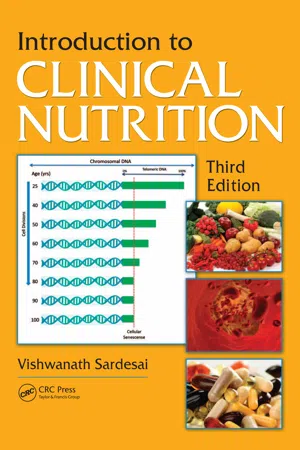 eBook - PDF
- Vishwanath Sardesai(Author)
- 2011(Publication Date)
- CRC Press(Publisher)
69 4 Role of Essential Fatty Acids 4.1 Fatty Acids Fatty Acids are chains of covalently linked carbon atoms, bearing hydrogen atoms, which termi-nate in a carboxylic group that is responsible for their properties as acids. The naturally occurring Fatty Acids are, for the most part, unbranched and acyclic, but complex structures with branched or cyclic chains do occasionally occur, particularly in lower biological forms. The total number of carbon atoms in a molecule is usually even although Fatty Acids containing odd-numbered car-bon atoms also are found in nature. They have the basic formula CH 3 [CH 2 ] n COOH, where n can be any number from 2 to 22 and is usually an even number. One method of classification of Fatty Acids is according to their chain length (i.e., the number of carbon atoms they contain). Fatty Acids containing 2–4 carbon atoms are called short-chain Fatty Acids, while those with 6–10 and 12–24 carbon atoms are called medium-chain and long-chain Fatty Acids, respectively. Fatty Acids can also be classified according to the number of double bonds between the carbon atoms (i.e., the degree of saturation): saturated, with no double bonds; unsaturated, with one double bond; and polyunsaturated Fatty Acids (PUFAs), with two or more double bonds. Fatty Acids with two, three, four, five, and six double bonds are called dienoic, trienoic, tetraenoic, pentaenoic, and hexaenoic, respectively. The carbon atoms of the Fatty Acids are numbered from the carboxyl group ( Δ numbering system) or lettered (W or n numbering system): numbering system (carboxyl side) CH 3 16 4 3 2 1 (CH ) CH CH CH COOH 1 13 14 15 16 W or number 2 11 2 2 2 n ing system (W-side) Fatty Acids are abbreviated in the Δ nomenclature by listing the carbon number and position of double bonds (C a Δ b ). Thus, palmitic acid is abbreviated as C 16 :0 or C 16 :0 Δ 0 , and palmitoleic acid as C 16 :1 or C 16 :1, Δ 9 . eBook - PDF
- Frank D. Gunstone, John L. Harwood, John L. Harwood(Authors)
- 2007(Publication Date)
- CRC Press(Publisher)
1 1 FATTY ACID AND LIPID STRUCTURE C. M. Scrimgeour and J. L. Harwood 1.1 Fatty acid structure 1.1.1 Introduction and nomenclature of Fatty Acids Fatty Acids are aliphatic, usually straight chain, mono-carboxylic acids. The broadest definition includes all chain lengths, but most natural Fatty Acids have even chain lengths between C 4 and C 22 , with C 18 the most common. Natural fatty acid structures reflect their common biosynthesis — the chain is built in two-carbon units and cis double bonds are inserted at specific positions relative to the carboxyl carbon. Over 1000 Fatty Acids are known with different chain lengths, positions, configurations and types of unsaturation, and a range of additional substituents along the aliphatic chain. However, only around 20 Fatty Acids occur widely in nature; of these, palmitic, oleic, and linoleic acids make up ~80% of commodity oils and fats. Figure 1.1 shows the basic structure of Fatty Acids and a number of the functional groups found in Fatty Acids. A list of many of the known structures, sources, and trivial names is available online (Adlof and Gunstone, 2003). Table 1.1 illustrates the naming of some commonly encountered Fatty Acids (additional examples are found in the following sections). Fatty Acids are named systemati-cally as carboxylic acid derivatives, numbering the chain from the carboxyl carbon (IUPAC-IUB, 1976). Systematic names for the series of saturated acids from C 1 to C 32 are given in Table 1.2. The -anoic ending of the saturated acid is changed to -enoic, -adienoic, -atrienoic, -atetraenoic, -apentaenoic, and -ahexaenoic to indicate the presence of one to six double bonds, respectively. Carbon–carbon double bond configuration is shown systematically by Z or E , which is assigned following priority rules for the substituents. eBook - PDF
- Marie Dunford, J. Doyle, Marie Dunford(Authors)
- 2021(Publication Date)
- Cengage Learning EMEA(Publisher)
Due to electronic rights, some third party content may be suppressed from the eBook and/or eChapter(s). Editorial review has deemed that any suppressed content does not materially affect the overall learning experience. Cengage Learning reserves the right to remove additional content at any time if subsequent rights restrictions require it. 196 Chapter 06 Fats phospholipids (phosphate-containing fats) are also found in food and in the body. These three classes of fat compose the category known as lipids. Fatty Acids vary due to their chemical compositions To understand the differences in the various fats, one must look closely at their chemical compositions. Fatty Acids, which are chains of carbon and hydrogen with a carboxyl group (a carbon with a double bond to oxygen and a single bond to an oxygen/hydrogen, written as COOH) at one end. The length of the fatty acid chain can range from 4 to 24 carbons. The num- ber of carbons will be an even number because fatty acid chains are manufactured by adding two car- bons at a time. An example of a fatty acid is shown in Figure 6.2. The fatty acid in this example, oleic acid, has 18 carbons. The Fatty Acids used most commonly in human metabolism have 16 or 18 carbons. A saturated fatty acid contains no double bonds between carbons. The term saturated refers to the fact that no additional hydrogen atoms can be incorpo- rated. An example of one saturated fatty acid, palmitic acid, is shown at the top of Figure 6.3. Unsaturated Fatty Acids contain one or more double bonds between carbons, reducing the num- ber of hydrogen atoms that can be bound to the structure. When only one double bond between car- bons is present, it is referred to as a monounsatu- rated fatty acid (mono means “one”). When two or more double bonds are present, these Fatty Acids are referred to as polyunsaturated (poly means “many”). Unsaturated Fatty Acids have 16 to 22 carbons and from 1 to 6 double bonds. eBook - PDF
- Khetarpaul, Vipul(Authors)
- 2021(Publication Date)
- Daya Publishing House(Publisher)
While this approach is of some use, it may lead to confusion over the true basis by which Fatty Acids modulate physiology. There is mounting evidence that each fatty acid has its own role in nutrition that is not dictated by its omega designation. Chemically similar Fatty Acids often have widely ranging functionalities. This phenomenon is exemplified by the antagonistic relationship between arachidonic acid and EPA metabolism, even though the Fatty Acids differ only by the additional double bond in EPA. The fundamental relationship between members of the same ω family is one of interconvertibility. Families are grouped only by their potential to be converted to longer chain members of the same omega designation, or in a more practical sense, by their ability to act as precursors for the production of a particular fatty acid of interest. The enzymatic activities required for the conversion of Fatty Acids to longer, more unsaturated chain members of the same omega family are redundant. Consequently, if cells are not capable of recognizing Fatty Acids based on their omega designation and responding by modulating desaturase and elongase activities appropriately, animals are truly at the mercy of their diets. The regulation of acyl content appears to be critical to the function of a cell, in as much as mammalian cells expend a substantial amount of energy in maintaining distinct and heterogeneous membrane fatty acid compositions. Cells are capable of preserving these compositional identities even under conditions of phospholipid diffusion and vesicular transport, suggesting that acyl composition is tightly regulated. In addition to overall membrane acyl content, phospholipid acyl composition is rigorously maintained in a positionally specific manner. No longer available |Learn more
- (Author)
- 2014(Publication Date)
- Learning Press(Publisher)
Margarine and vegetable shortening, which can be derived from the above oils, are used mainly for baking. These examples of fats can be categorized into saturated fats and unsaturated fats. ________________________ WORLD TECHNOLOGIES ________________________ Chemical structure A triglyceride molecule There are many different kinds of fats, but each is a variation on the same chemical structure. All fats consist of Fatty Acids (chains of carbon and hydrogen atoms, with a carboxylic acid group at one end) bonded to a backbone structure, often glycerol (a backbone of carbon, hydrogen, and oxygen). Chemically, this is a triester of glycerol, an ester being the molecule formed from the reaction of the carboxylic acid and an organic alcohol. As a simple visual illustration, if the kinks and angles of these chains were straightened out, the molecule would have the shape of a capital letter E. The Fatty Acids would each be a horizontal line; the glycerol backbone would be the vertical line that joins the horizontal lines. Fats therefore have ester bonds. The properties of any specific fat molecule depend on the particular Fatty Acids that constitute it. Different Fatty Acids are composed of different numbers of carbon and hydrogen atoms. The carbon atoms, each bonded to two neighboring carbon atoms, form a zigzagging chain; the more carbon atoms there are in any fatty acid, the longer its chain will be. Fatty Acids with long chains are more susceptible to intermolecular forces of ________________________ WORLD TECHNOLOGIES ________________________ attraction (in this case, van der Waals forces), raising its melting point. Long chains also yield more energy per molecule when metabolized. Saturated and unsaturated A fat's constituent Fatty Acids may also differ in the number of hydrogen atoms that are bonded to the chain of carbon atoms. Each carbon atom is typically bonded to two hydrogen atoms. eBook - PDF
- Sharma, Dipiti(Authors)
- 2021(Publication Date)
- Daya Publishing House(Publisher)
6 Lipids 6.0 Introduction General Characteristics Lipids that are solid at room temperature are called as fats (for example butter) and those that are liquid are called oils (for example vegetable oil). Lipids have following features: They are organic compounds made up of carbon, hydrogen and oxygen. Lipids as a class also have a lower ratio of oxygen to carbon compared with carbohydrate, proteins or alcohols. They rarely occur in on organism in free state, but are usually combined with proteins (lipoproteins) or with carbohydrate as glycolipids. They provide 9 kcal/g energy i.e. they supply more energy than carbohydrate, proteins. Lipids do not have repeating monomeric units i.e. they are not polymeric in nature. Although lipids form a diverse group even then they share two main characteristics: 1. They dissolve in organic solvents such as chloroform, This ebook is exclusively for this university only. Cannot be resold/distributed. benzene and ether etc. 2. They are not readily soluble in water. Fatty Acids are long chain hydrocarbon containing a terminal carboxyl group and are found in most lipids in the body and in the lipids in food. Fatty acid is an organic acid composed of a chain of carbon atoms with attached hydrogen atoms; it has an acid group at one end and methyl group at the other end. These are normally found as esters in natural fats and oils, however they do occur in unesterified form when Fatty Acids bound to certain proteins. Fatty Acids with lesser number of carbon atoms (4 to 8) are present in milk fats, whereas those of intermediate chain length (10 to 14) and between 16 to 20 carbon atoms are found in most of the animal and vegetable fats.
Index pages curate the most relevant extracts from our library of academic textbooks. They’ve been created using an in-house natural language model (NLM), each adding context and meaning to key research topics.
