Biological Sciences

Genetically Modified Organisms
Genetically Modified Organisms (GMOs) are living organisms whose genetic material has been altered using genetic engineering techniques. This can involve the introduction of new traits or the modification of existing ones. GMOs are commonly used in agriculture to improve crop yield, resistance to pests, and tolerance to environmental conditions. The use of GMOs is a topic of debate due to concerns about potential environmental and health impacts.
Written by Perlego with AI-assistance
Related key terms
1 of 5
12 Key excerpts on "Genetically Modified Organisms"
 eBook - PDF
- M. H. Fulekar(Author)
- 2010(Publication Date)
- CRC Press(Publisher)
17.1 GENETIC MODIFICATION — PERSPECTIVE Biotechnology and genetic modifications are commonly used as interchangeable. Genetically modified is a special set of technologies that alter the genetic makeup of such living organisms as animals, plants or bacteria. Combining genes from different organisms is known as recombinant DNA technology and the resulting organism is said to be ‘genetically modified’, ‘genetically engineered’, or ‘transgenic’. Locating genes for important traits such as those conferring insect resistance or desired nutrients is one of the most limiting steps in the process. However, genome sequencing and discovery programmes for hundreds of different organisms are generating detailed maps along with data-analyzing technologies to understand and use them. Genetically modified organism (GMO) is used for producing genetically modified (GM) foods. GM foods have been available since 1990s. The most common modified foods are derived from plants: soyabean, corn, canola and cotton seed oil and wheat (ISAAA, 2002).The process of producing GMO used for GM foods may involve taking DNA from one organism, modifying it in a laboratory and then inserting it into the target organism’s genome to produce new and useful traits or phenotypes. Such GMOs are generally referred to as transgenic. Other methods of producing a GMO includes increasing or decreasing the CHAPTER CHAPTER Genetically Modified Organisms IN ENVIRONMENT 17 number of copies of a gene already present in the target organism, silencing or removing a particular gene or modifying the position of a gene within the genome. In 2006, a total of 252 million acres of transgenic crops were planted in 22 countries by 10.3 million farmers. The majority of these crops were herbicide and insect resistant, soyabeans, corns, cotton, canola and alfalfa. eBook - ePub
Genetic Engineering
Volume 2: Applications, Bioethics, and Biosafety
- Tariq Ahmad Bhat, Jameel M. Al-Khayri, Tariq Ahmad Bhat, Jameel M. Al-Khayri(Authors)
- 2023(Publication Date)
- Apple Academic Press(Publisher)
GMOs are those which have foreign genes. Genes with desired characteristics are identified and isolated. Then these isolated genes are introduced into target organisms with the help of biological vectors. These transgenic organisms having genes of interest from other organisms incorporated into their genome are called GMOs. GMOs are essentially to be analyzed properly prior to use. The key features in context of use of GMOs may exhibit side-effects for health. The use positive use of GMOs is also beneficial to cope the needs of everlasting increment in the human world population. The GMOs are providing very promising scope in human history._____________________ Genetic Engineering, Volume 2: Applications, Bioethics, and Biosafety. Tariq Ahmad Bhat & Jameel M. Al-Khayri (Eds.) © 2023 Apple Academic Press, Inc. Co-published with CRC Press (Taylor & Francis)5.1 Introduction
With advancement in biotechnological protocols, scientists are able to detect particular genes controlling a specific characteristic. Isolation of genes of interest is also possible and at the same time transfer of genes of interest to new organisms is now possible. The organisms which contain genes of interest isolated from other organisms are termed as Genetically Modified Organisms (GMOs) (James, 2016 ). Biotechnology has unable scientists to alter the genetic makeup of organisms and to make them an ideal organisms with desired characteristics. Such GMOs are widely being prepared to meet human needs (Hill, 2005 ).GMOs are not only good yielding and less laborious to handle but they come up with the ability to control the pollution, pests, and abiotic stresses of heavy metals. GMOs may be used to produce specific proteins or growth promoters for other specified organisms, including human beings. Some of the genetically modified microorganism have the ability of reclamation of acidic soils (Sehubent, 2002). The introduction of GMOs still needs careful observations as they are able to disturb the ecological cycles or lifecycles of other species found nearby (Tzotzos et al., 2010 No longer available |Learn more
- (Author)
- 2014(Publication Date)
- Academic Studio(Publisher)
____________________ WORLD TECHNOLOGIES ____________________ Chapter- 6 Genetically Modified Organism GloFish, the first genetically modified animal to be sold as a pet A genetically modified organism (GMO) or genetically engineered organism (GEO) is an organism whose genetic material has been altered using genetic engineering techniques. These techniques, generally known as recombinant DNA technology, use DNA molecules from different sources, which are combined into one molecule to create a new set of genes. This DNA is then transferred into an organism, giving it modified or novel genes. Transgenic organisms, a subset of GMOs, are organisms which have inserted DNA that originated in a different species. ____________________ WORLD TECHNOLOGIES ____________________ Production Genetic modification involves the insertion or deletion of genes. When genes are inserted, they usually come from a different species, which is a form of horizontal gene transfer. In nature this can occur when exogenous DNA penetrates the cell membrane for any reason. To do this artificially may require attaching the genes to a virus or just physically inserting the extra DNA into the nucleus of the intended host with a very small syringe, or with very small particles fired from a gene gun. However, other methods exploit natural forms of gene transfer, such as the ability of Agrobacterium to transfer genetic material to plants, or the ability of lentiviruses to transfer genes to animal cells. History The general principle of producing a GMO is to add new genetic material into an organism's genome. This is called genetic engineering and was made possible through the discovery of DNA and the creation of the first recombinant bacteria in 1973; an existing bacterium E. coli expressing an exogenic Salmonella gene. This led to concerns in the scientific community about potential risks from genetic engineering, which were thoroughly discussed at the Asilomar Conference. No longer available |Learn more
- (Author)
- 2014(Publication Date)
- The English Press(Publisher)
________________________ WORLD TECHNOLOGIES ________________________ Chapter- 1 Genetically Modified Organism GloFish, the first genetically modified animal to be sold as a pet A genetically modified organism (GMO) or genetically engineered organism (GEO) is an organism whose genetic material has been altered using genetic engineering techniques. These techniques, generally known as recombinant DNA technology, use DNA molecules from different sources, which are combined into one molecule to create a new set of genes. This DNA is then transferred into an organism, giving it modified or novel genes. Transgenic organisms, a subset of GMOs, are organisms which have inserted DNA that originated in a different species. Production Genetic modification involves the insertion or deletion of genes. When genes are inserted, they usually come from a different species, which is a form of horizontal gene ________________________ WORLD TECHNOLOGIES ________________________ transfer. In nature this can occur when exogenous DNA penetrates the cell membrane for any reason. To do this artificially may require attaching the genes to a virus or just physically inserting the extra DNA into the nucleus of the intended host with a very small syringe, or with very small particles fired from a gene gun. However, other methods exploit natural forms of gene transfer, such as the ability of Agrobacterium to transfer genetic material to plants, or the ability of lentiviruses to transfer genes to animal cells. History The general principle of producing a GMO is to add new genetic material into an organism's genome. This is called genetic engineering and was made possible through the discovery of DNA and the creation of the first recombinant bacteria in 1973; an existing bacterium E. coli expressing an exogenic Salmonella gene. This led to concerns in the scientific community about potential risks from genetic engineering, which were first discussed in depth at the Asilomar Conference in 1975. No longer available |Learn more
- (Author)
- 2014(Publication Date)
- The English Press(Publisher)
________________________ WORLD TECHNOLOGIES ________________________ Chapter- 6 Genetically Modified Organism GloFish, the first genetically modified animal to be sold as a pet A genetically modified organism (GMO) or genetically engineered organism (GEO) is an organism whose genetic material has been altered using genetic engineering techniques. These techniques, generally known as recombinant DNA technology, use DNA molecules from different sources, which are combined into one molecule to create a new set of genes. This DNA is then transferred into an organism, giving it modified or novel genes. Transgenic organisms, a subset of GMOs, are organisms which have inserted DNA that originated in a different species. ________________________ WORLD TECHNOLOGIES ________________________ Production Genetic modification involves the insertion or deletion of genes. When genes are inserted, they usually come from a different species, which is a form of horizontal gene transfer. In nature this can occur when exogenous DNA penetrates the cell membrane for any reason. To do this artificially may require attaching the genes to a virus or just physically inserting the extra DNA into the nucleus of the intended host with a very small syringe, or with very small particles fired from a gene gun. However, other methods exploit natural forms of gene transfer, such as the ability of Agrobacterium to transfer genetic material to plants, or the ability of lentiviruses to transfer genes to animal cells. History The general principle of producing a GMO is to add new genetic material into an organism's genome. This is called genetic engineering and was made possible through the discovery of DNA and the creation of the first recombinant bacteria in 1973; an existing bacterium E. coli expressing an exogenic Salmonella gene. This led to concerns in the scientific community about potential risks from genetic engineering, which were thoroughly discussed at the Asilomar Conference. eBook - PDF
Acceptable Genes?
Religious Traditions and Genetically Modified Foods
- Conrad G. Brunk, Harold Coward, Conrad G. Brunk, Harold Coward(Authors)
- 2009(Publication Date)
- SUNY Press(Publisher)
The creation of genetic hybrids and techniques that cause multiples of the normal genetic content to occur have yielded products that have more robust characteristics overall as well as increased yields. All these techniques have profoundly changed the genetics of the parent varieties from which they were derived. While all such organisms are undoubtedly genetically modified, none is regarded as a GMO. The label of GMO is usually reserved for organisms developed by combining certain techniques of cell manipulations and transgene transfer. A variety of techniques are used to effect gene transfer such as the use of an electrical current to get transgenes into a cell, or the use of bacterial or biological agents (e.g., Agrobacterium tumefaciens) or gene guns that liter- ally shoot microscopic pellets coated with the transgene DNA into plants. Another group of techniques used to create GMOs consists of those where the genetic modification involves creating and screening for changes to genes already resident in the organism being manipulated. Such techniques use chemicals or radiation to induce random mutations in plant cells, which are then screened for protein changes relevant to the trait sought. Organisms produced this way tend to escape public notice as GMOs as they do not owe their newly acquired trait to the addition of “foreign” DNA. While conventional plant breeding and selection practices have often focused on complex traits (e.g., yield, time to maturation), the nature of the techniques involved in the generation of GMOs means they are more typi- cally focused on one gene and its influence on simple traits (e.g., herbicide resistance as might be conferred by a single protein as coded for by a single gene). The above techniques have enabled a more rapid turnaround in both the generating of new strains and the selection for the best among those conferred with the new trait. No longer available |Learn more
- (Author)
- 2014(Publication Date)
- Library Press(Publisher)
________________________ WORLD TECHNOLOGIES ________________________ Chapter- 6 Genetically Modified Food Genetically modified (GM) foods are foods derived from Genetically Modified Organisms. Genetically Modified Organisms have had specific changes introduced into their DNA by genetic engineering techniques. These techniques are much more precise than mutagenesis (mutation breeding) where an organism is exposed to radiation or chemicals to create a non-specific but stable change. Other techniques by which humans modify food organisms include selective breeding (plant breeding and animal breeding), and somaclonal variation. GM foods were first put on the market in the early 1990s. Typically, genetically modified foods are transgenic plant products: soybean, corn, canola, and cotton seed oil. Animal products have also been developed, although as of July 2010 none are currently on the market. In 2006 a pig was controversially engineered to produce omega-3 fatty acids through the expression of a roundworm gene. Researchers have also developed a genetically-modified breed of pigs that are able to absorb plant phosphorus more efficiently, and as a consequence the phosphorus content of their manure is reduced by as much as 60%. Critics have objected to GM foods on several grounds, including possible safety issues, ecological concerns, and economic concerns raised by the fact that these organisms are subject to intellectual property law. Method Genetic modification involves the insertion or deletion of genes. In the process of cisgenesis, genes are artificially transferred between organisms that could be conventionally bred. In the process of transgenesis, genes from a different species are inserted, which is a form of horizontal gene transfer. In nature this can occur when exogenous DNA penetrates the cell membrane for any reason. No longer available |Learn more
- (Author)
- 2014(Publication Date)
- Library Press(Publisher)
________________________ WORLD TECHNOLOGIES ________________________ Chapter- 6 Genetically Modified Food Genetically modified (GM) foods are foods derived from Genetically Modified Organisms. Genetically Modified Organisms have had specific changes introduced into their DNA by genetic engineering techniques. These techniques are much more precise than mutagenesis (mutation breeding) where an organism is exposed to radiation or chemicals to create a non-specific but stable change. Other techniques by which humans modify food organisms include selective breeding (plant breeding and animal breeding), and somaclonal variation. GM foods were first put on the market in the early 1990s. Typically, genetically modified foods are transgenic plant products: soybean, corn, canola, and cotton seed oil. Animal products have also been developed, although as of July 2010 none are currently on the market. In 2006 a pig was controversially engineered to produce omega-3 fatty acids through the expression of a roundworm gene. Researchers have also developed a genetically-modified breed of pigs that are able to absorb plant phosphorus more efficiently, and as a consequence the phosphorus content of their manure is reduced by as much as 60%. Critics have objected to GM foods on several grounds, including safety issues, ecological concerns, and economic concerns raised by the fact that these organisms are subject to intellectual property law. Method Genetic modification involves the insertion or deletion of genes. In the process of cisgenesis, genes are artificially transferred between organisms that could be conven-tionally bred. In the process of transgenesis, genes from a different species are inserted, which is a form of horizontal gene transfer. In nature this can occur when exogenous DNA penetrates the cell membrane for any reason. eBook - PDF
- Richard N. Arteca(Author)
- 2014(Publication Date)
- Cengage Learning EMEA(Publisher)
The counterpart to this argument is the theory that humanity has had a pro-found effect on the evolution of many species, including gene transfer between species through the use of plant breeding. In addition, gene transfer between unrelated organ-isms occurs in nature all the time. Copyright 2015 Cengage Learning. All Rights Reserved. May not be copied, scanned, or duplicated, in whole or in part. Due to electronic rights, some third party content may be suppressed from the eBook and/or eChapter(s). Editorial review has deemed that any suppressed content does not materially affect the overall learning experience. Cengage Learning reserves the right to remove additional content at any time if subsequent rights restrictions require it. CHAPTER 12 PLANT BIOTECHNOLOGY AND Genetically Modified Organisms: AN OVERVIEW 297 Safety Considerations One safety concern is that releasing GMOs into the environment could have many unforeseen ecological consequences. Others say that moving organisms between conti-nents could create more problems than GMOs because there is no known biological con-trol to bring them back into equilibrium when these organisms are relocated. Another concern is that GMOs may not be safe to eat, which is possible. However, others say that when a GMO is produced, we know exactly which gene is being introduced so it is highly unlikely that a problem will arise, as compared to traditional plant breeding. When new plants are produced via traditional plant breeding, large segments of DNA with many genes are transferred between plants, which can cause many unknown problems. The possibility exists that the GMOs used for food will contain novel allergens; however, this can be readily tested for prior to making GMOs available to the general public. Anticorporate Arguments Opponents of GMOs state that the purpose of corporations is to make money, not to protect the welfare of the general public. eBook - PDF
Transgenic Crop Protection
Concepts and Strategies
- O Kaul, O Kaul, G.S. Dhaliwal(Authors)
- 2004(Publication Date)
- CRC Press(Publisher)
11 REGULATION OF GENETICALLY-MODIFIED CROPS: A SCIENTIFIC PERSPECTIVE KEES HULSMAN Australian School of Environmental Studies Faculty of Environmental Sciences, Griffith University Nathan. Q. 4111, Australia INTRODUCTION There has been a noticeable increase in the environmental release of transgenic or genetically-modified organisms (GMOs) over the past decade. Biotechnology is a multi-billion global industry and governments perceive it as an income earner for the future in the new globalized economy. Many governments are encouraging biotechnology businesses to set up headquarters in their jurisdiction. For example in Australia, Queensland Premier Peter Beattie and his government are marketing Queensland as The Smart State and are investing in the development of biotechnology. Research Institutions and Universities are directing research funds towards biotechnology because of its financial returns via research grants and market returns resulting from the development of new products and processes. One of the major problems associated with GMOs is the uncertainty of their impacts on human and environmental health. These two concerns are brought together in the application of gene technology to agriculture. There is an on going conflict between the proponents and critics of the application of gene technology in agriculture. Proponents of GMOs have argued that biotechnology is necessary to feed the world. They claim that it is more environmentally friendly than 326 Transgenic Crop Protection chemical sprays are to control weeds and animal pests and will also reduce agricultural reliance on toxic chemicals. In addition, gene technology is a natural extension of conventional breeding techniques but it has the advantage of making precise genetic changes and, therefore, may be used to solve problems caused by intensive agriculture in a more environmentally-friendly manner (Levidow and Carr, 1997).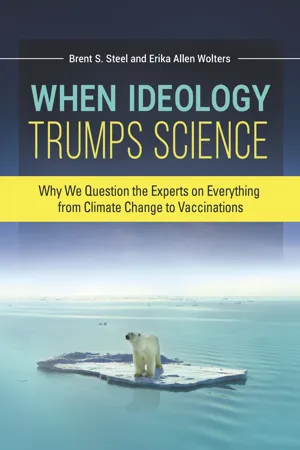 eBook - PDF
When Ideology Trumps Science
Why We Question the Experts on Everything from Climate Change to Vaccinations
- Erika Allen Wolters, Brent S. Steel(Authors)
- 2017(Publication Date)
- Praeger(Publisher)
CHAPTER 2 Genetically Modified Organisms (GMOs) Any politician or scientist who tells you these [GMO] products are safe is either very stupid or lying. —David Suzuki INTRODUCTION With the world’s population rapidly increasing to 9 billion people by 2050 (United Nations, 2015), concern over meeting global food needs is rising. Most of the population growth is predicted for sub-Saharan Africa and the southeast parts of Asia. Concurrent with population growth, sub-Saharan Africa is expected to be one of the regions most impacted by climate change, resulting in less water, fewer acres of arable land, and overall less food security (Kotir, 2011). Concern over how to meet global food needs to combat food insecurity in places like sub- Saharan Africa requires addressing how to increase food production. Demand for high-yield crops and increased productivity suggest that a second Green Revolution 1 fueled by biotechnology, primarily genetically modified (GMO, or genetically modified organism) foods, may be neces- sary to meet current and growing food needs, as conventional agriculture requires more water and land, and is subject to diseases that GMO crops are resistant to. Concurrent with the growing demand for increased crop yields glob- ally, there is mounting concern in the United States over the safety of biotechnology. Although numerous studies have found that GMO foods 2 are safe for human consumption and the environment (DeFrancesco, 2013; European Commission, 2010) and produce higher crop yield and a reduction of pesticide use (Klu ¨mper and Qaim, 2014), recent opposition to GMO foods has signaled the public’s concern over the use of biotech- nology. As a result, some states, such as Vermont, have attempted label- ing laws for foods that contain transgenic crops, that is, crops that have genetic material from another organism in them. eBook - PDF
- Smith, P(Authors)
- 2018(Publication Date)
- Agri Horti Press(Publisher)
genetically modified food crops Genetic modification, otherwise referred to as recombinant DNA (rDNA) technology or gene-splicing, has proven to be a more precise, predictable and better understood method for the manipulation of genetic material than previously attained through conventional plant breeding. To date, agricultural applications of the technology have involved the insertion of genes for desirable agronomic traits ( e.g. herbicide tolerance, insect resistance) into a variety of crop plants, and from a variety of biological sources. Examples include soybeans modified with gene sequences from a Streptomyces species encoding enzymes that confer herbicide tolerance, and corn plants modified to express the insecticidal protein of an indigenous soil microorganism, Bacillus thuringiensis (Bt). A growing body of evidence suggests that the technology may be used to make enhancements to not only the agronomic properties, but the food, nutritional, industrial and medicinal attributes of genetically modified (GM) crops. Regulatory supervision of rDNA technology and its products has been in place for a longer period of time in the United States than in most other parts of the world. The methods and approaches established to evaluate the safety of products developed using rDNA technology continue to evolve in response to the increasing availability of new scientific information. As our understanding of the potential applications of the This ebook is exclusively for this university only. Cannot be resold/distributed. 229 Genetically Modified of Crop Plants technology is broadened, the safety of products developed using rDNA technology and the potential effects of introduced gene sequences on human health or the environment will be more closely scrutinized.
Index pages curate the most relevant extracts from our library of academic textbooks. They’ve been created using an in-house natural language model (NLM), each adding context and meaning to key research topics.

