Biological Sciences

Marsupials
Marsupials are a group of mammals characterized by giving birth to relatively undeveloped young, which then continue to develop in a pouch on the mother's abdomen. This unique reproductive strategy is a defining feature of marsupials, distinguishing them from placental mammals. Examples of marsupials include kangaroos, koalas, and opossums, and they are primarily found in Australia, the Americas, and nearby islands.
Written by Perlego with AI-assistance
Related key terms
1 of 5
6 Key excerpts on "Marsupials"
- Diane Schmidt(Author)
- 2003(Publication Date)
- Libraries Unlimited(Publisher)
The catalog lists and describes 151 species of Marsupials plus three monotremes, along with keys to family, genus, and species. The species accounts consist of very detailed physical descriptions along with distri- bution, location of type specimens, and type location. There are 28 plates at the end of the volume illustrating selected specimens and/or skulls, some of them hand colored. Saunders, Norman, and Lyn Hinds, eds. Marsupial Biology: Recent Research, New Perspectives. Sydney, NSW, Australia: UNSW Press, 1997. 413 p. $127.25. ISBN 0868403113. Mammals 321 Summarizes the latest research on the biology of Marsupials, including reproduction and development, general ecology, pathology and homeosta- sis, and developmental neurobiology. Stonehouse, Bernard, and Desmond Gilmore, eds. The Biology of Mar- supials. Baltimore: University Park Press, 1977. 486 p. (Biology and Environment). ISBN 0839108524. Unlike Hunsaker's volume by the same name, above, this treatise emphasizes the biology of Australasian species. One chapter provides an annotated list of the living marsupial species worldwide. Marine Mammals Berta, Annalisa, and James L. Sumich. Marine Mammals: Evolutionary Biology. San Diego: Academic Press, 1999. 494 p. $62.95. ISBN 0120932253. This volume covers the evolution and systematics of the pinnipeds, cetaceans, sirenians, and other marine mammals as well as discussing their biology, ecology, and behavior. An appendix covers the classification of marine mammals, including distribution and descriptions at the family level. Hoelzel, A. Rus, ed. Marine Mammal Biology: An Evolutionary Approach. Maiden, MA: Blackwell Science, 2002. 432 p. $73.95. ISBN 0632052325. This textbook covers a range of topics in marine mammal biology, including sensory systems, vocal anatomy, feeding ecology, energetics, life history strategies, problem-solving abilities, and conservation.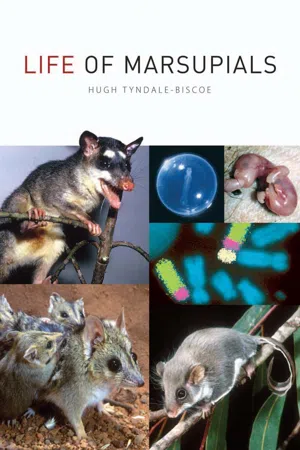 eBook - ePub
- Hugh Tyndale-Biscoe(Author)
- 2005(Publication Date)
- CSIRO PUBLISHING(Publisher)
Chapter 1
What is a marsupial?
This is the story of a group of mammals that were isolated from the rest of the world for many millions of years. It is set on the great southern continent of Gondwana that stretched from the Caribbean to the islands of New Guinea and included the three present-day continents of South America, Antarctica and Australasia. The characters are the marsupial mammals and the plot is how they came to be there and how they adapted to the special conditions of their vast homeland.Today Marsupials only occur in Australasia and the Americas, although fossil Marsupials have been discovered on every continent of the world. If they occurred on all the continents in the past, why are they not more widely distributed today? We first need to ask whether Marsupials really share a common relationship closer than that to any other group of mammals. If they do, where did Marsupials originate and how did they come to be where they are today?The features that were described first by the Europeans were the pouch of the female and the extraordinarily small size of the young at birth. These are their two most distinctive features and reproduction is what sets Marsupials apart from other mammals and permeates the life history of every species. But what confused the early European explorers was that many Marsupials closely resembled mammals more familiar to them that follow similar life styles.First European encounter with American Marsupials
The first marsupial brought to Europe from America was a common opossum collected by Vincente Yañez Pinzón on his first voyage to the New World in 1500. He collected a female, which had young in its pouch, and later he presented it to Queen Isabella and King Ferdinand II in Grenada. By the end of the voyage to Spain the young were gone and the mother opossum dead but the Queen inserted her fingers into the ‘second belly’ of this strange creature from the New World. This extraordinary organ and the young it enclosed caused astonishment in scientific circles throughout Europe and led to speculation about how the tiny young reached the pouch – did they grow from the teats as buds, or were they blown into the pouch from the mother’s nostrils? Both ideas had a long currency but the equally astonishing fact that they crawl to the pouch unaided by their mother was not discovered for another 420 years. The strange appearance of this New World animal, with a fox-like head and a monkey’s hands, also puzzled European scientists, who described it as the monkey-fox or ‘simivulpa’. eBook - PDF
Invasion Biology and Ecological Theory
Insights from a Continent in Transformation
- Herbert H. T. Prins, Iain J. Gordon(Authors)
- 2014(Publication Date)
- Cambridge University Press(Publisher)
Marsupials now predominate in the Australasian region, which I define as Australia, New Guinea and islands east to the Solomons and west to the Makassar and Lombok Straits, or Wallace’ s Line (Dickman 2005). One hundred and fifty-seven living species in four orders and 16 families have been described from Australia and 78 more species from the broader region, although many further cryptic species are likely to be revealed when current molecular studies have been completed. Living Marsupials are united by their common reproductive mode and by several features of both their hard and soft anatomy, but are nonetheless astonishingly diverse in size (4.5–80 000 g) and ecological attributes. Some species such as the moles Notoryctes spp. spend their lives almost entirely underground, whereas some gliders Petaurus spp. and several Invasion Biology and Ecological Theory: Insights from a Continent in Transformation, eds H. H. T. Prins and I. J. Gordon. Published by Cambridge University Press. © Cambridge University Press 2014. species within the four genera of cuscuses descend rarely to the ground. There are mountain-top specialists, such as the mountain pygmy possum Burramys parvus Broom, and many species that exploit the low-lying but undulating deserts of Australia’ s continental interior. The diets of Marsupials reflect the extraordinary diver- sity of habitats that they occupy, with many species specialising in hunting insects, other invertebrates or small vertebrates, others consuming nectar, sap and other plant products, and many more browsing, grazing or showing little preference for what they eat (Lee and Cockburn 1985; Dickman and Vieira 2006). Marsupials clearly have demonstrated an impressive ability to disperse to different parts of the world in the past, and their broad distribution in Australasia shows that they are successfully able to exploit a wide range of environments today.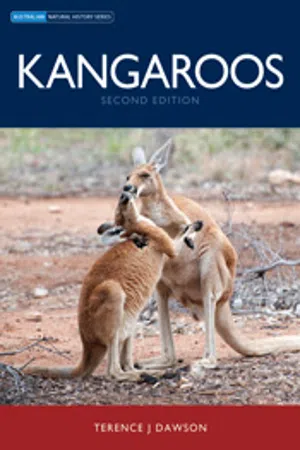 eBook - ePub
- Terence J Dawson(Author)
- 2012(Publication Date)
- CSIRO PUBLISHING(Publisher)
5
REPRODUCTIVE BIOLOGY
The delightful picture of a doe kangaroo with a large joey looking out of her pouch is one of the evocative characteristics of Australian Marsupials (Plate 13 ). Having a young spend much of its early development in a pouch instead of within the body frequently evokes the question: why are the Marsupials so different in their reproduction? Does it represent stagnation in evolutionary progress or is it just an alternative (and perhaps even better) reproductive strategy to that used by the placentals? The former view prevailed for many years but is now challenged, principally from ecological viewpoints. In truth, the real question about modes of reproduction in the mammals is: why did the placentals diverge from the basic pattern of vertebrate reproduction that Marsupials have generally followed? The hormonal and structural features that are the basis on which the live bearing of young (viviparity) developed in Marsupials and placentals were certainly established in monotremes and probably evolved even before the emergence of reptiles. The shelled egg of the reptiles, which is still seen in birds, provided the basic structures used in the development of viviparity.Despite the attention given to the evolution of viviparity, the most outstanding early feature of mammalian reproduction was actually the evolution of lactation, i.e. milk feeding. Lactation and maternal care are at the base of mammalian evolution and developed more than 200 Mya; that is, before the divergence of the monotremes from the marsupial–placental lineage. Remember that the monotremes, such as the Platypus, are mammals that lay eggs but nurse their young. Lactation possibly arose in the mammal-like reptiles as a way of preventing the drying out of parchment-shelled eggs, but after its nutritive role was established it opened the door to an extended period of parental care and its benefits. The placentals achieved this by combining lactation with an extension of intrauterine development via major developments of the placenta. The Marsupials, on the other hand, extended extrauterine pouch development and used lactational innovations to largely nourish the developing young. The marsupial embryo does receive nourishment via a placenta but this lasts only a few days until it is born at a very immature stage. eBook - PDF
Early Miocene Paleobiology in Patagonia
High-Latitude Paleocommunities of the Santa Cruz Formation
- Sergio F. Vizcaíno, Richard F. Kay, M. Susana Bargo(Authors)
- 2012(Publication Date)
- Cambridge University Press(Publisher)
A dated phylogeny of Marsupials using a molecular supermatrix and multiple fossil constraints. Journal of Mammalogy, 89, 175–189. Birney, E. C. and Monjeau, J. A. (2003). Latitudinal variation in South American marsupial biology. In Predators with pouches: the biology of carnivorous Marsupials, ed. M. Jones, C. Dickman and M. Acher. Hobart, Australia: CSIRO Publishing, pp. 297–317. Birney, E. C., Sikes, R. S., Monjeau, J. A., Guthmann, N. and Carleton, J. P. (1996). Comments on Patagonian Marsupials of Argentina. In Contribution in Mammalogy, A Memorial Volume Honoring Dr. J. Knox Jones Jr., ed. H. H. Genoways and R. J. Baker. Museum of Texas Tech University Press, pp. 149–154. Bown, T. M. and Fleagle, J. G. (1993). Systematics, biostratigraphy, and dental evolution of the Palaeothentidae, later Oligocene to Early–Middle Miocene (Deseadan–Santacrucian) Caenolestoid Marsupials of South America. Journal of Palaeontology Memoir 29, 67, 1–76. Bozinovic, F., Ruiz, G. and Rosenmann, M. (2004). Energetics and torpor of a South American “living fossil”, the microbiotheriid Dromiciops gliroides. Journal of Comparative Physiology B, 174, 293–297. Charles-Dominique, P. (1983). Ecology and social adaptation in didelphid Marsupials: comparisons with eutherians of similar ecology. In Advances in the Study of Mammalian Behavior, ed. J. F. Eisenberg. Shippensburg: American Society of Mammalogist, pp. 305–422. Charles-Dominique, P., Atramentowicz, M., Charles-Dominique, M. et al. (1981). Les mammiferes frugivores arboricoles nocturnes d’une foret guyanaise: inter-relations plantes– animaux. Revue d’Ecologie (Terre Vie) 35, 341–436. Churchfield, S. and Sheftel, B. I. (1994). Food niche overlap and ecological separation in a multi-species community of shrews in the Siberian taiga. Journal of Zoology, 234, 105–124. Churchfield, S., Nesterenko V. eBook - ePub
The Endocrinology of Pregnancy and Parturition
Current Topics in Experimental Endocrinology, Vol. 4
- L Martini, V. H. T. James(Authors)
- 2013(Publication Date)
- Academic Press(Publisher)
This led to a better understanding of many physiological aspects of marsupial reproduction. Species which have proven amenable to captivity include the tammar wallaby, the quokka, the American opossum, two species of bandicoot, the fat-tailed dunnart, and the brushtail possum. The tammar wallaby has proven particularly successful in this respect, which is fortunate because it also has one of the most interesting patterns of reproduction. For this reason, this species has been employed in the majority of laboratory studies. Successful hypophysectomy experiments have enabled the role of the pituitary gland to be examined (Hearn, 1973, 1974, 1975) and a range of biochemical assay methods has been employed to study placental function (Renfree, 1973a, b, 1975 ; Renfree and Tyndale-Biscoe, 1973b). The aspects of reproduction which have attracted most attention are the control of embryonic diapause, seasonal breeding, and maternal recogniton of pregnancy. Much of this work has been reviewed extensively in recent years (Tyndale-Biscoe, 1973, 1979, 1983 ; Renfree, 1980b ; Amoroso et al., 1980 ; Tyndale-Biscoe and Hinds, 1981) and so will not be discussed at length here. This article will concentrate on a number of new developments in the area of marsupial pregnancy and parturition which have arisen largely as a result of the development of adequate assay techniques for the measurement of reproductive hormones in these species. The hormones themselves and the difficulties encountered in measuring them will be discussed first. This will be followed by a brief description of the estrous cycle
Index pages curate the most relevant extracts from our library of academic textbooks. They’ve been created using an in-house natural language model (NLM), each adding context and meaning to key research topics.

