Biological Sciences

Mammals
Mammals are a class of vertebrate animals characterized by the presence of mammary glands, which produce milk for feeding their young. They are also distinguished by having hair or fur, a four-chambered heart, and a neocortex region in the brain. Mammals are found in diverse habitats worldwide and exhibit a wide range of behaviors and adaptations.
Written by Perlego with AI-assistance
Related key terms
1 of 5
10 Key excerpts on "Mammals"
 eBook - ePub
Drawing Wild Animals
Essential Techniques and Fascinating Facts for the Curious Artist
- Oana Befort, Maggie Reinbold(Authors)
- 2018(Publication Date)
- Quarry Books(Publisher)
Mammals REPRESENTING the smallest class of vertebrate animals, with roughly 5,400 described species across multiple orders, Mammals are an incredibly diverse and fascinating group. They range in size from tiny bats and mice to massive whales, united by the presence of hair, mammary glands, and unique brain and ear structures. All Mammals are endothermic, or “warm-blooded,” with the ability to regulate their own body temperature through internal processes instead of relying on the external environment. Endothermy allows species to thrive and survive in even the harshest environments; consequently, Mammals are broadly distributed across all habitat types throughout the world. Mammals display an incredible range of lifestyles and food preferences, from arboreal insectivores to aquatic carnivores to fossorial (burrowing) omnivores. They vary greatly in their external ornamentation, from color patterns such as stripes and spots to structures on the head like horns and antlers. They communicate in a variety of ways, using scent, sound, and movement to relay information and interact with each other under myriad community structures, from solitary living to strict hierarchies. All Mammals give birth to live young, except for a few egg-laying species such as the duck-billed platypus of Australia. The platypus and a handful of echidna species, collectively called monotremes, lay eggs like birds and reptiles, but most of the incubation occurs inside the mother’s body, with young drinking milk immediately after hatching. In contrast to the monotremes are the marsupials, a group of Mammals that give birth to live young, but the offspring are born extremely small and undeveloped. Newborn marsupials are essentially still fetuses, and must make their way to the safety of the mother’s pouch, where they actively suckle milk and continue developing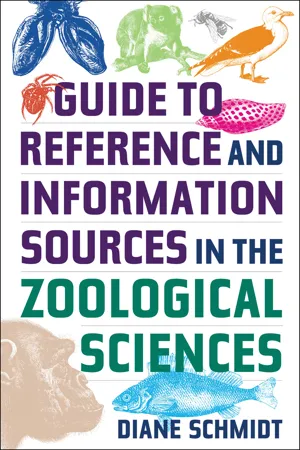
- Diane Schmidt(Author)
- 2003(Publication Date)
- Libraries Unlimited(Publisher)
8 Mammals There are about 4,600 species of Mammals, the smallest of the vertebrate classes. Mammals are among the most familiar animals. They have hair, three bones in their middle ears (the malleus, incus, and stapes), and pro- duce milk. Mammals range in size from the bumblebee bat of Thailand (Craseonycteris thonglongyai, 2 grams) to the largest animal that ever lived, the blue whale (Balaenoptera musculus, over 130 tons). There are three major divisions of Mammals. The smallest group is the monotremes, or Prototheria, which lay eggs rather than give birth to live young but do produce milk. The marsupials, or Metatheria, are the pouched Mammals and live primarily in Australia and South America. The largest group is the placental Mammals, or Eutheria, which bear live young that have been nourished in utero by a placenta. Because we humans are also Mammals, it should come as no surprise that the Mammals are probably the best studied group of animals. Even so, nearly 40% of all Mammals are rodents and bats that few people ever see and fewer study. In addition, large Mammals are still being discovered, including a new beaked whale in 2002 and several species of deer and bovids in Southeast Asia in the 1990s. Classification of Mammals (taken from Martin etal., 2001) Prototheria Monotremata (3 species) 307 No longer available |Learn more
- (Author)
- 2014(Publication Date)
- Learning Press(Publisher)
________________________ WORLD TECHNOLOGIES ________________________ Chapter- 1 Introduction to Mammals Mammals Temporal range: Late Triassic – Recent, 220– 0 Ma Examples of various mammalian orders Scientific classification Kingdom: Animalia Phylum: Chordata Subphylum: Vertebrata Infraphylum: Gnathostomata clade : Eugnathostomata clade : Teleostomi Superclass: Tetrapoda ________________________ WORLD TECHNOLOGIES ________________________ (unranked): Mammaliaformes Class: Mammalia Linnaeus, 1758 Subgroups • Subclass † Allotheria • Subclass Prototheria • Subclass Theria o Infraclass Metatheria o Infraclass Eutheria Mammals are members of a class of air-breathing vertebrate animals characterized by the possession of hair, three middle ear bones, and mammary glands functional in mothers with young. Most Mammals also possess sweat glands and specialized teeth, and the largest group of Mammals, the placentals, have a placenta which feeds the offspring during gestation. The mammalian brain, with its characteristic neocortex, regulates endothermic and circulatory systems, including a four-chambered heart. Mammals range in size from the 30–40 millimeter (1- to 1.5-inch) Bumblebee Bat to the 33-meter (108-foot) Blue Whale. According to Mammal Species of the World , which is updated through periodic editions, 5676 species were known in 2005, distributed in 1,229 genera, 153 families and 29 orders. In 2008 the IUCN completed a 5-year, 17,000 scientist Global Mammal Assessment for its IUCN Red List, which counted 5488 accepted species at the end of that period. The class is divided into two subclasses (not counting fossils): the Prototheria (order of Monotremata) and the Theria, the latter containing the infraclasses Metatheria (including marsupials) and Eutheria (the placentals). No longer available |Learn more
- (Author)
- 2014(Publication Date)
- Research World(Publisher)
The monotremes branched early from other Mammals and do not have the nipples seen in most Mammals, but they do have mammary glands. Viviparous Mammals are classified into the subclass Theria and are divided into two infraclasses: Metatheria (of which only the Marsupialia survive), and Eutheria. Marsupialia, or marsupials, have short gestation periods and give birth to undeveloped young which are contained within a pouch-like sac (marsupium) located in front of the mothers' abdomen. Eutherians, commonly known as placentals, are Mammals that give birth to complete and fully developed young. This is usually characterized by long gestation periods. The majority of mammal species are classified as eutherians. ________________________ WORLD TECHNOLOGIES ________________________ Physiology Endothermy Nearly all Mammals are endothermic (warm-blooded). Most Mammals also have hair to help keep them warm. Like birds, Mammals can forage or hunt in cold weather and climates where non-avian reptiles and large insects cannot. Endothermy requires plenty of food energy, so pound for pound Mammals eat more food than most reptiles. Small insectivorous Mammals eat prodigious amounts for their size. A rare exception, the naked mole rat produces little metabolic heat, so it is considered an operational poikilotherm. Birds are also endothermic, so endothermy is not a defining mammalian feature. Intelligence In intelligent Mammals, such as primates, the cerebrum is larger relative to the rest of the brain. Intelligence itself is not easy to define, but indications of intelligence include the ability to learn, matched with behavioral flexibility. Rats, for example, are considered to be highly intelligent as they can learn and perform new tasks, an ability that may be important when they first colonize a fresh habitat. In some Mammals, food gathering appears to be related to intelligence: a deer feeding on plants has a brain smaller than a cat, which must think to outwit its prey. No longer available |Learn more
- (Author)
- 2014(Publication Date)
- Research World(Publisher)
The monotremes branched early from other Mammals and do not have the nipples seen in most Mammals, but they do have mammary glands. Viviparous Mammals are classified into the subclass Theria and are divided into two infraclasses: Metatheria (of which only the Marsupialia survive), and Eutheria. Marsupialia, or marsupials, have short gestation periods and give birth to undeveloped young which are contained within a pouch-like sac (marsupium) located in front of the mothers' abdomen. Eutherians, commonly known as placentals, are Mammals that give birth to complete and fully developed young. This is usually characterized by long gestation periods. The majority of mammal species are classified as eutherians. ________________________ WORLD TECHNOLOGIES ________________________ Physiology Endothermy Nearly all Mammals are endothermic (warm-blooded). Most Mammals also have hair to help keep them warm. Like birds, Mammals can forage or hunt in cold weather and climates where non-avian reptiles and large insects cannot. Endothermy requires plenty of food energy, so pound for pound Mammals eat more food than most reptiles. Small insectivorous Mammals eat prodigious amounts for their size. A rare exception, the naked mole rat produces little metabolic heat, so it is considered an operational poikilotherm . Birds are also endothermic, so endothermy is not a defining mammalian feature. Intelligence In intelligent Mammals, such as primates, the cerebrum is larger relative to the rest of the brain. Intelligence itself is not easy to define, but indications of intelligence include the ability to learn, matched with behavioral flexibility. Rats, for example, are considered to be highly intelligent as they can learn and perform new tasks, an ability that may be important when they first colonize a fresh habitat. In some Mammals, food gathering appears to be related to intelligence: a deer feeding on plants has a brain smaller than a cat, which must think to outwit its prey.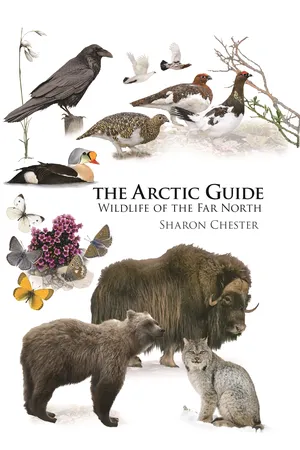 eBook - ePub
The Arctic Guide
Wildlife of the Far North
- Sharon Chester(Author)
- 2016(Publication Date)
- Princeton University Press(Publisher)
MammalsALL Mammals, from humans to lemmings to muskoxen to whales, share certain physical features. All Mammals possess modified sweat glands called mammary glands, which in a female can produce milk. All have body hair, at least at the beginning of their lives, and all have a four-chambered heart, single-boned lower jaw, and a middle ear composed of three bones.Arctic Mammals are warm-blooded, or endothermic, creatures. They are able to maintain a constant body temperature despite changing climatic conditions. Their core body temperatures range from 97.7°F to 105°F (36.5°C–40.5°C), this despite the fact that marine species live in seawater of 28°F (−2°C) and land Mammals experience winter temperatures averaging −33°F (−36°C).Most of the northern Mammals have developed well-insulated, compact bodies with short appendages, which minimize heat loss and conserve body heat. Mammals that spend most of their time in water usually have a thick layer of blubber—a subcutaneous sheet of fat, collagen, and elastin—that sheathes the vital organs, increases buoyancy, and acts as an energy reservoir during periods of fasting.Terrestrial Mammals typically have a dense coat of fur. Many have fur on both the upper and lower surfaces of the feet and have a double coat of fur that becomes heavier in winter. Air trapped between the dense inner coat and the outer layer of coarse, long guard hairs provides excellent insulation.Some marine Mammals also have fur for insulation. Sea otters have the greatest hair density of any mammal, ranging from 170,000 to more than 1 million hairs per sq in (26,000–165,000 hairs per sq cm). The highest hair density occurs on the forearms, sides, and rump, the lowest on the chest, legs, and feet. Polar bears have a double coat of fur, which is backed by a 4.5 in (11 cm) layer of fat. No longer available |Learn more
- (Author)
- 2014(Publication Date)
- White Word Publications(Publisher)
The platypus and the echidna present a particular sex determination system that is different from other vertebrates. Certain glands of Mammals known as mammary glands are specialized to produce milk, a liquid used by newborns as their primary source of nutrition. The monotremes branched early from other Mammals and do not have the nipples seen in most Mammals, but they do have mammary glands. ________________________ WORLD TECHNOLOGIES ________________________ Viviparous Mammals are classified into the subclass Theria and are divided into two infraclasses: Metatheria (of which only the Marsupialia survive), and Eutheria. Marsu-pialia, or marsupials, have short gestation periods and give birth to undeveloped young which are contained within a pouch-like sac (marsupium) located in front of the mothers' abdomen. Eutherians, commonly known as placentals, are Mammals that give birth to complete and fully developed young. This is usually characterized by long gestation periods. The majority of mammal species are classified as eutherians. Physiology Endothermy Nearly all Mammals are endothermic (warm-blooded). Most Mammals also have hair to help keep them warm. Like birds, Mammals can forage or hunt in cold weather and climates where non-avian reptiles and large insects cannot. Endothermy requires plenty of food energy, so pound for pound Mammals eat more food than most reptiles. Small insectivorous Mammals eat prodigious amounts for their size. A rare exception, the naked mole rat produces little metabolic heat, so it is considered an operational poikilotherm. Birds are also endothermic, so endothermy is not a defining mammalian feature. ________________________ WORLD TECHNOLOGIES ________________________ Intelligence Skeletons of human and gorilla in the MIAT museum - front view, Gent, Belgium ________________________ WORLD TECHNOLOGIES ________________________ The fastest land animal, the cheetah can reach 120 kmh (75 mph) eBook - ePub
- Rajesh Jani(Author)
- 2021(Publication Date)
- CRC Press(Publisher)
CHAPTER 3 BIOLOGICAL FEATURES OF WILD ANIMALST he classifications of the Mammals into different groups indicate their relationship with each other genealogically. Their capacity to adapt to their environment is most important. The environment includes the surroundings, the conditions that influence the body forms and the habitat of the animal that it supports. It is characterised most easily by the vegetation. In an enlarged definition environment includes both physical or abiotic and living or biotic environment. The abiotic environment includes the medium of life and the climate. This medium and the climatic conditions regulate and considerably affect the behaviour of the organism. Climatic conditions like the temperature, rainfall, day length, soil, topography all exert influence.STATUS OF WILD ANIMALS
The wild animals according to their population and habitat, as specified by International Union of Nature and Natural resources (IUCN), based red data book are categories as- extinct (no reasonable doubt that its last individual has died),
- extinct in the wild (survive in captivity),
- critically endangered (facing extremely high risk of extinction in the wild in the immediate
- endangered (it is not critically endangered but is facing a high risk of extinction in the wild in the near future),
- vulnerable (is facing a high risk of extinction in the wild in the medium term future),
- conservation dependent , low risk data deficient and not evaluated.
Salient Features
- Prototheria, (Gr. Pratos, first, ther, wild beast), as the name indicates, they are the most primitive of the Mammals. Prototheria has only one order the Monotremata (Gr. monos, single, trema atos, a hole). This is the lowest order of Mammals having a single opening for both the genital and the digestive organs.
- Monotremata is represented by the echidnas (spiny ant-eater) and the duck-billed platypus. They show some reptilian characters and are egg layers. When the young ones hatch the mother suckles them. The milk glands do not have a teat or nipple.
 eBook - PDF
The Design of Mammals
A Scaling Approach
- John William Prothero(Author)
- 2015(Publication Date)
- Cambridge University Press(Publisher)
Eukaryotes (nucleated cells) first appeared 1.5 billion years ago. Vertebrate fossils recently found in China date to 450 million years ago (mya). The earliest mammal-like reptiles, the cynodonts (Order Therapsida, Class Synapsida), surfaced in the fossil record of the Late Permian and early Triassic periods (245 mya), slightly after the dinosaurs (in geological terms). Until near the end of the Cretaceous period (65 mya) Mammals were shrew- to rat-sized creatures, slinking about in the dark to evade the dominating dinosaurs. Within ten million years – a wink in the timespan of the universe – following the dinosaur extinction a significant radiation of the Mammals took place, giving rise to all the contemporary taxonomic orders, with some individual species of large size [1]. The primary purpose of this chapter is to introduce some qualitative but mainly quantitative measures of mammalian diversity, both size- and taxonomy-related. These measures involve a somewhat different way of looking at Mammals than has been customary in scaling studies. Mammals as a divergent vertebrate Structural features believed to be unique to Mammals are recapped in Table 2.1; of the ten structures listed, seven are considered to be universal. In principle any one of these structures might be regarded as the defining characteristic of Mammals (see above quote from Boitani and Bartoli). But mammary glands are the most important of these structures from an evolutionary standpoint; lactation has profound implications for mammalian social behavior [2]. 10 Body size range in adult vertebrates Publication of size range should be mandatory. Calder 1987 Body size influences virtually every aspect of animal life. It is fundamental to mamma- lian scaling studies (see above quote from Calder). Often in scaling studies a measure is needed of the size range for some sample of Mammals. Of special significance is the size range for Mammals generally.
- Thomas Allen Jefferson, Marc A. Webber, Robert L. Pitman, Brett Jarrett, Thomas A. Jefferson(Authors)
- 2011(Publication Date)
- Academic Press(Publisher)
2.Basic Marine Mammal Biology
In this chapter, we will introduce those readers who are unfamiliar with marine Mammals to the subjects of this guide. We will not attempt to give a detailed summary of the biology of marine Mammals, as that is not the purpose of this book. Besides, it has already been done much better than we could do, elsewhere (e.g., see Berta et al. 2006 ; Hoelzel 2002 ; Perrin et al. 2002 ; Reeves and Stewart 2003 ). Instead, we will simply provide a brief summary of the basic biology of the group of animals that we call marine Mammals, primarily intended for use by those readers who are new to these animals.What is a Marine Mammal?
It is important to recognize that marine Mammals are not a natural biological grouping. Many people do not realize this, but the term “marine mammal” is somewhat of a “catch-all” phrase used for those groups of Mammals that have returned to life in the “sea.” The most important criterion is that they must get all or most of their food from the aquatic environment. It is not essential that they actually live in the sea. In fact, many species of marine Mammals never encounter marine waters, living instead in various land-locked lakes and rivers. However, all of them are thought to have come from marine ancestors.Marine Mammals are not necessarily completely dependent on an aquatic existence. For instance, pinnipeds do not generally mate or give birth in the water, and polar bears may spend great amounts of time moving on land long distances away from the nearest marine waters. But, these Mammals, along with the cetaceans and sirenians, do obtain most or all of their sustenance from the water, and this makes them marine Mammals. One or two species of otters (the sea otter and marine otter) and the polar bear are also usually included as marine Mammals.In reality, there is no hard-and-fast rule of what is a marine mammal. Some people consider other Mammals also to be in this group, but the scheme introduced below is, by far, the most common in use. It originated with the list of “marine Mammals” produced when the U.S. Congress passed the Marine Mammal Protection Act of 1972, and has been widely followed ever since.
Index pages curate the most relevant extracts from our library of academic textbooks. They’ve been created using an in-house natural language model (NLM), each adding context and meaning to key research topics.

