Biological Sciences

Protozoal Parasite
A protozoal parasite is a single-celled organism that can cause various diseases in humans and animals. These parasites are often transmitted through contaminated food or water, and they can infect different organs and systems in the body. Common examples of protozoal parasites include Plasmodium, which causes malaria, and Giardia, which causes gastrointestinal illness.
Written by Perlego with AI-assistance
Related key terms
1 of 5
10 Key excerpts on "Protozoal Parasite"
 eBook - PDF
- F. H. Kayser, K. A. Bienz, J. Eckert(Authors)
- 2011(Publication Date)
- Thieme(Publisher)
V Parasitology Trichinella spiralis 9 Protozoa J. Eckert General information on parasites. A parasite (from the Greek word parasitos ) is defined as an organism that lives in a more or less close association with another organism of a different species (the host), derives sustenance from it and is pathogenic to the host, although this potential is not always expressed. In the wider sense, the term parasite refers to all organisms with such char-acteristics. In medicine the term is used in a narrower sense and designates eukaryotic pathogens, which belong to the protozoa (unicellular organisms Chapter 9) and metazoa, including helminths (parasitic “worms,” Chapter 10), arthropods (Chapter 11), and some other groups of lower medical signifi-cance (Annelida, Pentastomida, not covered in this book). Parasites cause numerous diseases (parasitoses) in humans, some being of extraordinary significance (e.g., malaria). Of practical concern in central Europe are both autochthonous and imported (tropical and travelers’) parasitic infections. A uniform disease nomenclature has been adopted in this book with the sole use of the suffix – osis (plural – oses )—for example trypanosomosis and not trypanosomiasis. This system, based on the Standardized Nomenclature of Parasitic Diseases (SNOPAD) (originally published in 1988 and recom-mended by the International Society of Parasitologists) avoids the inconsis-tent usage of disease names, such as leishmaniasis on the one hand and toxoplasmosis on the other. A selection of the most important parasitoses is presented in the following chapters. In Table 1. 10 (p. 28) zoonoses caused by parasites are listed. Parasitic protozoa are eukaryotic, single-celled microorganisms about 1–150 l m in size and enclosed by a trilaminated cell membrane. They possess one, rarely two nuclei (and multinuclear reproductive forms). Reproduction is asexual by binary or multiple fission of the cell, or sexual. eBook - PDF
- Edward Bittar(Author)
- 1998(Publication Date)
- Elsevier Science(Publisher)
Chapter 33 Principles of Parasitology and Parasitic Disorders BRIAN R. SHIELS Introduction 564 Protozoan Parasites 564 Metazoan Parasites 566 Principles of Parasitology 568 Principle 1: Find and Enter 568 Principle 2: Establish and Survive 571 Principle 3: Differentiate, Reproduce, and Leave 579 Principles of Parasitic Disorders 586 Principle 1: Disorder Due to Parasite Activity 587 Principle 2: Disorder Caused by a Host Response to the Parasite 588 The Last Principle: Fundamentals are Important 592 Summary 593 Principles of Medical Biology, Volume 9B Microbiology, pages 563-595. Copyright © 1997 by JAI Press Inc. All rights of reproduction in any form reserved. ISBN: 1-55938-814-5 563 564 BRIAN R. SHIELS INTRODUCTION To outline the principles that define the biology of parasites and the disorders they cause is a daunting task. This is because the adoption of a parasitic lifestyle has been a common event in the evolution of a large number of organisms, from bacteria to vertebrates; and because the relationships formed between parasites and their hosts reveal increasing levels of complexity the more they are investigated. Simpli-fication of the task can be achieved by adopting the definition of a parasite as given by Bryant and Behm (1989), a parasite is an organism that lives within another organism, called a host, to that hosts detriment, and is absolutely dependent on that host for the completion of at least part of its life cycle. Further reductionism will limit the subject matter to eukaryotic organisms which are the etiological agents of the major parasitic disorders of man (Table 1), and the fundamentals to be discussed will concentrate on the relationship between parasite and mammalian host. Protozoan Parasites A large number of parasites are classified within the phylum Protozoa and are, therefore, unicellular organisms. Like all animal cells these parasites have a nucleus, delineated by a double unit membrane; endoplasmic reticulum; golgi and mitochon-dria. eBook - PDF
- Wilhelm Tham, Marie Louise Danielsson-Tham, Wilhelm Tham, Marie Louise Danielsson-Tham(Authors)
- 2013(Publication Date)
- CRC Press(Publisher)
CHAPTER 13 Protozoan Parasites: A Plethora of Potentially Foodborne Pathogens Lucy J. Robertson # Introduction Although it is now widely accepted that the various species that traditionally are collectively categorized as “protozoa” are not necessarily closely related to each other, it remains a useful term in many situations relating to human and animal health. However, it should be noted that in many scientific contexts, this classification is no longer formally used. Thus, the term ‘protozoan parasites’ as used within this chapter refers to those eukaryotic, unicellular, organisms that infect another organism, the host, obtaining benefits at the latter’s expense. For some infections with protozoan parasites, the host organism is severely weakened or compromised and, in some infections, may be killed. The human burden of parasitic protozoan infection is enormous. On a global basis, billions of people are infected by protozoan parasites and the DALY (disability-adjusted life year) toll due to protozoan infections is correspondingly huge (WHO 2008). Although vector-borne protozoan infections, such as malaria, are probably most familiar to us, particularly in tropical countries, infections from other protozoan parasites also occur commonly, in temperate regions as well, and add to the burden. # Parasitology Laboratory, Institute for Food Safety and Infection Biology, Norwegian School of Veterinary Science, PO Box 8146 Dep., 0033 Oslo, Norway. Email: [email protected] 170 Food Associated Pathogens Several of the parasitic protozoa that are of importance to human health have an oral infection route. Transmission is often faecal-oral or via ingestion of tissue cysts in meat. For these parasites, the foodborne route of transmission is likely to be highly relevant, or, indeed, for tissue cysts, essential. eBook - PDF
- Rathoure, Ashok Kumar(Authors)
- 2021(Publication Date)
- Daya Publishing House(Publisher)
Chapter 1 Parasitology 1.1 Introduction Parasitology is the study of parasites and their relationships to their hosts. While it is entirely proper to classify many bacteria and fungi and all viruses as parasites, parasitology has traditionally been limited to parasitic protozoa, helminthes and arthropod, as well as those species of arthropods that serve as vector for parasites. It follows that parasitology encompasses elements of protozoology, helminthology and medical arthropodology. Human parasitology, an important part of parasitology, studies the medical parasites including their morphology, life cycle, the relationship with host and environment. According to the very broad definition of parasitology, parasites should include the viruses, bacteria, fungi, protozoa and metazoa (multicelled organisms) which infect their host species. Parasites are living things which harm udders by becoming metabolically dependent on them. It is an old animal relationship based on the concept of dependence for nutrition and support. Parasitology is studied in a wide variety of headings and it is a dynamic aspect of zoology with links to other fields of sciences and social sciences. No biological association is of greater medical importance than parasitism. Parasites plague humanity and are at the root cause of many diseases especially in the tropics, the need for a dedicated branch of zoology to study these exciting but disturbing polyphyletic animal groups. Parasitology is an applied field of biology dedicated to the study of the biology, ecology and relationships which parasites are involved in with other organisms known as the host. This ebook is exclusively for this university only. Cannot be resold/distributed. eBook - PDF
- N A Khan(Author)
- 2008(Publication Date)
- CRC Press(Publisher)
CHAPTER 5 Protozoa 1. INTRODUCTION The term protozoa is derived from 'proto' meaning 'first' and 'zoa' meaning 'animal'. Protozoa are 'first animals' which generally describes their animal like nutrition. Protozoa are the largest group of single-celled, microscopic organisms with more than 20,000 species that are found in all aspects of life. Protozoa are widely distributed in various environments from favourable rainforests to sandy beaches to the bottom of oceans to snow- covered mountains. With the availability of improved diagnostic methods, protozoa are being discovered from diverse habitats. However, the abundance and diversity of protozoa in ecosystems is dependent on abiotic factors such as water, temperature, pH, salinity, osmolarity and biotic factors including the availability of food particles. Protozoa include the causative agents of some of the most notorious and deadly diseases. For example, malaria alone causes between one to two million deaths worldwide, annually. Other protozoa play important roles in the food chain maintaining a balanced ecosystem or act as commensal organisms (not harmful) of nearly all humans. Some of the protozoan pathogens have only recently been identified as a major threat to human health. For example, Cryptosporidium was originally described in the 19th century, but has recently been associated with serious human infections in AIDS patients. With the increasing number of AIDS patients during the last few decades, many of the protozoan pathogens have become a major problem to human health. 2. PROTOZOA: CELLULAR PROPERTIES Protozoa are the largest single-cell non-photosynthetic animals, which lack cell walls. The study of protozoa, invisible to the naked eye, was initiated 183 with the discovery of the microscope in 1600s by Antonio van Leeuwenhoek (1632 -1723). The majority of protozoan pathogens are less than 150 pm in size with the smallest one between 1 -1 0 pm. eBook - PDF
- Mark F Wiser(Author)
- 2010(Publication Date)
- Garland Science(Publisher)
The line between parasitism and commensalism is often blurry and the precise definition between the two terms often varies according to author. For example, according to some definitions, commen-sals, in contrast to parasites, are not physiologically dependent upon the host and can live independently of the host. However, several protozoan species found within the human intestinal tract, that feed upon bacteria and debris and do not cause any human disease, are often referred to as commensals even though they are completely dependent on the host for their survival. In addition, one can also distinguish between obligate sym-bionts, which cannot live apart from their hosts, and facultative symbionts, which can be either free-living or symbiotic. Similarly, many parasitic pro-tozoa are facultative pathogens in that they do not always cause disease. The life cycle of many parasitic protozoa can be completed in a single host. These monoxenous parasites generally have a life cycle stage out-side of the host and transmission almost always involves the ingestion of an infective form. Other parasitic protozoa are heteroxenous in that they require multiple host species to complete their life cycle. Quite often one of the hosts is a blood-feeding arthropod referred to as a vector . Some para-sitic protozoa can only infect a single or limited range of host or vector spe-cies; whereas others are more promiscuous and can infect a wide range of hosts. Human diseases caused by parasites normally found in other animals are called zoonoses and the animal host is the reservoir . Generally zoonotic diseases do not involve a person-to-person transfer. protrusion adhesion traction de-adhesion/ retraction (A) (B) Figure 1.6 Ameboid movement. (A) Schematic of ameboid movement. (B) Light micrograph showing ectoplasm (pseudopodium) and endoplasm (cell body). eBook - PDF
Microbiology
Principles and Explorations
- Jacquelyn G. Black, Laura J. Black(Authors)
- 2018(Publication Date)
- Wiley(Publisher)
Unless health scien- tists take a course in parasitology, their only opportunity to learn about helminths and arthropods is in conjunction with the study of microscopic infectious agents. PRINCIPLES OF PARASITOLOGY A parasite is an organism that lives at the expense of another organism, called the host. Parasites vary in the degree of damage they inflict on their hosts. Although some cause little harm, others cause moderate to severe damage. Parasites that cause disease are called pathogens. Parasitology is the study of parasites. Although few people realize it, among all living forms, there are probably more parasitic than nonparasitic organisms. Many of these parasites are microscopic throughout their life cycle or at some stage of it. Historically, in the development of the science of biology, parasitology came to refer to the study of protozoa, hel- minths, and arthropods that live at the expense of other organisms. We will use the term parasite to refer to these organisms. Strictly speaking, bacteria and viruses that live at the expense of their hosts also are parasites. The manner in which parasites affect their hosts dif- fers in some respects from that described in earlier chap- ters for bacteria and viruses. Special terms also are used to describe parasites and their effects. This introduction PRINCIPLES OF PARASITOLOGY 298 The Significance of Parasitism 298 • Parasites in Relation to Their Hosts 298 • Wolbachia 299 PROTISTS 300 Characteristics of Protists 300 • The Importance of Protists 300 • Classification of Protists 301 FUNGI 307 Characteristics of Fungi 307 • The Importance of Fungi 310 • Classification of Fungi 311 CHAPTER MAP HELMINTHS 315 Characteristics of Helminths 315 • Parasitic Helminths 316 ARTHROPODS 323 Characteristics of Arthropods 323 • Classification of Arthropods 323 to parasitology will make discussions of parasites here and in later chapters more meaningful. eBook - ePub
- Douglas P. Fine(Author)
- 2018(Publication Date)
- CRC Press(Publisher)
Chapter 6 PARASITES Primitive members of the animal kingdom, parasites may be classified as either Protozoa or Helminths (Metazoa). Discussion of those parasites or parasitic diseases for which there are data regarding the complement system will be organized around Table 1. The subject of complement activation by parasites has also been reviewed by Santoro et al. 1 Mahmoud 2 has emphasized immunologically critical differences between the Protozoa and Metazoa. Protozoa are more like bacteria, being unicellular and replicating within the host. Helminths on the other hand are multicellular and generally do not divide or multiply within the definitive host. One characteristic of parasitic infections is chronicity. It is usual for parasitic infections to last months or years and, in many cases, to be associated with relatively little in the way of symptomatic disease; even when symptomatic disease develops, destruction of the host is rarely so rapid as in bacterial and viral diseases. In many cases a fairly satisfactory symbiotic relationship develops between host and parasite. Such a situation requires that there be some circumvention of the usual host immune responses. Ogilvie and Wilson 3 divided the mechanisms by which parasites evade the immune response into two: defects in host immune response and certain characteristics of the parasites that enable them to evade an otherwise effective host response. Host immune defects might include those on a genetic or developmental basis, such as an immature immune system in the very young. Acquired host immune defects may be induced by overwhelming numbers of parasites or by soluble immunoregulatory factors secreted by parasites. Parasitic antigens may become incorporated into immune complexes, which may themselves be immunosuppressive. Many parasites go through multiple developmental stages within the host; each transformation presents an antigenically new microbe with which the immune system must cope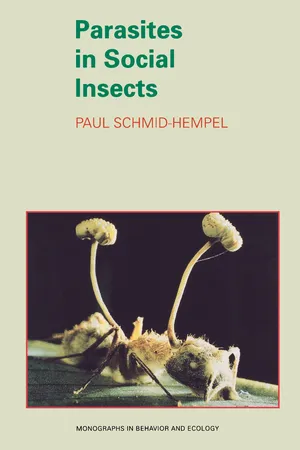 eBook - PDF
- Paul Schmid-Hempel(Author)
- 2019(Publication Date)
- Princeton University Press(Publisher)
A rather enigmatic parasite, most likely a fungus, is Myrmicinosporidium durum, which has a wide range of hosts in the Northern Hemisphere (Sanchez-Pena et al. 1993; appendix 2.3). Infected ants live even longer than noninfected ones but they become darker brown due to the accumulation of fungal spores. Otherwise, their behav-ior seems not affected. Sanchez-Pena et al. ( 1993) note that effects are more typ-ical of chronic infections by protozoa rather than of the usually virulent fungi. So far, nothing is know about its life cycle and transmission. 2.4 Protozoa Protozoans are a rather diverse group of microorganisms. According to Brusca and Brusca (1990), they are grouped into the phyla Sarcomastigophora (com-prising the Mastigophora=Flagellata, Sarcodina, Opalinata), Labyrinthomor-pha, Ciliophora (lnfusioria), and the former Sporozoa that have now been split T H E P A R A S I T E S A N D T H E I R B I 0 L 0 G Y • 45 into Apicomplexa, Microspora, Ascetospora, and Myxozoa. The classification used by other authors is not always in line with this scheme. Lipa (in Steinhaus 1963) estimated that some 1200 species of protozoa are associated with insects in general. Normally, protozoa infect insect hosts via the alimentary tract, rarely directly through the integument. Some groups remain in the gut lumen and attach them-selves to the gut wall, e.g., many ciliates, flagellates, and gregarines. Others penetrate into the hemocoel and remain there in the hemolymph or within cells of various organs and tissues, e.g., many Apicomplexa and Microsporidia. Mi-crosporidia readily cause pathogenic effects. Some protozoa exhibit tissue tro-pisms, i.e., they only infect certain types of cells but not others (Tanada and Kaya 1993). In addition to these direct infection routes, protozoa can also be transmitted transovarially to offspring. This is mainly found in the Microspori-dia, e.g., by Nosema kingi in Drosophila (Armstrong 1976). eBook - PDF
Modern Parasitology
A Textbook of Parasitology
- F. E. G. Cox(Author)
- 2009(Publication Date)
- Wiley-Blackwell(Publisher)
Parasitic 22 CHAPTER 1 Fig. 1.16 Balantidium ro/i from in vi/TO culture, Drnwn from a hacmatoxylin sUined slide. ciliates occur in most groups of venebrates and invertebrates and those in amphibians and earth- worms are frequently encountered in elementary biology classes. Few of the parasitic ciliates are of any economic importance. 1.1 1.1 &lantidium coli Balantidium coli (Fig. L161 is a common parasite of pigs in all pans of the world and has also been recorded in rats, dogs, monkeys, apes and humans. It is difficult to know how many hu- man cases there have been but about 1000 have been recorded, mainly in the tropics. The ciliate lives in the lumen of the large intestine and may invade the gut walJ where it produces ulcers re- sembling those caused by En/amoeba histelytiea although the majority of cases 3rc asymptomatic. Transmission is by cyStS and epidemiological evi- dence suggestS that most human infections arc acquired from pigs. 1.12 PNEUMOCYSTIS The taxonomic position of Pneumocystis is un- cenain but it is almost certainly a fungus. How- ever, as it has been long regarded as a protozoan, it is included here. Pneumocystis carinH is a natural parasite occurring in the lungs of about 80% of humans in which it exists as a harmless amoeba forming cysts which are the transmission stages. In immunocompromised indiViduals para- site numbers increase until they 611 the alveolar spaces, causing pneumonia which may be fatal. Pneumocystosis is a common complication in people suffering from AIDS. REFERENCES AND FURTHER READING Bruce-Chwatt, L.I. 11985) Essential Malariology, 2nd edn. London, Heinemann. Canning, E.U. &. Lorn, I. 119861 The Microsporidia of Vulebralc,s.
Index pages curate the most relevant extracts from our library of academic textbooks. They’ve been created using an in-house natural language model (NLM), each adding context and meaning to key research topics.

