Chemistry

Composite Materials
Composite materials are made by combining two or more different materials to create a new material with enhanced properties. These materials often consist of a reinforcement material, such as fibers or particles, embedded in a matrix material. Composites are designed to exhibit specific characteristics, such as increased strength, reduced weight, or improved durability, making them valuable in various industries.
Written by Perlego with AI-assistance
Related key terms
1 of 5

10 Key excerpts on "Composite Materials"
 eBook - ePub
Biomaterials Science
An Introduction to Materials in Medicine
- Buddy D. Ratner, Allan S. Hoffman, Frederick J. Schoen, Jack E. Lemons(Authors)
- 2012(Publication Date)
- Academic Press(Publisher)
Chapter I.2.9
Composites
Claudio Migliaresi Department of Materials Engineering and Industrial Technologies and BioTech Research Center, University of Trento, Trento, ItalyIntroduction
The word composite means “consisting of two or more distinct parts.” At the atomic level, materials such as metal alloys and polymeric materials could be called Composite Materials in that they consist of different and distinct atomic groupings. At the microstructural level (about 1 to 10 microns), a metal alloy such as a plain carbon steel containing ferrite and pearlite could be called a composite material since the ferrite and pearlite are distinctly visible constituents as observed in the optical microscope.In engineering, a composite material usually refers to a material consisting of constituents in the nano- to micro- to macrosize range, each having a distinct interface separating them. Such composites usually consist of one or more discontinuous phases embedded within a continuous phase. The discontinuous phase is usually harder and stronger than the continuous phase, and is called the reinforcement or reinforcing material , whereas the continuous phase is termed the matrix . In some cases, tough fillers, e.g., rubber particles, are combined with brittle matrices in order to produce higher toughness materials with better impact strength. In other cases, the “reinforcement” could be aimed at achieving specific functional properties, such as bioactivity in the case of biomedical composites. Many body tissues are composites, such as extracellular matrix (ECM), tendons, ligaments, skin, bone, and so on, with an additional complexity due to their hierarchical structure.The addition to a matrix of harder, stronger or tougher fillers may improve to different extents the resulting material stiffness, strength or toughness, depending on the filler type, content, and filler–matrix adhesion. Properties of composites are strongly influenced by the properties of their constituent materials, their distribution and content, and the interface and interphase interactions between them. The interface is particularly important for short fiber- or particle-reinforced composites. External applied stresses are in fact transferred from the matrix to the filler through the interface, and properties of composites with the same constituents but strong or weak interfaces can be better or worse than those of the pure matrix. eBook - ePub
- George Staab(Author)
- 1999(Publication Date)
- Butterworth-Heinemann(Publisher)
1INTRODUCTION TO Composite Materials
1.1 Historic and Introductory Comments
In the most general of terms, a composite is a material that consists of two or more constituent materials or phases. Traditional engineering materials (steel, aluminum, etc.) contain impurities that can represent different phases of the same material and fit the broad definition of a composite, but are not considered composites because the elastic modulus or strength of the impurity phase is nearly identical to that of the pure material. The definition of a composite material is flexible and can be augmented to fit specific requirements. In this text a composite material is considered to be one that contains two or more distinct constituents with significantly different macroscopic behavior and a distinct interface between each constituent (on the microscopic level). This includes the continuous fiber laminated composites of primary concern herein, as well as a variety of composites not specifically addressed.Composite Materials have been in existence for many centuries. No record exists as to when people first started using composites. Some of the earliest records of their use date back to the Egyptians, who are credited with the introduction of plywood, papier-mâché, and the use of straw in mud for strengthening bricks. Similarly, the ancient Inca and Mayan civilizations used plant fibers to strengthen bricks and pottery. Swords and armor were plated to add strength in medieval times. An example is the Samurai sword, which was produced by repeated folding and reshaping to form a multilayered composite (it is estimated that several million layers could have been used). Eskimos use moss to strengthen ice in forming igloos. Similarly, it is not uncommon to find horse hair in plaster for enhanced strength. The automotive industry introduced large-scale use of composites with the Chevrolet Corvette. All of these are examples of man-made Composite Materials. Bamboo, bone, and celery are examples of cellular composites that exist in nature. Muscle tissue is a multidirectional fibrous laminate. There are numerous other examples of both natural and man-made Composite Materials. eBook - ePub
- Ever J. Barbero(Author)
- 2017(Publication Date)
- CRC Press(Publisher)
Chapter 2Materials
Composite Materials are formed by the combination of two or more materials to achieve properties (physical, chemical, etc.) that are superior to those of its constituents. The main components of Composite Materials, or composites, are fibers and matrix. The fibers provide most of the stiffness and strength. The matrix binds the fibers together thus providing load transfer between fibers and between the composite and the external loads and supports. Also, it protects the fibers from environmental attack. Other substances are used to improve specific properties. For example, fillers are used to reduce the cost and improve processability and dimensional stability [50 ].The design of a structural component using composites involves simultaneous material and structural design. Unlike conventional materials (e.g., steel), the properties of the composite material can be designed simultaneously with the structural aspects. Composite properties (e.g., stiffness, thermal expansion, etc.) can be varied continuously over a broad range of values, under the control of the designer. The objective of this chapter is to describe the constituents used in the fabrication of the composite material. The capabilities and limitations of various processing techniques used to fabricate the material and the parts are presented in Chapter 3 .A brief review of the most common types of materials used in the fabrication of composites is presented in this chapter, with emphasis on properties, advantages, disadvantages, and cost. No attempt is made to explain how fibers and polymers are produced; excellent material science books and handbooks cover that subject [51 –53 ]. Comprehensive lists of material suppliers can be found in specialized publications [54 ,55 ], trade associations [56 ,57 ], or the World Wide Web. Another important aspect of design and fabrication is to have standard test methods to verify the material properties used in design [58 eBook - ePub
- George Staab(Author)
- 2015(Publication Date)
- Butterworth-Heinemann(Publisher)
1Introduction to Composite Materials
Abstract
This chapter contains a brief summary of the history of Composite Materials including the relative importance of four classes of materials (metals, polymers, ceramics, and composites) from 10,000 BC through 2200. A general description of the characteristics of composites as they pertain to isotropic, anisotropic, and orthotropic materials is presented along with various composite material classifications. The terminology associated with laminated Composite Materials analysis as well as a brief discussion of the advantages of using composites is presented along with representative examples of tensile strength and elastic modulus for selected fibers. The chapter concludes with a presentation of selected manufacturing techniques applicable to Composite Materials.Keywords Fibrous Particulate Lamina Laminate Reinforcements Fibers Matrix Hybrid Micromechanics Macromechanics Isotropic Orthotropic Anisotropic1.1 Historic and introductory comments
In the most general of terms, a composite is a material which consists of two or more constituent materials or phases. Traditional engineering materials (steel, aluminum, etc.) contain impurities which can represent different phases of the same material and fit the broad definition of a composite, but are not considered composites because the elastic modulus or strength of each phase are nearly identical. The definition of a composite material is flexible and can be augmented to fit specific requirements. In this text, a composite material is considered to be the one which contains two or more distinct constituents with significantly different macroscopic behavior and a distinct interface between each constituent (on the microscopic level). This includes the continuous fiber-laminated composites of primary concern herein, as well as a variety of composites not specifically addressed.Composite Materials have been in existence for many centuries. No record exists as to when people first started using composites. Some of the earliest records of their use date back to the Egyptians, who are credited with the introduction of plywood, paper mache, and the use of straw in mud for strengthening bricks. Similarly, the ancient Inca and Mayan civilizations used plant fibers to strengthen bricks and pottery. Swords and armor were plated to add strength in medieval times. An example is the Samurai sword, which was produced by repeated folding and reshaping to form a multilayered composite (it is estimated that several million layers could have been used). Eskimos use moss to strengthen ice in forming igloos. Similarly, it is not uncommon to find horse hair in plaster for enhanced strength. The automotive industry introduced large scale use of composites with the 1953 Chevrolet Corvette. All of these are examples of man-made Composite Materials. Bamboo, bone, and celery are examples of cellular composites which exist in nature. Muscle tissue is a multidirectional fibrous laminate. There are numerous other examples of both natural and man-made Composite Materials. eBook - ePub
Fabrication and Machining of Advanced Materials and Composites
Opportunities and Challenges
- Subhash Singh, Dinesh Kumar, Subhash Singh, Dinesh Kumar(Authors)
- 2022(Publication Date)
- CRC Press(Publisher)
Chapter 1 Introduction, History, and Origin of Composite Materials Subhash Singh Department of Mechanical and Automation Engineering, Indira Gandhi Delhi Technical University for Women, New Delhi, India Mohammad Uddin Department of Mechanical Engineering, South University of Australia Chander Prakash School of Mechanical Engineering, Lovely Professional University, Phagwara, IndiaDOI: 10.1201/9781003327370-1CONTENTS- 1.1 Introduction to Composites
- 1.2 Applications of Composites
- 1.2.1 Aircrafts and Aerospace
- 1.2.2 Automotive and Transportation
- 1.2.3 Marine
- 1.2.4 Construction and Infrastructure
- 1.2.5 Corrosive Environments
- 1.2.6 Energy
- 1.2.7 Electricals and Electronics
- 1.2.8 Sports/Recreational Applications
- 1.3 Historical Evolution of the Composites
- 1.4 Conclusions
- References
1.1 Introduction to CompositesComposites are material systems with multiple phases produced by combining diverse materials in an attempt to achieve those superior characteristics as well as performance which cannot be achieved by the individual constituting components [1 ]. Unlike in alloys, the obtained phases within a composite aren’t due to phase transformations, natural reactions, or any alternative phenomena. An alloy is always a homogeneous mixture in which the components added don’t retain their original characteristics and are generated by natural processes. This isn’t the case within a composite because the added constituents restore their original characteristics and also the composite needn’t always be homogenous [2 ]. That's the basic difference between an alloy and a composite. When observed at a macroscopic scale, among the various phases, a composite would generally comprise of a continuous, weaker phase, termed “the matrix” and a much stronger, stiffer phase termed “reinforcement.” But in certain situations, due to the effects of processing and chemical reactions, between the phases there would be another distinct phase termed “interphase” present among the matrix as well as the reinforcements [3 ]. Finally, a composite is formed with stacked layers of reinforcement fibers as well as a matrix with required characteristics in a particular direction or in multi-directions. Fig. 1.1 No longer available |Learn more
- (Author)
- 2014(Publication Date)
- Learning Press(Publisher)
____________________ WORLD TECHNOLOGIES ____________________ Chapter- 5 Composite Materials and Biomaterials Composite Materials A cloth of woven carbon fiber filaments, a common element in Composite Materials Composite Materials , often shortened to composites , are engineered or naturally occurring materials made from two or more constituent materials with significantly different physical or chemical properties which remain separate and distinct at the macroscopic or microscopic scale within the finished structure. ____________________ WORLD TECHNOLOGIES ____________________ The most visible applications is pavement in roadways in the form of either steel and aggregate reinforced Portland cement or asphalt concrete. Those composites closest to our personal hygiene form our shower stalls and bathtubs made of fibreglass. Imitation granite and cultured marble sinks and countertops are widely used. The most advanced examples perform routinely on spacecraft in demanding environments. Composition Plywood is a commonly encountered composite material Wood is a natural composite of Cellulose fibers in a matrix of lignin. The earliest man-made Composite Materials were straw and mud combined to form bricks for building construction. The ancient brick-making process can still be seen on Egyptian tomb paintings in the Metropolitan Museum of Art. Composites are made up of individual materials referred to as constituent materials. There are two categories of constituent materials: matrix and reinforcement. At least one portion of each type is required. The matrix material surrounds and supports the reinforcement materials by maintaining their relative positions. The reinforcements impart their special mechanical and physical properties to enhance the matrix properties. A synergism produces material properties unavailable from the individual constituent
- F L Matthews, G A O Davies, D Hitchings, C Soutis(Authors)
- 2000(Publication Date)
- Woodhead Publishing(Publisher)
Also some features of composite construction, such as filament winding, cannot easily be represented (if at all) by some FE packages. Following a review of com-posites and the FE method, the application of the method to composites is discussed in detail. The particular issues are then illustrated via a number of examples taken from particular situations. Overview 5 2 Fundamentals of composites 2.1 Basic characteristics 2.1.1 Definitions and classification A composite is a mixture of two or more distinct constituents or phases. In addition three other criteria are normally satisfied before we call a ma-terial a composite. Firstly, both constituents have to be present in reason-able proportions. Secondly, the constituent phases should have distinctly different properties, such that the composite’s properties are noticeably different from the properties of the constituents. Lastly, a synthetic composite is usually produced by deliberately mixing and combining the constituents by various means. We know that composites have two (or more) chemically distinct phases on a microscopic scale, separated by a distinct interface, and it is important to be able to specify these constituents. The constituent that is continuous and is often, but not always, present in the greater quantity in the compo-site is termed the matrix. The normal view is that it is the properties of the matrix that are improved upon when incorporating another constituent to produce a composite. A composite may have a ceramic, metallic or poly-meric matrix. The mechanical properties of these three classes of material differ considerably. As a generalisation, polymers have low strengths and Young’s moduli, ceramics are strong, stiff and brittle, and metals have inter-mediate strengths and moduli, together with good ductilities, i.e. they are not brittle. Because of their economic importance, the emphasis in this text will be on polymer matrix composites (PMCs).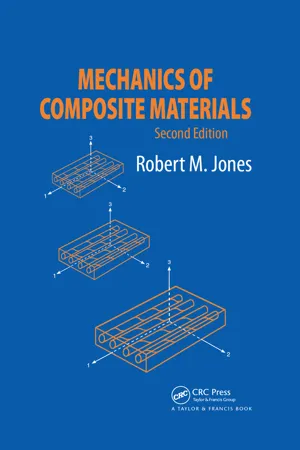 eBook - ePub
- Robert M. Jones(Author)
- 2018(Publication Date)
- CRC Press(Publisher)
composite material signifies that two or more materials are combined on a macroscopic scale to form a useful third material. The key is the macroscopic examination of a material wherein the components can be identified by the naked eye. Different materials can be combined on a microscopic scale, such as in alloying of metals, but the resulting material is, for all practical purposes, macroscopically homogeneous, i.e., the components cannot be distinguished by the naked eye and essentially act together. The advantage of Composite Materials is that, if well designed, they usually exhibit the best qualities of their components or constituents and often some qualities that neither constituent possesses. Some of the properties that can be improved by forming a composite material are• strength • stiffness • corrosion resistance • wear resistance • attractiveness • weight • fatigue life • temperature-dependent behavior • thermal insulation • thermal conductivity • acoustical insulationNaturally, not all of these properties are improved at the same time nor is there usually any requirement to do so. In fact, some of the properties are in conflict with one another, e.g., thermal insulation versus thermal conductivity. The objective is merely to create a material that has only the characteristics needed to perform the design task.Composite Materials have a long history of usage. Their precise beginnings are unknown, but all recorded history contains references to some form of composite material. For example, straw was used by the Israelites to strengthen mud bricks. Plywood was used by the ancient Egyptians when they realized that wood could be rearranged to achieve superior strength and resistance to thermal expansion as well as to swelling caused by the absorption of moisture. Medieval swords and armor were constructed with layers of different metals. More recently, fiber-reinforced, resin-matrix Composite Materials that have high strength-to-weight and stiffness-to-weight ratios have become important in weight-sensitive applications such as aircraft and space vehicles. eBook - ePub
Composite Materials
Properties, Characterisation, and Applications
- Amit Sachdeva, Pramod Kumar Singh, Hee Woo Rhee, Amit Sachdeva, Pramod Kumar Singh, Hee Woo Rhee(Authors)
- 2021(Publication Date)
- CRC Press(Publisher)
3 Properties of Composite Materials Arvind Kumar Chauhan, Amarjeet Singh, Deepak Kumar and Kuldeep MishraContents
3.1Introduction 3.2Properties of Polymer-Matrix Composites 3.2.1Electrical Properties of Polymer Composites 3.2.2Mechanical Properties of Polymer Composites 3.3Properties of Ceramic-Matrix Composites 3.3.1Electrical Properties of Ceramic-Matrix Composites 3.3.2Mechanical Properties of Ceramic-Matrix Composites 3.4Properties of Metal-Matrix Composites 3.5Properties of Composite Materials used in Energy Storage/Conversion Devices 3.6Conclusions References3.1Introduction
Composite Materials have a macroscopic structure containing two or more non-soluble materials. One old and well-known example of a composite material is mud brick, which is prepared by fire-drying mud. It has good compressive strength but poor tensile strength. Strong fibrous straw can be a good reinforcing material to be added to mud to make excellent building blocks. The straw is used to bind clay and concrete to form an admirable building material called cob. The most appropriate properties of Composite Materials are:- High stiffness and strength across a wide temperature range
- High Young’s modulus
- Highly resistive to corrosion/oxidation
- Low density and light weight
- High thermal and electrical conductivity
- High wear resistance.
Concrete, a mixture of small stones, cement, and sand, has good compressive strength. Its tensile strength is enhanced by adding metal rods or wires, when it is called reinforced concrete or reinforced cement concrete (Figure 3.1a eBook - ePub
- Flake C Campbell Jr(Author)
- 2003(Publication Date)
- Elsevier Science(Publisher)
Chapter 1 Introduction to Composite Materials and Processes: Unique Materials that Require Unique ProcessesA composite material can be defined as a combination of two or more materials that results in better properties than when the individual components are used alone. As opposed to metal alloys, each material retains its separate chemical, physical and mechanical properties. The two constituents are normally a fiber and a matrix. Typical fibers include glass, aramid and carbon, which may be continuous or discontinuous. Matrices can be polymers, metals or ceramics. This book will deal with continuous and discontinuous fibers embedded in polymer matrices, with an emphasis on continuous-fiber high-performance structural composites. Examples of continuous reinforcements include unidirectional, woven cloth and helical winding, while discontinuous reinforcements include chopped fibers and random mat (Fig. 1 ).Fig. 1 Reinforcement Options1.1 Laminates
Continuous-fiber composites are laminated materials (Fig. 2 ) in which the individual layers, plies or laminae are oriented in directions that enhance the strength in the primary load direction. Unidirectional (0°) laminates are extremely strong and stiff in the 0° direction; however, they are also very weak in the 90° direction because the load must be carried by the much weaker polymeric matrix. While a high-strength fiber can have a tensile strength of 500 ksi or more, a typical polymeric matrix normally has a tensile strength of only 5–10 ksi (Fig. 3 ). The longitudinal tension and compression loads are carried by the fibers, while the matrix distributes the loads between the fibers in tension and stabilizes and prevents the fibers from buckling in compression. The matrix is also the primary load carrier for interlaminar shear (i.e., shear between the layers) and transverse (90°) tension. The relative roles of the fiber and the matrix in determining the mechanical properties are summarized in Table 1 .Fig. 2
Index pages curate the most relevant extracts from our library of academic textbooks. They’ve been created using an in-house natural language model (NLM), each adding context and meaning to key research topics.

