Chemistry

Synthesis of Alkanes
The synthesis of alkanes involves the creation of saturated hydrocarbons with single bonds between carbon atoms. This can be achieved through several methods, including hydrogenation of alkenes, reduction of alkyl halides, and decarboxylation of carboxylic acids. These processes are important in organic chemistry for the production of various alkanes with specific properties and applications.
Written by Perlego with AI-assistance
11 Key excerpts on "Synthesis of Alkanes"
 No longer available |Learn more
- (Author)
- 2014(Publication Date)
- Research World(Publisher)
Alkanes are separated in an oil refinery by fractional distillation and processed into many different products. Fischer-Tropsch The Fischer-Tropsch process is a method to synthesize liquid hydrocarbons, including alkanes, from carbon monoxide and hydrogen. This method is used to produce substitutes for petroleum distillates. Laboratory preparation There is usually little need for alkanes to be synthesized in the laboratory, since they are usually commercially available. Also, alkanes are generally non-reactive chemically or biologically, and do not undergo functional group interconversions cleanly. When alkanes are produced in the laboratory, it is often a side-product of a reaction. For ________________________ WORLD TECHNOLOGIES ________________________ example, the use of n -butyllithium as a strong base gives the conjugate acid, n-butane as a side-product: C 4 H 9 Li + H 2 O → C 4 H 10 + LiOH However, at times it may be desirable to make a portion of a molecule into an alkane like functionality (alkyl group) using the above or similar methods. For example, an ethyl group is an alkyl group; when this is attached to a hydroxy group, it gives ethanol, which is not an alkane. To do so, the best-known methods are hydrogenation of alkenes: RCH=CH 2 + H 2 → RCH 2 CH 3 (R = alkyl) Alkanes or alkyl groups can also be prepared directly from alkyl halides in the Corey-House-Posner-Whitesides reaction. The Barton-McCombie deoxygenation removes hydroxyl groups from alcohols e.g. and the Clemmensen reduction removes carbonyl groups from aldehydes and ketones to form alkanes or alkyl-substituted compounds e.g.: Applications The applications of a certain alkane can be determined quite well according to the number of carbon atoms. The first four alkanes are used mainly for heating and cooking purposes, and in some countries for electricity generation. Methane and ethane are the main components of natural gas; they are normally stored as gases under pressure. No longer available |Learn more
- (Author)
- 2014(Publication Date)
- Academic Studio(Publisher)
Alka-nes are separated in an oil refinery by fractional distillation and processed into many different products. Fischer-Tropsch The Fischer-Tropsch process is a method to synthesize liquid hydrocarbons, including alkanes, from carbon monoxide and hydrogen. This method is used to produce substitutes for petroleum distillates. Laboratory preparation There is usually little need for alkanes to be synthesized in the laboratory, since they are usually commercially available. Also, alkanes are generally non-reactive chemically or biologically, and do not undergo functional group interconversions cleanly. When alka-nes are produced in the laboratory, it is often a side-product of a reaction. For example, ________________________ WORLD TECHNOLOGIES ________________________ the use of n -butyllithium as a strong base gives the conjugate acid, n-butane as a side-product: C 4 H 9 Li + H 2 O → C 4 H 10 + LiOH However, at times it may be desirable to make a portion of a molecule into an alkane like functionality (alkyl group) using the above or similar methods. For example, an ethyl group is an alkyl group; when this is attached to a hydroxy group, it gives ethanol, which is not an alkane. To do so, the best-known methods are hydrogenation of alkenes: RCH=CH 2 + H 2 → RCH 2 CH 3 (R = alkyl) Alkanes or alkyl groups can also be prepared directly from alkyl halides in the Corey-House-Posner-Whitesides reaction. The Barton-McCombie deoxygenation removes hydroxyl groups from alcohols e.g. and the Clemmensen reduction removes carbonyl groups from aldehydes and ketones to form alkanes or alkyl-substituted compounds e.g.: Applications The applications of a certain alkane can be determined quite well according to the num-ber of carbon atoms. The first four alkanes are used mainly for heating and cooking purposes, and in some countries for electricity generation. Methane and ethane are the main components of natural gas; they are normally stored as gases under pressure. No longer available |Learn more
- (Author)
- 2014(Publication Date)
- Academic Studio(Publisher)
Fischer-Tropsch The Fischer-Tropsch process is a method to synthesize liquid hydrocarbons, including alkanes, from carbon monoxide and hydrogen. This method is used to produce substitutes for petroleum distillates. Laboratory preparation There is usually little need for alkanes to be synthesized in the laboratory, since they are usually commercially available. Also, alkanes are generally non-reactive chemically or biologically, and do not undergo functional group interconversions cleanly. When alkanes are produced in the laboratory, it is often a side-product of a reaction. For ________________________ WORLD TECHNOLOGIES ________________________ example, the use of n -butyllithium as a strong base gives the conjugate acid, n-butane as a side-product: C 4 H 9 Li + H 2 O → C 4 H 10 + LiOH However, at times it may be desirable to make a portion of a molecule into an alkane like functionality (alkyl group) using the above or similar methods. For example, an ethyl group is an alkyl group; when this is attached to a hydroxy group, it gives ethanol, which is not an alkane. To do so, the best-known methods are hydrogenation of alkenes: RCH=CH 2 + H 2 → RCH 2 CH 3 (R = alkyl) Alkanes or alkyl groups can also be prepared directly from alkyl halides in the Corey-House-Posner-Whitesides reaction. The Barton-McCombie deoxygenation removes hydroxyl groups from alcohols e.g. and the Clemmensen reduction removes carbonyl groups from aldehydes and ketones to form alkanes or alkyl-substituted compounds e.g.: Applications The applications of a certain alkane can be determined quite well according to the number of carbon atoms. The first four alkanes are used mainly for heating and cooking purposes, and in some countries for electricity generation. Methane and ethane are the main components of natural gas; they are normally stored as gases under pressure. It is, however, easier to transport them as liquids: This requires both compression and cooling of the gas. eBook - PDF
Chemistry
Structure and Dynamics
- James N. Spencer, George M. Bodner, Lyman H. Rickard(Authors)
- 2011(Publication Date)
- Wiley(Publisher)
(They tend to remain oily liquids when cooled.) These compounds are now called alkenes. The connection between alkanes and alkenes can be understood by think- ing about a hypothetical reaction in which we break a C¬H on both carbon atoms in ethane so that one of the electrons in these bonds ends up on each atom. We then bring the hydrogen atoms together to form an H 2 molecule and allow the electrons on the two carbon atoms to interact to form a double bond between these atoms. Although this hypothetical reaction does not occur, the opposite reaction is easy to achieve. In the presence of a suitable catalyst, such as platinum metal, we can transform an alkene into the parent alkane. The generic formula for an alkene with one double bond is C n H 2n . Alkenes are examples of unsaturated hydrocarbons because they have fewer hydrogen atoms than the corresponding alkanes. They were once named by adding the suffix -ene to the name of the substituent that carried the same num- ber of carbon atoms. The IUPAC nomenclature for alkenes names these compounds as derivatives of the parent alkanes. The presence of the C“C double bond is indicated by chang- ing the -ane ending on the name of the parent alkane to -ene. CH 3 OCH 2 OCH 3 Propane CH 3 OCH 3 Ethane CH 2 PCHOCH 3 Propene CH 2 PCH 2 Ethene CH 2 PCHOCH 3 Propylene H 2 CPCH 2 Ethylene C“C H 2 Pt + HOCOCOH H H H H A A A A H H H H HOCOCOH H H H H A A A A HOCOCOH H H A A HOH H T T T H T H H H H 16.5 THE UNSATURATED HYDROCARBONS: ALKENES AND ALKYNES 733 The location of the double bond in the skeleton structure of the compound is indicated by specifying the number of the carbon atom at which the C“C bond starts. The names of substituents are then added as prefixes to the name of the alkene. 1-Butene CH 2 PCHOCH 2 OCH 3 2-Butene CH 3 OCHPCHOCH 3 C“C 734 CHAPTER 16 / ORGANIC CHEMISTRY E x e r c i s e 1 6 . eBook - ePub
- Harold A. Wittcoff, Bryan G. Reuben, Jeffery S. Plotkin(Authors)
- 2012(Publication Date)
- Wiley(Publisher)
Chapter 13 Chemicals from AlkanesAlkanes occur as such in natural gas and petroleum, and accordingly are the cheapest raw materials for chemicals. They are the feedstocks for cracking (Sections 4.5 and 4.6) and catalytic reforming (Section 4.8). Methane is the main source for synthesis gas (Section 12.4.1) via steam reforming. The higher alkanes can be subjected to the same process if desired, or the steam reforming process can be redirected to give methane. An important process is pyrolysis of hydrocarbons to carbon black, which is discussed at the end of this chapter.Apart from pyrolysis, these reactions are endothermic and accompanied by an increase of entropy. They are all unselective and take place at high temperatures. There are few long-established examples of alkane functionalization, that is, of the use of alkanes directly for downstream chemicals. The most important are the conversion of n -butane to maleic anhydride (Section 7.4.2), the oxidation of n -butane or naphtha to acetic acid (Section 12.5.2.2), the oxidation of isobutane to t -butylhydroperoxide (Section 6.8), the oxidation of ethylbenzene to ethylbenzene hydroperoxide (Section 6.8), and the chlorination of methane (Section 12.2). Lesser volume uses involve ammoxidation of methane to hydrocyanic acid (Section 12.1), conversion of methane to acetylene (Section 12.3), and nitration of propane. These have largely been discussed.Any alkane may be nitrated. In practice only propane is used as feed, and from its nitration result nitromethane, nitroethane, and 1- and 2-nitropropane. The nitration takes place at 420°C, and the products are separated by distillation. They are used as additives for gasoline for racing cars, as solvents especially for polycyanoacrylates, and as stabilizers of chlorinated solvents. DuPont developed a process for the nitration of cyclohexane to nitrocyclohexane as a step in a caprolactam synthesis (Section 9.2.2) but it is not currently used.
- Morris Hein, Scott Pattison, Susan Arena, Leo R. Best(Authors)
- 2014(Publication Date)
- Wiley(Publisher)
The fossil fuels provide a rich resource of hydrocarbons for human society. In the past, these resources have been used primarily as a source of heat (via combustion). We now see that extensive combustion can have severe environmental consequences (e.g., air pollution and global warming). Fossil fuels also serve as the raw materials for much of today’s chemical industry. One theme that runs through the study of organic chemistry is the synthetic relationship between com- pounds; for example, acids are often formed from alcohols. Fossil fuels are the starting materials for many of these synthetic sequences. And, in the long run, the fossil fuels may well prove to be more valuable to us as a source of organic chemicals than as a source of heat. 19.5 SATURATED HYDROCARBONS: ALKANES Carefully define and describe alkane and learn the names and formulas for the first ten alkanes. The alkanes, also known as paraffins or saturated hydrocarbons, are open- or branched-chain hydrocarbons with only single covalent bonds between the carbon atoms. We will study the alkanes in some detail because many other classes of organic compounds can be considered as derivatives of these substances. For example, it is necessary to learn the names of the first 10 members of the alkane series because these names are used as a basis for naming other classes of compounds. Methane, CH 4 , is the first member of the alkane series. Alkanes with two-, three-, and four-carbon atoms are ethane, propane, and butane, respectively. The names of the first four alkanes are of common or trivial origin and must be memorized, but the names beginning with the fifth member, pentane, are derived from Greek numbers and are relatively easy to recall. The names and formulas of the first 10 members of the series are given in Table 19.4.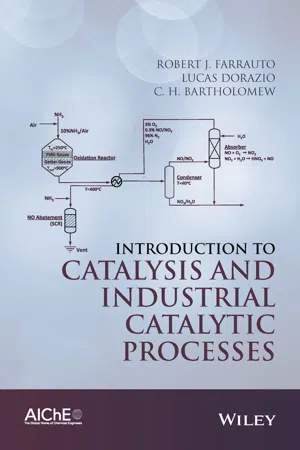
- Robert J. Farrauto, Lucas Dorazio, C. H. Bartholomew(Authors)
- 2020(Publication Date)
- Wiley-AIChE(Publisher)
CHAPTER 9HYDROGENATION, DEHYDROGENATION, AND ALKYLATION9.1 INTRODUCTION
Selective catalytic hydrogenation of functional groups contained in organic molecules is one of the most useful, versatile, and environment-acceptable reaction routes available for organic synthesis. This important area of catalytic chemistry has been and continues to be the foundation for the development of numerous, diverse, largeand small-scale commercial hydrogenation processes, including (i) fine chemicals, (ii) intermediates for the pharmaceutical industry, (iii) monomers for the production of various polymers, and (iv) fats and oils for edible and nonedible products.Dehydrogenation reactions find a wide application in production of hydrogen, alkenes, polymers, and oxygenates. In recent years, the demand for light alkenes has grown dramatically due to increased demand for polypropylene, acrylonitrile, oxo alcohols, and propylene oxide. As a result, dehydrogenation of lower alkanes to alkenes is a rapidly expanding business.Alkylation allows smaller molecules to be coupled to for larger molecules mostly for petroleum applications.9.2 HYDROGENATION
9.2.1 Hydrogenation in Stirred Tank Reactors
With exception of a few continuous hydrogenation processes in petroleum refining, hydrogenation processes are often conducted in stirred tank reactors. This chapter focuses on hydrogenation occurring within stirred tank reactors, which are ideally suited and extensively used for liquid-phase hydrogenation reaction. For reactions where the hydrocarbon to be hydrogenated is in the liquid phase, stirred tank reactors are ideal. For hydrogenation, stirred tank reactors can be designed in two configurations, semibatch and continuous, which are illustrated in Figure 9.1 eBook - PDF
- H. Stephen Stoker(Author)
- 2015(Publication Date)
- Cengage Learning EMEA(Publisher)
Cycloalkane nomenclature. The IUPAC name for a cycloalkane is obtained by placing the prefix cyclo - before the alkane name that corresponds to the number of carbon atoms in the ring. Alkyl groups attached to the ring are located by using a ring-numbering system (Section 1-13). Cis–trans isomerism. For certain disubstituted cycloalkanes, cis–trans isomers exist. Cis–trans isomers are compounds that have the same molecular and structural formulas but different arrangements of atoms in space because of restricted rotation about bonds (Section 1-14). Natural sources of saturated hydrocarbons. Natural gas and petroleum are the largest and most important natural sources of both alkanes and cycloalkanes (Section 1-15). Physical properties of saturated hydrocarbons. Saturated hydrocarbons are not soluble in water and have lower densities than water. Melting and boiling points increase with increasing carbon chain length or ring size (Section 1-16). Chemical properties of saturated hydrocarbons. Two important reactions that saturated hydrocarbons undergo are combustion and halogenation. In combustion, saturated hydrocarbons burn in air to produce CO 2 and H 2 O. Halogenation is a substitution reaction in which one or more hydrogen atoms of the hydrocar-bon are replaced by halogen atoms (Section 1-17). Halogenated alkanes. Halogenated alkanes are hydrocarbon derivatives in which one or more halogen atoms have replaced hydrogen atoms of the alkane (Section 1-18). Halogenated alkane nomenclature. Halogenated alkanes are named by using the rules that apply to branched-chain alkanes, with halogen substituents being treated the same as alkyl groups (Section 1-18). Concepts to Remember Exercises and problems are arranged in matched pairs with the two members of a pair addressing the same concept(s). The answer to the odd-numbered member of a pair is given at the back of the book. eBook - ePub
Introductory Organic Chemistry and Hydrocarbons
A Physical Chemistry Approach
- Caio Lima Firme(Author)
- 2019(Publication Date)
- CRC Press(Publisher)
Chapter FourteenAlkanes (nomenclature, properties, and reactions)
HYDROCARBONS
Hydrocarbons are a class of organic compounds containing only carbon and hydrogen atoms. There are four main types of hydrocarbons: alkanes, alkenes, alkynes (aliphatic compounds), and aromatic compounds, besides alkadienes and polyenes. Aliphatic compounds (non-aromatic hydrocarbons) can be open-chain compounds (acyclic) or closed-chain compounds (cyclic). Alkanes just have single C-C bonds. Alkenes just have one double C=C bond (and all other single C-C bonds for alkenes higher than ethane). Alkynes just have one triple C≡C bond (and all other single C-C bonds for alkynes higher than ethyne). Alkadienes have two double C=C bonds. Polyenes have more than two double C=C bonds. The simplest alkane is methane. The simplest alkene is ethene. The simplest alkyne is ethyne. The iconic aromatic compound is benzene. The simplest alkadiene is butadiene. The simplest polyene is hexatriene. See Fig. 14.1 for their representations.Figure 14.1 Representation of simplest or iconic hydrocarbons.ALKANES
The general formula of alkanes is CnH2n+2. Besides being the simplest alkane, methane is also the most abundant. It is present in the atmosphere, in the oceans (e.g., in methane clathrate – methane trapped in solid, crystal water) and in the Earth’s crust. Ethane and propane are the second and third simplest alkanes and they made up the natural gas along with methane (in largest amount) and butane. All of these compounds are important fossil fuels, along with gasoline, diesel, and kerosene. Alkanes can also be used as solvents, lubricating oil, paraffin wax, and asphalt. Natural gas is obtained from Earth’s crust reservoir and higher alkanes are obtained from petroleum crude oil after its refining process. In the first and main unit of the petroleum refining process, there is a huge distillation tower where the separation of main alkanes takes place. See Table 14.1 eBook - ePub
- James G. Speight(Author)
- 2010(Publication Date)
- Gulf Professional Publishing(Publisher)
Alkanes can have straight or branched chains, but without any ring structure. 2. Alkenes (olefins) are unsaturated hydrocarbons insofar as not all of the carbon valencies are satisfied by another atom and have a double bond (C=C) between carbon atoms. Alkenes have the general formula C n H 2 n, assuming no ring structures in the molecule. Alkenes may have more than one double bond between carbon atoms, in which case the formula is reduced by two hydrogen atoms for each additional double bond. For example, an alkene with two double bonds in the molecule has the general formula C n H 2 n – 2. Because of their reactivity and the time involved in crude oil maturation, alkenes do not usually occur in petroleum. 3. Alkynes (acetylenes) are hydrocarbons which contain a triple bond (C≡C) and have the general formula C n H 2 n – 2. Acetylene hydrocarbons are highly reactive and, as a consequence, are very rare in crude oil. 4. Cycloalkanes (naphthenes) are saturated hydrocarbons containing one or more rings, each of which may have one or more paraffinic side chains (more correctly known as alicyclic hydrocarbons). The general formula for a saturated hydrocarbon containing one ring is C n H 2 n. 5. Aromatic hydrocarbons (arenes) are hydrocarbons containing one or more aromatic nuclei, such as benzene, naphthalene, and phenanthrene ring systems, which may be linked up with (substituted) naphthene rings and/or paraffinic side chains. 5.1. Bonding in hydrocarbons Since carbon adopts the tetrahedral geometry when there are four σ bonds, only two bonds can occupy a plane simultaneously. The other two bonds are directed to the rear or to the front of the plane eBook - ePub
- George A. Olah, Arpad Molnar, G. K. Surya Prakash(Authors)
- 2017(Publication Date)
- Wiley(Publisher)
The combustion of hydrocarbons for energy generation or in propulsion systems is itself a radical chain process. Thermal cracking, oxygenation, hydrogenation–dehydrogenation, cyclization, and so on proceed through free radicals. In the discussion of the transformation of hydrocarbons, the reaction chemistry as well as relevant mechanistic aspects will be treated throughout the book.Free-radical reactions play an important role not only in high-temperature refining and processing operations (cracking, reforming, hydrocracking, dehydrogenation, etc.) but also in oxidation chemistry (Chapter 9) and in many addition and substitution reactions (Chapters 6, 10, and 11) as well as in polymerization (Chapter 13). The high-pressure polymerization of ethylene, for example, played a key role in the development of the plastic industry.1.8.2 Heterolytic (Ionic) Reactions
In electrophilic acid-catalyzed reactions of unsaturated hydrocarbons (alkenes, alkynes, arenes) positive hydrocarbon ions—carbocations—are formed, which are then responsible for the electrophilic transformations134 [Eqs. (1.24 )–(1.26 )].(1.24)(1.25)(1.26)The carbocations involved in these reactions are trivalent carbenium ions, of which CH3 + is parent. It was Whitmore in the 1930s, who first generalized their importance in hydrocarbon transformations based on fundamental studies by Meerwein, Ingold, Pines, Schmerling, Nenitzescu, Bartlett, and others.Subsequently, it was realized that hydrocarbon ions (carbocations) also encompass five (or higher) coordinate carbonium ions for which CH5 + is parent.135 Alkanes having only saturated C–H and C–C bonds were found to be protonated by very strong acids, specifically, superacids, which are billions or even trillions of times stronger than concentrated sulfuric acid.54Protolytic reactions of saturated hydrocarbons in superacid media54 were interpreted by Olah as proceeding through the protonation (protolysis) of the covalent C–H and C–C single bonds. The reactivity is due to the electron donor ability of the σ bonds involving two-electron, three-center bonds. Protolysis of C–H bonds leads via five coordinate carbocations with subsequent cleavage of H2 to trivalent ions, which then themselves can further react [Eq. (1.27 )]. The reverse reaction of carbenium ions with molecular hydrogen can be considered as alkylation of H2 through the same pentacoordinate carbonium ions that are involved in C–H bond protolysis. Indeed, this reaction is responsible for the long used (but not explained) role of H2
Index pages curate the most relevant extracts from our library of academic textbooks. They’ve been created using an in-house natural language model (NLM), each adding context and meaning to key research topics.

