Economics

Bretton Woods System
The Bretton Woods System was a monetary system established in 1944, which aimed to promote international economic stability and prevent another global economic depression. It created fixed exchange rates tied to the US dollar, and established the International Monetary Fund (IMF) and the World Bank to oversee international monetary cooperation and provide financial assistance to countries in need.
Written by Perlego with AI-assistance
Related key terms
1 of 5

12 Key excerpts on "Bretton Woods System"
 eBook - ePub
- David Hudson(Author)
- 2014(Publication Date)
- Routledge(Publisher)
Eichengreen 1996 ). By abandoning the gold standard, and allowing their currencies to depreciate, countries made their exports cheaper and reduced imports – thus helping to boost their domestic economy. International investors understood this and had much less confidence in governments’ commitments to maintain the value of their currency. And because investors understood that currency instability would be the rule, capital flows became increasingly short-term and speculative. Crucially, the lessons drawn from this period of competitive devaluations and beggar thy neighbour policies formed the intellectual foundations for the multilateralism behind the Bretton Woods System.The Bretton Woods System
The Bretton Woods System ran from 1945–71, and enjoyed its heyday between 1958 and 1971 (Helleiner 2011 ). It was named after the conference held in the Mount Washington Hotel in Bretton Woods, New Hampshire, US in 1944 where the papers were signed. The Bretton Woods conference – officially called the United Nations Monetary and Financial Conference – was also significant because it was the place where the IMF and the International Bank for Reconstruction and Development (the World Bank) were born.The Bretton Woods conference was famously attended by John Maynard Keynes as the British delegate and Harry Dexter White for the US. Much of the shape of the international system that emerged was down to the intellect, conflict and compromise between these two men, the lessons that were taken from the interwar period, as well as the underlying power of the US and Britain in the international system of the time. Ultimately, the US was in a much stronger position than the British post-World War II, since Britain was in debt to the US having had to borrow to finance their war effort (Block 1977 ).The planning and design of the system was underway well before the end of the war, for example the Atlantic Charter of 1941, which was the outcome of a secret meeting between Churchill and Roosevelt on a ship in the North Atlantic. It was widely agreed at the time that the Great Depression and World War II were a result of the beggar thy neighbour policies and the economic protectionism and unilateralism of the 1930s (Nurske 1944 ; Cohen 2002 ). The US – as the newly-emerging leader – was committed to setting up a multilateral liberal order. However, while it was decided that the new international monetary system had to prevent the unilateralism, protectionism and instability of the 1930s, it also had to provide sufficient policy autonomy for governments to pursue domestic goals such as full employment and promoting social welfare as they saw fit. This compromise – between an open international and multilateral liberalism on the one hand, and a socially democratic domestic order on the other – was famously dubbed ‘embedded liberalism’ by John Ruggie (1982) eBook - PDF
Bretton Woods Agreements
Together with Scholarly Commentaries and Essential Historical Documents
- Naomi Lamoreaux, Ian Shapiro(Authors)
- 2019(Publication Date)
- Yale University Press(Publisher)
217 T he Bretton Woods System established in the 1944 agreements was a com-promise between the fixed exchange rates of the gold standard, seen as conducive to rebuilding the network of global trade and finance, and the greater flexibility to which countries had resorted in the 1930 s in the effort to restore and maintain domestic economic and financial stability. Each mem-ber would declare a par value of its currency in terms of dollars, while the United States declared the par value of the dollar as $ 35 per ounce of gold. The Articles of Agreement formally obliged member countries to ask the IMF for permission in advance before adjusting their parities, as a way of pre-venting opportunistic, beggar-thy-neighbor exchange rate changes. Adjust-ment would occur in the face of a fundamental disequilibrium that was never defined but that has later been construed to mean an imbalance requiring a change in the real exchange rate. The agreements further obliged countries to remove restrictions on the current account while permitting them to maintain controls on transactions on capital accounts (so as to limit destabilizing capital flows). Capital con-trols and the ability to adjust parities in the face of shocks gave members the flexibility to use domestic monetary and fiscal policy to alleviate business- cycle shocks, but adherence to the pegged parities limited the size of these policy actions. The IMF, based on the principle of a credit union, whereby Chapter 10 The Operation and Demise of the Bretton Woods System, 1958–1971 Michael D. Bordo 218 MICHAEL D. BORDO members could withdraw more than their original gold quotas, 1 was to pro-vide relief to members for temporary current account shortfalls. The system evolved differently than what the framers of Bretton Woods first imagined. Originally, currencies were treated as equal in the Articles. eBook - PDF
- Tomasz Grosse(Author)
- 2020(Publication Date)
- Peter Lang Group(Publisher)
Fourthly, the author is interested in the crisis management within the system and takes under consideration the manner of handling system reforms and its results. Keywords: geoeconomics, the Breton Woods, monetary system, embedded liberalism, USA, UK. Introduction Henry Morgenthau Jr., the United States Secretary of the Treasury, in the summer of 1944 (so still during World War II) invited representatives of 44 countries to a conference in Bretton Woods. It was an event which decided about the shape of international monetary (and, broadly speaking, economic) system func- tioning in the postwar world. It turned out that the Bretton Woods (BW) system, which had been planned to last indefinitely, endured only until 1971 (although it finally collapsed in 1973). All in all, it was in force for more than a quarter of a century. The assessment of this regime is a matter of controversy among scholars. Some of them believe it was the best period in terms of development Tomasz Grzegorz Grosse 304 and employment rise rate in the West, i.e. mainly in the US, Western Europe and Japan. The discussed economic regime caused stabilization of prices (viz. inflation), exchange rates and interest rates; therefore, it had a positive impact on international trade. 1 Others prove that the main cause of the high rate of eco- nomic growth at that time were US recovery plans (mainly the Marshall Plan) and investments of American enterprises abroad. 2 They had the greatest impact upon postwar reconstruction of Western Europe and Japan. 3 Simultaneously, scholars point at a series of institutional dysfunctions of this system, which were reflected in increasingly common problems appearing in particular countries. Growing dissatisfaction of all the main Western countries participating in BW finally led to the fall of this regime. eBook - ePub
- Brett Bowden, Leonard Seabrooke(Authors)
- 2006(Publication Date)
- Routledge(Publisher)
The second was the Bretton Woods regime, which most historians generally date as having existed between 1944 and the early 1970s. The Bretton Woods System is seen by many academics as the standard with which to judge all other monetary systems. It is revered largely because its system of fixed but adjustable exchange rates, administered by the International Monetary Fund (IMF), brought stability to the international monetary system after the interwar problems of confidence, liquidity, and adjustment. However, as Barry Eichengreen (1996: 7) points out, the Bretton Woods System is an aberration in the history of exchange rate regimes. It was a product of international negotiation, but, more commonly, monetary agreements have arisen ‘out of the individual choices of countries constrained by the prior decisions of their neighbors and, more generally, by the inheritance of history’.Finally, the period since 1973 has been the era of floating exchange rates. Floating rates did exist in the 1920s — before the inception of the gold exchange standard and after its demise in the 1930s — but they were a transitory affair and it is only in the last thirty years that floating rates have become widespread globally. It is true that there have been a variety of regional currency arrangements since 1973 (e.g. the European Monetary System), attempts made to fix the currency of small nations to larger states (e.g. the African Financial Community) and a recent attempt to introduce a single global currency and global central bank by 2024, but these are of second-order importance.This chapter assesses how private and public agents have imposed civility in international monetary relations over the last 150 years. It explores why the ‘market solutions’ of the Gold Standard were replaced by a belief after 1944 that national governments should work with a supra-national institution (the IMF) to bring civility to the IMS. Under the Bretton Woods framework, co-operation between members was desirable in order to stabilize exchange rates, to regulate capital flows, and to guarantee that international obligations did not override domestic policy objectives. Due to a combination of factors, the tenets of Bretton Woods were challenged by the early 1970s but the introduction of floating exchange rates in 1973 did not eBook - ePub
- Daniel R. Kane(Author)
- 2018(Publication Date)
- Routledge(Publisher)
Reconstruction of the international monetary system began even before the end of the Second World War. Draft proposals submitted by Harry Dexter White of the US Treasury and John Maynard Keynes of the UK Treasury culminated in the Bretton Woods conference of 1944 which ushered in a new era of international monetary co-operation and led to the establishment of the International Monetary Fund.These attempts to improve international monetary co-operation formally recognised that countries are financially interdependent and that there was an urgent need to harmonise national economic policies. They represented an important step towards avoiding the exchange rate chaos which had characterised the 1930s and which, through competitive devaluations and the export of unemployment, had served to spread economic instability internationally.The IMF, which was to oversee the operation of the proposed system of fixed exchange rates, was conceived as an international fund, although subsequently it came to function as a world central bank. Its major provisions, which were to provide a framework for almost 30 years of comparative economic stability, were to: (i) promote international monetary co-operation and development; (ii) facilitate the growth of international trade; (iii) promote exchange rate stability; (iv) reduce the magnitude and duration of payments imbalances.These provisions were to be effected by: (i) the establishment of par values and the maintenance of individual currencies within 1 per cent of declared par values — requirements which, in practice, evolved into the ‘gold exchange standard’;(ii) fund approval for any exchange rate realignments which cumulatively exceeded 10 per cent of declared par values but which were necessary to correct fundamental balance of payments disequilibrium;(iii) the provision of gold and convertible currencies to finance transitory or cyclical current account deficits.The immediate task facing the international community in 1945, however, was post-war reconstruction and development. The war had destroyed much of Europe’s economic fabric and had left European countries dependent on the US for imports but without the means to pay for them. Rapid European recovery, therefore, seemed unlikely without US assistance. eBook - ePub
- Anthony Endres(Author)
- 2005(Publication Date)
- Routledge(Publisher)
fixed exchange rate system. Second, no postwar system should deny contemporary conventions in international finance. Therefore gold had an undeniable role though it should emphatically not act as a limit on the production of money in any national monetary system, or as a brake on the expansion of international trade by restricting international liquidity.Bretton Woods: first principles
The Bretton Woods International Monetary Agreement in 1945 has been discussed, dissected and analysed by countless historians, economic historians and economists.7 This chapter does not intend to offer thorough retrospective accounts of the origins of the BW Agreement, of its workings in practice or of its actual performance and effectiveness. We wish to outline the Agreement as a distinctive doctrine, that is as a unified Schumpeterian political economy bound by normative principles. It is vital to view the Agreement creating what was later dubbed the BW ‘international monetary order’ (McKinnon 1996: 41–3) as a blueprint – a set of constitutional rules and guidelines for the world economy. It must not be seen as a precise guide to the actual conduct of participating nations within that order over the period from its promulgation in 1945 to its widely acknowledged demise in the early 1970s. By comparison, the actual operation of the nineteenth-century gold standard corresponded very imperfectly with the rules which academic economists formulated as a model or representation of that international financial order. As Bordo (1993: 36) maintains, the BW order's ‘architects never spelled out exactly how the system was supposed to work’. Indeed, the workings of the BW principles established in the 1944 Articles of Agreement were somewhat flexible and open-ended; they were interpreted over time in a manner not obviously consistent with the intentions of the architects.8 eBook - ePub
The Financial System Under Stress
An Architecture for the New World Economy
- Marc Uzan(Author)
- 1996(Publication Date)
- Routledge(Publisher)
2
THE INTERNATIONAL MONETARY FUND AND THE INTERNATIONAL MONETARY ORDER SINCE 1945
An historical perspective
Harold James*The general evolution of the international monetary system since the Bretton Woods Conference has been a movement away from rules and toward cooperation. Increased information has played the role previously occupied by a legal or quasi-legal framework. This development constitutes the fundamental challenge, and opportunity, faced by international financial institutions. The satisfaction of this demand for the reliable provision of information and analysis will become their principal raison d’être .THE HISTORICAL ARGUMENT
The construction of the postwar international monetary system came as a result of a general agreement that a repetition of the economic and political nationalism of the 1930s could and should be avoided. The interwar experience had provided a vivid and terrifying demonstration of how the collapse of the economic order could bring political and social fragmentation. In the new order, a commitment to keep stable but adjustable exchange rates would eliminate the temptation to engage in competitive devaluation. Controls on capital movements would eliminate the big speculative flows that had destroyed the exchange rate regime of the interwar period. The essential insight of the new vision was that harmonious interstate relations involved a willingness to agree on the surrender of some aspects of national sovereignty.The agreements produced at Bretton Woods combined a vision of a liberal world economy with a rule. The rule’s primary purpose was to constrain national economic policies in cases where otherwise the interaction of different national strategies might cause disaster for the world as a whole (in currency policy, competitive devaluations; in trade policy, the application of protectionism). Apart from this, it would preserve the policymaking options (“sovereignty”) of nation-states. At the time of Bretton Woods, a vivid memory of the 1930s saw the requirements of the international order as frequently in conflict with the imperative of building a more just and stable domestic order. The conference aimed at providing a solution to this dilemma. The main attraction of the rule was that it was impersonal and largely automatic. States were obliged under the terms of their legislation accepting Bretton Woods to maintain fixed exchange rates. The pursuit of inappropriate policy would lead to danger signals, in the form of balance of payments imbalances. A state could then either take corrective action (adjustment), if necessary with the assistance of the resource pool created in the International Monetary Fund; or, if it was judged that the imbalance reflected a fundamental disequilibrium, the exchange rate could be altered with the approval of the Fund. The commitment to keep the exchange rate fixed would by itself provide sufficient limitation of the room for national policy maneuver. A further function of the Fund was to create, through the quota mechanism, an additional pool of reserves (it functioned analogously to a credit union). The goal was to ensure that, in a period when outside the United States a general shortage of reserves existed, this limitation would not stand in the way of the movement to liberalized trade and exchange convertibility. eBook - PDF
Monetary War and Peace
London, Washington, Paris, and the Tripartite Agreement of 1936
- Max Harris(Author)
- 2021(Publication Date)
- Cambridge University Press(Publisher)
10 From Bretton Woods to Today Successful though the Tripartite Agreement was in putting an end to the monetary chaos of the early 1930s, it could not survive the demands of total war. Soon after Britain and France imposed exchange controls with the outbreak of the Second World War, it became an agreement in name only and then faded from view. Policymakers were intent, however, on avoiding a relapse to the economic conflagration of the 1930s and began planning for a postwar world early on in the conflict. These efforts culminated in the 1944 conference at Bretton Woods, where the allies established the International Monetary Fund (IMF), World Bank, and a system of fixed-but-adjustable exchange parities. Ever since, Bretton Woods has become the key landmark of international monetary cooper- ation, forming the historical backdrop for policymakers today. The Tripartite Agreement, on the other hand, is largely forgotten, product of a decade whose lessons many assume to be only in the negative. Yet the Agreement’s principles live on, embedded in so much of the postwar push for collaboration. The sentiments articulated in those five paragraphs of September 1936 – refrain from competitive depreciation, work toward exchange stability, avoid exchange control, consult and inform – reappear time and again, from the IMF’s Articles of Agreement in 1944 to G20 communiqués today. 1 In fact, the Tripartite Agreement first recognized the dual concept that countries should not sacrifice their domestic economies just to maintain their exchange rates but neither should they ignore the effect of their international monetary actions on 1 For instance, the July 2013 G20 communiqué of finance ministers and central bank governors declared, “We will refrain from competitive devaluation and will not target our exchange rates for competitive purposes. We will resist all forms of protectionism and keep our markets open” (Group of Twenty 2013). 233 eBook - PDF
- Dominick Salvatore(Author)
- 2014(Publication Date)
- Wiley(Publisher)
CHAPTER S I X T E E N The International Monetary System: Past, Present, and Future After studying this chapter, you should be able to: ■ Understand the meaning of an international monetary system ■ Understand how the gold standard worked ■ Know what the Bretton Woods System is ■ Describe how the Bretton Woods System operated ■ Understand how U.S. trade deficits contributed to the collapse of the system ■ Know how the present international monetary system works ■ Understand the causes and effects of the recent global financial crisis ■ Identify the major international economic problems facing the world today CHAPTER OUTLINE 16.1 Introduction 16.2 Meaning of International Monetary System 16.3 The Gold Standard and the Interwar Experience 16.4 The Bretton Woods System 16.5 Operation and Evolution of the Bretton Woods System Case Study 16-1 Macroeconomic Performance under Different Exchange Rate Regimes 16.6 U.S. Balance-of-Payments Deficits and Collapse of the Bretton Woods System 16.7 Operation of the Present International Monetary System 404 eBook - ePub
A New Deal for the World
America’s Vision for Human Rights
- Elizabeth Borgwardt(Author)
- 2007(Publication Date)
- Belknap Press(Publisher)
PART IIBRETTON WOODS, JULY 1944
There is a curious notion that the protection of national interests and the development of international cooperation are conflicting philosophies—that somehow or other men of different nations cannot work together without sacrificing the interests of their particular nations . . . We have found on the contrary that the only genuine safeguard for our national interests lies in international cooperation.US Treasury Secretary Henry Morgenthau, Jr., remarks at theclosing banquet of the Bretton Woods Conference Passage contains an image
CHAPTER 3
THE PERILS OF ECONOMIC PLANNING
Dean Acheson could sense disaster looming. The American assistant secretary of state for economic affairs was preparing to serve as the State Department’s chief representative at the upcoming inter-Allied conference on international financial institutions, to be held at Bretton Woods, New Hampshire, in June and July of 1944. The 730 delegates from 44 countries were meeting to refine blueprints for “a rule-based postwar financial order”—an international monetary fund to stabilize and manage currency exchange rates, and an international bank to finance large-scale reconstruction and development projects.1The basic idea was to devise a mechanism for the free convertibility of currencies, rather than allowing weaker currencies to coalesce into mutually exclusive trading blocs around stronger currencies, as had happened in the 1930s. As with other institutions for the postwar world, the Depression-derived watchword was “stability”; freer trade, freely convertible currencies, and reconstruction projects that were not unduly hamstrung by crippling wartime debts were to be the economic ingredients for a more prosperous and stable international system.Acheson was worried because he could see the outlines of a classic Senate imbroglio taking shape. Treasury Secretary Henry Morgenthau, Jr., who chaired the international financial conference, was planning to assemble a delegation that would be predisposed to favor his own multilateralist designs. And he intended to bypass the ranking Republican on the Senate Banking and Currency Committee, Charles Tobey of New Hampshire, a well-known isolationist, in favor of the next most senior Republican, John Danaher of Connecticut.2 eBook - PDF
Money and Empire
Charles P. Kindleberger and the Dollar System
- Perry Mehrling(Author)
- 2022(Publication Date)
- Cambridge University Press(Publisher)
A country which temporarily had too much money could lend it to another which was short, as commercial banks in the USA lend Federal funds back and forth in a private market.” 56 Even without a proper world central bank, the Eurodollar market was already growing up to serve that function; the political problem was that the persistence of the Bretton Woods myth made that reality hard to see. For Charlie, the problem with the Bretton Woods frame was that, however functional it might have been for the world of 1944, the world had moved on and the forces that had produced a changed reality seemed quite certain to continue driving reality even farther away in the years to come: “I do not know, but this is where major forces in trade, transport, communications, capital movements, foreign exchange, and especially the international corporation are pushing.” 57 Significantly, Charlie wrote these words not in 1966, but three years later at an academic conference he organized with the political scientist Andrew Shonfield, in an attempt to find common ground between American cosmopolitans such as himself and European regionalists such as Shonfield. In effect, the conference was an academic analogue of the 1933 World Economic Conference where John H. Williams had tried to broker a key-currency deal between the major world central banks, only to be shot down by his own President Roosevelt. Fatefully, the proceeds of the 1969 academic conference would be published in 1971, the very year that President Nixon unilaterally 55 Kindleberger (1981a; 316, 107, 102, 109, 325–6). 56 Kindleberger (1981a, 73). 57 Kindleberger (1981a, 328). MONEY AND EMPIRE 154 devalued the dollar against gold, thereby bringing the Bretton Woods era to an end. History may not repeat, but it does seem to rhyme. In 1966, however, Charlie thought it was still possible to avert disaster. Similarly, in 1969: “Demonetization [of gold] is nonetheless inevitable.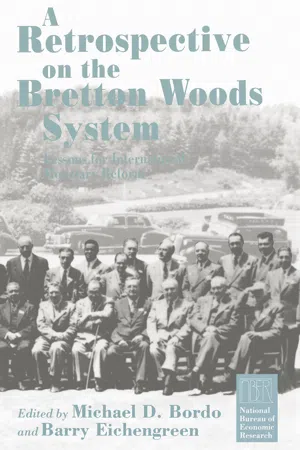 eBook - PDF
A Retrospective on the Bretton Woods System
Lessons for International Monetary Reform
- Michael D. Bordo, Barry Eichengreen, Michael D. Bordo, Barry Eichengreen(Authors)
- 2007(Publication Date)
- University of Chicago Press(Publisher)
The drive all around was a return, in the broad essentials, to laissez faire” (Hansen 1945, 199). By 5. These authors emphasize convergence of conceptual frameworks as a determinant of coop- eration, but they provide different stones of how such convergence does or does not take place. 161 The Political Origins of Bretton Woods the late 1930s, Hansen argued, all this had changed. A new social purpose infused postwar planning the second time around. Understanding how this “new thinking” got established and shaped government policy and the Anglo- American agreement is our task. 3.2 The Emergence of an International Policy Community The Bretton Woods agreement is often seen as the result of the ideas and diplomacy of John Maynard Keynes and Harry Dexter White.6 Indeed, these economists, particularly Keynes, were pivotal figures in devising monetary plans, and they led their delegations in the celebrated Anglo-American nego- tiations during the war. But they were also part of a larger collection of econ- omists and policy specialists who were located in the British and American Treasury Departments, in other government offices, and in universities and policy institutions. While many of the beliefs held by this loose community of specialists reflected the evolving views of professional economists, the community itself was given form by the demands of British and American governments to deliberate on postwar economic matters. The process of post- war planning on both sides of the Atlantic served to organize and stimulate the activities of these policy specialists. We can trace the contours of this assemblage of experts and situate it within the larger institutions of British and American government.
Index pages curate the most relevant extracts from our library of academic textbooks. They’ve been created using an in-house natural language model (NLM), each adding context and meaning to key research topics.

