Economics

Four Asian Tigers
The Four Asian Tigers refer to the economies of Hong Kong, Singapore, South Korea, and Taiwan, which experienced rapid industrialization and high growth rates from the 1960s to the 1990s. These countries implemented export-oriented policies, invested in education and infrastructure, and attracted foreign investment, leading to significant economic development and modernization.
Written by Perlego with AI-assistance
Related key terms
1 of 5
10 Key excerpts on "Four Asian Tigers"
 eBook - ePub
Global Shift
Asia, Africa, and Latin America, 1945-2007
- Mike Mason(Author)
- 2012(Publication Date)
- McGill-Queen's University Press(Publisher)
5Tigers: Export-Led Industrialization
in South Korea, Taiwan, Hong Kong,
and Singapore
INTRODUCTIONGrowth first started accelerating in East Asia, in Japan’s former colonies of Korea and Taiwan. Then it spread to Southeast Asia… It rose steadily in the city-states of Singapore and Hong Kong… China and India awoke, having once been great in their own right… [N] ot for a long time to come will an empire reign the way the United States reigned after World War II.Alice Amsden, The Rise of the RestThe Asian Tigers – South Korea, Taiwan, Hong Kong, and Singapore – also known as the East Asian newly industrialized economies (NIE s) and “late industrializers,” comprise an archipelago of physically small countries that developed beyond all expectation in just a few decades.1 From 1960 to 1970 the GDP growth of Singapore was 8.8 per cent, of Hong Kong 10 per cent, of Taiwan 9.2 per cent; from 1975 to 1984 growth in these archipelagic states held firm at 8.5, 10, and 9.2 per cent respectively. Thereafter, while their expansion continued at a remarkable rate, they were joined by other Southeast Asian states like Malaysia and Thailand, all of which benefited from investment from Japan. Finally, from the late 1980s, China rose – the Goliath of all of the NIE s.What explains the boom of these miniature Japans? In the conventional argument, having first tried import substitution industrialization (ISI) in the footsteps of Latin America,2 from the mid-1960s and with the encouragement of the IMF, the Tigers switched development strategies and modelled themselves on Japan’s export-led industrialization (ELI). Accelerated takeoff followed almost immediately, leaving behind states, like those in Latin America, which did not learn the ELI lesson.The story as told by Alice Amsden, the chronicler of South Korea’s industrialization is, however, different. She writes that although writers in the West have tended to disparage ISI, the NIE s actually stuck with it and from it moved on to ELI slowly and deliberately. “Despite all the bad press, even the most efficient mature high-tech industries now practice import substitution. In Asia, assemblers of calculators, computers, and cell phones first buy hundreds of their parts and components from overseas, mostly from Japan. Then step-by-step they selectively import-substitute them. Protection never enters, but its equivalent does. The government provides assemblers with science parks, semiconductor design services, spillovers from government labs, cheap credit, and joint R&D… The whole idea that export-led growth and import substitution were at odds proved to be mismeasured and false.”3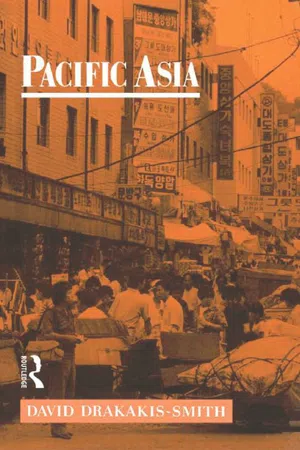 eBook - ePub
- David W. Drakakis-Smith(Author)
- 2002(Publication Date)
- Routledge(Publisher)
It is data such as these that have singled out the newly industrializing countries (NICs) of Pacific Asia, the so-called four little tigers (or dragons), for particular attention, especially as their impressive manufacturing growth has occurred over such a short period of time. In the 1950s, manufacturing accounted only for around 12 per cent of GDP in each, but by the 1980s it was comparable to that of the most advanced industrial nations. Furthermore, there appears now to be a second wave of manufacturing nations rising in the Pacific Asia region, with Malaysia and Thailand being singled out by their rapid rates of economic growth.However, not all of the four little tigers have exactly the same background to their success. There are several common denominators, some of which are local in origin, some of which are global, but the particular mix is unique to each state and the end-product slightly different. In our conclusions we will not only review the economic achievements of recent growth but also examine some of the social consequences.Pacific Asia’s four little tigers
1950s to 1970s
One of the principal common factors linking Hong Kong, Singapore, South Korea and Taiwan is that all four were colonies: the first two of Britain and the last two of Japan. However, there were considerable differences in the extent of local capital development, with Japanese colonialism laying a dead-hand on Taiwan and Korea in this respect, whereas in Hong Kong’s and Singapore’s domestic capital interests were well-developed in local retail and commerce.After the Second World War a variety of factors combined to induce rapid early growth. Hong Kong and Taiwan, for example, received enormous refugee populations following the communist assumption of control in China. Most of these were urbanized and brought labour skills or capital to invest. To a certain extent this happened in South Korea, following the partition after the civil war, but not to any great extent in Singapore.Also during the 1950s, the United States sought to develop Taiwan and South Korea as bastions of successful capitalism in an unstable region where communism seemed to be spreading rapidly. Much of this US aid and investment was in projects such as road and rail networks or education. Indeed, in Taiwan almost three-quarters of all infrastructural investment came from United States aid. eBook - PDF
Political Cultural Developments in East Asia
Interpreting Logics of Change
- P. W. Preston(Author)
- 2016(Publication Date)
- Palgrave Macmillan(Publisher)
THE HISTORICAL DEVELOPMENT EXPERIENCE OF EAST ASIA... 53 THE FOUR EAST ASIAN TIGERS The group of countries often labelled the four tigers offer distinctive varia- tions on the Japanese theme of the developmental state turned to the goal of national development. However, the quartet is not all of apiece as two were colonial territories of Imperial Japan and two were trading ports within the British Empire. Thus the broad geo-strategic and geo- economic environment has been important. 55 The state has been a key factor. Thereafter, American policy and general influence were crucial: first, providing aid (financial, military and technical); second, opening its markets (to the exports of these countries); and third, expanding the global marketplace into which the four tigers could expand by virtue of its own vigorous domestic economic growth. The tigers comprise, firstly, South Korea and Taiwan —sometime colonies of Japan, which have pur- sued state-led development within the direct context of cold war tensions; then, secondly, the sometime colonial port cities of Singapore and Hong Kong, now successful trading cities. Their record has been noted and much debated. In Northeast Asia, the Japanese colonial holdings were re-ordered. So, first, the war-time great powers the USA and USSR decided to divide Korea, 56 and this produced the Democratic People’s Republic of Korea (DPRK) and the Republic of Korea (ROK), or, more usually, North and South Korea. The two Korean leaderships were hostile to each other, and in 1950, after numerous mutual provocations, the North invaded the South. eBook - ePub
Transpacific Rebalancing
Implications for Trade and Economic Growth
- Barry P. Bosworth, Masahiro Kawai, Barry P. Bosworth, Masahiro Kawai(Authors)
- 2015(Publication Date)
- Brookings Institution Press(Publisher)
As the income level in the PRC rises, there is a growing culture of consumerism, with shifts in spending patterns leading to higher consumption of luxury goods and services. For instance, strong demand from the PRC has been driving the recent recovery in the retail of branded watches and jewelry, while tourist arrivals in the Asian Tiger economies from the PRC have been growing rapidly (He, Cheung, and Chang 2007). In fact, this shift toward consumption whereby goods and services that had previously been regarded as luxuries are now viewed as necessities is also evident among the young urban generation in many traditionally thrifty societies in the region. The Asian Tiger economies should continue to position themselves to capitalize on such ongoing increases in intraregional demand by reorientating their economic structures to tap into the changing spending patterns of prospering Asian countries.In this regard, the Asian Tiger economies could maintain their dynamic and niche-based competitiveness by focusing on services exports, particularly by building up ancillary capabilities. Services sector productivity in Hong Kong, China; the Republic of Korea; Singapore; and Taipei,China stands at approximately 84, 27, 58 and 53, respectively, on a scale of 1 to 100, where 100 represents the productivity level in the U.S. services sector. This suggests that there is ample room for further development of the services industry, and there is a need to eradicate existing policy distortions that favor the manufacturing industry.Regulatory reforms in the services sector of the Asian Tiger economies would not only boost productivity in this sector but would also generate large gains in overall economic growth. Policy initiatives such as funding the upgrading of workers’ skills and expertise would result in a more knowledgeable and experienced workforce that would enhance the quality of services. Moreover, policies that induce firms to innovate in their work processes and incorporate the use of technology would lead to the improvement of work practices. Business investments targeting higher-value-added exportable services industries, such as financial services, medical tourism, and tertiary education, should also be encouraged, perhaps by offering tax breaks and incentives for regional expansion. eBook - PDF
The Paradox of Catching Up
Rethinking State-Led Economic Development
- L. Tan(Author)
- 2005(Publication Date)
- Palgrave Macmillan(Publisher)
68 4 The East Asian Miracle The East Asian success in economic catch-up has been long acknowl- edged, and was described as the East Asian Miracle in the well-known World Bank study in 1993. The World Bank report covered eight high-performing East Asian economies: Japan; the ‘Four Tigers’: Hong Kong, Singapore, Taiwan and South Korea; and the three newly industrializing economies (NIEs) of Southeast Asia, Thailand, Indonesia and Malaysia. During the four decades between 1950 and 1990, these economies, on average, had delivered even higher real GDP growth than the Soviet Union in its peak years. Consequently, Japan, already an industrial economy before the War, had rapidly rose to the rank of the world’s second largest economy. The Four Tigers, following Japan’s state-led export-oriented development model, have succeeded in modernization and raised their per capita income to the levels of the OECD countries towards the end of the twentieth century. The NIEs that took the same development approach have also significantly narrowed their income gaps with the Western industrial economies. It should be first emphasized that the East Asian economies are fundamentally different from the Soviet centrally planned economy, as they are primarily based on private property ownership. As men- tioned previously, the Soviet planned economy, with complete state ownership and elimination of markets, stands for the extreme case of state-led economic development that could not sustain its economic growth. East Asian economies, on the other hand, belong to the larger camp of market system underlined by private ownership, although their domestic markets and property rights in general are less developed than in the Western industrial economies. If a society in principle The East Asian Miracle 69 respects private property and allows the markets to work, it then has met the preliminary conditions for sustainable economic growth. eBook - PDF
Europe’s Greece
A Giant in the Making
- A. Kalaitzidis(Author)
- 2009(Publication Date)
- Palgrave Macmillan(Publisher)
The characteristics of being a “tiger” according to the World Bank were, first and foremost, high growth rates, private domestic investment and rapidly growing human capital, high levels of domestic savings, as well as social changes such as the reduction of agriculture, urbanization, the reduction of population growth rates, and an E u r o p e ’ s G r e e c e : A G i a n t i n t h e M a k i n g 150 expansion of education (The World Bank 1993, 5). The necessary elements were all economically derived, such as “sound developmental policy,” good macroeconomic performance, a strong banking system, and a labor force to sustain it (The World Bank 1993, 5). In his seminal comparative work on developing economies, Stephen Haggard analyzed development strategies and categorized what we call tiger economies into three kinds: (a) import-substituting economies, mainly Latin American countries, where the size of the country allows for import substi- tution and the generation of domestic industry healthy enough because of domestic demand; (b) export-led economies, mainly the Asian Tiger econ- omies, such as S. Korea and Taiwan, led by industries focused on produc- ing consumer products for North America and Europe; and (c) entrepôt economies, such as Hong Kong and Singapore, which lack the size to pro- mote either large scale import substitution or even export-led growth and thus mainly focus on service and commercial activities (Haggard 1990). In order to understand the different “pathways,” Haggard analyzed the fol- lowing aspects of each category’s strategies: (1) orientation, (2) instruments, (3) agents, and (4) integration. Considering that “even countries pursuing similar strategies exhibit variation” (Haggard 1990, 27), when comparing these economies to European peripheral economies, such as Ireland and Greece, one must consider not only the size of economic growth, as shown in table 8.1, but also the elements that produce it. eBook - ePub
Education and Training for Development in East Asia
The Political Economy of Skill Formation in Newly Industrialised Economies
- David Ashton, Francis Green, Donna James, Johnny Sung(Authors)
- 2005(Publication Date)
- Routledge(Publisher)
3 Whatever the validity of any such long-term forecasts, what is clear is that learning technology from others can only be carried on while others have the superior technology.In that light, it is relevant to consider the implications of the model of developmental skill formation for the future competitiveness of the tiger economies. Simple extrapolation sees these economies as continuing to perform well, but that assumption ignores some of the previously mentioned contradictions in the model which, if unresolved, could be the source of a serious economic crisis or slowdown. In focusing on the institutional arrangements, which is what our model does, we would not wish to negate the impact of culture. In all the societies we have examined, Confucian culture has left a strong imprint on the educational system in the form of an emphasis on rote learning. While this may have facilitated high levels of achievement in the basics—mathematics, science and language—which, in turn, has prepared young people well for further training in craft and intermediate level skills, this approach is now being seriously challenged. With the emphasis in the knowledge-intensive industries on creativity there is a real fear, expressed in current policy debates, about the adequacy of an educational system which so far has served these societies well. The persistence of rote learning as the normal pedagogy is deep-seated, hard to challenge, and could, it is argued, have potentially damaging effects on economic growth. In all four societies there is concern that unless their education systems, at the highest level, can introduce a more creative, research-based tradition, they will lose out in the field of industrial research and development. The latter is widely credited as the source of new ideas and products for the next generation of industries. Unless the tiger economies can match the West in this area, they face the danger that, in spite of their unprecedented growth, they may yet fail to maintain the impetus behind their economic success. eBook - PDF
International Advertising
Realities and Myths
- John Philip Jones(Author)
- 1999(Publication Date)
- SAGE Publications, Inc(Publisher)
16 The Asia Pacific Tigers Michael Ewing As we move towards 2000, Asia will become the dominant region of the world: economically, politically and culturally. Up until the 1990s the West set the rules. Now Asians are creating their own rules and will soon determine the game as well. Even Japan will be left behind as the countries of South East Asia, led by the overseas Chinese and China, increasingly hold economic sway. John Naisbitt, Megatrends Asia, 1996 I nternationally renowned art critic Robert Hughes once said that nothing dates more quickly than visions of the future. For more than two decades international investors, business commentators, and politicians alike have viewed the tiger economies of the Asia Pacific as the ultimate metaphor for success, growth, employment, and myriad other economic virtues. Today, however, adjectives such as miracle are being replaced with crisis, and melting is used to describe economies once considered boiling. The traditional Chi-nese character for crisis has two faces, symbolizing both danger and oppor-225 226 A N I N T E R N A T I O N A L C I R C U M N A V I G A T I O N tunity. The question is, Which face will have more influence on advertising in the region at the start of the new century? Anyone writing about the economies of East and Southeast Asia in 1999 cannot ignore the recent financial firestorm and its sometimes devastating aftermath. At the risk of suffering the same fate as earlier soothsayers, I will offer my thoughts on the medium-term prospects for the region. But I will not focus in this chapter principally on the impact of the meltdown. M y key themes are the factors that make East Asia unique from an advertiser's perspective. eBook - PDF
Continent, Coast, Ocean
Dynamics of Regionalism in Eastern Asia
- Ooi Kee Beng, Ding Choo Ming(Authors)
- 2007(Publication Date)
- ISEAS Publishing(Publisher)
Samir Amin and other dependency theorists applied this theory to Asia in the mid-1970s, arguing that none of the Asian economies had come close to “the stage of independent and autonomous development”, 84 85 East Asian Economic Studies 85 but on the contrary, “unequal development” and the dependency-dominance relationships in these economies had become a more serious problem than ever before. Some neo-Marxist theorists even went so far as to lump Asian economies together with other Third World regions under the vague category of “under-development”, which was said to be the consequence of “over- development” in the core economies of the West. As the economic success of the Four Tigers became increasingly evident, however, this rival paradigm sank into oblivion. The second rival paradigm came on the scene toward the end of the 1970s when the “economic miracle” of East Asia attracted the attention of the world’s academic communities. Many prominent social scientists, including sociologist Peter Berger and political scientist Ezra Vogel, argued that the East Asian model of economic development was different from the free-market model, and undertook to develop an alternative “Asian type of modernization”, with emphasis placed on the contribution state interventions and traditional Confucian values make to economic success. Proponents of this “East Asian model” cite evidence to show that free market mechanisms were restricted in many ways in the economies of the Four Tigers, while the state played a decisive and active role in promoting economic development. Confucianism is said to contribute to the economic miracle of Japan and the Four Tigers by inculcating the importance of education, hard work, thrift and discipline. One important conclusion is that economic modernization does not necessarily follow the Western pattern prescribed by modernization theorists. This rival paradigm remained vocal until the Asian financial turmoil in 1997. eBook - ePub
- Robert Looney, Robert E. Looney, Robert Looney(Authors)
- 2014(Publication Date)
- Routledge(Publisher)
Potentially contentious policies included labour controls, compulsory land acquisition and allocation, and the ‘crowding out’ of the local private sector in both product and factor markets by multinationals and the state sector (which has not happened in the other Asian Tiger economies). The country also ranks far below its per capita income rank in comparative rankings, which include variables such as ‘political freedom’, ‘human development’ and ‘well-being’. 26 After the ‘miracle’: developmental challenges of the 21st century Singapore’s development model of the 20th century might not be replicable in other emerging economies because they do not face the same favourable initial conditions that Singapore and other Asian Tigers enjoyed then, and/or they do not possess the political will or institutional capacity necessary to enact and implement the comprehensive social as well as economic policies that Singapore could undertake in the 20th century. Another reason why countries might not follow the Singapore model is that 21st-century internal and international developments have revealed the model’s own shortcomings in continuing to deliver positive results for its population. The most critical shortcoming of Singapore’s growth model is its sustainability—or lack thereof. Almost from the beginning, studies have shown that GDP growth in most periods was achieved mainly through increasing the quantum of inputs—of capital, labour, even land 27 —rather than their productivity. 28 This strategy may have been efficient in developing a middle-income economy with underutilized resources (e.g. the high unemployment of the 1960s), and the ability to ‘borrow’ internationally (e.g. by participating in multinational networks) to ‘catch up’ to the global technological frontier
Index pages curate the most relevant extracts from our library of academic textbooks. They’ve been created using an in-house natural language model (NLM), each adding context and meaning to key research topics.

