Geography

Geological Structure
Geological structure refers to the arrangement and orientation of rock layers, faults, and folds within the Earth's crust. It encompasses features such as anticlines, synclines, and fault lines, which influence the landscape and natural resources. Understanding geological structure is crucial for geologists and geographers in interpreting the formation and evolution of landforms, as well as in resource exploration and environmental management.
Written by Perlego with AI-assistance
Related key terms
1 of 5


12 Key excerpts on "Geological Structure"
 eBook - PDF
- Haakon Fossen(Author)
- 2010(Publication Date)
- Cambridge University Press(Publisher)
Chapter ................................ 1 Structural geology and structural analysis Structural geology is about folds, faults and other deformation structures in the lithosphere – how they appear and how and why they formed. Ranging from features hundreds of kilometers long down to microscopic details, structures occur in many different settings and have experienced exciting changes in stress and strain – information that can be ours if we learn how to read the code. The story told by structures in rocks is beautiful, fascinating and interesting, and it can also be very useful to society. Exploration, mapping and exploitation of resources such as slate and schist (building stone), ores, groundwater, and oil and gas depend on structural geologists who understand what they observe so that they can present reasonable interpretations and predictions. In this first chapter we will set the stage for the following chapters by defining and discussing fundamental concepts and some of the different data sets and methods that structural geology and structural analysis rely on. Depending on your background in structural geology, it may be useful to return to this chapter after going through other chapters in this book. 1.1 Approaching structural geology For us to understand structural geology we need to observe deformed rocks and find an explanation for how and why they ended up in their present state. Our main methods are field observations, laboratory experiments and numerical modeling. All of these methods have advantages and challenges. Field examples portray the final results of deformation processes, while the actual deformation history may be unknown. eBook - PDF
- Barbara W. Murck, Brian J. Skinner(Authors)
- 2016(Publication Date)
- Wiley(Publisher)
These features are also important from a practical perspective. For example, faults control the locations of certain types of ore deposits. Other rock structures can affect slope stability, structural geology The study of stress and strain, the processes that cause them, and the deformation and rock structures that result from them. influence the flow of groundwa- ter, or trap oil and natural gas deep underground (Figure 9.8). Many practical applica- tions, such as oil prospecting and groundwater flow map- ping, require geologists to make inferences about rock units and structures that lie underground, hidden from view. Most of their information comes from obser- vations made at the surface, with additional information from drilling and other methods of subsurface study. A systematic program of measurements and mapping can give structural ge- ologists a very good idea of what might lie beneath the surface. Strike and Dip The principle of original horizontality tells us that sedi- mentary strata are horizontal when they are first deposited (see Remember This!). Where such rocks are tilted, we can Structural geology and oil • Figure 9.8 Oil-bearing rocks Illustration of anticline where oil-bearing rocks were found. BYe]k H& :dYaj'F? AeY_] ;gdd][lagf These rocks, which contain oil, are from an exploratory oil well on the North Slope of Alaska. The diagram underneath the rock hammer shows a typical rock forma- tion that harbors oil. A lay- er of porous rock (in yellow) forms an arch-shaped fold with impervious rock over- lying it. Oil and natural gas rise through the porous rock, becoming trapped at the top of the arch. 236 Chapter 9 Folds, Faults, and Geologic Maps infer that deformation has occurred. To de- scribe this deformation, a geologist starts by measuring the orientation of the tilted rock lay- er. eBook - ePub
- R G Park, Professor R G Park, R Park, R. G. Park(Authors)
- 2013(Publication Date)
- Routledge(Publisher)
Part Two Geotectonics
 Passage contains an image
13 Major Earth Structure
DOI: 10.4324/9780203825112-13In the last four chapters of this book we discuss the significance of Geological Structures in the context of large-scale Earth processes. This branch of structural geology is often described as geotectonics. The development over the past three decades of plate tectonic theory gives us a way of integrating rock deformation into a model that attempts to explain the evolution of the crust as a whole. As a background to the plate tectonic hypothesis, which is dealt with in Chapter 14 , we discuss major Earth structure and the distribution of tectonic activity. Chapter 15 relates deformation to the plate tectonic model, and, finally, Chapter 16 describes examples of this relationship in the geological past back to the Precambrian.13.1 Major Topographic Features of the Earth
If we can imagine the Earth viewed from space with the water of the oceans removed, the major features of the structure of the crust would be readily apparent (Figure 13.1 ). A first-order division of the crust can be made into continents and oceans, and superimposed on these large features are rather linear elevations consisting of the mountain ranges on the continents and the great system of ocean ridges. Of a smaller order of magnitude are the deep ocean trenches. We shall now examine the nature and pattern of these large-scale structures, and their relationship to the tectonically active zones of the crust.Figure 13.1 The major topographic features of the Earth's surface as they would appear with the ocean waters removed. (After Wyllie, 1976,.)Continents and Oceans
The distribution of the topographic level of the Earth’s surface is shown in Figure 13.2 eBook - PDF
- Mateo Gutierrez(Author)
- 2012(Publication Date)
- CRC Press(Publisher)
These forms are called tectonic (Twidale, 1971; Goudie, 2004c) or tectodynamic (Tricart, 1968) landforms. In the geomorphic sense, “structure” includes not only rock type (lithology) and arrangement of strata (stratigra- phy and tectonics) but also active and continuous changes in these properties (Twidale, 1971). Structural geomorphology research considers erosion as a constant and neither speci- fies its mechanisms nor analyzes its processes; it is used only to understand the interaction of erosion and tectodynamics and to indicate how structure influences the type of landform (Tricart, 1968). Exogenetic forces acting on rock structure produce structural landforms of various magnitudes. Rocks have vary- ing resistance to weathering and erosional processes. Fur- thermore, external dynamics can create specific landforms when they act on certain rock types. In fact, books have been written to describe the wide variety of landforms in granitic areas. Some important ones are those of Twidale (1982b) and Twidale and Vidal Romaní (2005). In limestone and evaporitic terrains, dissolution creates a wide variety of morphologies called karst. The study of these rocks is an applied science that includes hydrogeology, ore deposits, and geotechnical engineering, among others. Karst is the subject of numer- ous books (for example, Sweeting, 1972). Sandstone forma- tions also have specific landforms (Young and Young, 1992; Young, 2004; Härtel et al., 2007). Tectonic geomorphology is the study of the constant struggle between tectonic processes that generate topogra- phy and surface processes that slowly denude and rejuvenate the landscape (Burbank and Anderson, 2001). Today, many geomorphologists study small-scale geomorphic processes; they have not focused on the geomorphic advances resulting from the discovery of plate tectonics and large-scale moun- tain building (Summerfield, 1991; Keller and Pinter, 1996; Burbank and Anderson, 2001).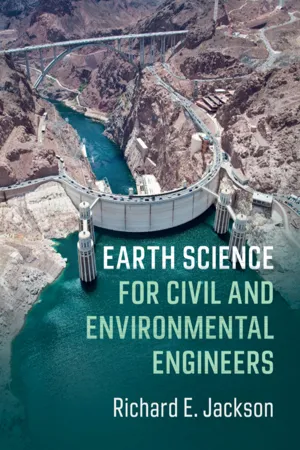
- Richard E. Jackson(Author)
- 2019(Publication Date)
- Cambridge University Press(Publisher)
Thus plate tectonics created the three-dimensional structures in rocks that are the domain of the engineering geologist and the subject of Chapter 3. Of particular concern in foundation engineering, engineering geology and hydrogeology are other three-dimensional (3D) features referred to as joints, fractures or discontinuities, such as are shown in Figure 1.5. The various kinds of geological maps that are prepared for different purposes are described, including engineering geology maps, which the engineer needs to be able to read just as he or she must be able to read and interpret a topographic or a highway map. We complete Chapter 3 with the principles of stereographic projection to reduce 3D field features to two-dimensional (2D) representations. Chapter 4 is an introduction to rock mechanics – the theoretical basis for the design of built structures with foundations in rock and of structures that are wholly enclosed by rock under stress, e.g., tunnels and mines. We discriminate between the rock – a geological material defined by its mineralogy, colour, grain size, etc. – and the rock mass, which is the volume of rock that will affect the built structure and the properties of which are determined by its weathering, stresses and the discontinuities present in it. Then we address the stresses in rock masses from tectonic activity, the inherent strength of each rock mass and indicators of volumetric strain. We consider how fluid flow occurs in the discontinuities of rock masses as these can cause inflows into tunnels and mines, the undermining of dam foundations and the seepage of contaminants from hazardous-waste repositories created in mined cavities. We begin a discussion of rock-slope failure that is continued in Chapter 15. Part I ends with a discussion in Chapter 5 of the engineering characterization of rock specimens and rock masses.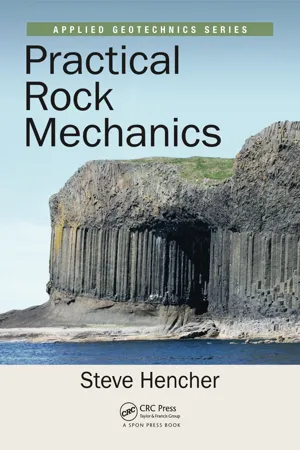 eBook - PDF
- Steve Hencher(Author)
- 2015(Publication Date)
- CRC Press(Publisher)
3.3.2 General Structural geologists make much use of physical models to mimic structures that we see in rock masses. The models do not necessarily meet the strict rules of similitude favoured for rock mechanics experiments (Fumagalli, 1968), but they can be very revealing. Figure 3.3 illustrates results from a sand box experiment carried out by Hubbert (1951). Layers of differently coloured sand or dry powdered clay are placed in a box, on either side of a vertical plate connected to a screw. When the screw is advanced to the right, it simul-taneously applies horizontal compression to the right whilst releasing the passive horizontal support to the left. Shallow, overthrust faulting and folding occurs to the right of the vertical plate, and normal faulting to the left (these terms will be explained shortly). Anderson (1951) recognised that the Earth’s surface can be assumed to be a principal plane with no shear traction; that being so, one principal stress direction would be vertical, and the other two horizontal. The relative magnitudes of these three principal stresses give rise to the main forms of faulting: normal, thrust and strike-slip. 3.3.3 Normal faults Dip of Geological Structures is usually measured from the horizontal, as discussed in Chapter 5, but for faults, structural geologists sometimes use the term ‘hade’, which is the dip angle 48 Practical rock mechanics measured from the vertical. A normal fault, by definition, ‘hades towards the down-throw side’.* The down-thrown side of the fault is called the ‘hanging wall’; the rock beneath the fault is the ‘footwall’. An area down-thrown between conjugate sets of normal faults is known as a ‘graben’ and the whole structure a ‘rift’. Famous examples of this type of struc-ture include much of the Rhine Valley and the East African Rift Valley.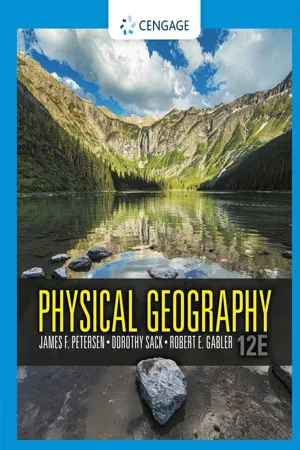 eBook - PDF
- James Petersen, Dorothy Sack, Robert Gabler, , James Petersen, James Petersen, Dorothy Sack, Robert Gabler(Authors)
- 2021(Publication Date)
- Cengage Learning EMEA(Publisher)
390 C H A P T E R 1 4 • T E C T O N I S M A N D V O L C A N I S M 14-2 Tectonic Forces, Rock Structure, and Topography Tectonic forces, which at the largest scale move the lithospheric plates, also cause bending, warping, folding, and fracturing of Earth’s crust at continental, regional, and even local scales. Such deforma- tion is documented by rock structure, the nature, orientation, incli- nation, and arrangement of affected rock layers. For example, rock Natural landforming processes proceed at a wide variety of rates, usually expressed in millimeters or centimeters of change per year, century, or millennium, averaged over the time span of avail- able data. However, these are average rates and many natural pro- cesses operate in an episodic, rather than in a steady and continuous, manner. In episodic processes, a period of relative calm and little change continues until a certain threshold condition is reached, resulting in a short burst of rapid, often intense activity that causes significant environmental modification. The exact timing of these periods of increased activity is difficult or impossible to predict with certainty. Many physical processes in the Earth system oper- ate according to this punctuated equilibrium (● Fig. 14.4). Earth- quakes and volcanic eruptions provide good examples of this type of Earth change. Long periods of limited activity are occasionally interrupted by large earthquakes or major eruptions that are short- lived but cause great change in the landscape. After an occurrence of major change, the landscape adjusts to the newly created condi- tions and stays in relative equilibrium, experiencing comparatively limited modification by exogenic processes until the next major event again disrupts the system (● Fig. 14.5). eBook - PDF
- Alan F. Arbogast(Author)
- 2017(Publication Date)
- Wiley(Publisher)
265 CHAPTER PREVIEW Earth’s Inner Structure Rocks and Minerals in the Earth’s Crust Identification of Igneous Environments Clastic Rocks The Rock Cycle Geologic Time Geologic Time Human Interactions with Geologic Time: The Anthropocene CHAPTER 12 Earth’s Internal Structure, Rock Cycle, and Geologic Time The previous chapter discussed the formation and character of soils, which can be viewed as the Earth’s skin. Now it is time to look more intently at the solid Earth by focusing on its internal structure and compo- sition. The inner Earth is important to understand because processes far below the surface drive the movements of our planet’s outermost layer, the crust. Geographers are interested in the composition of the crust because it is the part of the solid Earth that most directly affects people, such as when an earthquake devastates a community. This chapter will also give you an appreciation for geologic time and why it is relevant, especially when you consider how quickly Earth is now changing due to human impacts. Visions of America/UIG via Getty Images The Grand Canyon is one of the best-known landscapes on Earth. In addition to being a beautiful place, the canyon is interesting because it contains rocks that span much of the Earth’s history. This chapter focuses on the geologic history of Earth, the evolution and composition of rocks, and the character of continents and ocean basins. 266 CHAPTER 12 Earth’s Internal Structure, Rock Cycle, and Geologic Time Earth’s Inner Structure Have you ever wondered what the inside of Earth is like? Science fiction writers have often pondered this question, with the most famous example being Jules Verne’s famous book Journey to the Center of the Earth. In this story, a professor leads a party of explorers on a wild adventure to the center of Earth through a volcano in Iceland. Although such an adventure is pure fiction, most geologists would certainly like to make the trip. eBook - ePub
- (Author)
- 2008(Publication Date)
- Trade Paper Press(Publisher)
dip.stratigraphy branch of geology that deals with the sequence of formation of sedimentary rock layers and the conditions under which they were formed. Its basis was developed by the English geologist William Smith. Stratigraphy in the interpretation of archeological excavations provides a relative chronology for the levels and the artifacts within them. The basic principle of superimposition establishes that upper layers or deposits have accumulated later in time than the lower ones.stromatolite mound produced in shallow water by mats of algae that trap mud particles. Another mat grows on the trapped mud layer and this traps another layer of mud and so on. The stromatolite grows to heights of a yard or so. They are uncommon today but their fossils are among the earliest evidence for living things—over 2,000 million years old.subduction zone region where two plates of the earth’s rigid lithosphere collide, and one plate descends below the other into the weaker asthenosphere. Subduction occurs along ocean trenches, most of which encircle the Pacific Ocean; portions of the ocean plate slide beneath other plates carrying continents.surveying accurate measuring of the earth’s crust, or of land features or buildings. It is used to establish boundaries, and to evaluate the topography for engineering work. The measurements used are both linear and angular, and geometry and trigonometry are applied in the calculations.tectonics in geology, the study of the movements of rocks on the earth’s surface. On a small scale tectonics involves the formation of folds and faults, but on a large scale plate tectonics deals with the movement of the earth’s surface as a whole.topaz mineral, aluminum fluorosilicate (Al2 (F2 SiO4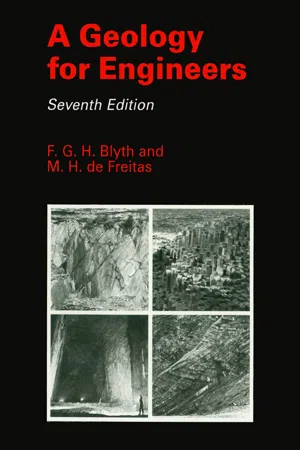 eBook - ePub
- F.G.H. Blyth, Michael de Freitas(Authors)
- 2017(Publication Date)
- CRC Press(Publisher)
8Geological StructuresSedimentary rocks, which have been described in Chapter 6 , occupy the greater part of the Earth’s land surface; they occur essentially as layers or strata and are parts of the stratigraphical sequence of rocks discussed in Chapter 2 . A single stratum may be of any thickness from a few millimetres to a metre or more, and the surfaces which separate it from the next stratum above or below are called bedding planes. In this chapter we are concerned with the arrangements of sedimentary rocks as structural units in the Earth’s outer crust. The ways in which these structures appear on geological maps are considered in Chapter 12 .Dip and strike
Consider a flat uniform stratum which is tilted out of the horizontal (Fig. 8.1 ). On its sloping surface there is one direction in which a horizontal line can be drawn, called the strike. It is a direction that can be measured on beds that are exposed to view and recorded as a compass bearing. At right angles to the strike is the direction of maximum slope, or dip. The angle of inclination which a line drawn on the stratum in the dip direction makes with the horizontal is the angle of dip (or true dip), and can be measured with a clinometer and recorded to the nearest degree (Fig. 12.8 ). For example, a dip of 25° in a direction whose bearing is N. 140° would be written 25° at 140. The bearing is taken from north (or, in the southern hemisphere, from south). A line on a sloping rock-surface in any other direction than that of the true dip makes a smaller angle with the horizontal, called an apparent dip. Apparent dips are seen in quarry faces where the strike of the face is not parallel to the true dip direction (Fig. 12.12 ).Fig. 8.1 Dip and strike. Dipping strata in an exposure of rock at the surface of the ground. Angle of dip shown.Strike and dip are two fundamental conceptions in structural geology, and are the geologist’s method of defining the attitude of inclined strata. The information is placed on a map as a short arrow (dip arrow) with its tip at the point of observation, together with a number giving the angle of true dip (Fig. 12.1 eBook - ePub
The New Science of Geology
Studies in the Earth Sciences in the Age of Revolution
- Martin J.S. Rudwick(Author)
- 2023(Publication Date)
- Routledge(Publisher)
A shift into a cognitive zone with fully structural intentions is marked by the development of new forms of illustration in the early nineteenth century. Generalized columnar sections of a more abstract kind showed the succession of strata that were the ‘raw material’ for the structure of a given region, deliberately abstracted from the complications of post-depositional disturbance. Observed exposures of rocks at the surface or in mines and wells were plotted on topographical profiles and extrapolated inwards to form traverse sections that displayed the inferred structure of the region along a given traverse. The surface outcrops of rocks were plotted on maps that were truly geological in that they were designed to suggest the underground structure of the region—often by being closely associated with traverse sections. At the same time landscapes were made more explicitly geological, first by the accentuation of theoretically significant features at the expense of the more fortuitous, then by applying the deliberately conventional colouring that was being used for sections and maps, so as to suggest the three-dimensional structure of the area portrayed.Finally, after about 1820 these truly geological forms of illustration were modified still further to enable them to become the vehicles of cognitive goals that reached beyond the analysis of three-dimensional structures to the interpretation of those structures in causal terms. Theoretical sections were used to convey interpretations of the history of the earth in all its aspects—the history of sedimentation, of igneous activity, of mountain-building and of life; theoretical maps were used to convey causal interpretation of spatial patterns and spatial events in the earth’s history; and even theoretical landscapes were occasionally used for the same purposes.The ‘envelopes’ that I have drawn around these varied forms of illustration are intended to summarize my interpretation of the contingent socio-historical circumstances in which these varied forms of the visual language of geology came into existence. There seems to be a broad division in the late eighteenth century between the practical enterprise of ‘mineral geographers’ and the work of those I have termed ‘traveller-naturalists’. The former, of whom the compilers of the Atlas minéralogique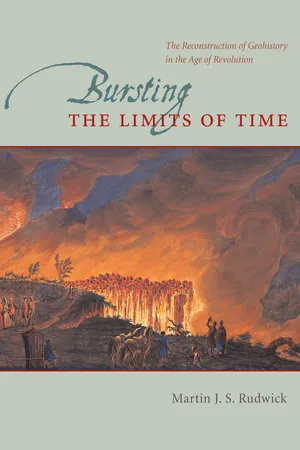 eBook - PDF
Bursting the Limits of Time
The Reconstruction of Geohistory in the Age of Revolution
- Martin J. S. Rudwick(Author)
- 2008(Publication Date)
- University of Chicago Press(Publisher)
Like other branches of natural history, the goals of geognosy were those of description and classification. The structural position of a rock mass in relation to others was one of the diagnostic criteria for classifying it; others included the na-ture of its constituent rock or rocks, its topographical expression or characteristic altitude, and the nature of any fossils it might contain. The structural order of rock masses, as being above or below others, could often be translated confidently into a temporal order of younger and older; but priority was given to the structural, because it could be observed directly. Rock masses were classified first as belonging to one or other of the four major groups of Primaries, Secondaries, Superficials (or alluvials), and Volcanics; and then, within each major category, according to their natural kinds or “species”, such as schist and sandstone. Secondary rock masses . E ARTH P HYSICS AS A C AUSAL S CIENCE [ ] were generally easier to interpret than the Primaries, and bedded Secondary “for-mations” could often be detected in a consistent sequence, at least within a given re-gion. But they were still treated primarily in terms of an observed structural order, rather than in the sense of an inferred temporal sequence, let alone a geohistory. Geognosy was a structural science; like mineralogy and physical geography, it was not a causal science, still less a science of geohistory. . EARTH PHYSICS AS A CAUSAL SCIENCE The “physics” of specimens Mineralogy was a science of specimens, practiced primarily indoors in museums; physical geography was a science of spatial distributions, based on outdoor field-work; and geognosy was a science of three-dimensional structures, also based on fieldwork but exploiting additionally the dimension of depth that was revealed by the practice of mining. All three were branches of natural history, in that their goals were those of description, identification, and classification.
Index pages curate the most relevant extracts from our library of academic textbooks. They’ve been created using an in-house natural language model (NLM), each adding context and meaning to key research topics.
