Geography

Lithology
Lithology refers to the physical and chemical characteristics of rocks, including their composition, texture, and structure. It is an important aspect of geology as it helps to identify and classify different types of rocks and understand their formation processes. Lithology is often used in the exploration and extraction of natural resources such as oil, gas, and minerals.
Written by Perlego with AI-assistance
Related key terms
1 of 5

5 Key excerpts on "Lithology"
 eBook - PDF
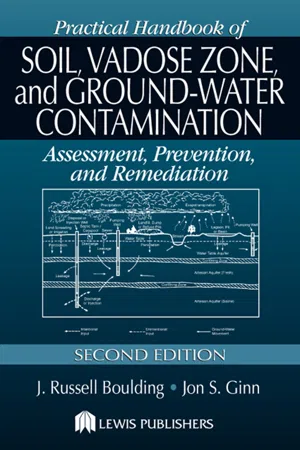
Practical Handbook of Soil, Vadose Zone, and Ground-Water Contamination
Assessment, Prevention, and Remediation, Second Edition
- J. Russell Boulding, Jon S. Ginn(Authors)
- 2016(Publication Date)
- CRC Press(Publisher)
P ART I Basic Concepts 3 CHAPTER 1 Geology, Soils, and Geomorphology Geology, the study of the earth, includes the investigation of earth materials, the processes that act on these materials, the products that are formed, the history of the earth, and the origin and development of life-forms. There are several sub fi elds of geology. Physical geology deals with all aspects of the earth and includes most earth science specialties. Historical geology is the study of the origin of the earth, continents and ocean basins, and life-forms. Economic geology is an applied approach focusing on the search and exploitation of mineral resources, such as metallic ores, fuels, and water. Structural geology deals with the various structures of the earth and the forces that produce them. Geophysics is the examination of the physical properties of the earth and includes the study of earthquakes and methods to evaluate the subsurface. All of the geology sub fi elds are used to some extent in the study of ground water. Probably the most dif fi cult concept to comprehend by individuals with little or no geological training is the complexity of the subsurface, which is hidden from view and, at least presently, cannot be adequately sampled. A guiding principle in geologic and hydrogeologic studies is that the present is the key to the past. The processes occurring today are the same processes that have occurred throughout geologic history, although their magnitude may vary with time. Furthermore, an understanding of present processes, and how they have acted in the past, can be used as a guide to predict the future. Soil science, also called pedology , and geomorphology , the study of surface landforms, are disciplines related to geology but focusing on the earth’s surface. Geology, soil science, and geomorphology are intimately related and concerned with many of the same earth processes, such as weathering, erosion, and deposition. eBook - PDF
Geology
The Made Simple Series
- William H. Matthews(Author)
- 2013(Publication Date)
- Butterworth-Heinemann(Publisher)
Recent developments with satellites scanning a country or region sometimes indicate unusual formations that have been missed from ground-level exploration. The use of infra-red and other types of This Earth of Ours 7 cameras, in conjunction with satellites, is also opening up new methods of locating economically important minerals. But not all the work of the geologist is in the field; much of his time is spent in the laboratory, measuring very accurately the size of specimens, looking for minute changes, or cutting very thin rock slices for observation under the microscope. (4) Physical Geology Physical geology deals with the earth's composition, its structure, the movements within and upon the earth's crust, and the geologic processes by which the earth's surface is, or has been, changed. This broad division of geology, which includes such basic geologic subsciences as mineralogy (the study of minerals) and petrology (the study of rocks), provides us with much-needed information about the composition of the earth. In addition, it embraces structural geology to explain the arrangement of the rocks within the earth, and geomorphology to explain the origin of its surface features. Another important branch of physical geology is economic geology, the study of the economic products of the earth's crust and their application for commercial and industrial purposes. Included here, for example, are the important fields of mining and petroleum geology. (These and several other branches of physical geology will be considered in the first part of this book.) The branches of physical geology enable the geologist to make detailed studies of all phases of earth science. The knowledge gained from such research brings about a better understanding of the physical nature of the earth. (5) Historical Geology Historical geology is the study of the origin and evolution of the earth and its inhabitants. eBook - PDF
Laterite Soil Engineering
Pedogenesis and Engineering Principles
- M Gidigasu(Author)
- 2012(Publication Date)
- Elsevier(Publisher)
Studies have shown (Liang, 1964) that deposits of various textural groups of laterite materials are associated with characteristic land forms, drainage and erosion patterns and vegetation types, and can be located directly by observation on the land surface or indirectly by the examination of aerial photographs (Table XX). Aerial-photographic studies have shown that a clear understanding of pedology, geology and geological processes is the most valuable asset to terrain studies, and aerial photographs represent, at present, the best available means of studying relatively large areas of laterite-soil deposits on detailed or regional scales (Moun-tain, 1967). Geophysical surveys, vegetation studies and topographical analyses have been successfully used in most cases, whereas in other cases laterite materials have no recognizable indication of their presence and are only found through systematic prospecting (Clare and Beaven, 1962, 1965). 5.3 USE OF GEOPHYSICAL EXPLORATION TECHNIQUES Geophysical methods of exploration consist of identifying changes in the charac-ter of subsurface materials by measuring changes in certain physical characteristics of the earth at or near its surface. These methods permit the determination of the nature of deep layers using for example their gravimetric, magnetic, electric or seismic characteristics measured with appropriate equipments placed on the soil surface or at shallow depths. Though these methods have been developed primarily for oil and mineral prospecting and are used extensively for this purpose, some electric and seismic methods are being used on an increasing scale in subsurface explorations for civil engineering purposes. In addition, minor geophysical methods utilizing radioactive, thermal and other properties are also used to a limited extent under special conditions. eBook - PDF
- Alastair Ruffell, Jennifer McKinley(Authors)
- 2008(Publication Date)
- Wiley(Publisher)
The trained geologist can take such views and compare them visually to real samples, and estimate to within a few percent the proportions of specific fragment species. Redrawn from Tucker (1988). Field of view in each case, typically 0.5–1 centimetres 194 CONVENTIONAL GEOLOGICAL ANALYSIS relevant when certain minerals are apparent. Hence the need for specialists as analysis progresses: often an experienced all-round geologist will be sufficient to enable an initial assessment of a scene or soil/sediment comparison. However, at some point a specialist in certain landforms, minerals or soils will be required, enabling the best assessment. Further specialist analysis Two main avenues are available to the forensic geologist following optical exami-nation and comparison (hand specimen and microscope) of soil, sediment or rock. These are to determine either the mineral content (e.g., quartz, mica, clay) or the chemistry (e.g., silica, iron, magnesium, potassium) of contained particles. Although chemistry and mineralogy are related, they are not the same: silicon oxide for instance can take different mineral forms, from quartz to tridymite, or may not have a crystal structure at all (glass). Thus a mineralogical analysis can predict with some certainty the chemical makeup of a rock or sediment, just as knowledge of the chemical makeup can be used to determine likely molecular arrangement and thus infer mineralogy. Mineralogical determination For coarse-grained soil and sediment (particles above silt-grade or 62 microns), the optical properties of many minerals in a thin section under a polarizing microscope allow mineral determination to be made. Some minerals are opaque (blocking the passage of light), occur as such fine fraction (generally below silt grade or of the clay-size fraction), or are stained or mixed with organic matter, iron oxide, etc. eBook - PDF
- Frank H. T. Rhodes, Richard O. Stone, Frank H. T. Rhodes, Richard O. Stone(Authors)
- 2013(Publication Date)
- Pergamon(Publisher)
CHAPTER 4 Philosophy of Geology Geology, it is sometimes claimed, is unique amongst the sciences in being chiefly concerned with historical development, rather than present state, and by its lack of a distinctive methodology, such as those which are characteristic of other sciences. Unsatisfactory as both statements are as generalizations, they contain enough truth to merit our concern. All sciences contain a historical element; it is the relative historical em-phasis in which they differ. Meaningful discourse in biology or astronomy, for example, would be impossible without it. G.G. Simpson has drawn a useful distinction between the immanent processes and products which are the universal components of the earth—and indeed of the whole material universe—and the particular state of the earth or some part of it at any given moment. Such a state, though always contingent upon and the product of the interactions of immanent processes and products, is itself unique. The goal of geology is so to describe and understand the present processes, constitution and composition of the earth as to establish relationships between them, and thus to interpret earlier historical products and sequences. The study of existing states, processes and components involves the application of all of the sciences, including especially physics, chemistry and biology, even though the particular abstractions favored by geologists may not always be those chosen by these other scientists. The uniqueness of geology lies in their combination and historical extrapolation to remote periods. It is not the events themselves of these periods that are thus studied, but rather their results and records. In this, geology infers causes from results, rather than predicts results from causes, as does the less-historical science.
Index pages curate the most relevant extracts from our library of academic textbooks. They’ve been created using an in-house natural language model (NLM), each adding context and meaning to key research topics.

