Geography

Monoculture
Monoculture refers to the practice of cultivating a single crop or plant species over a large area. This agricultural method is often associated with reduced biodiversity and increased vulnerability to pests and diseases. Monoculture can have significant environmental and economic impacts, including soil degradation and loss of ecosystem resilience.
Written by Perlego with AI-assistance
Related key terms
1 of 5

6 Key excerpts on "Monoculture"
 eBook - ePub
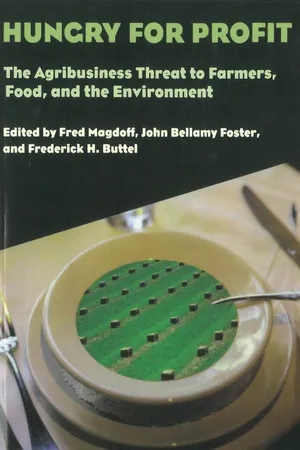
Hungry for Profit
The Agribusiness Threat to Farmers, Food, and the Environment
- Fred Magdoff, John Bellamy Foster, Frederick H. Buttel, Fred Magdoff, John Bellamy Foster, Frederick H. Buttel(Authors)
- 2000(Publication Date)
- Monthly Review Press(Publisher)
6The technologies that allowed the shift toward specialization and Monoculture were mechanization, the improvement of crop varieties, and the development of agrochemical to fertilize crops and control weeds, insects, and other crop pests as well as antibiotics and growth stimulants for agricultural animals. United States government commodity policies over the last several decades encouraged the acceptance and utilization of these technologies. In addition, the largest agribusiness corporations have found that concentrating certain processing facilities for a given product (chickens, hogs, or wheat) in specific areas of the country produces more profits, which lead to more farm and regional specialization. As a result, farms today are fewer, larger, more specialized, and more capital intensive.From an ecological perspective, the regional consequences of Monoculture specialization are many-fold:7(1) Most large-scale agricultural systems exhibit a poorly structured grouping of farm components, with almost no linkages or complementary relationships between crop enterprises, and among soils, crops, and animals.(2) Cycles of nutrients, energy, water, and wastes have become more open, rather than closed as in a natural ecosystem. Despite the substantial amount of crop residues and manure produced on farms, it is becoming increasingly difficult to recycle nutrients, even within agricultural systems. Animal wastes cannot economically be returned to the land in a nutrient-recycling process because animal production is frequently geographically remote from where crops are grown. In many areas, agricultural waste has become a liability rather than a resource. Recycling nutrients from urban centers back to the fields is similarly difficult. eBook - PDF
- Vandana Shiva(Author)
- 2016(Publication Date)
- Zed Books(Publisher)
Fourth, and crucially, chemical intensification and genetic engineering in Monocultures produces less food than ecological alternatives that are based on biodiversity intensification. * * * According to the dominant paradigm of food production, diversity hinders productivity. This creates an imperative for uniformity and Monocultures, and has generated the paradoxical situation in which modern plant “improvement” has been based on the destruction of the biodiversity it then uses as a raw material. The irony of plant and animal breeding is that it destroys the very building blocks on which the technology depends. Forestry development schemes introduce Monocultures of industrial species such as eucalyptus, and push into extinction the diversity of local species that once fulfilled local needs. Agricultural modernization schemes introduce new and uniform crops into farmers’ fields and destroy the diversity of local varieties. Modernization of animal husbandry destroys diverse breeds and introduces factory farming. This strategy of basing productivity increase on the destruc-tion of diversity is dangerous and unnecessary. Monocultures are ecologically and socially nonsustainable because they destroy both nature’s economy and people’s economy. In agriculture, forestry, fisheries, and animal husbandry, production is being incessantly pushed in the direction of diversity destruction. Production based on uniformity thus becomes the primary threat to biodiversity conservation and to ecological and socioeconomic sustainability. Diversity must first be made the logic of production before it can be conserved. If production continues to be based on the logic of uniformity and homogenization, uniformity will continue « 63 Biodiversity to displace diversity. “Improvement” from the corporate view-point, or from the viewpoint of Western agricultural or forestry research, is often a loss for the Global South, and especially for the poor in the Global South. eBook - PDF
Health of People, Places and Planet
Reflections based on Tony McMichael's four decades of contribution to epidemiological understanding
- Colin D. Butler, Jane Dixon, Anthony G. Capon, Colin D. Butler, Jane Dixon, Anthony G. Capon(Authors)
- 2015(Publication Date)
- ANU Press(Publisher)
There are other quantifiable, mostly detrimental, changes that extend out from Monocultures and their impact on the simplification of ecosystems as chains and nets of causes and consequences. These span an array of intentional human behaviours designed to maintain Monocultures and unforeseen outcomes for the planet and its inhabitants. Such inputs and outcomes include: • kidnapping and slavery • distortions of production systems • fold changes over time of consumption of foods and nutrients, with impacts on human behaviour and health • widespread and increasing antibiotic and hormone use • similar increases in pesticide and herbicide use Health of People, Places and Planet 238 • combinations of genetic modification of plants and pesticide use • thus, selection against beneficial species and for unwanted species: microbial, animal and plant • soil loss • soil degradation • pollution of soil, freshwater, oceans • habitat destruction • climate disruption. It is not yet clear how we can reverse many of these trends, but Monoculture is one of the central problems we need to solve in order to slow the decline of planetary and human health. Introduction Humans began as gatherer-hunters. 1 At varying times in the past 10–15,000 years and in various parts of the world, we began to domesticate animals and cultivate specific crops (Ponting, 1992). For much of our subsequent history, cultivated grains (sometimes as mixed-crop agriculture, sometimes more extensively planted as a single crop) have provided the majority of human energy intake, often supplemented by hunting, fishing and gathering, as well as by raising domesticated sources of animal protein in the form of eggs and dairy products and, relatively less importantly until quite recently, meat. The following nutrients are rare in nature: sugar, salt, fat, meat, alcohol. The following sources of mood-altering drugs are similarly rare: tobacco, poppies, coca, marijuana, coffee, tea, cocoa.
- Gupta, V K(Authors)
- 2021(Publication Date)
- Daya Publishing House(Publisher)
It is obvious that the large scale expansion of agroforestry plantations are critically important if not indispensable for meeting the national needs of timber and non-timber forest products, conservation of biodiversity and achieving the national goal of 33 per cent forest cover. Monoculture plantations are uniform agrosystems that substitute natural ecosystems and their biodiversity, either in degraded zones of natural forest or in grasslands. In forestry sense, a Monoculture forest is dominated by a single species of tree. This is very common feature in forests that grow back after natural disturbances such as fire, floods, landslides or insect attacks. Natural Monocultures are common in northern coniferous forests such as the temperate rainforests and boreal forests of North America, Europe and Russia. These forests may be technically Monocultures as the word is used in forestry. But they are fully functioning ecosystems containing thousands of species of mosses, ferns, fungi, herbs, insects, reptiles, amphibians and mammals. While, manmade Monoculture plantation forests are farms with Monoculture of trees planted in rows, many a times exotic and hybridised. These forests are often established on lands that have already been cleared of its original forest or on grasslands/fallow. Plantations can be of two types namely managed and unmanaged systems. In managed system, normal agricultural management practices such as watering, manuring, weeding, etc. are carried out at regular intervals. In unmanaged plantations, management practices are resorted to only during initial 2 – 3 years and later the trees are allowed to grow on their own with least human indulgence. This ebook is exclusively for this university only. Cannot be resold/distributed. eBook - PDF
- Hazem Shawky Fouda(Author)
- 2019(Publication Date)
- Delve Publishing(Publisher)
However, cultivation may comprise a wide range of practices. These practices will then tend to select for the morphological domestication in the seed crops. Agriculture can be defined in terms of: • Scale of cultivation • Its importance in the local landscapes • Its contribution in the human diet Introduction to Agriculture: A Global Perspective 5 In this way, agriculture is defined as the form of land use, which actually signifies a change or modification in the landscape, as farmers cultivate, grows, and focus more on the domestic plants as well as animals, on a regular basis. Agricultural practices develop fields for large-scale production of livestock and crops. Though, small-scale cultivation may comprise just a small number of plants, agriculture comprises the formation of extensive fields of propagated vegetation on a practical scale that it must be identifiable in the regional datasets of palaeovegetation, recoverable from palaesols and a conspicuous part of the indirect source of archaeological plant remains. According to the factors of specific cultural and geographical contexts, how a person distinguishes small-scale cultivation from agriculture differs. Systems of irrigation are an important and widespread method by which different landscapes of the agriculture have been formed. Water control can be concentrated on its drainage or removal, or by adding water to dry areas so as to allow effective cultivation process, in those regions where rainfall is not enough to improve the productivity. In case of riverine agriculture, similar to that correlated with the ancient Egypt and Mesopotamia, this took the form of basins and canals that eventually helped in the conservation of floodwater and distributed this water more widely. In some of the mountain environments, like, canal systems and the Andes generally closely linked to the cultivated terraces, were developed to carry steep slopes into the agricultural practices, also. eBook - ePub
- Gurminder K. Bhambra, Lucy Mayblin, Kathryn Medien, Mara Viveros-Vigoya, Gurminder K. Bhambra, Lucy Mayblin, Kathryn Medien, Mara Viveros-Vigoya, Author(Authors)
- 2023(Publication Date)
- SAGE Publications Ltd(Publisher)
2–3). The social-metabolic archetype, however, is not a specific crop or commodity, but the system-wide template, combining the extractive logic of the mine with the scalable organizational logic of the Monoculture plantation (Tsing, 2015, p. 40). Monoculture begins by a process of emptying, appropriating the resources gained through the processes of clearance, notably timber, reorganizing the landscape to maximize production using radically simplified logics of maximum yield. Labour-intensive cultigens, such as sugarcane, require labour to be radically cheapened by the socio-economics of slavery and indenture. Other sites, producers and organisms are treated as competitors that must be violently suppressed for a Monoculture monopoly to be established, as Ghosh (2021) vividly illustrates with early Dutch monopolies of the Moluccan nutmeg trade. The ‘Plantationocene’ or ‘Capitalocene’ demand the radical interruption of mutual, care-based processes of generation and regeneration, and the breaking of ties between beings and places. What we might term vital labour is severely suppressed or eliminated for the colonial monocultural plantation to come to define what agriculture means today (Haraway et al., 2019). Vital, life-giving capacities for inter-person and inter-species interdependence and care are incompatible with the plantation Monoculture's biocidal demands for radical simplification. Clear-felling and mining materially embody radical simplification as a socio-ecological logic, eliminating other competing life-forms by making them waste. Coerced labour is made efficient by minimizing care and reproduction in favour of a single productive task
Index pages curate the most relevant extracts from our library of academic textbooks. They’ve been created using an in-house natural language model (NLM), each adding context and meaning to key research topics.
