Geography

Transhumance
Transhumance is the seasonal movement of livestock and people between fixed summer and winter pastures. This traditional practice is common in mountainous regions and helps to optimize grazing resources and minimize overgrazing. It is a sustainable way of utilizing natural resources and has significant cultural and economic importance for many communities.
Written by Perlego with AI-assistance
Related key terms
1 of 5

12 Key excerpts on "Transhumance"
 eBook - ePub
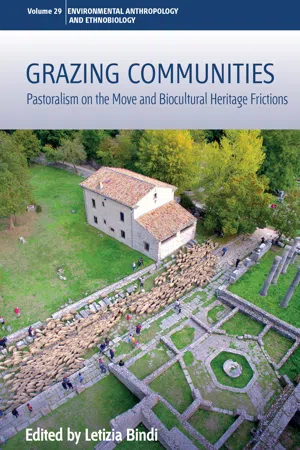
Grazing Communities
Pastoralism on the Move and Biocultural Heritage Frictions
- Letizia Bindi(Author)
- 2022(Publication Date)
- Berghahn Books(Publisher)
Although intensive and sedentary livestock farming has clearly become dominant in the last few decades in Europe, as in many other rural regions of the world, we find many groups of shepherds and herders still engaged in this kind of activity with their specific rules, ways of life, and systems of beliefs. Given that a significant component of traditional shepherds and herders practice more or less extensive forms of Transhumance, several classical studies have associated pastoral communities with nomadism/semi-nomadism. This framing sometimes ends up casting ethnographies of these groups as research on nomadic knowledge-practice systems more than studies of a specific way of livestock breeding. It is true that pastoralist communities usually move with their livestock from drylands or cold mountainous regions to more temperate and fertile ones, following the availability of grasslands and more favorable climactic conditions. Nonetheless, the focus of their “life world” should not be considered the nomadic experience, but rather their deep knowledge of territories and routes, their expert management of animals rooted in centuries-old traditions, and the consistent social organization and division of labor that this movement entails.Transhumance as a whole encompasses biodiversity conservation and enhancement, capillary maintenance of the lands, the protection of ancient forms of settlement often connected with wise and sustainable uses of resources (water, soil, pastures) and traditional forms of cooperation and economic circularity that could today be reconsidered and updated in a profitable way.More recently, sheep, cattle, and other livestock breeding has been transformed or influenced by processes of modernization, mechanization, and intensive milk/meat/wool production (Arhem 1984; Aronson 1980; Asad 1970; Chatty 1986; Ingold 1980; Nori and Scoones 2019; Salzman and Galaty 1990; Schlee 1989; Scoones 1995; Viazzo 1989). This has generated aspects of uncertainty, discontinuity, and change in practices, a shift in knowledge transmission and a vast socioeconomic transformation. Nonetheless, in many European countries the practice of Transhumance still exists as an efficient form of extensive farming that profoundly influences the landscape, biodiversity conservation, raw-material processing, particular uses of vernacular architecture, traditional social structures, systems of knowledge, and practices at large. It is probably in this sense that Tim Ingold opportunely indicates in the Foreword to this volume the “spirit of coexistence” as a possible perspective central to every current of revitalization of extensive and traditional pastoralism in Europe and invites us to “relearn from the animals and from those who herd them, how to become grazers ourselves.”
- Eugene Costello, Eva Svensson, Eugene Costello, Eva Svensson(Authors)
- 2018(Publication Date)
- Routledge(Publisher)
Chapter 1Transhumant pastoralism in historic landscapes
Beginning a European perspective
Eugene Costello and Eva SvenssonTranshumance – a Concept Better to Discuss Than to Define?
Pastoralism offers a vast field of study, and within it transhumant practices represent an important range of past and contemporary human mobility strategies. In its widest sense, Transhumance may simply be described as the seasonal movement of livestock. The Oxford English Dictionary adds some environmental qualification to this by defining Transhumance as “the action or practice of moving livestock from one grazing ground to another in a seasonal cycle, typically to lowlands in winter and highlands in summer”. The wide-ranging geographic and social implications of such a definition mean, of course, that the study of transhumant practices permits a very wide perspective on human society, touching on themes as diverse as livestock management, economic responsiveness, social mobility and competition for land. Furthermore, use of the relative words ‘lowlands’ and ‘highlands’ means that a considerable proportion of the earth’s surface may be considered as potential settings for Transhumance. There are consequently many ways in which people might conceive of and define the practice, and there has not been one, but many transhumant pastoralisms in Europe during historical times.For ethnographers, who long dominated the field of historical Transhumance, it was diversity, not shared experiences and characteristics that were emphasised. The importance of ethnography and ethnographic documentation of transhumant pastoral regimes all over Europe on the eve of their demise cannot be overestimated. These records are now invaluable to historical archaeologists working with transhumant pastoralism, especially as the field is difficult to access with only archaeological methods. They also form narratives of their own, transmitting Transhumance as a pre-modern, out-dated mode of production located in the peripheries of mainstream and modern farming, and not as a rational agricultural practice. Another prominent feature of the ethnographic narratives on Transhumance is regionalisation, emphasising geographically bounded regional, and even local, characteristics and traditions as structuring principles. These regionalised approaches have often been combined with both nature determinism and the assumption that characteristics of a cultural system are more strongly accentuated in the peripheries than the centres (See below “Transhumance and pastoralism – an overview”, with references; Svensson, Chapter 2 eBook - ePub
- John G. Evans(Author)
- 2004(Publication Date)
- Routledge(Publisher)
8
Transhumance
This chapter is about Transhumance, the way people move animals around in relation to the seasonal availability of grazing land and usually within a broader farming system. More deeply, the aim is to understand how these movements play a part in people’s social lives, and especially how they bring together individuals of different age and gender groupings so that future life-cycle events may be learnt about. It is about meetings which are less frequent than those of a routine kind (school, workplace, home and recreation), which last for a few days or several weeks, and which are among strangers or at least among people who do not meet in daily life. These are associations that come about in relation to the annual subsistence cycle at particular times of the year and on journeys or when a part of a family is moving around.In broadening things in this way it may seem that Transhumance is superfluous to such a programme: other practices offer similar possibilities. We could examine systems of mobility like the student year, relationships between town and country, or the modern business world, each of which satisfies similar social functions. We might also show that there were relationships between some of these systems, as with solitude and simplicity in Transhumance as an antidote to the intense communality of city life, and both of these institutions – Transhumance and the city – developed in some areas at around the same time. But I want to focus on just one of these because the point is easier to make through exemplification.Another reason for looking at a single system is that it allows us to explore the relative importance of different influences in its development and perhaps reveal unexpected ones. In a book on environmental archaeology, Transhumance is particularly relevant because of the way it is seen as being at the service of environmental and economic imperatives. Transhumance is a strong construct even with people who do not practise it. There is an attraction in the idea of different transformations in a common subsistence structure; there is an attraction in Transhumance being a consolidation in farming of a practice that is natural to animal flocks and herds; and there is an appeal in the way early agriculture may have developed out of such a natural system (). Yet we should not necessarily deconstruct Transhumance in this way, for maybe, too, it was similarly used in the past. eBook - ePub
Archaeology of Mountain Landscapes
Interdisciplinary Research Strategies of Agro-Pastoralism in Upland Regions
- Arnau Garcia-Molsosa(Author)
- 2023(Publication Date)
- SUNY Press(Publisher)
A central Tatra Park Project goal is to document seasonal migratory Transhumance between the park’s high montane, subalpine, and alpine environmental zones and lower mid mountains and foothills to the north. Transhumance refers to the economically (e.g., natural resource-based) driven, seasonal migration of animals and humans between ecologically and topographically varied landscapes within geographic regions. For Transhumance to be advantageous for a species (animal or human), a region should present a seasonally defined deficit of one or more important natural resources in one subregion and possess relatively greater resource abundance in another (usually adjacent) region or subregion in an alternate season. Both human and animal seasonal migrations associated with Transhumance can be classified as either horizontal, moving between geographic areas and eco-zones having limited rises or falls in elevation or vertical, involving more pronounced vertical ascents and descents (e.g., traveling between lower elevation valleys or plains and higher hills or mountains) (cf. Arnold and Greenfield 2006; Brunswig 2015:46–52; Carrer 2012, 2015; Geddes 1983; Hafner and Schwöer 2018). Seasonal movements between differing, adjacent eco-zones, as an example, migration into seacoast regions with summer season abundance of fish and sea mammals from inland winter camp areas or involving movement of hunting parties following migratory game herds from low-elevation mountain fall-winter-spring camps to high-tundra grazing land, reflect both the annual rhythm of human, animal, and plant cycles and their intimate economic codependency. Other types of natural resources, the presence of tool raw material (high-quality lithic stone or metal ores), seasonal concentrations of food and medicinal plants, mineral deposits (e.g., salt), and wild or domestic animal forage plants, can also contribute to the benefits of transhumant economic systems.Methods for inferring human Transhumance from archaeological and paleo-environmental records are diverse and frequently dependent on local and regional circumstances of geological and archaeological preservation. More common methods include chemical isotope ratios of carbon and nitrogen in human and animal bone and teeth, analysis of radiocarbon-dated bog and archaeological sediments for organic content, magnetic susceptibility, pollen, and charcoal content (associated with climate-related [e.g., natural] and anthropogenic [forest-clearing] fires), and transhumant migratory transfer of geographically sourced tool materials and mollusk shells outside their geologic origin locations (cf. Brunswig 2015:84–91; Dietre et al. 2014, 2016; Galop et al. 2013; Kienlin and Valde-Nowak 2002–2004; Leigh et al. 2016; Martin 2015; Nehlich et al. 2009; Rey et al. 2013; Riehl 2006). eBook - PDF
The Textile Revolution in Bronze Age Europe
Production, Specialisation, Consumption
- Serena Sabatini, Sophie Bergerbrant(Authors)
- 2019(Publication Date)
- Cambridge University Press(Publisher)
The main differentiation is between ver- tical or short Transhumance, where there is seasonal shifting between valleys and uplands, and horizontal or long Transhumance, which connects plains and mountain ranges on a seasonal basis (Wendrich and Barnard 2008). Regardless of the length of the mobility, in some areas the entire group moves from the summer to the winter pastures – like in Khazanov’s (1984, 21) ‘semi-sedentary pastoralism’ – and in other areas only specialised sub-groups move seasonally, while most of the group is sedentary, like in Khazanov’s (1984, 21) ‘herdsman husbandry’ and ‘Yaylag pastoralism’. Further significant discrimination can be found between ‘intra-regional Transhumance’, in which the herders own or have rights on the winter and/or summer pastures, and ‘inter-regional transhu- mance’, in which the herders move towards and into areas where they need to negotiate grazing rights (Cleary and Delano Smith 1992, 25–26).The latter, in turn, is usually called ‘normal Transhumance’ if pastoralists own land or access rights in their wintering area, and ‘inverse Transhumance’ if pastoralists own land or access rights in their summering area (Braudel 1949). The number of animals involved, as well as the type of livestock (capri-ovine or bovine), are other important factors affecting seasonal movements and thus contributing to the internal variance of Transhumance (Migliavacca 1991a). A further crucial aspect is the productive focus of the different transhumant strategies, since an emphasis on the exploitation of milk, wool, meat, or even a lack of specialisa- tion might have an influence not only on the type of breeds and on the age and sex ratio of the flock, but also on the mobility and management of the animals (Carrer 2015). eBook - ePub
Social and Ecological History of the Pyrenees
State, Market, and Landscape
- Ismael Vaccaro, Oriol Beltran(Authors)
- 2016(Publication Date)
- Routledge(Publisher)
Finally, despite the repeated announcements of its disappearance, the practice of Transhumance has continued up to now, even if the journeys are not always on foot. 6 Overall, in line with Roigé et al. (1995), the authors of this chapter see Transhumance as a strategy enabling pastures located in different ecological settings to be exploited in a complementary way throughout the annual cycle, in a particular social, economic, demographic, and political context. It is a historical activity but not one that can be explained as a survival from the past. Transhumance today is different from what it was 50 or 200 years ago: the people involved, the size of the flocks, the destinations and calendar of movements, the orientation and organization of production, and its relationship with other social and economic activities have all changed. Nevertheless, modern Transhumance cannot be understood solely in terms of the present, and must be seen in the light of the changes that came about in the Alta Ribagorga and the Pyrenees in the course of the 20 th century. For this reason, the context in which Transhumance is practised today and the processes of change it underwent in the course of the last century are outlined below. The geographical, economic, and demographic context The Alta Ribagorça is made up of the valleys that form the head of the Noguera Ribagorzana River, in the central part of the axial Pyrenees: the Barravés Valley with the Noguera Ribagorzana River, the Boí Valley with the Noguera de Tort River, the Castanesa Valley with the Baliera de Castanesa River and the Viu Valley with the stream of the same name. This is a high mountain area, with altitudes ranging from 800 metres at the bottom of the valleys up to over 3,000 metres at the peaks eBook - PDF
Challenging Preconceptions of the European Iron Age
Essays in Honour of Professor John Collis
- Wendy Morrison(Author)
- 2022(Publication Date)
- Archaeopress Archaeology(Publisher)
It is quite possible that ‘relaxed’ Transhumance movements through areas of extensive land use alternated with, or simply preceded, more strictly managed livestock journeys through more intensively used fields defined by more grid-like patterns of rectilinear boundaries. We also need to consider the prehistorians’ idea that the axes Figure 7. St Geniez, journey’s end: after a day of some 16 hours, during which they have covered about 40 kilometres, the cows are re-united with their calves (transported in the trucks) Andrew Fleming 62 of coaxial boundary patterns may have represented propitious or supernaturally sanctioned directions of movement (Fleming 2008: 192-9). As contexts for a persistent direction of travel, cosmology and Transhumance are not mutually exclusive; it’s highly improbable that early Transhumance, and the dairying often closely associated with it, was an exclusively ‘economic’ pattern of behaviour. Transhumance as a persistent cultural practice The wide geographical distribution of medieval Transhumance (which includes Cornwall and Devon) makes it look very unlikely that the practice was introduced to England by a recently-arrived Germanic elite. It seems that early speakers of English had a name for a characteristic type of landscape – ‘wold’ – which was evidently widespread enough to be recognised and appropriately named across a swathe of central England when it was encountered by incomers. It is unlikely that ‘wold’ landscapes - encompassing open areas and scattered zones of woodland in mosaic, as Fox envisaged - developed by random processes of vegetational succession alone; their distinctive character would have reflected the impact of grazing and browsing animals. As O’Connor (2009) has noted, ‘environmental stability is the exception rather than the rule’ and ‘long periods of environmental stasis may be more indicative [than change] of deliberate human intervention’. eBook - ePub
Agricultural and Pastoral Landscapes in Pre-Industrial Society
Choices, Stability and Change
- Fèlix Retamero, Inge Schjellerup, Althea Davies, Fèlix Retamero, Inge Schjellerup, Althea Davies, Althea Davies(Authors)
- 2014(Publication Date)
- Oxbow Books(Publisher)
Mesta organisation), as well as in Arles in Southern France, in the plains of the River Po or in the plains neighbouring the Apennines in Italy. However, as some examples here will show, the so-called Transhumance of livestock has also been a very common practice at smaller, local scales in most parts of Europe. It not only allows people to move the herbivores away from the fields, but also to exploit sometimes vast areas (ecologically) improper for cultivation, such as wetlands and bogs, woods or higher mountain slopes. In order to allow these tranhumances at various scales, European agro-pastoral societies have always elaborated very strict juridical systems defining local calendars for annual pastoral activities in terms of territorial allowances and bans. Here, precise local knowledge of the vegetation cycles of both cultivated and uncultivated areas tends to regulate the movements of livestock, especially in the cultivated areas between the end of the harvests and the beginning of a new vegetation cycle. Often (family) landownership can be more or less temporarily suspended by so-called ‘surface rights of common grazing’ when the fields are uncultivated or lie fallow. On the other hand, the grazing areas used during the agricultural season are often, but not always, collectively owned and herded. Especially in mountainous regions, the spatial separation of crops and pastures is vertically managed according to the different altitudes, sun exposures and geomorphologies. But also in less steep and even rather flat regions, the seasonal variations in, for example, precipitation or drought can determine the local pastoral areas like moorlands or river- and lakesides.The botanical characteristics of the cultivated crops as well as the ethological specificities of the animal breeds and species concerned, have often been locally selected and adapted and form specific, recognisable ensembles of agro-pastoral practice. These ensembles of domesticated cultivars and animal breeds also come to shape local landscapes through specific field patterns, physical or juridical divisions, paths, enclosures, roads and other developments such as irrigation or drainage. As various cases studied here show, the temporary removal of livestock from the cultivated areas, is written into the landscape by the existence of temporary habitats, livestock enclosures and other specific pastoral facilities like isolated hay-barns or watering places.
- Cornelia Flora(Author)
- 2001(Publication Date)
- CRC Press(Publisher)
These local communities attempt to access a determined territory and bar the access to all “noncrianceros” from the local area or other areas. Shepherding, as prac-ticed by the Patagonia crianceros, differs from free access to resources. TRANSHUMANT AGROECOSYSTEM Livestock movement is regulated by the cyclical rhythm of the seasons, and house-hold activities adjust to these cycles. Each year, a temporary change of settlement fol-lowed by a return marks the beginning of a new cycle. The transhumant system is attached to the landscape and weather, which determine grazing possibilities. Where-as the crianceros previously moved their livestock four times a year in response to forage availability, the privatization of the river valley land has reduced the cycle to moves in the summer (to the mountains) and the winter (to the desert). The circuit consists of the summer pasture, the winter forage, and the livestock trail that connects them. In the summer season, the livestock are moved to high moun-tain valleys, 1,200 m above sea level. This environment provides pasture and water to the flock during the summer days. The length of stay varies from 3 to 5 months, based on the distance from the winter fields and the altitude of the summer fields. In the winter season, the livestock move to the plateau and lower valleys. Water and pasture availability are very limited by the end of the winter. Transhumance efficiency declined drastically with the formation of large farms in the best precordillera fields. The distances involved in the circuit vary considerably, from a few kilometers to more than 200 km. Livestock feeding, livestock composition, number of livestock, and landscape characteristics determine the cycle length. The crianceros accom-pany the migration on horseback, with cargo animals (mules saddled with cargo bas-kets), or with old-model, deteriorated pickup trucks (Bendini and Tsakoumagkos, 1994). Transhumant Communities and Agroecosystems in Patagonia 107 No longer available |Learn more
Crossing Boundaries
Legal and Policy Arrangements for Cross-border Pastoralism
- Food and Agriculture Organization (FAO)(Author)
- 2019(Publication Date)
- United Nations(Publisher)
Box 1. Protecting the environmental benefits of Transhumance Livestock mobility in Spain is made possible by the existence of a vast network of cattle trails, called caña- das. This ancient network comprises around 110 000 km of tracks protected by the 1995 Vias Pecuarias Act (Ley 3/1995, 23 March 1995). The Act recognizes the role of Transhumance on foot in maintaining pastoral resources and lays down a legal system for the governance of cattle trails. The legal document states: “the economic and social importance involved in seasonal migration to new pastures during centuries is not held in doubt.” The document also recognizes that cattle trails are “ecological corridors, essential to migration, geographic distribution and the genetic exchange of wild species.” The Act defines administrative powers over livestock trails, classification and demarcation, rules gov- erning modification of routes, occupancy and use rights, compatible and complementary uses, and infringements and sanctions. Its enactment has led to greater popular support for pastoral mobility and an increase in the practice of traditional Transhumance, which had become eroded over previous decades. This, in turn, has generated an appreciable resurgence of mountain biodiversity as a result of the improved ecological connectivity. Source: Ministry of Agriculture, Food and Environment (2012). “ Herd movements are central to pastoral cultures and play an important role in shaping identity and promoting social cohesion ” 5 LEGAL AND POLICY ARRANGEMENTS FOR CROSS-BORDER PASTORALISM The nature of pastoral mobility is determined by many factors, although utilization of ephemeral resources (Krätli et al., 2013) is the most important. In mountain regions, herd movements are between high-altitude pastures that are available in warm months and low-altitude pastures that provide protection during the cold season. eBook - PDF
- Elizabeth C. Robertson, Jeffrey D. Seibert, Deepika C. Fernandez, Mark U. Zender(Authors)
- 2006(Publication Date)
- University of Calgary Press(Publisher)
Journal of Archaeological Science 27: 391–407. Niamir-Fuller, M., and N. Turner. |1999| A Review of Recent Literature on Pastoralism and Transhumance in Africa. In Managing Mobility in African Rangelands: The Legitimization of Transhumance , edited by M. Niamir-Fuller. Food and Agriculture Organization of the United Nations, Rome. Paine, R. |1994| Herds of the Tundra: A Portrait of Saami Reindeer Pastoralism . Smithsonian Institution Press, Washington, D.C. Payne, S. |1973| Kill-Off Patterns in Sheep and Goats: The Mandibles from AΑvan Kale. Anatolian Studies 13:281– 303. Rafiullah, S. M. |1966| The Geography of Transhumance . Aligarh Muslim University, Aligarh. Shennan, S. |1988| Quantifying Archaeology . Edinburgh University Press, Edinburgh. Sterud, Eugene |1978| Prehistoric populations of the Dinaric Alps. In Social Archaeology: Beyond Subsistence and Dating , edited by Charles L. Redman, M. J. Berman, E. V. Curtin, W. T. Langhorne, Jr., N. M. Versaggi, and J. C. Wanser, pp. 381–408. Academic Press, New York. Walker, M. J. |1983| Laying a Mega-Myth: Dolmens and Drovers in Prehistoric Spain. World Archaeology 15:37–50. 253 ABSTR ACT With the recent over emphasis of a coastal migration route for the first Americans to the near exclusion of an ice-free interior route, there is a need for rational-ity. The purpose of this exercise is to show that the latter is still a viable working hypothesis. Clovis-site geochronology correlates with north-ern hemisphere climate changes of the Pleistocene-Holocene transition. Deglaciation chronology and paleoecological evidence from Alaska and Canada can reasonably be correlated with the same paleoclimate data. These indicate that a rapid movement of Nenana explorers from the Yukon Plateau along the Interior Plains of Canada to the Anzick site in Montana may have been possible during Allerød time. eBook - ePub
- C. R. Whittaker(Author)
- 2020(Publication Date)
- Cambridge Philological Society(Publisher)
Transhumance IN ANCIENT GREECE Most students of ancient history know that in ancient Greek literature we possess two, and only two, real descriptions of Transhumance proper. In Oedipus Rex 1121 sqq. Sophocles tells the story of Transhumance normale : two shepherds, one from Corinth and one from Thebes, are summer pasturing their flocks on mount Cithaeron from early spring to the rise of Arcturus. Then they return to their home cities in the lowlands. 1 About five centuries later Dio Chrysostom gives a charming account (Or.7) of two brothers in Euboia who had been herdsman of a rich man. When he died, apparently murdered by Domitian, they withdrew to the mountains where they had their summer dwellings. This was their real homestead and when winter came and no work was available in the town, they made their huts tighter and stayed in the hills living by tilling a kitchen garden and hunting. Although the situation is somewhat irregular, it looks like Transhumance inverse, where the more permanent houses are situated in the mountains. If we look at the terminology which the shepherds in Sophocles use, the words epaula and stathma to the winter dwelling in the lowlands, and at Oedipus’ use of the word synaulos, it seems obvious that aule was used for the summer dwelling as well. Stathmos is used by Dio of the summer dwellings which become permanent when the skene is made tighter, and the winter dwellings in the lowlands are called skene and aule. Most likely there is no great difference between the housing of men and cattle in the different areas. If we add to this the myth of Kerambos, told by Antonius Liberalis (22), we exhaust the literary evidence. Kerambos did not trust the warnings of Pan and the Nymphs that it was necessary to winter pasture in the lowlands and therefore he lost his sheep when snow came, and he was transformed into a Kerambyx. Alexander’s speech to his soldiers reported by Arrian (7.9.2) has been mentioned in the same connection
Index pages curate the most relevant extracts from our library of academic textbooks. They’ve been created using an in-house natural language model (NLM), each adding context and meaning to key research topics.
