Geography

Pastoral Nomadism
Pastoral nomadism is a traditional form of subsistence agriculture practiced by nomadic communities who rely on herding animals for their livelihood. These nomads move with their livestock in search of fresh pasture and water, adapting to the seasonal availability of resources. This lifestyle is often found in arid and semi-arid regions where sedentary agriculture is not feasible.
Written by Perlego with AI-assistance
Related key terms
1 of 5

11 Key excerpts on "Pastoral Nomadism"
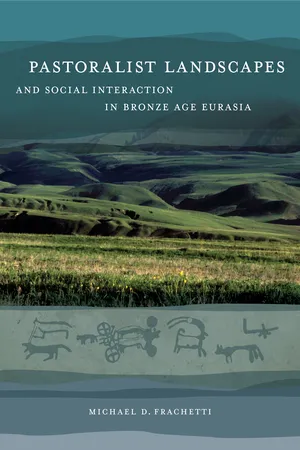
- Michael David Frachetti(Author)
- 2009(Publication Date)
- University of California Press(Publisher)
Locales such as seasonal pasture zones, settlements, and ritual sites shape a broad geography of interactions, which, I suggest, frames the most distinguishing ontological reality of pastoralist populations. Nomadic pastoralism is most commonly understood as a social and economic strat-egy predominantly based in routined (such as seasonal) migratory management of domesticated herd animals (Lattimore 1940, 54; Barth 1964, 4; Khazanov 1994, 17). Etymologically, the words “nomadism” and “pastoralism” imply pasturing or raising of herds (Salzman 2002, 245). A number of scholars, such as Barfield (1993, 4), note that the term “nomadism” is also used in association with other mobility strategies (such as hunting/foraging) (see also Barnard and Wendrich 2008). Thus, “nomadic” is com-monly used as a referent to movement or mobility, and “pastoralism” refers to a produc-tive economic strategy: “raising livestock on natural pastures” (Salzman 2002, 245). Much of the earliest ethno-historical work concerning pastoralists was guided by the categorical inclusion or exclusion of particular societies as “nomads” (Myres 1941; Bacon 1958). Although arguably more sophisticated, the categorization of socio-functional types of nomadic systems can still be found in contemporary literature (Khazanov 1994) and its critique has also been prolific (Ingold 1985). Archaeological studies of nomadic pastoralism have been hindered by reductive modes of classification as well. Roger Cribb (1991, 16) astutely notes that the archaeologist’s ability to document the origins or emer-gence of nomadic pastoralism, for example, has depended largely on the identification of defining attributes, such as extent of mobility or inclusiveness of agriculture, to index typologically a population along an arbitrary continuum of nomadism. Salzman (2002, 249) characterizes nomadic strategies as highly variable and flexible, rather than typologically distinct. No longer available |Learn more
Crossing Boundaries
Legal and Policy Arrangements for Cross-border Pastoralism
- Food and Agriculture Organization (FAO)(Author)
- 2019(Publication Date)
- United Nations(Publisher)
The people who practise pastoralism are often called pastoralists, and mo- bility of livestock herds is often inseparable from mobility of pastoral com- munities. The extent of movement differs greatly between societies. Some pastoralists live in permanent settlements throughout the year, moving their herds over relatively short distances between seasons, while others are almost entirely mobile, relocating their households seasonally as herds are moved to new lands (see Figure 1). However, even in the most nomadic of pastoral so- cieties, herd movements follow patterns and pastoralists have a deep sense of belonging to certain landscape features and a strong ownership over fixed resources, such as water points, pastures and salt pans. Typical features of pastoral production systems Pastoralism has been described as “the finely-honed symbiotic relationship between local ecology, domesticated livestock and people in resource-scarce, climatically marginal and highly variable conditions” (Nori and Davies, 2007). “ Pastoralism in its various forms occupies about one- third of all land on earth, providing high-value livestock products while simultaneously protecting a vast area of natural heritage ” 3 LEGAL AND POLICY ARRANGEMENTS FOR CROSS-BORDER PASTORALISM It is a sophisticated form of natural resources management based on a contin- uous ecological balance between pasture, livestock and people. A central fea- ture in many pastoral systems is herd mobility, which enables strategic use of heterogeneous resources and is the basis of the overall productivity and resil- ience of pastoralism. Herd mobility contributes to sustainable management of rangeland ecosystems, playing a role, for example, in seed dispersal and ger- mination rates. Many of the most productive fodder plants thrive under the influence of large, mobile herds of grazing animals, producing some of the world’s most iconic landscapes, such as the Serengeti and the Asian steppe. eBook - ePub
- Mark Q. Sutton, E. N. Anderson(Authors)
- 2020(Publication Date)
- Routledge(Publisher)
8 PastoralismPastoralism is that form of agriculture in which the practitioners specialize in, and obtain their primary subsistence from, the husbandry of one or a few domesticated animal species. These species are invariably herbivores: cattle, horses, sheep, llamas, alpacas, goats, camels, reindeer, and similar animals. Plant cultivation often forms one component of pastoralism but is not generally dominant. In some cases, however, such as reindeer, the species of focus is not domesticated.A precise definition of pastoralism is elusive, with the primary disagreement centering around the proportion of horticulture to agriculture in the economy and the degrees of mobility (see Krader 1959:499; Khazanov 1984:7, 15–17; and Cribb 1991:15–17, 20; also see Spooner 1973; Weissleder 1978; and Goldschmidt 1979). The term “nomad” has generally been used by anthropologists to refer to mobile pastoralists and should not be applied to hunter-gatherers (see Krader 1959:499). A brief history of the study of pastoralists has been presented by Neville Dyson-Hudson (1972:2–7; also see Waller and Sobania 1994).Pastoralists and their animals have developed a long-term mutually beneficial relationship (see Krader 1959:501). Animals provide humans with products such as meat, milk, hide, dung, wool, and labor and with services such as companionship and the transportation of people and goods. Humans provide animals with protection from predators, a steady food supply, health care, an expanded habitat, and assured reproductive success.Pastoralism requires a great deal of land as a pasture base. It is generally more productive (calories per acre) than most hunting and gathering but less productive than farming. However, pastoralism can be very efficient in areas unsuitable for farming. Pastoralists utilize their animals to convert unusable biomass from one trophic level into usable products at another trophic level: Grasses that humans cannot digest are converted into milk and meat that they can eat. Even though using the animals involves an additional trophic step, it is highly efficient in such circumstances because people cannot use the grasses anyway. However, the use of supplemental feed, such as corn, that humans could directly consume is a very inefficient use of resources, and few pastoralists do it. eBook - ePub
Time Resources, Society and Ecology
On the Capacity for Human Interaction in Space and Time
- Tommy Carlstein(Author)
- 2019(Publication Date)
- Routledge(Publisher)
4Nomadic PastoralismSome Characteristics of Nomadic Pastoralism
Nomadic pastoralists, or pastoral nomads, like many present day hunter-gatherers occupy marginal habitats. Their form of spatial mobility which has rendered them the epithet of ‘nomads’ is highly related to the marginality of their resource base, while their dependence on domestic livestock, on the other hand, sets them clearly apart from hunters dependent on wild food. The criterion of low regional population density and a less than ‘sedentary’ form of livelihood associated with the occupation of marginal habitats warrants their place next in this book following the hunter-gatherers.The objective of this chapter is not to produce a concise theory of nomadic and other types of pastoralism, but to furnish models which epitomize salient features and key mechanisms found among nomadic and transitional types of pastoralists. The present chapter draws on the materials assembled in Johnson’s comparative survey on ‘The Nature of Nomadism’ (1969) in conjunction with various case studies.The term ‘nomadic pastoralisť used here evaluates pastoralism as an ecotechnology first and mobility second. If the choice of technology is such that animals are tended and the main source of livelihood is not agriculture, then the fact of spatial mobility over time is largely induced by the livestock herds in relation to the resources in the habitat.According to cultural evolutionary theory, nomadic pastoralism has evolved from agriculture mixed with animal husbandry, rather than vice versa. A different train of events has most likely been the case with the evolution of the reindeer ecotechnology in northern areas, where Pastoral Nomadism could have developed from hunting.** eBook - PDF
The Gaddi Beyond Pastoralism
Making Place in the Indian Himalayas
- Anja Wagner(Author)
- 2013(Publication Date)
- Berghahn Books(Publisher)
These study and research interests at least partly hinge on de fi nitions of pastoralism, nomadism, and transhumance, which in themselves de fi ne directions of research. Before I further engage in a discussion of pastoralist studies, it is therefore necessary to consider the basic terminology used in the fi eld. On a general note, the terms pastoralist, nomadic, and transhu-mant are o Ğ en used either interchangeably or in combined expressions such as nomadic pastoralism, Pastoral Nomadism, or transhumant pas-toralism. In distinctions that are more clear-cut, pastoralism is the most general term, signifying a system of production, such as in, “the use of extensive grazing on rangelands for livestock production” (Food and Ag-ricultural Organization of the United Nations [FAO] 2001: introduction, overview). Following the distinctions of the FAO, pastoralism in turn can 20 • The Gaddi Beyond Pastoralism be categorized according to the degree of movement involved in herding practices from “nomadic through transhumant to agropastoral” (ibid.: in-troduction, pastoral enterprises). However, “any classi fi cation of this type must be treated as a simpli fi cation; pastoralists are by their nature fl exible and opportunistic, and can rapidly switch management systems as well as operating multiple systems in one overall productive enterprise” (FAO 2001: introduction, pastoral enterprises). The FAO distinguishes nomadic pastoralism from transhumant pas-toralism by the de fi nition that nomadic movements, albeit following es-tablished migration routes, vary from year to year in search of pasture. Transhumant movements follow regular routes in the seasonal exploita-tion of pastures. Transhumance is associated with permanent homes and o Ğ en some agriculture. It varies from agropastoralism through the la Ĵ er’s de fi nition as the cultivation of su ffi cient land for subsistence and grazing areas within the reach of villages (FAO 2001: introduction, pastoral en-terprises). eBook - ePub
- Hilton Kramer, Kenneth Walton(Authors)
- 2017(Publication Date)
- Routledge(Publisher)
7 Pastoralism—A Basic Dry-Land ResponseThe green spots and strips of irrigation cultivation seen on a satellite photograph of the arid lands occupy a much smaller area than other types of land-use. Dry farming has been shown to fill in some of the gaps but by far the most ubiquitous economic response to dry lands is pastoralism. Pastoralism, however, embraces many ways of life and standards ot living. At one end of the scale is the wealthy rancher of cattle or sheep in the USA or Australia who produces beef and hides, mutton and wool as a commercial enterprise with a title to hundreds of square miles worked from a permanent base and providing paid employment for a few tens of people. This way of life is far removed from that of the nomads of the Old World whose objective is subsistence for themselves and their families. There are, in fact, as many different forms of pastoralism as there are methods of cultivation in the arid lands. Pastoralism is also a way of life which has been subject to rapid changes in scale and distribution, changes which have been initiated by changes in the environment, as through climatic change or rainfall variability, or through social, economic and government pressures.Evidence from the Old World points to south-west Asia as the area in which animals were first domesticated although as yet there is no absolute agreement as to the ways in which this was achieved. Some believe that in areas where game was relatively scarce, as in most of the arid lands, there was an incentive to capture and to keep the animals alive until they were required for food. Others prefer the concept that, in the period of desiccation which followed the pluvials of the glacial periods, man and animals were drawn together by common need at water points and that from this unity of interest in survival there was the opportunity for domestication. In more humid areas where game was plentiful quite large communities could live above day-today subsistence level and have the leisure to elaborate the arts depicted by the prehistoric inhabitants of the caves at Lascaux in France, at Altamira in Spain or by the rock paintings of the Ahaggar in the Sahara. In such localities and under such climates there was less incentive to domesticate since a ready supply of comparatively slow-moving animals was available provided that population increase did not outstrip local food supplies. eBook - PDF
Let Shepherding Endure
Applied Anthropology and the Preservation of a Cultural Tradition in Israel and the Middle East
- Gideon M. Kressel(Author)
- 2012(Publication Date)
- SUNY Press(Publisher)
Herdsmen accommodating themselves to the life patterns of seden- tary neighbors are to this day still described (Lewis 1987: 8) as being lured by the prospects of good grazing and of raiding. The same view is espoused in a number of studies published in a recent anthology on the archaeology of Pastoral Nomadism in the Levant (Bar-Yosef and Khazanov 1992). In fact, the latest Asia-Africa migrations across the Sinai point to a more complex situation, requiring the observer to portray the historical phenomenon with greater precision. In the present book we maintain that the conventional view that contacts between pastoralists and agriculturalists were merely based on economic modes of exchange falls short of accounting for a complex reality. Thus Middle Eastern archaeology has revealed the existence of 4 Let Shepherding Endure pastoralist sites (Rosen 1988,1992, 1993; Rosen and Avni 1993), though it has yet to show that the artifacts and other debris discovered there were produced by the nomads themselves. Migration Patterns and Power Dynamics Since ancient times, long-distance migration was largely a joint tribal affair. Peoples organized themselves into communities or tribes with a wide assortment of historically different patterns and modes of subsistence as they sought safety in numbers on these treks. Human cultural heritage since the Old Stone Age reinforced the link obtaining between common descent (with the concomitant heritage of shared customs) characterizing a group of people, and its possession and control of territory. These were apparently the earliest distinctive traits of tribes (Sahlins 1968). The ethnocultural background proper to Neolithic times, especially the emerg- ing pattern of pastoral life, emphasized the instrumentality of tribalism for maintaining rights over grazing lands and water resources. eBook - PDF
The Nomadic Alternative
Modes and Models of Interaction in the African-Asian Deserts and Steppes
- Wolfgang Weissleder(Author)
- 2011(Publication Date)
- De Gruyter Mouton(Publisher)
In the dry season all these people revert to the nomadic way of life. Nomadic pastoralism is thus mainly an adaptation of people with an undeveloped technology to the scarcity of water in the dry season. People utilize water wherever it may be found. When the reserves are exhausted in one place they move to another site, usually in a fairly regular annual cycle. Most of these areas do not lack pasture during ordinary years. As the population grows and the herds increase - and sometimes this process is accompanied by an expansion of the settled population, which in itself causes a further decrease in pasture areas - the pasture also becomes a scarce commodity. Such changes are liable to end the nomadic way of life, since the continuous coordination of two scarce factors of production, neither of which has a substitute, is beyond the capability of the nomad. Even in regions which usually supply all the nomad's needs, such situ-ations may occasionally arise and cause a crisis. Musil describes such a situation which caused the Rwala great consternation: Hmär avowed that he had no memory of any such egregiously unfavorable season in thirty years. Where pasturage was abundant, water was absent, and where there was water, there was no pasturage (1927: 110).® Shortage of water is due to inadequate rainfall and the many fluctua-• A romanticized account of such a crisis can be found in C. R. Raswan (1936: 85ff.). Spurred on by the sight of their starving camels, the Rwala Bedouin invaded the terri-tory of a neighboring tribal group, and in the resulting fighting numerous lives were lost. Ecology and Politics of Middle Eastern Pastoralists 47 tions therein. The pastoral nomad needs a minimal amount of rain even in areas of winter pasture and certainly in summer grazing grounds. eBook - ePub
Climate Change Adaptation in Africa
An Historical Ecology
- Gufu Oba(Author)
- 2014(Publication Date)
- Routledge(Publisher)
3 Pastoralism, space, time and knowledgeSocial and ecological perspectivesWe know that from the tenth to the twelfth centuries ad, the climate situation may have been similar to the present day, when the mechanisms of pastoralist adaptations clearly assumed a common pattern of grazing movements. What is certain is that Neolithic pastoralists had a comparable understanding of temporal and spatial concepts (time and space) and local geographical knowledge that they used as adaptive tools for survival in their changing environments. Their knowledge enables us to understand the different types of land use that evolved in response to the changing natural environment, implying that “human activity, [both] practical and symbolic, has a direct relationship with nature” (Sanga 2004). The direction of environmental change in response to long-term use requires us to understand pastoralism in the context of space, time and knowledge as used by herders as well as our ability to interpret the past.Environmental changes that influenced different sequences of population movements might have been driven by human activities. The use of fire, livestock grazing and periodic occupation of particular landscapes transforms them from wild to domesticated landscapes. Wild landscapes harbour pests such as biting flies and are therefore avoided. Settlements convert wild landscapes into domesticated ones, while abandonment brings about the reverse. The dynamics of settled and wild landscapes change in accordance with population movements and fluctuations in the climate. During periods of epidemics when livestock and people died, domesticated landscapes reverted to the wild, showing that landscape changes are “connected to past environmental memory” (Sheltler 2007: 5, 6). Environmental changes influence economic relations among local populations, such as when the vegetation shifts from grassland to bush lands, shifts in patterns of land use occurred – for example, populations that managed grazers moved out and populations that managed browsers moved in (see Chapter 7 eBook - ePub
As Nomadism Ends
The Israeli Bedouin Of The Negev
- Avinoam Meir(Author)
- 2019(Publication Date)
- Routledge(Publisher)
It transpires from this that territorial tendencies may exist in a latent form among pastoral nomads, being put into practice only when the ideological conditions are ripe. This example may be seen as an illustration of the notion discussed above that institutionalized alternatives are kept in reserve and are activated only when circumstances make them desirable. In essence, pastoral nomadic societies are located at the minimal territoriality end of the continuum and begin to move away from it primarily when major economic and political processes begin to affect the society and environment. At this stage, however, territorial capacities imply that the relationships that exist now between the number of persons that can be supported directly by agricultural or other resources may be different from the type of relationships that existed previously between the number of animals and pasture resources that was crucial for the survival of the pastoralists (Dyson-Hudson and Dyson-Hudson 1980). This leads us to the relation between the demographic issue and the process of sedentarization.Demographic Dynamics and Behavior
In contrast to the issue of territoriality, that of demographic dynamics and behavior among pastoral nomads during transition has received relatively little attention. This may perhaps be attributable in the main to difficulties in identifying and defining the various groups along the nomadism-sedentarism continuum, enumerating them or obtaining accurate vital statistics concerning them. Yet the issue is of considerable significance, particularly given that sedentarization and a shift in the balance between pastoral and nonpastoral modes of production has become a dominant reality for many pastoral nomadic societies. As indicated above, this shift implies major changes in ecological relations of food production that are associated with changes in economic and social structure. These processes have important consequences in terms of demographic regime and dynamics, but primarily in terms of individual demographic behavior. It is the latter issue that is of particular importance and it will be discussed after the more general discussion of demographic processes during transition away from pastoralism. eBook - PDF
Tropentag 2012
Resilience of agricultural systems against crises
- (Author)
- 2012(Publication Date)
- Cuvillier Verlag(Publisher)
Pastoralism and rangelands — Contents I TISHREE P ATTNAIK , J HARNA P ATHAK : Issues and Challenges of Current Agricultural Patterns in India: A Step Towards Sustainability 35 S HANG Z HANHUAN , R.J. L ONG , L.M. D ING , X.S. G UO : Rangelands Ecosystems of the Tibetan Plateau: their Current Status and Sustainable Development Strategies 36 17 'LHVHV :HUN LVW FRSULJKWJHVFKW]W XQG GDUI LQ NHLQHU )RUP YHUYLHOIlOWLJW ZHUGHQ QRFK DQ 'ULWWH ZHLWHUJHJHEHQ ZHUGHQ (V JLOW QXU IU GHQ SHUV|QOLFKHQ *HEUDXFK Animals Strengthening Resilience of Pastoralists through Improved Economic Integration M ARIO Y OUNAN 1 , D AVID M. M WANGI 2 , E. N JUGUNA 2 , W ILLI D ÜHNEN 1 1 Vétérinaires sans Frontières Germany (VsF G), Kenya 2 Kenya Agriculture Research Institute (KARI), Kenya Many arid and semiarid environments are rapidly approaching a precarious ecological state. The session on ‘Pastoralism and Rangelands’ will look at potential solutions for a range of problems that affect pastoralist livestock production at present; these include: 1. The need for an ecologically balanced Natural Resource Management in the face of rapidly increasing human and livestock numbers in the drylands, sus-tainable utilisation of tropical rangelands being a major focus for this session 2. The need to improve market access and provide a more robust marketing in-frastructure (agricultural value chain approach, public-private partnerships in the management of livestock markets) 3. Workable mechanisms to buffer pastoralist livelihoods against external shocks (Early warning systems, Livestock insurances) 4. Full utilisation of new opportunities created through the advance of modern communication technology, banking services and electronic cash transfer sys-tems in remote regions This paper proposes that increased and more stable incomes are a major contribu-tion to buffer pastoralist households against external shocks and to strengthen the resilience of pastoralist communities.
Index pages curate the most relevant extracts from our library of academic textbooks. They’ve been created using an in-house natural language model (NLM), each adding context and meaning to key research topics.
