Geography

Ranching
Ranching is a form of agriculture focused on raising livestock, typically cattle, on large open land areas known as ranches. It is commonly associated with the American West and other regions with extensive grasslands. Ranching involves managing the animals, maintaining the land, and often includes activities such as herding, branding, and caring for the livestock.
Written by Perlego with AI-assistance
Related key terms
1 of 5

4 Key excerpts on "Ranching"
 eBook - ePub
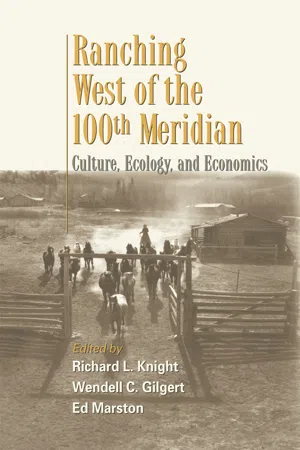
Ranching West of the 100th Meridian
Culture, Ecology, and Economics
- Richard L. Knight, Wendell Gilgert, Ed Marston, Richard L. Knight, Wendell Gilgert, Ed Marston(Authors)
- 2012(Publication Date)
- Island Press(Publisher)
23 Rather than lark buntings and bobcats, we will have starlings and striped skunks. Rather than rattlesnakes and warblers, we will have garter snakes and robins. Is that the West we want? It will be the West we get if we do not slow down, get to know the human and natural histories of our region better, and then act to conserve them.Ranching: THE VIEW FROM HERE
The West is a region of diverse ecosystems, cultures, and economies. Ranching as a land use, and ranchers as a culture, have been with us for more than four hundred years, dating back to the early Spanish colonists who struggled northward over El Paso del Norte and found a home for their livestock near present-day Espanola, New Mexico. Today, more so than at any time in its history, the Ranching culture is under assault. If what I have presented in this essay is true—that ranch lands are compatible with our region’s natural heritage and that herbivory is a necessary ecological process in the restoration and maintenance of healthy rangelands—then why are ranchers and livestock grazing so vilified? Why have scores of environmental groups banded together for “a prompt end to public lands grazing”?24Could it be a difference in values? I began this essay by reporting how a conservation biologist wrote a review of livestock grazing that universally condemned it as a land use incompatible with biodiversity. In trying to understand how his review differed from what other scientists have reported, ranging from the National Academy of Sciences to noted plant ecologists, I began to wonder if it was just a difference in values. Might some westerners want the public and private lands free of manure, cows, sheep, and fences because they want them for their own uses—such as mountain biking and river rafting? Do some want ranchers and their livestock off the western ranges because they believe what others have told them—that cows and sheep sandblast land and that cattle barons are arrogant bastards intolerant of any but their own kind? Certainly differing values and distorted mythology can obscure facts; at the end of the day, emotion may trump judgment. Would it make any difference if we found that ranchers are stewards of the land, that cows are being used as a tool in the recovery of arid ecosystems, that open space, biodiversity, and county coffers are enriched more from Ranching than from the rapidly eclipsing alternative, ranchettes? Perhaps.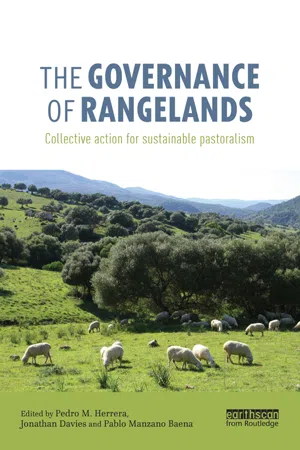 eBook - ePub
The Governance of Rangelands
Collective Action for Sustainable Pastoralism
- Pedro M. Herrera, Jonathan Davies, Pablo Manzano Baena(Authors)
- 2014(Publication Date)
- Routledge(Publisher)
On some government lands, where the public also holds rights to benefit based on the governance institutions for these “public lands,” the amount and nature of the resources allocated to each type of use and user is a subject of contention, and sometimes costly litigation. Different constituencies seek to invoke their rights of access in order to advance their ability to benefit from public lands. For example, the Multiple Use Sustained Yield Act of 1960 and the Forest and Land Management Planning Act of 1972, hold that the Forest Service and the Bureau of Land Management, respectively, must manage public lands for multiple uses, but the statutes do not provide guidance on priorities or methods of allocation among those uses. Pastoralist ability to benefit, then, can be heavily influenced by political and managerial decisions about the rights to benefit from diverse user groups, and by changes in or interpretations of environmental regulations pertinent to livestock grazing. As a Forest Service natural resource manager commented at a 2013 symposium, “for the rancher using the national forest the [environmental] bar keeps getting higher every year.” In California, Arizona, and Texas, ranchers have established grassroots local governance organizations that help them maintain the ability to benefit from rangelands in ways that fit to local tenure and institutional arrangements, and to build resilience to shifts in policy and markets that might have an impact on their ability to maintain access to and benefit from rangeland resources.Evolution of Ranching land tenure in the Western United States: a general overviewA general history of livestock grazing in the western United States begins with the implantation of livestock in the Southwest. In 1598, Spanish settlers brought cattle, sheep and goats into what is now New Mexico. For about 200 years, Spanish and Mexican land grants, thousands of hectares in size, were given to individuals and communities for farming, grazing, and woodcutting. Local tribes, such as the Navajo, adopted livestock grazing very early on (Bailey 1980). In California, a short-lived Spanish colonization began in 1769, and as in the Southwest was then superseded by Mexican control in 1822, and finally by the United States in 1848. In the Spanish and Mexican periods of California large land grants were given out to individuals for Ranching, leaving a legacy of some extensive private rangeland ownerships.In the mid-nineteenth century, settlers from eastern regions moved rapidly into the arid western territories, drawn by the Gold Rush and other mining strikes, and by abundant open land for settlement. This land was known as the “public domain” as it belonged to the federal government and it was originally designated for privatization and development through sales and grants. American land allocation policies were eventually implemented that, beginning with the 1862 Homestead Act, limited settler land claims to a few hundred acres. These claims were made in the rare areas with decent soils and water for irrigation, leaving arid and mountainous land in the public domain. In the Southwest and California, under American governance, the majority of community and individual grants given out by the Spanish and Mexican governments were abrogated by the courts, ceded to clever entrepreneurs and lawyers, or returned to the federal or state governments for back taxes, and only rarely remained in the hands of some of the grantees (de Buys 1985). eBook - PDF
- Frank H. Baker(Author)
- 2019(Publication Date)
- CRC Press(Publisher)
Each ranch has its peculiar objec-tives, ecological features, market situations, financial capabilities, and the personal preference of its owner. As Penfield (1982) wrote, The most important element in a grazing sys tern involves a commitment EY you to make it work. And at the same time the rancher must be committed to working with nature not against it--a principle to be kept in mind when selecting a grazing system. Both native rangelands and cultivated forage commun-ities and their biological and economic ecosystems lead ultimately to the production of livestock products used by man, Most lands under livestock or wildlife production have unbalanced ecosystems in which one or more of the major con-stituents (plant, animal, or man) has a chronic or seasonal lack of nutrients, water, or other environmental requirement (Whythe, 1978). It is the responsibility of the soil and crop scientists to help overcome these deficiencies. But it is the rancher, the manager of the range, who has to decide whether the proposals of the scientists and the new discov-eries are economically acceptable; the rancher, after all, is part of the ecosystem in which he lives with his domestic livestock. TYPES OF GRAZING SYSTEMS The number and variation of grazing systems is almost infinite, Every ranch has its peculiar characteristics-- 997 even adjoining ranches with similar ecological conditions differ in objectives, management, and financial capabil-ities. For this presentation we will consider some of the most common grazing systems, knowing that within each of them the variations are numerous. Any rancher can identify with one of these models and design his own system. Continuous Grazing Continuous grazing is the constant use of forage on a given area, either throughout the year or during most of the growing period. This type of grazing does not always result in range decline (overgrazing). eBook - PDF
- Marcus Colchester(Author)
- 1997(Publication Date)
- LAB (Latin America Bureau)(Publisher)
5 The ranchers soon found that the very poor soils of the savannahs and the tough grasses that grew on them did not allow intensive cattle-Ranching. On the contrary, the cattle were allowed to roam over vast areas, with a mean popula-tion density of less than one head of cattle per hectare. However, the huge extent of the savannahs, which encompass more than one and a half million hectares on the Guyanese side of the frontier, allowed a steady expansion of the herd. Especially after the Second World War, various experiments, not all suc-cessful, were made to improve the pastures and regulate the herds in fenced enclosures. By the 1960s, the Guyanese herd on the Rupununi savannahs had grown to as many as 60,000 head, by no means all of which were grazing on officially leased lands. 46 ROADS AND RANCHES Frontier Inequalities Ranching has undoubtedly brought wealth to the region, but this wealth has not been evenly distributed, being concentrated in the hands of the 500 or so non-Amerindians in the district who have the connections and capital to secure priority to lands and invest in veterinary services and fencing. The major costs, however, have been borne by the Amerindians who have lost vast tracts of their ancestral lands to the ranchers and have suffered severe health problems due to introduced diseases. 6 Mirroring the social order that developed in Roraima State in Brazil, the area's Ranching society had, and to a great extent still has, a near feudal charac-ter. Ranchers of European descent claim control of most of the valuable iand and employ poor labourers and Amerindians as cowhands, most often still referred to by the Brazilian term, vaqueiros. Less trained Amerindians workfor the ranchers on an ad hoc basis as occasional labour, while the remaining Amerindians make a living as best they can on what is left of their lands.
Index pages curate the most relevant extracts from our library of academic textbooks. They’ve been created using an in-house natural language model (NLM), each adding context and meaning to key research topics.
