History

Cattle Ranchers
Cattle ranchers were individuals or companies that owned and managed large tracts of land for the purpose of raising and breeding cattle. This practice was particularly prominent in the western United States during the 19th century. Cattle ranching played a significant role in shaping the economy and culture of the American West.
Written by Perlego with AI-assistance
Related key terms
1 of 5

10 Key excerpts on "Cattle Ranchers"
 eBook - ePub
Northern Plainsmen
Adaptive Strategy and Agrarian Life
- John W. Bennett(Author)
- 2017(Publication Date)
- Routledge(Publisher)
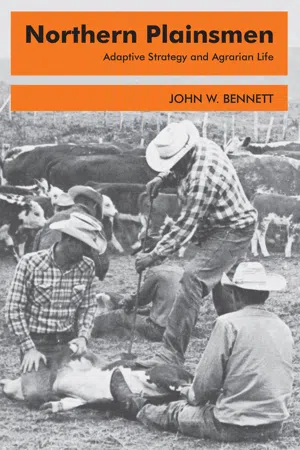
This system of raising livestock is, of course, based on fixed pasturage and on the production of the animals for sale on the market. It can be contrasted with subsistence herding as practiced by many African peoples, where the cattle are raised on open range or pasture lands, followed around by the people, and used directly for food, as well as for objects of social and economic exchange within the society (e.g., as a “bride price”). Tribal people raising cattle for subsistence purposes must take into account many of the same factors noted here for commercial ranchers, but the rhythms and causes of particular practices will differ. Basically, subsistence herding does not bring food and water to the animals, but lets them seek it, or takes them to the sources. In ranching on limited tracts of land, water is provided by dugouts and other devices; grass is husbanded and enhanced by sowing cultivated species; alfalfa is raised on irrigated tracts and fed to the animals in the winter. These are considerable differences, but there is also no doubt that the modern rancher, as indicated above, has to consider many of the same factors noted for subsistence herding: variability of rainfall, and the need to move the animals to exploit pasture areas. That is, the need for the modern commercial rancher to consider the “ecosystem” of his range and its cattle is an evident as it is for the African herder—perhaps even more so.Ranching as a cultural style has intimate contacts with natural phenomena: grass, topography, water, and animals. The nostalgic attitudes held by ranchers toward the old wilderness and the wild species are in part simply the persistence of traditions based on the frontier experience, but they are also meaningful symbolizations of the intimate ecology of the ranching operation. Ranchers view cattle as economic objects, but they also have a mystique about these animals and their own ability to manipulate them. “He really knows cow, that feller. He can tell what she’s going to do every time before she does it,” remarked a rancher about his neighbor. Horses are still functional in ranching everywhere in the West, since the horse is the best means to control cattle when moving them from field to field, or in the branding and roundup procedures. A horse is not an economic object to the rancher, but a friend and associate. The rancher’s pastimes—the riding, calfthrowing, and roping events of the rodeo, the events of the horse show like the barrel race which requires a horse to change course instantaneously, and many others—are all based on the functional activities of ranching. The whole Western style of horsemanship is a projection of the ranching occupation itself, as are the distinctive costumes.All of these things have been virtually done to death by the mass media, which appear to have an inexhaustible fascination for the ranching way of life. The symbols and activities have become so familiar that the average TV viewer or novel reader is inclined to take them as legend, not realizing that the way of life is a genuine one, and the cultural ecology one of considerable intricacy. The ranching culture developed along with the mass media in North American life: the life had become a legend in its very first decade during the nineteenth century, and this means that it has become a kind of legend for many of its practitioners as well. Ranchers, and especially their sons and daughters, are conscious of television images of their own way of life; at least one ranch in Jasper has called itself “Ponderosa” after the ranch in the TV program. The pull of the ranching occupation in Jasper is thus not only the result of the solidarity and profitability of ranching, but also of the glamorizing influence of the international mass media. Jasper itself appears frequently in Canadian TV broadcasts and in advertisements in national magazines: invariably it is the ranching industry which is featured. The much more numerous farmers are given less attention. eBook - ePub
Colombian Peasants in the Neoliberal Age
Between War Rentierism and Subsistence
- Nazih F. Richani(Author)
- 2023(Publication Date)
- SUNY Press(Publisher)
A brief recap of some of the central strands in the extensive literature on cattle ranching and the agrarian question might help contextualize this chapter. Livestock and pasture use expanded in the nineteenth century but was limited because of the density and inhospitality of forestry and the sparsely populated urban centers. By the mid-nineteenth century, there were only 1.5 million head of cattle in the country, about 75 percent of them concentrated in five main regions: Cundinamarca, Boyacá, upper Magdalena River, upper Cauca River, and the inlands of the Caribbean Coast (Van Ausdal 2008). Since then, cattle ranching has ebbed and flowed with the changing rural political economy and the country’s capitalist development and its relationship with global markets.Most scholars studying the agrarian economy and the role of the large landowning class during the first half of the twentieth century have presented various alternative explanations for the continuity of ranching, which they assume to be at best precarious (Van Ausdal 2008). One prevalent explanation is that the decision to invest in cattle ranching is related to the “prestige” and “power “status it confers by virtue of its entrenchment in traditional values (Kalmanovitz 2003; Reyes 2009; Gómez 1987; Perez 2001). Another explanation has focused on cattle ranching as a mean of expanding and acquiring more land, which also increases political influence (Reyes 2009; Romero). Gómez (1987) and Feder (1975) argued that the control of territory and agrarian resources were the main function of cattle raising. One of the classic arguments in Colombian historiography is that in a country with a large agrarian frontier, “the monopoly of available land was the only way to control labor” (Van Ausdal 2008; Reyes 1978; Reyes 2009; McGreevey 1971). Furthermore, by dominating the peasantry, landed elites ensured that the state remained under their hegemony (Fals Borda 2002; LeGrand 1986). Van Ausdal (2008, 91) posits the profit motive without discounting the speculative aspect for cattle ranching to better explain why a segment of the dominant classes opted for such an activity, particularly between 1850 and 1950. These explanations are not mutually exclusive; in fact many are complementary, such as the nexus among land acquisition, power, prestige, and labor/peasant control and profit; they present useful pieces that help solve the puzzle. But often this literature does not accord land laws and state policies the weight they merit because they are either assumed or underplayed. This shortcoming becomes evident in explaining why narcotraffickers chose this economic activity as opposed to others and why this activity expanded exponentially during the second half of the twentieth century and increasingly since the late 1970s (see figure 2.1 No longer available |Learn more
A Living Past
Environmental Histories of Modern Latin America
- John Soluri, Claudia Leal, José Augusto Pádua, John Soluri, Claudia Leal, José Augusto Pádua, John Soluri, Claudia Leal, José-Augusto Pádua(Authors)
- 2018(Publication Date)
- Berghahn Books(Publisher)
50 And while this aspect of the rural world was defined largely by elites, mounted cowboy motifs and Brahman bulls stenciled on buses and trucks throughout Latin America today attest to the continuing symbolism of the region’s cattle culture. Likewise, while mechanization has reduced the demand for steeds in ranching across the region, horses—themselves often adapted to local environmental conditions—are still key work animals and, through rodeos and cavalcades, symbols of rural life and status.Despite the strong association between landed elites and ranching, cattle (and other livestock) have been integral to the lives of many peasants.51 Oxen helped plow the fields and carry goods. Cheese made from the milk of a cow or two—“the pride and happiness of the household”—improved the family’s diet or income without much added labor or additional resources.52 Money pooled for common cause, called a vaca (literally cow) in much of Latin America, underscores the role of cattle as informal savings accounts. With a little more land, a peasant might breed cattle as well, selling yearlings to ranchers to raise and fatten. On the agrarian frontier, such enterprises reinforced property claims and captured the labor of colonizing the forest in a saleable commodity: grass.53 While the skewed ownership of cattle, not just land, highlights Latin America’s enduring inequalities, the share of peasants and small ranchers has often been larger than generally imagined. The tendency of small producers to breed animals that were traditionally slaughtered at four to five years has meant that snapshots of ownership patterns downplay the percentage of animals that originated on peasant farms.54For ranchers, raising cattle was a lifestyle. Even if absentee, they often felt an affinity for the countryside and valued physical work under open skies, although they might have done little of it themselves. They took pride in cinching deals with a handshake, competing in livestock shows, and being the object of respect. As James Parsons and many others have pointed out, “raising cattle is a prestigious activity in Latin America.”55 Sometimes this status is generalized too quickly. On the frontier, there might be little in the way of material comforts or education for an urbanite to differentiate rancher and peasant. However, ranchers moved with swagger and assumed their place at the top of the social structure. In Mexico’s Huasteca region, Claudio Lomnitz found that they felt “superior to [their] peones not because they [were] essentially different from them, but because they [were] better, more distilled, versions of the same.”56 This shared culture (at times), as well as personal relations, entitlements, and debt tied ranch workers to their patrón. eBook - ePub
Crossing the Next Meridian
Land, Water, and the Future of the West
- Charles F. Wilkinson(Author)
- 2013(Publication Date)
- Island Press(Publisher)
23The Costs of Overgrazing: Adjustments to the Rancher’s Code
By the mid-1880s, cattlemen controlled the land they needed, but the ground and the vegetation were absorbing a terrible beating. In 1886, Theodore Roosevelt, who later would make his mark on grazing and other resource policy as president, traveled through the plains country. He wrote of the life of the cowboy and the “free grass” offered up by the United States. He also issued this warning:But scantiness of food, due to overstocking, is the one really great danger to us in the [northern Great Plains], who do not have to fear the droughts that occasionally devastate portions of the southern ranges. In a fairly good country, if the feed is plenty, the natural increase of a herd is sure shortly to repair any damage that may be done by an unusually severe winter—unless, indeed, the latter should be one such as occurs but two or three times in a century. When, however, the grass becomes cropped down, then the loss in even an ordinary year is heavy among the weaker animals, and if the winter is at all severe it becomes simply appalling. The snow covers the shorter grass much quicker, and even when there is enough, the cattle, weak and unfit to travel around, have to work hard to get it; their exertions tending to enfeeble them and to render them less able to cope with the exposure and cold.... The cows in calf are those that suffer most, and so heavy is the loss among these and so light the calf crop that it is yet an open question whether our northern ranges are as a whole fitted for breeding. When the animals get weak they will huddle into some nook or corner and simply stay there till they die....
- David Montejano(Author)
- 2010(Publication Date)
- University of Texas Press(Publisher)
Thus, in the late nineteenth century, some of the largest Panhandle ranches were managed by British-accented administrators who reported to a home office in London or New York. The other safe avenue for investors who knew nothing about ranching (except from the exaggerated reports they read) was to work through cowboy partners in Texas. Such partnerships account for the making of the legendary “cattle kings.” The accumulation of fortunes within a single lifetime came to those cowboys who were financed through the backing of English and American capitalists. Trail driver Henry Campbell, for example, had found financial backing with a Colonel Britton, a Chicago banker, and established the Matador Ranch, in which he had a one-fifth share. Charles Goodnight, hired cowboy, entered a partnership with the Englishman John Adair and organized the JA Ranch in the Panhandle. Shanghai Pierce, once a hired hand, amassed more than a million acres because of a profitable agreement with the Kountze Brothers’ banking firm. 35 In brief, the entry of outside capital accelerated the differentiation of pioneers into “cattle kings” and “cow hands.” As the cattle industry came to represent huge investments of capital, the questions of water rights, grazing rights, and cattle ownership acquired a new significance. Ranches increased, herds became numerous, range rights became more precarious, and grass and water became scarcer. Cattlemen with land organized to assert their property rights as well as to extend their control over the public domain. They formed associations to control grazing and water rights, to organize roundups, to supervise branding, and to combat cattle diseases and thieves. In the process, they acted also to discourage the homesteader and the independent cowboy. 36 Mavericking, once a common practice, became a dangerous activity in parts where established cattlemen desired to retain complete control of the range. Even the meaning of frontier terminology changed eBook - PDF
Public Lands and Political Meaning
Ranchers, the Government, and the Property between Them
- Karen R. Merrill(Author)
- 2002(Publication Date)
- University of California Press(Publisher)
Western cattle ranch-ers began “breeding up” their herds—that is, investing in purer bred cattle—to meet consumer demand for higher grades of beef; these cattle were less hardy than earlier breeds and required better care, in-cluding feed during the winter. Ranchers thus now devoted more of their land to cultivating hay or other forage crops. What these changes indi-cated was that ranching was settling down, and although thousands of ranchers still used the public lands, their operations looked more like farming than ever before; indeed, their resemblance to farming pro-voked many a discussion at the ANLSA conventions. The changes in practice on the range were also both fueled and given political meaning by the renewed national interest in homesteading and, specifically, in al-tering the terms of the Homestead Act. Congress devoted more time to the public lands question during this period of less than twenty years than it had since the 1860s and 1870s, and the attention given to home-steading would have profound effects on both western ranching and the subsequent relationship between ranchers and public land agencies, as the “bona fide homesteader” became an inviolable and very popular 38 Properties of the Homebuilder figure in the political discourse surrounding the public lands. In both planned and unplanned ways, ranchers hitched their fortunes to the “homebuilder”; and in quite unpredictable and fascinating ways, this move established the terms in which ranchers and land managers would understand the public range of the twentieth century. But if the homesteader was ascendant in this period, other events and trends moved the public land question in quite different direc-tions—directions that tell us much more about the organization of pol-itics and the power of the federal government. eBook - PDF
Livestock/Deadstock
Working with Farm Animals from Birth to Slaughter
- Rhoda M. Wilkie(Author)
- 2010(Publication Date)
- Temple University Press(Publisher)
Each cultural group also brought distinctive attitudes that contrib-uted to how it interacted with its animals. For example, Hispanics tended to perceive cattle primarily as a means to an end, a commodity. Although Celts and West Africans shared this attitude, they also admired and cared for their cattle; bovines were esteemed animals (Carlson 2001, 86–92). Moreover, Carlson draws on the work of Professor Terry Jordan to suggest ranching did not stem from western America; it was “a cultural activity that immigrants carried out of the eastern Mediterranean and Nile as they swept out across Europe and Asia” (Carlson 2001, 64). And despite their enduring cultural resonance, the massive cattle drives through extensive grazing terrain per-sisted for little more than two decades, from the end of the Civil War to the mid-1880s. 14 Increasing speculation and substantial levels of British capital investment during this period fueled a cattle boom at the beginning of the 1880s. “American frontiersmen and cowboys cleared the way for westward expansion, [but] it was the English business class that provided much of the financial muscle to turn an outback into the richest and most profitable 28 / Chapter 2 pastureland in the world” (Rifkin 1992, 52). Herbert Brayer (1949, 97) spells out the scale and significance of their intervention and suggests that this con-tribution should not be underestimated: From numerous small operations [the British] organized the great [cattle] companies; they made possible the stocking of the ranges to a degree never before attained; they invested in the best stock they could secure and imported the finest pure-bred Shorthorn, Hereford and Angus bulls to breed up the herds then on the ranges; they improved their range lands by developing water facilities, reseeding pastures, and fencing to prevent overgrazing; at a time when annual winter losses were high they introduced winter feeding on a mass scale and constructed livestock shelters. eBook - ePub
The Governance of Rangelands
Collective Action for Sustainable Pastoralism
- Pedro M. Herrera, Jonathan Davies, Pablo Manzano Baena(Authors)
- 2014(Publication Date)
- Routledge(Publisher)
On some government lands, where the public also holds rights to benefit based on the governance institutions for these “public lands,” the amount and nature of the resources allocated to each type of use and user is a subject of contention, and sometimes costly litigation. Different constituencies seek to invoke their rights of access in order to advance their ability to benefit from public lands. For example, the Multiple Use Sustained Yield Act of 1960 and the Forest and Land Management Planning Act of 1972, hold that the Forest Service and the Bureau of Land Management, respectively, must manage public lands for multiple uses, but the statutes do not provide guidance on priorities or methods of allocation among those uses. Pastoralist ability to benefit, then, can be heavily influenced by political and managerial decisions about the rights to benefit from diverse user groups, and by changes in or interpretations of environmental regulations pertinent to livestock grazing. As a Forest Service natural resource manager commented at a 2013 symposium, “for the rancher using the national forest the [environmental] bar keeps getting higher every year.” In California, Arizona, and Texas, ranchers have established grassroots local governance organizations that help them maintain the ability to benefit from rangelands in ways that fit to local tenure and institutional arrangements, and to build resilience to shifts in policy and markets that might have an impact on their ability to maintain access to and benefit from rangeland resources.Evolution of ranching land tenure in the Western United States: a general overviewA general history of livestock grazing in the western United States begins with the implantation of livestock in the Southwest. In 1598, Spanish settlers brought cattle, sheep and goats into what is now New Mexico. For about 200 years, Spanish and Mexican land grants, thousands of hectares in size, were given to individuals and communities for farming, grazing, and woodcutting. Local tribes, such as the Navajo, adopted livestock grazing very early on (Bailey 1980). In California, a short-lived Spanish colonization began in 1769, and as in the Southwest was then superseded by Mexican control in 1822, and finally by the United States in 1848. In the Spanish and Mexican periods of California large land grants were given out to individuals for ranching, leaving a legacy of some extensive private rangeland ownerships.In the mid-nineteenth century, settlers from eastern regions moved rapidly into the arid western territories, drawn by the Gold Rush and other mining strikes, and by abundant open land for settlement. This land was known as the “public domain” as it belonged to the federal government and it was originally designated for privatization and development through sales and grants. American land allocation policies were eventually implemented that, beginning with the 1862 Homestead Act, limited settler land claims to a few hundred acres. These claims were made in the rare areas with decent soils and water for irrigation, leaving arid and mountainous land in the public domain. In the Southwest and California, under American governance, the majority of community and individual grants given out by the Spanish and Mexican governments were abrogated by the courts, ceded to clever entrepreneurs and lawyers, or returned to the federal or state governments for back taxes, and only rarely remained in the hands of some of the grantees (de Buys 1985).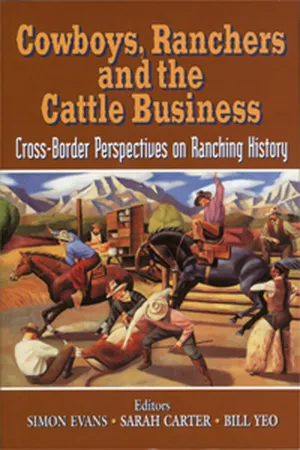 eBook - PDF
Cowboys, Ranchers and the Cattle Business
Cross-Border Perspectives on Ranching History
- Simon M. Evans, Sarah Carter, Bill Yeo(Authors)
- 2000(Publication Date)
- University of Calgary Press(Publisher)
9 Moreover, despite an enduring romantic portrayal begun by 19th century dime novelists, the working routine of cowboys was fairly monotonous and ranch policies aimed to establish an orderly work force. Consequently, rules of conduct on well-run ranches prohibited lawless and intemperate behavior. 10 45 C O W B O Y S , R A N C H E R S A N D T H E C A T T L E B U S I N E S S The newcomers, by contrast, were generally hastily formed companies with access to large amounts of capital and their goals were more speculative. Expecting quick profits, they imported low-quality longhorns, ran bigger herds on the range and relied primarily on unfenced pasturage for their stock. Furthermore, they invested rninimally in ranch or stock improvements. 11 Conrad Kohrs, whose career exemplifies the characteristics of the older, established cattlemen, became one of Montana's preeminent stockman and business leaders. After a period of gold mining, Kohrs recognized that providing meat to miners afforded greater opportunities and began buying, selling and butchering beef in the 1860s. He began ranching, placing 1000 head in the Sun River Valley, possibly as early as 1869. Without a personal source of capital, Kohrs financed his expansion through various partnerships and his ability as an entrepreneur. He joined the Wyoming Stock Growers' Association in the early 1870s, and later helped form the Montana association. His attention to maintaining good stock led a contemporary to evaluate him as one of the three most significant contributors to improved breeding in the American West. 12 In a recent work, historical geographer Terry G. Jordan further elaborates on the distinction between the older, established cattlemen of the Rocky Mountains and those who followed by tracing the development of their cultural/pastoral practices. He maintains that, from the beginning, the Midwestern herding system prevailed in the Rocky Mountains, from Colorado to Alberta and British Columbia. eBook - PDF
Trails and Trials
Markets and Land Use in the Alberta Beef Cattle Industry, 1881-1948
- Maxwell L. Foran(Author)
- 2003(Publication Date)
- University of Calgary Press(Publisher)
ONE The Legacy of the Ranching Era 1881-1907 We believe that we have there the garden of the world. CHARLES TUPPER, 1879 LBERTA CATTLE INDUSTRY BEGAN AS AN OPEN RANGE RANCHING ENTERPRISE, fuelled by eastern Canadian and British capital, and supported by untested beliefs about the western Canadian environment. For over twenty years it provided beef to local and regional consumers, and most importantly to a profitable export market in Great Britain. However, by 1908 environmental factors, agricultural land pressures, and international competition in the export market had imposed significant modifications on the ranching industry. Yet ranching did not die. Moreover, the transformed livestock enterprises that had emerged in former ranching areas continued to reflect attitudes and practices forged during this early period. The Canadian ranching experience was a northerly extension of the American cattle industry. Ranching began in the Alberta foothills area and gradually expanded to the lower plains and brown soil zones to the east. The period before 1896 was dominated by open-range practices and was Canada's closest counterpart to the romanticized American western frontier. Although commercial cattle raising in Alberta actually began in the late 1870s, the ranching era in western Canada owed its formal origins to the leasehold system of land usage instituted in 1881. When compared to American practices, the leasehold system provides a major difference between the two frontiers. Formal leaseholds precluded rangeland violence in western Canada. Also in sharp 1 T Trails and Trials contrast to the American experience, the survival of the leasehold system helped consolidate the ranchers' privileged position. 1 The early cattle operators in Alberta shared three assumptions. They presumed that the grasslands were exclusive to pastoral activities, and that the climate was amenable to cheap beef production.
Index pages curate the most relevant extracts from our library of academic textbooks. They’ve been created using an in-house natural language model (NLM), each adding context and meaning to key research topics.
