Geography

UN Sustainable Development Goals
The UN Sustainable Development Goals (SDGs) are a set of 17 global goals aimed at addressing social, economic, and environmental challenges to achieve a more sustainable future by 2030. These goals cover a wide range of issues including poverty, inequality, climate change, and sustainable cities, and serve as a framework for international cooperation and action towards a more equitable and sustainable world.
Written by Perlego with AI-assistance
Related key terms
1 of 5

11 Key excerpts on "UN Sustainable Development Goals"
- Claudia Murray, Camilla Ween, Yadira Torres-Romero, Yazmin Ramirez(Authors)
- 2020(Publication Date)
- Routledge(Publisher)
7Guiding Improved Urban Development
Unsustainable development goals and the new urban agenda, how South America is fearing in the world scene?7.0 Introduction‘Sustainability’ is a wide-ranging term, often bandied about with little understanding of its meaning or intent. It emanates from the original definition of ‘sustainable development’ that is generally agreed to be:Development that meets the needs of the present without compromising the ability of future generations to meet their own needs (Brundtland Report for the World Commission on Environment and Development, 1987, p. 37).This definition basically means that anything development does now should not compromise resources or opportunities in the future. Sustainability practice can be applied to every aspect of human activity: shelter, food production, mobility, use of natural resources as well as political and social systems. When considering the sustainability of urban development proposals, it is necessary to consider a very wide range of factors, many of which require significant adaptive change. The United Nations (UN) sustainable development goals (SDGs) are a benchmark for what most world leaders now believe society needs to work towards.This chapter examines the performance of Latin America and Caribbean (LAC)1 countries regarding the achievement of the SDGs, focusing on those goals that are closely related to urban development. Section 7.1 will explain the SDGs and their predecessors, the Millennium Development Goals (MDGs), which concluded in 2015. In Section 7.2 , the New Urban Agenda signed in Quito (Ecuador) in 2016 will be briefly described, while Section 7.3 presents intended nationally determined contributions agreed during the 21st Conference of the Parties in Paris 2015 (COP21) to combat climate change. These sections prepare the reader for a deeper understanding of the issues the world is facing in relation to climate change and their applicability to LAC, paying special attention to the role urban development plays in the most urbanised continent on earth. Section 7.4 evaluates how the LAC countries are performing by following a series of international indicators, while Section 7.5 evaluates each country and their current policies in order to point out best practice as well as shortcomings. Section 7.6 looks at how LAC can achieve the SDGs as well as protect real estate and infrastructure assets. Section 7.7 eBook - ePub
- Jeffrey D. Sachs(Author)
- 2015(Publication Date)
- Columbia University Press(Publisher)
Sustainable Development Solutions Network (SDSN). The key motivation for the new SDSN is the idea that the world needs not only new goals, political motivation, and will, but also a new era of intensive problem solving in sustainable development challenges that include health, education, agriculture, cities, energy systems, conservation of biological diversity, and more. The SDSN is a network of universities around the world, hundreds of them, in partnership with governments, businesses, and nongovernmental organizations. It is launching national chapters in dozens of countries, and several regional chapters as well (for example, the countries of the Amazon basin, the African Sahel, and Southeast Asia).14.1 UN Secretary-General Ban Ki-moonBan Ki-moon—World Economic Forum Annual Meeting 2011, Remy Steinegger, World Economic Forum, Wikimedia Commons, CC BY-SA 2.0.The 193 countries of the UN General Assembly worked for three years, from 2012 to 2015, to agree on seventeen Sustainable Development Goals, which they adopted on September 25, 2015. These goals are summarized by their logos in figure 14.2 . They embrace the three pillars of sustainable development: economic development (including the end of extreme poverty), social inclusion, and environmental sustainability. In addition to the seventeen goals, the UN General Assembly also adopted 169 more detailed targets distributed among the seventeen goals. The UN General Assembly emphasized, however, that each nation should choose its own national targets based on its national circumstances and priorities. Countries will also be expected to report on an agreed-upon set of indicators to measure progress towards the goals and targets.14.2 Sustainable Development GoalsLet’s look at the seventeen goals in a bit more detail.United Nations Development ProgrammeSDG 1: End extreme poverty. The first goal aims to finish the work of the Millennium Development Goals to “end poverty in all its forms everywhere.” The essence of SDG 1 is to ensure that by 2030, all people are living above the line of extreme poverty set by the World Bank.SDG 2: End hunger and promote sustainable agriculture eBook - ePub
Africa in the Post-2015 Development Agenda
A Geographical Perspective
- Leo Charles Zulu, Cristina D'Alessandro(Authors)
- 2018(Publication Date)
- Routledge(Publisher)
3 . The SDGs were meant to be more ‘action-oriented, concise and easy to communicate, limited in number, aspirational, global in nature, and universally applicable to all countries, while taking into account different national realities, capacities and levels of development, and respecting national policies and priorities’ (UNDP, 2012, p. 63). Through them, a better balance is sought among the economic, social, and environmental dimensions of development (Bates-Eamer, Lee, Lim, & Kapila, 2012; Osborn, Cutter, & Ullah, 2015).Some of the SDGs reflect clarification or a breakdown of the original MDGs to bring more attention to particular previously neglected issues, or to draw attention to emerging ones. For instance, the separation of poverty and hunger (MDG 1) into two goals (SDGs 1 and 2) reflects the critical importance of both goals, while concerns over growing income inequities between the rich and poor are newly captured (SDG 10, and parts of SDG 4, 8, and 11) along with goals for addressing the need for sustainable consumption and production (SDG 12). SDGs reflecting issues that have emerged over the past 15 years include recognition of rapid urbanization, especially in SSA, as a major trend for the twenty-first century (Grant, 2015) that poses sustainable development challenges that need to be addressed, but also offers opportunities than should be seized for urban areas (SDG 11). Other emerging issues include concerns over climate change (SDG 13), especially as Africa is the most vulnerable continent and one least able to deal with adverse climate impacts; and the importance of equitable access to sustainable and reliable energy as a major driver of economic and social development (SDG 7), and to reliable infrastructure (SDG 9). Sustainable natural resources management and environmental stewardship strategies have also been enhanced, with the inclusion of marine and oceanic resources (SDG 15) and conservation of terrestrial ecosystems (SDG 15). The following section summarizes contributions from the articles in the special issue on lessons from Africa’s performance on some of the MDGs and the challenges and opportunities as we transition to the SDGs. Given the enormity of the development issues, sectors, and dimensions that that the MDGs and the greatly expanded SDGs seek to address, these contributions are no more than a partial sample of those issues to illustrate how geographic analysis has contributed and continues to be uniquely placed to contribute to debates and the search for effective development solutions focusing on Africa. eBook - PDF
- Stephen Scoffham(Author)
- 2016(Publication Date)
- Routledge(Publisher)
While time will tell the effectiveness of the Sustainable Development Goals, the proactive language sets out a clear agenda for the role of education and institutions in actively promoting sustainable development. Sustainable development is commonly thought of as having three mutually support- ing dimensions – economic, social and environmental. These work together and link to the idea of quality of life for all, recognising that we live in an interconnected world. They also relate to some of the ‘big’ questions that geography seeks to answer, namely: n Where is this place? What is it like and why? n Why and how is it changing? What will it be like in the future? What kinds of futures do we want? n What do people do here? How are their actions influenced by, and how do they impact on, environments at different scales? n How is this place connected to other places? How am I connected to other people and places? n Who gets what, where, when and how? Who decides? n What’s it got to do with me? Why should I care? Sustainability education is relevant across the entire curriculum and is best approached through holistic teaching and learning. It has a particular association with geography and requires careful underpinning with geographical thinking and knowledge. Issues concern- ing sustainability and the environment have a values-led and affective base, often articulated as a need to ‘care for the world’, which can sometimes eclipse other necessary components of knowledge and critical thinking. While values and emotions are intrinsic and inescapable facets of sustainability, being properly equipped to respond to these issues also demands some degree of cognitive understanding about how and why human, biological and physical worlds interact with and affect each other. eBook - PDF
The World's Search for Sustainable Development
A Perspective from the Global South
- Mukul Sanwal(Author)
- 2015(Publication Date)
- Cambridge University Press(Publisher)
This transformation is in line with the core objectives of the Charter of the United Nations ‘to save succeeding generations from the scourge of war’, ‘to promote social progress and better standards of life in larger freedom’, ‘to employ international machinery for the promotion of the economic and social advancement of all peoples’, and ‘to be a centre for harmonizing the actions of nations in the attainment of these common ends’. The concept of sustainable development represents a shift in understanding of humanity’s place on the planet from the view that emerged in industrialized countries with the shift of population from agriculture to urban areas, of conquering nature for human well-being. Now, there is a broad agreement that society needs to change, though there are major debates as to the nature of the outcome, the changes necessary and the tools and actors for these changes. In most cases, people bring to the debate already existing political and philosophical outlooks, and use similar words to mean a wide divergence of perspectives on the goals and methods of moving towards sustainable development. The emerging view, largely in states with large number of rural poor, is that the process of global change is driven by three distinct yet interrelated factors – urbanization, energy/natural resources linkages and scientific and technological advances; interdependence in a globalizing international economy is shaped by patterns of natural resource use; and the direction and nature of human society and civilization is towards greater equality. In this view, the international community in the United Nations is the forum for collective review and management of the process of global change to enable well-being of all. 23.2 Integrated global agenda Sustainable development goals are now considering people and planet, rather than countries.
- Jonas Ebbesson, Ellen Hey(Authors)
- 2022(Publication Date)
- Cambridge University Press(Publisher)
We recognize that developing countries and countries 57 Agenda for Development, UN Doc. A/RES/51/240, 20 June 1997, para. 6, para. 7. 58 See n. 41 and n. 42 and accompanying text. 59 See, e.g., Agenda for Development, n. 57, paras. 21, 44. 60 Id., para. 15. 61 Id., para. 7. 62 Id., para. 1. 63 Philipp Pattberg et al. (eds.), Public–Private Partnerships for Sustainable Development (EE, 2013). 64 Ellen Hey, “The MDGs, Archeology, Institutional Fragmentation and International Law: Human Rights, International Environmental and Sustainable (Development) Law,” in Hélène Ruiz Fabri, Rüdiger Wolfrum & Jana Gogolin (eds.), Selected Proceedings of the European Society of International Law, vol. 2 (Hart, 2010), 488. The Sustainable Development Goals, Agenda 2030, and International Law 13 with economies in transition face special difficulties in responding to this central challenge. Thus, only through broad and sustained efforts to create a shared future, based upon our common humanity in all its diversity, can globalization be made fully inclusive and equitable. These efforts must include policies and measures, at the global level, which correspond to the needs of developing countries and economies in transition and are formulated and implemented with their effective participation. 65 The MDGs, which were the precursors of the SDGs, in turn reflected the outcomes of earlier multilateral conferences and the International Development Goals, presented by the Organisation for Economic Co-operation and Development (OECD) in 1996. 66 Seven of the eight MDGs provide substantive goals that were to be reached by 2015 or earlier in developing states. Thus, MDGs 1–7 concern, respectively, the reduction of poverty and food insecurity, achieving universal primary education, the promotion of gender equality, the reduction of child mortality, and the need to improve mental health, combat diseases, and ensure environmental sustain- ability.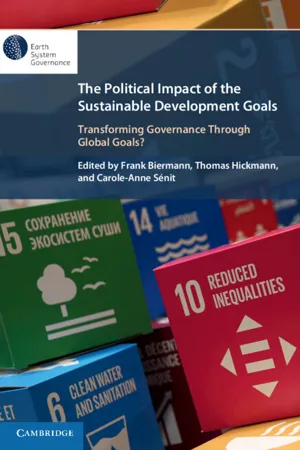 eBook - PDF
The Political Impact of the Sustainable Development Goals
Transforming Governance Through Global Goals?
- Frank Biermann, Thomas Hickmann, Carole-Anne Sénit(Authors)
- 2022(Publication Date)
- Cambridge University Press(Publisher)
Similarly, studies tend to focus on a limited number of the 17 Sustainable Development Goals and their interactions. As a result, some goals are under-researched, and comprehensive models that cover all 17 goals are lacking. More efforts are needed to understand interlinkages between global goals. As highlighted throughout this assessment, at the centre of the 2030 Agenda is the ambition to address at the same time economic, ecological and social goals and to break down silos in policy-making at all political levels and societal scales. To overcome silos in decision-making and open windows of opportunity for more coherent policies towards sustainable development, we need to gain a deeper understanding of the complexity of the interlinkages across the goals (Breuer, Leininger and Tosun 2019; Pradhan 2019; van Vuuren et al. 2021). In line with key findings from Chapter 4 of this assessment, while a few recent studies have shed light on interactions between goals, we still need more research on what policies best reflect the synergies and trade-offs in the interplay of the goals (e.g., van Soest et al. 2019). Scientists need to engage more in science–policy–society interactions. The Sustainable Development Goals are the outcome of complex intergovern- mental negotiations. Civil society groups, corporations and science organizations were able to bring in their views. Yet in the end, the 2030 Agenda and the 17 global goals were adopted by governments as a political agreement marked by The Goals as a Transformative Force? Key Insights 217 countless political compromises and bargains. To what extent are these goals then based on insights from science and scientific data? While scientists have informed the Sustainable Development Goals through various channels, some scholars argue that this has not been enough and now call for having a stronger voice in the implementation and operationalization of the goals (Roehrl, Liu and Mukherjee 2020). eBook - PDF
Pathways for Peace
Inclusive Approaches to Preventing Violent Conflict
- United Nations, World Bank(Authors)
- 2018(Publication Date)
- World Bank(Publisher)
The 2030 Agenda is a universal agenda that commits all countries to work toward a peaceful and resilient world through inclusive and shared prosperity and the upholding of human rights. It puts people at the center and pledges to leave no one behind, to empower women, and to give special attention to countries in protracted crisis. The 2030 Agenda emphasizes that peace, development, human rights, and humanitarian responses are inextricably linked and mutually reinforcing. It includes a focus on building peaceful, just, and inclusive societies, not only as an enabler but also as a fundamental component of development outcomes. The 17 Sustainable Development Goals (SDGs) are integrated and indivisible in nature. Efforts to achieve one goal are seen as instrumental to achieving other goals. For example, actions to address goals such as eradicating poverty (SDG 1), reducing inequalities (SDG 10), promoting quality education (SDG 4), achieving gender equality (SDG 5), addressing climate change (SDG 13), supporting peace and strengthening institutions (SDG 16), and promoting partnerships (SDG 17) can have mutually reinforcing effects. The SDGs provide a blueprint for scaling up investments to transform economies, build resilience, strengthen institutions, and bolster capacities. By integrating sustainability in all activities and promoting inclusivity, partnerships, and accountability, the 2030 Agenda can contribute to peace. Source: UN General Assembly 2015. Introduction 7 in control of its own destiny and the state to build positive relationships with its citizens. International actors play a critical role in supporting endogenous preventive efforts. Their support is also instrumental in sus-taining regional efforts by neighbors that have an interest in avoiding violence, the negative effects of which could spill over into their own countries. Can Prevention of Violent Conflict Be Done Differently? This study is about the prevention of violent conflict. eBook - ePub
- Simon Sneddon(Author)
- 2023(Publication Date)
- Routledge(Publisher)
The strength of the MDGs also proved to be something of a weakness, however, as the lack of many hard targets meant that states were able to pay lip service to the goals. There were also criticisms that poorer countries were not sufficiently involved in the drafting of the MDGs, which focused more on what the richer countries were doing, rather than on the extent to which the situation in poorer states was improving.The 17 Sustainable Development Goals build on the 8 Millennium Development Goals, the targets for which were mostly unmet. The UN published an annual SDG report, and the 2022 report points out that whilst the world is over two-thirds of the way through the goal period for most of the SDGs (2000–2030), there are still enormous gaps in the level of reporting. This, of course, means that judging the relative successes of the goals individually or together is not easy.5.2 SDG 1: No Poverty
It is widely understood that poverty can be both a cause and effect of environmental issues. As we saw in Chapter 2 , the impact of global issues (e.g. climate change) will have greater impact on poorer communities than it does on richer countries. This may be because of fragile infrastructure or simple geography. Living in poverty also raises difficult scenarios for individuals and communities.Whilst all agree that poverty is an issue which needs to be tackled, there will, of course, be different levels of income which lead to poverty, depending upon where you live. SDG 1 tackles this disparity by aligning to the World Bank’s level of “extreme poverty,” which is defined as living on less than US$1.90 per person per day.CRITIQUING THE LAWIs it morally acceptable for a person to kill a protected or endangered species of animal in order to get money to alleviate their family’s poverty?Should we take an ecocentric or anthropocentric (see Chapter 2 ) approach in this situation?Should it be legally acceptable?There is a double-edged sword here, however. The UN Environment Programme, among many others, has identified that the poorer a community or state is, the less it is able to spend to withstand the impacts of climate change, such as extreme weather or rising sea levels. Similarly, the poorer a community, the less it is able to spend on the cleaner technologies which would alleviate some of those impacts. Reducing the numbers of people in poverty will allow for a faster adoption of lower-polluting technologies. eBook - PDF
Sustainable Development Goal Nine and African Development
Challenges and Opportunities
- (Author)
- 2021(Publication Date)
- LIT Verlag(Publisher)
Unit 1: Sustainable Development Goal Nine and African Development – Continental Perspectives Sustainable Development Goal Nine (SDG 9) and Conti- nental African Perspectives – An Introduction Karl Wohlmuth 1 1 The Issues How is SDG 9 defined with regard of targets and indicators? In this introductory Unit 1 key issues are presented on the relevance of SDG 9 for Africa’s development. “Build resilient infrastructure, promote inclusive and sus- tainable industrialization and foster innovation”; this is the definition of Sustaina- ble Development Goal Nine (SDG 9); it has three core elements (infrastructure, industrialisation, and innovation). The eight targets of SDG 9 which are of im- portance for the discussions in the volume are 2 : - Develop quality, reliable, sustainable, and resilient infrastructure, includ- ing regional and transborder infrastructure, to support economic development and human well-being, with a focus on affordable and equitable access for all. Empha- size quality, accessibility, and fairness. - Promote inclusive and sustainable industrialization and, by 2030, signif- icantly raise industry’s share of employment and gross domestic product, in line with national circumstances, and double its share in least developed countries. - Increase the access of small-scale industrial and other enterprises, espe- cially so in developing countries, to financial services, including affordable credit, and their integration into value chains and markets. - Upgrade, by 2030, infrastructure and retrofit industries to make them sustainable, with increased resource-use efficiency and greater adoption of clean and environmentally sound technologies and industrial processes, with all coun- tries being committed to act in accordance with their respective capabilities. eBook - PDF
Atlas of Sustainable Development Goals 2017
From World Development Indicators
- World Bank(Author)
- 2017(Publication Date)
- World Bank(Publisher)
national and regional development planning Atlas of Sustainable Development Goals 2017 113 11.b By 2020, substantially increase the number of cities and human settlements adopting and implement-ing integrated policies and plans towards inclusion, resource efficiency, mitigation and adaptation to cli-mate change, resilience to disasters, and develop and implement, in line with the Sendai Framework for Disaster Risk Reduction 2015–2030, holistic disaster risk management at all levels 11.c Support least developed countries, including through financial and technical assistance, in build-ing sustainable and resilient buildings utilizing local materials Goal 12 Ensure sustainable consumption and production patterns 12.1 Implement the 10-Year Framework of Programmes on Sustainable Consumption and Production Patterns, all countries taking action, with developed countries taking the lead, taking into account the development and capabilities of developing countries 12.2 By 2030, achieve the sustainable management and efficient use of natural resources 12.3 By 2030, halve per capita global food waste at the retail and consumer levels and reduce food losses along production and supply chains, including post- harvest losses 12.4 By 2020, achieve the environmentally sound manage-ment of chemicals and all wastes throughout their life cycle, in accordance with agreed international frameworks, and significantly reduce their release to air, water and soil in order to minimize their adverse impacts on human health and the environment 12.5 By 2030, substantially reduce waste generation through prevention, reduction, recycling and reuse 12.6 Encourage companies, especially large and trans-national companies, to adopt sustainable practices and to integrate sustainability information into their reporting cycle 12.7 Promote public procurement practices that are sus-tainable, in accordance with national policies and priorities 12.8
Index pages curate the most relevant extracts from our library of academic textbooks. They’ve been created using an in-house natural language model (NLM), each adding context and meaning to key research topics.

