Geography

Sustainable Development Goal 2
Sustainable Development Goal 2 aims to end hunger, achieve food security, improve nutrition, and promote sustainable agriculture. It focuses on ensuring access to safe, nutritious, and sufficient food for all, as well as promoting sustainable agricultural practices and supporting small-scale farmers. This goal also seeks to address the interconnected issues of food production, distribution, and consumption to create a more sustainable and equitable food system.
Written by Perlego with AI-assistance
Related key terms
1 of 5
12 Key excerpts on "Sustainable Development Goal 2"

- Jonas Ebbesson, Ellen Hey(Authors)
- 2022(Publication Date)
- Cambridge University Press(Publisher)
2 SDG 2: End Hunger, Achieve Food Security and Improved Nutrition and Promote Sustainable Agriculture Carmen G. Gonzalez abstract This chapter examines the relationship between Sustainable Development Goal (SDG) 2, Zero Hunger, and international law. It argues that SDG 2 is supported by international human rights law. However, international economic law (trade, investment, finance) impedes the achievement of SDG 2 by undermining the livelihoods of small farmers and restricting the ability of states to regulate in the public interest. When these bodies of law conflict, international economic law generally prevails as a consequence of the powerful mechanisms through which it is enforced, including the World Trade Organization’s dispute settlement system, investor-state arbitration under international investment agreements, and the loan conditionalities imposed by the International Monetary Fund and the World Bank. keywords SDG 2, hunger, right to food, structural adjustment, trade liberalization, IMF, World Bank, World Trade Organization, international investment agreements, food security, sustainable agriculture 2.1 introduction Sustainable Development Goal (SDG) 2, Zero Hunger, seeks to address the prob- lem of world hunger and to promote sustainable agriculture. Despite ample food production at the global level, the UN Food and Agriculture Organization (FAO) reports that over 2 billion people did not have regular access to safe, nutritious, and 72 sufficient food in 2019. 1 In 2020, the COVID-19 pandemic aggravated food insecurity by disrupting food supply chains, driving more people into poverty, and curtailing the purchasing power of consumers. 2 The FAO also acknowledges that the world is not on track to meet the targets of SDG 2 on plant and animal diversity that are vital to sustainable agriculture. eBook - ePub
SDG2 - Zero Hunger
Food Security, Improved Nutrition and Sustainable Agriculture
- Ambe Emmanuel Cheo, Kugedera Andrew Tapiwa(Authors)
- 2021(Publication Date)
- Emerald Publishing Limited(Publisher)
Table 3 by Gil et al. (2019) was designed based on the availability of empirical data associated with monitoring progress. It is important to note here that even though the SDG targets are the same for all countries, the pathways used by countries to achieve the respective targets will be different based on the specificity of the local context, for example, data availability, local priority, local policy, etc.According to the Gil et al. (2019), Targets 2.1–2.5 are directly related to food security and agricultural sustainability, whereas Targets 2a–2c are more market-related measures aimed at increasing agricultural investments and reducing market restriction, distortions, and volatility. Each of the targets is designed to achieve specific requirements of the SDG-2 as presented in the subsequent paragraphs using some targets.SDG-2 Target 2.1 aims to ‘end hunger and ensure access by all people, in particular the poor and people in vulnerable situations including infants, to safe nutritious and sufficient food all year round’ by 2030 (World Bank, 2017). Largely, this can only be achieved through interactions with other SDGs such as ‘no poverty’. The use of improved agricultural technologies and improved genetic resources, such as crop seeds and animals, may be helpful in ending hunger and improving nutrition for poor and vulnerable people. However, most people living in war zones are still failing to meet this target. These groups will, therefore, require the support of organisations such as the United Nations and other charity organisations (United Nations, 2015a).Table 3. Review of the SDG-2 Targets and Indicators Proposed by the United Nations (Adapted from Gil et al., 2019).SDG-2 Targets Previous Set of Indicators (UN-IAEG-SDGs) Revised List of Indicators by Gil et al. (2019) 
- Pia Katila, Carol J. Pierce Colfer, Wil de Jong, Glenn Galloway, Pablo Pacheco, Georg Winkel(Authors)
- 2019(Publication Date)
- Cambridge University Press(Publisher)
The clear separation of biodiversity conservation and agricultural production has been an impediment in achiev- ing optimised outcomes for either (Gordon et al. 2017). A serious reform of the current food system is clearly needed. Sunderland, O’Connor, Muir et al. 50 The question central to this chapter is: Can we feed and nourish the grow- ing human population without further damaging our wider environment, especially forests, in the process? Throughout the chapter we explore this question by examining SDG 2 (Zero Hunger) in relation to forests. First, we focus on the SDG 2 targets that are impacted by or will directly impact forests. This is fol- lowed by a discussion on the relationship between SDG 2 and the other SDGs in regard to forests. 2.2 Zero Hunger and Forests SDG 2 seeks to ‘End hunger, achieve food security and nutrition and pro- mote sustainable agriculture’ (United Nations 2015). The goal aims to end hunger and all forms of malnutrition by 2030. It also commits to ‘universal access to safe, nutritious and sufficient food at all times of the year’ (Table 2.1). The narrative further describes how achieving SDG 2 will require sus- tainable food production systems and resilient agricultural practices, equi- table access to land for farmers and communities, technology and markets, and international cooperation on investments in infrastructure and technol- ogy to boost agricultural productivity. Targets 2.1–2.5 (Table 2.1) are closely entwined with forests and forest-related livelihoods. Unless agriculture and forestry are designed to coexist, the possible impacts of achieving SDG 2 on forests include increasing resource use to raise production, thereby creating more pollution (e.g. phosphorus, nitrates, fossil fuels) and higher rates of deforestation (Springmann et al. 2018). eBook - ePub
Reorienting Indian Agriculture
Challenges and Opportunities
- Raj S. Paroda(Author)
- 2018(Publication Date)
- CAB International(Publisher)
The goal of SDG1 relates to elimination of poverty and SDG2 calls specifically to ‘end hunger, achieve food security and improved nutrition through sustainable agriculture’. Sustainability means using fewer natural resources to produce food and reducing food waste and loss. Improved nutrition means reducing both hunger and obesity through improved education, and access to and availability of good-quality foods (Farming First, 2015 ; Paroda, 2017). SDG1 and SDG2 resonate strongly with the Indian development agenda since elimination of poverty and hunger continues to be a major goal in the future. Fortunately, the database for poverty indicators is robust and India has adopted some of the elements of a social protection network. Food Security Act India is justly proud of its success at the food front but this has not taken care of existing hunger. If India succeeds in its goal of poverty reduction, it will contribute substantially to the elimination of hunger. Indian policy, however, has placed too much emphasis on hunger measured in terms of low dietary energy intake. The country faces a serious problem of poor nutrition. Many of its children are stunted and weigh less than the children in many other countries in the region. This could be partly due to the young age at which girls marry and their poor nutritional status. This is a principal challenge today, and if we can address this, it would take us a long way to meeting the SDGs. Interestingly, SDGs concerning hunger, decline in poverty and average per capita calorie intake seem to have been addressed well in recent years. For the country as a whole, rural poverty declined from 45.61% in 1983 to 28.30% in 2004–05, and urban poverty declined from 42.15% to 25.70% in a similar period. During the intervening period, the average calorie intake per capita declined from 2220 to 2040 and from 2089 to 2020 kcal in the rural and urban sectors, respectively eBook - PDF
Reorienting Indian Agriculture
Challenges and Opportunities
- Raj S. Paroda(Author)
- 2018(Publication Date)
- CAB International(Publisher)
The goal of SDG1 relates to elimination of pover-ty and SDG2 calls specifically to ‘end hunger, achieve food security and improved nutrition through sustainable agriculture’. Sustainability means using fewer natural resources to produce food and reducing food waste and loss. Improved nutrition means reducing both hunger and obe-sity through improved education, and access to and availability of good-quality foods (Farming First, 2015; Paroda, 2017). SDG1 and SDG2 resonate strongly with the Indian development agenda since elimination of poverty and hunger continues to be a major goal in the future. Fortunately, the database for pov-erty indicators is robust and India has adopted some of the elements of a social protection net-work. Food Security Act India is justly proud of its success at the food front but this has not taken care of existing hunger. If India succeeds in its goal of poverty reduction, it will contribute sub-stantially to the elimination of hunger. Indian policy, however, has placed too much emphasis on hunger measured in terms of low dietary en-ergy intake. The country faces a serious problem of poor nutrition. Many of its children are stunt-ed and weigh less than the children in many oth-er countries in the region. This could be partly due to the young age at which girls marry and their poor nutritional status. This is a principal challenge today, and if we can address this, it would take us a long way to meeting the SDGs. Interestingly, SDGs concerning hunger, decline in poverty and average per capita calorie intake seem to have been addressed well in recent years. For the country as a whole, rural poverty de-clined from 45.61% in 1983 to 28.30% in 2004–05, and urban poverty declined from 42.15% to 25.70% in a similar period. During the intervening period, the average calorie in-take per capita declined from 2220 to 2040 and from 2089 to 2020 kcal in the rural and urban sectors, respectively. eBook - PDF
- Guo Huadong(Author)
- 2022(Publication Date)
- EDP Sciences(Publisher)
SDG 2 零饥饿 第二章 SDG 2 Zero Hunger Chapter 2 8 Big Earth Data in Support of the Sustainable Development Goals (2021): The Belt and Road Background More than six years after the implementation of the 2030 Agenda for Sustainable Development, progress toward the goal of Zero Hunger has been slow and there is still a huge gap between the goal and its realization. The United Nations Secretary-General António Guterres has warned that the world is facing its biggest food crisis in 50 years. Conflicts, climate variability and extremes, economic slowdowns, and recessions have all increased dramatically in frequency and severity over the past decade (FAO et al., 2021). The COVID-19 pandemic could add 83 million to 132 million more undernourished people globally to the current 690 million. Africa, in particular, has seen per capita food production fall to its lowest level since 2014 due to the double impact of desert locusts and COVID-19. In addition, due to the simultaneous impact of conflict, extreme weather, and economic recession, the food security situation in the region has deteriorated over the past five years, and the number of people affected by hunger is at risk of doubling. Transforming agri-food systems to make them more efficient, inclusive, resilient and sustainable is key to achieving Zero Hunger (FAO, 2021). This includes action based on environmental measures such as the “5 Fs” (food, feed, fiber, forestry and fuel), as well as urban gardening and flower cultivation. In The State of World Food and Nutrition 2021, the Food and Agriculture Organization (FAO) proposed six potential ways to transform food systems in the dimensions of food supply security, access, utilization, stability, mobility, and sustainability, and listed technology, data, and innovation as accelerating factors (FAO et al., 2021).
- Brian P. McCullough, Timothy Kellison, E. Nicole Melton, Brian P. McCullough, Timothy Kellison, E. Nicole Melton(Authors)
- 2022(Publication Date)
- Routledge(Publisher)
E/2019/68 precedes the pandemic, and, therefore, the recent, sharp escalation of the problem is not reflected in the data relayed in this section.6.1 Indicators of progress
To develop a clearer picture of progress on SDG 2, we pair each of targets 2.1–2.5 and their respective indicators with available evidence regarding progress toward their achievement presented below. A full list of indicators is provided in Table 6.1.Table 6.1Sustainable Development Goal 2 indicators2.1.1 Prevalence of undernourishment 2.1.2 Prevalence of moderate or severe food insecurity in the population, based on the Food Insecurity Experience Scale (FIES) 2.2.1 Prevalence of stunting (height for age <−2 standard deviation from the median of the World Health Organization (WHO ) Child Growth Standards) among children under five years of age2.2.2 Prevalence of malnutrition (weight for height >+2 or <−2 standard deviation from the median of the WHO Child Growth Standards) among children under five years of age, by type (wasting and overweight)2.3.1 Volume of production per labor unit by classes of farming/pastoral/forestry enterprise size 2.3.2 Average income of small-scale food producers, by sex and indigenous status 2.4.1 Proportion of agricultural area under productive and sustainable agriculture 2.5.1 Number of plant and animal genetic resources for food and agriculture secured in either medium or long-term conservation facilities 2.5.2 Proportion of local breeds classified as being at risk, not-at-risk or at unknown level of risk of extinction 2.a.1 The agriculture orientation index for government expenditures 2.a.2 Total official flows (official development assistance plus other official flows) to the agriculture sector  No longer available |Learn more
Pathways Towards Food Security in the Arab Region
An Assessment of Wheat Availability
- United Nations Economic and Social Commission for Western Asia(Author)
- 2017(Publication Date)
- United Nations Publications(Publisher)
In that regard, two targets are proposed aimed at the following: (a) doubling agricultural productivity and the incomes of small-scale food producers; and (b) ensuring sustainable food production systems and implementing resilient agricultural practices that increase productivity and production. With the additional elements that have been added to the current MDG on poverty and hunger, the SDG on food security will need additional indicators to monitor and assess the progress achieved on the proposed targets beyond 2015. 25 21 United Nations, Report of the World Food Conference, Rome, 5-16 November, 1974 (New York: United Nations, 1975). 22 The World Bank, Poverty and Hunger: Issues and Options for Food Security in Developing Countries (Washington D.C.: the World Bank, 1986). 23 The list of threats to human security is long. However, most threats can be considered under seven main headings, as follows: economic security, food security, health security, environmental security, personal security, community security and political security. See UNDP, Human Development Report 1994 (New York: Oxford University Press for the United Nations Development Programme, 1994). 24 FAO, Rome Declaration on World Food Security and World Food Summit Plan of Action: World Food Summit 13-17 November 1996, Rome, Italy (Rome: FAO, 1996). 25 United Nations, “Open working group proposal for Sustainable Development Goals”, available from http://sustainabledevelopment.un.org/focussdgs.html (accessed 30 March 2015). 15 B. T HE FAO INDICATORS ON FOOD SECURITY As can be seen from the evolution of the concept of food security since the 1970s, it has matured into a multidimensional concept that incorporates four elements, namely, availability, access, utilization and stability. eBook - ePub
- Shawn W. McLaren(Author)
- 2022(Publication Date)
- Wiley-Blackwell(Publisher)
9 Food Security, Sustainable Food and Agriculture9.1 Introduction
Approximately 10% of the global population suffers from severe food insecurity (FAO 2018 ). There are approximately 60 million children who suffer from wasting and 160 million children who are stunted worldwide. Accessibility, affordability, utilisation and stability of food systems affect food security. While great progress has been made to reduce the number of malnourished children across the globe, changes to the food system such as the first green revolution have also resulted in 1.5 billion overweight adults, of which 600 million are obese. The food system is a major contributor to climate change and is affected by climate change. Some of the largest effects of climate change are already disproportionately affecting the populations at the highest risk of food insecurity. The minimally acceptable and sustainable diet is unaffordable for 1.2 billion people across the world. The UN Sustainable Development Goals (SDGs ) aim to eliminate malnutrition in all its forms by 2030 through a multisectoral approach. However, many countries are not on track to meet these goals. In addition, future challenges in sustainability and feeding the human population may undermine the progress already being made to meet the SDGs. There has been recent growing interest in sustainable food systems from high‐income countries that have resulted in promising innovations. However, the acceptability and appropriateness of these innovations in low‐ and middle‐income country settings must be addressed.9.1.1 Food Security
Food security refers to the availability of food, the ability to access food and the adequacy of available food for human health. However, food security is difficult to define as a concept (Barrett 2010 ). The definition of food security has evolved through time, and the main differences involve determining the adequacy of nutritional intake, whether food security refers to populations, households or individuals (Maxwell and Smith 1992 ). An early United Nations definition of food security is the ‘availability at all times of adequate world supplies of basic food‐stuffs to sustain a steady expansion of food consumption and to offset fluctuations in production and prices’ (United Nations 1975 ). This definition emphasises the importance of agricultural economics in ensuring availability of food. The financial aspect of food security is seen again in the definition offered by Valdes and Konandreas (1981 ), which states that food security is the ‘certain ability to finance needed imports to meet immediate targets for consumption levels’. However, inequality in food distribution and access can result in food insecurity on a household or individual level even if a country is considered food secure on aggregate. Insufficient access to food is one of the underlying causes of malnutrition according to the UNICEF conceptual framework (UNICEF 1990 ). The South African General Household Survey that took place in 2013 revealed that 79.6% of South Africans had adequate access to food, 17.6% had inadequate food access and 6.1% had severely inadequate access (Statistics South Africa 2013 ). The data from Statistics South Africa demonstrate the difference between aggregate food security and household food security. According to Smith et al. (2006
- Rattan Lal, David O. Hansen, Norman Uphoff(Authors)
- 2016(Publication Date)
- CRC Press(Publisher)
329 INTRODUCTION One of the most significant challenges facing humanity during the 21st century will be how to pursue three key goals simultaneously: global food security, environmental * The first two authors are at the University of California, Davis, and the third author is at The Ohio State University. 22 320 Food Security and Environmental Quality in the Developing World sustainability and poverty alleviation. These goals, which have been described as the critical triangle (Vosti and Reardon, 1997), are not necessarily or always com-plementary. Thus, achieving them simultaneously cannot be taken for granted, par-ticularly in the short term. Hundreds of millions of people labor to produce food from already depleted soils, degraded hillsides, tropical rain forests and dry areas that are threatened by desertification. Their efforts further harm the environment, thereby worsening their poverty. This contributes to a vicious cycle and jeopardizes their precarious food security. The three goals of the critical triangle are inextricably linked and successful pursuit of each will require policies, institutions and technol-ogies that make them more compatible. DIMENSIONS OF FOOD SECURITY The first and continuing challenge is food security, or how to produce and ensure access to enough food to feed the still-growing population. Food security is a necessary, although not sufficient, condition for the well-being of a society. Recent archeological evidence demonstrates that ancient civilizations rose and fell based on their ability to maintain a secure, stable food supply. Conceptually, the problem of food security has been with us at least since Malthus. In the previous century, the frightening specter of population demand’s outstripping the food supply arose at least once each decade.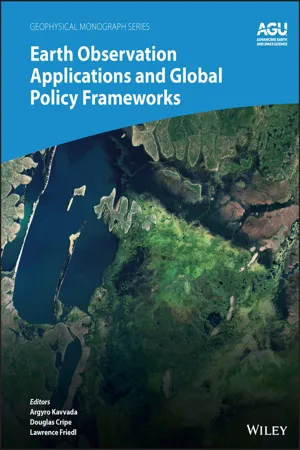
- Argyro Kavvada, Douglas Cripe, Lawrence Friedl, Argyro Kavvada, Douglas Cripe, Lawrence Friedl(Authors)
- 2022(Publication Date)
- American Geophysical Union(Publisher)
This includes engaging national level offices from the beginning, developing indicators that are data driven, science based, and relevant, as well as incorporating geospatial data into development activ- ities and progress monitoring indicator frameworks. However, questions remain about what and whose data, including of what quality (Scott & Rajabifard, 2017). Achieving the UN SDGs will rely upon both identifying and leveraging complementary and overlapping activities (Pradhan et al., 2017). It is imperative to maximize the value of data that has been created in the context of one activity or initiative for multiple uses, as articulated by the United Nations in the final report on the MDGs (United Nations, 2015a). In this vein, this chapter will address land used for food production as monitored through the Group on Earth Observations (GEO) and the GEO Global Agricultural Monitoring (GEOGLAM) Initiative, and its intersection with two global policy frameworks to which it contributes: the 2011 Group of 20 Action Plan on Food Price Volatility and Markets and the 2030 Agenda for Sustainable Development. The goal of GEOGLAM is to increase market transparency and improve food secu- rity by producing and distributing relevant, timely, and actionable information on agricultural conditions and outlooks on production at national, regional, and global scales. It achieves this by strengthening the international community’s capacity to utilize coordinated, comprehen- sive, and sustained Earth observations, with a particular focus on enhancing national systems for monitoring, as they in turn contribute to the global Earth observing system of systems (GEOSS) as envisaged by GEO (Christian, 2005; Singh Parihar et al., 2012). GEOGLAM is already contributing to achieving the 2030 Agenda, but there remain a multitude of untapped resources related to monitoring, measuring, and augmenting progress. eBook - PDF
- Shawn W. McLaren(Author)
- 2022(Publication Date)
- Wiley-Blackwell(Publisher)
Nutrition and Global Health, First Edition. Shawn W. McLaren. © 2023 John Wiley & Sons Ltd. Published 2023 by John Wiley & Sons Ltd. 9.1 Introduction Approximately 10% of the global population suffers from severe food insecurity (FAO 2018). There are approximately 60 million children who suffer from wasting and 160 million children who are stunted worldwide. Accessibility, affordability, utilisation and stability of food systems affect food security. While great progress has been made to reduce the number of malnourished children across the globe, changes to the food system such as the first green revolution have also resulted in 1.5 billion over- weight adults, of which 600 million are obese. The food system is a major contributor to climate change and is affected by climate change. Some of the largest effects of climate change are already disproportionately affecting the populations at the highest risk of food insecurity. The mini- mally acceptable and sustainable diet is unaffordable for 1.2 billion people across the world. The UN Sustainable Development Goals (SDGs) aim to eliminate malnutrition in all its forms by 2030 through a multisectoral approach. However, many countries are not on track to meet these goals. In addition, future challenges in sustainability and feeding the human population may undermine the progress already being made to meet the SDGs. There has been recent growing interest in sustainable food systems from high-income countries that have resulted in promising innovations. However, the acceptability and appropriateness of these innovations in low- and middle-income country settings must be addressed. 9.1.1 Food Security Food security refers to the availability of food, the ability to access food and the adequacy of available food for human health. However, food security is difficult to define as a concept (Barrett 2010).
Index pages curate the most relevant extracts from our library of academic textbooks. They’ve been created using an in-house natural language model (NLM), each adding context and meaning to key research topics.

