Geography

Sustainable Development Goal 6
Sustainable Development Goal 6 (SDG 6) aims to ensure access to clean water and sanitation for all. It focuses on improving water quality, reducing pollution, and protecting and restoring water-related ecosystems. SDG 6 also emphasizes the importance of water efficiency and sustainable water management practices to address water scarcity and ensure the availability of water for all.
Written by Perlego with AI-assistance
Related key terms
1 of 5
11 Key excerpts on "Sustainable Development Goal 6"

- Jonas Ebbesson, Ellen Hey(Authors)
- 2022(Publication Date)
- Cambridge University Press(Publisher)
6 SDG 6: Ensure Availability and Sustainable Management of Water and Sanitation for All Joyeeta Gupta and Hilmer Bosch abstract This chapter reviews the role of Agenda 2030 in further developing water law. It concludes that Sustainable Development Goal (SDG) 6, Clean Water and Sanitation, is a step forward in recognizing the holistic nature of water but that it does not define water as a public good or common good/concern or heritage and also does not reflect on whether water limits require us to redefine growth. It goes beyond a sectoral approach to promote an urgent, coherent, systemic, and multi-level story rightly ignoring whether some of it is based on soft or hard (inter)national law. However, SDG 6 moves backward from limited sovereignty to emphasize full permanent sovereignty over natural resources, and while it emphasizes access to water and sanitation, it does not address the larger distributive issues on which, for example, the 1997 Convention on the Law of the Non-Navigational Uses of Transboundary Watercourses elaborates. Finally, the implementation of SDG 6 may undermine its lofty goals by engaging the profit-oriented private sector in service delivery to the poorest and by enabling the commodification and privatization of the water. keywords SDG 6, water law, international law, water, sanitation, equity, no harm, access and allocation, justice, sovereignty 6.1 introduction This chapter examines the role of Agenda 2030 in governing fresh water through Sustainable Development Goal (SDG) 6, Clean Water and Sanitation, and the way 163 in which this SDG is embedded in Agenda 2030 and international water law. Freshwater is critical for life on Earth and for extraction, production, distribution, consumption, and disposal activities. Although freshwater is available as a renewable resource through the hydrological cycle, it is limited in quantity in time and is not evenly distributed worldwide.
- Brian P. McCullough, Timothy Kellison, E. Nicole Melton, Brian P. McCullough, Timothy Kellison, E. Nicole Melton(Authors)
- 2022(Publication Date)
- Routledge(Publisher)
sanitation-related activities and programmes, including water harvesting, desalination, water efficiency, wastewater treatment, recycling and reuse technologies 6.b Support and strengthen the participation of local communities in improving water and sanitation management Source : General Assembly (2015). The targets and indicators outlined by SDG 6 focus on holistic management of water resources, addressing everything from access to clean water and sanitation, to the community level development and capacity building necessary to continue managing these resources into the future. As it stands, much of the world’s water use is for agriculture and electricity, rather than for individual residential use. In the United States, the USGS reports that only about 12% of the water use is attributed to public supply (Dieter et al., 2018). The largest users are typically using the resource for economic gains, like for thermoelectric power or agriculture (Dieter et al., 2018). Water faces many of the traditional economic challenges. Like the “race to fish,” in a world with an uncertain supply of water resources or a demand greater than the resource can support, water becomes a resource with individuals and groups racing to extract, often resulting in an unequal distribution and economic losses. 17.2 Scope of global water issues The SDGs are classified into three categories, and Goal 6 falls under “environment,” as it focuses on water resources. The Sustainable Development Goals Report 2018 has been monitoring the state of sustainable development since 2015, and holds that the greatest barrier is lack of funding, once again bringing the conversation back to the “who pays” divide
- Pia Katila, Carol J. Pierce Colfer, Wil de Jong, Glenn Galloway, Pablo Pacheco, Georg Winkel(Authors)
- 2019(Publication Date)
- Cambridge University Press(Publisher)
Moreover, the phenomenon of defor- estation and its impacts on landscape and water availability are evident at scales larger than the catchment. It is therefore necessary to consider forest–water interactions at the catchment, landscape and subcontinental scales; actions with a beneficial impact at one scale may have an adverse impact at another. Amezaga, Bathurst, Iroumé et al. 182 6.3. Relevance of SDG 6 to Forests and Forest People SDG 6 is one of the new goals that emerged in 2015. Indeed, water was a notable omission from the SDG predecessors, the Millennium Development Goals (MDGs). In spite of its importance for achieving many of the MDG targets (WWAP 2009), it was hidden within MDG 7 Ensure Environmental Sustainability under the dual Target 7.C: ‘To halve the proportion of the uni- versal population without sustainable access to clean and safe drinking water and basic sanitation by 2015’. This has important implications for SDG 6’s policy context. While most of SDG 6 is new, the goal starts with an inher- ited focus on the water, sanitation and hygiene (WASH) agenda, which has developed a strong momentum after nearly two decades of MDG work. The drinking-water target was considered a big success as it was met five years before the deadline, but the sanitation target was never achieved. Although the proportion of the global rural population without access to improved sanitation has declined by nearly a quarter, half of people living in rural areas, including forested areas, do not have access to these facilities (UN 2015). Given this failure and the momentum behind the WASH agenda, it seems likely that a large proportion of the resources allocated to SDG 6 will be focused on sanitation. The reality is that the impact of MDG Target 7.C on the forestry sector and related policies was minimal; the same may be expected of the WASH impact. eBook - ePub
The Aral Sea Basin
Water for Sustainable Development in Central Asia
- Stefanos Xenarios, Dietrich Schmidt-Vogt, Manzoor Qadir, Barbara Janusz-Pawletta, Iskandar Abdullaev(Authors)
- 2019(Publication Date)
- Routledge(Publisher)
Tajikistan remains one of the poorest states among the Basin countries and its economy is particularly susceptible to the effects of the global economic crisis. The president of Tajikistan has emphasized the importance of water issues and especially of the dispute on water reservoirs with Uzbekistan. Consequently, the agenda of SDG 6 is Tajikistan’s priority, followed by the development of the agricultural sector, improving quality of social services, reducing unemployment, and improving access to universal education to eliminate poverty.Turkmenistan is a regional leader in the adaptation of the Sustainable Development Goals at the national level, in particular, with respect to optimizing the use of water resources. In September 2018, President Gurbanguly Berdimuhamedov published a book, On the Way to Achievement of the Sustainable Development Goals in Turkmenistan , to present the enormous amount of work carried out in the country.Uzbekistan works closely with the UN agencies to fulfill the SDGs. The country aims to improve the access of the urban and rural population to clean drinking water and sanitation. Another priority for the government is to enhance the energy efficiency of production, and to develop the energy sector, based on renewable energy sources such as hydropower. The country is working toward creating intersectoral synergies through the nexus approach.Current status of SDG 6 on clean water and sanitationA study on implementation of SDGs within the SPECA region (Alzhanova 2017 ) identified the most important goals for the Aral Sea Basin countries. The results of this analysis in an aggregated form are presented in the figure below (Figure 13.1 ). SDG 6 on Clean Water and Sanitation was referred to as one of the most critical for the region, while SDG 13 on Climate Action was also mentioned as a priority across all states.The framework of SDGs provides not only individual goals and targets but also relevant indicators. Through vigorous discussions, these indicators were agreed upon by the Member States to ensure fair monitoring of the progress in sustainable development by each country, both developing and developed. In the case of Goal 6, 11 indicators correspond to the eight targets in total. Table 13.1 eBook - PDF
- Guo Huadong(Author)
- 2022(Publication Date)
- EDP Sciences(Publisher)
From 2015 to 2019, the official development assistance commitments to the water sector increased by 11%, but expenditures increased by only 3% (SDG indicator 6.a.1). Of the 109 countries, only 14 have community management institutions that are highly involved in water and sanitation decision-making. In order to solve the problems hindering the realization of SDG 6 and bring the world back on track, the United Nations has launched the Global Acceleration Framework, including financing, data and information, capacity development, innovation and governance. Data and information are meant to improve water-related monitoring and assessment through data generation, validation, standardization and information exchange, including drawing on coherent data, innovative approaches, and tools. In recent years, Big Earth Data represented by space-based Earth observation are supporting the monitoring and evaluation of SDG targets 6.1, 6.3, 6.4, 6.5, 6.6 and 6.a. These technical means are capable of high spatiotemporal resolution monitoring through remote sensing with regular revisit periods and rapid information extraction, which can save money and time, and provide more accurate and comprehensive evaluation results. In recent years, China has carried out a large amount of research and practice on monitoring and evaluating the targets of SDG 6 supported by Big Earth Data, which has contributed to the global implementation of SDG 6 in terms of data products, models, methods and decision support. 67 Chapter 3 SDG 6 Clean Water and Sanitation This chapter focuses on four SDG targets: improving water quality (SDG 6.3), improving water- use efficiency (SDG 6.4), integrating water resources management (SDG 6.5), and protecting and restoring water-related ecosystems (SDG 6.6). eBook - ePub
- Oliver Cumming, Tom Slaymaker, Oliver Cumming, Tom Slaymaker(Authors)
- 2018(Publication Date)
- Routledge(Publisher)
The Sustainable Development Goal (SDG) on water and sanitation is a huge improvement on the MDG targets, and the impact of subsequent discourse on the human rights to safe drinking water and sanitation is reflected in the formulation of the targets and indicators. The SDG target seeks by 2030 to achieve universal and equitable access to safe and affordable drinking water for all, as well as access to adequate and equitable sanitation and hygiene for all and an end open defecation, paying special attention to the needs of women and girls and those in vulnerable situations. In addition, water quality concerns that were missing from the MDGs are addressed, including a commitment to reduce the number of people suffering from water scarcity and support, and to strengthen the participation of local communities in improving water and sanitation management. The importance of strengthening the wider water management environment, as well as immediate supply access, recognizes that equality in supplies may be hindered significantly if the resource base itself is inadequately managed and maintained, both in terms of the availability of quantities and the overall quality of the resource.Still, like the other SDGs, there is a risk that there are too many indicators and hence problems with monitoring and tracking, and the risk of an SDG monitoring industry emerging in each country, with an over-emphasis on tracking numbers of beneficiaries and an under-emphasis on tracking qualitative differences in access. In common with the MDGs, there is also a lack of clear mechanisms of accountability and similarly a definition of each goal and target at more specific national and subnational levels. These will always be different and need to be locally defined. Also generalized, globalized arguments that underpin policy debates tend to remain disconnected from the everyday experiences of local people. The ‘service ladder’ used for monitoring target 6.1 (see Chapter 12 ) is far more nuanced than the binary improved/unimproved classification used for MDG monitoring. However, as Welle52 eBook - PDF
Beyond the Gap
How Countries Can Afford the Infrastructure They Need while Protecting the Planet
- Julie Rozenberg, Marianne Fay(Authors)
- 2019(Publication Date)
- World Bank(Publisher)
SDG = Sustainable Development Goal. WATER, SANITATION, AND IRRIGATION 51 on climate change and global markets, while in Sub-Saharan Africa, an investment of 0.6 percent to 0.7 percent of GDP per year would improve food availability by 0.3 percent to 0.9 percent. • Complementary policies will be needed to limit the harm to ecosystems and provide farmers with climate-smart practices and technologies. WATER AND SANITATION: MDG OR SDG MAKES ALL THE DIFFERENCE Although access to water and sanitation services has increased greatly in recent decades, coverage rates in 2015 show that countries need to keep investing to close the gap for universal access even to “basic” services— with the 2015 coverage rate at 81 percent for basic water and at 61 percent for basic sanitation (table 2.2). Achieving universal access to “safely man-aged” water and sanitation services poses an even greater challenge, given the significantly lower coverage rates (43 percent for water and 30 per-cent for sanitation) and higher investment costs for “safe” water and san-itation. 1 Moreover, the population in LMICs will continue to grow rapidly in the coming decades, increasing the number of people who will need access.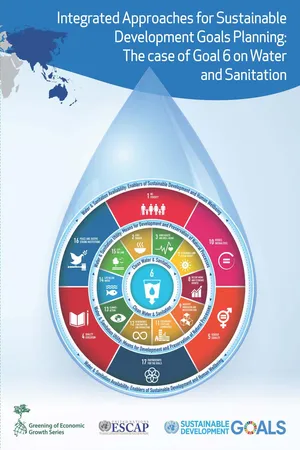 No longer available |Learn more
Integrated Approaches for Sustainable Development Goals Planning
The Case of Sustainable Development Goal 6 on Water and Sanitation
- United Nations Economic and Social Commission for Asia and the Pacific(Author)
- 2017(Publication Date)
- United Nations Publications(Publisher)
This is already being pursued by mapping the agencies responsible for the achievement of the SDG 6 targets. A longer-term strategy involves three additional interventions: to begin sustaining green economic growth 35 (SDG 8.1) via water-use efficiency (SDG 6.4) and improved water quality (SDG 6.3) through comprehensive wastewater treatment, which can improve water renewability and access-related issues for society. 3.4 Pilot application in Tajikistan 28 Major challenges and how systems thinking and the ESCAP framework helped address them Formation of sustainable development in Tajikistan is closely connected with the tasks of building a socially oriented market economy, effective management and careful use of natural resources, and the formation of a modern civil society. The most important areas to achieve sustainable development parameters in Tajikistan is the need to ensure universal access to modern energy resources (services) and technology, energy efficiency and increased use of renewable energy sources. This is especially true for relatively small countries with a predominance of mountainous regions that are remote from the main infrastructure and are underdeveloped. National consultations on the 2030 Agenda and the SDGs revealed that the main problematic areas of the country’s development after 2015 were: • education • health care • employment • non-equality • the fight against corruption • food security and nutrition • good governance • social protection • to prevention of potential conflicts and • reliable energy, ecology and management of demographic processes. The systems thinking model allowed for identifying the challenges to achieving sustainable inclusive development while addressing the interlinkages between SDG 6 with other objectives of the 2030 Agenda in Tajikistan. While developing the models and analysing linkages, the national team identified a critical relationship between SDG 6 and SDG 5 on gender equality. eBook - PDF
- World Bank(Author)
- 2016(Publication Date)
- World Bank(Publisher)
Just over a quarter of people in low-income countries have access to an improved sanitation facility, compared with just over half in lower middle-income countries. Delivery of water supply and sanita-tion is not just a challenge of service provision; it is intrinsically linked with climate change, water resources management, water scarcity, and water quality. Ensuring access to an improved water source and improved sanitation facilities In many countries, economic and population growth as well as urbanization have increased water demand while supply has remained unchanged or even decreased due to climate change. Although 2.6 billion people have gained access to an improved water source since 1990, dwindling supplies of safe drinking water remain a global problem. More than $250 bil-lion in GDP is lost every year in low- and middle-income countries because of inadequate water supply and sanitation services. 1 Sustainable Development Goal 6 recognizes that sustainably managing water goes beyond simply providing a safe water supply and sanita-tion to include the environment, human health, food security, disaster resilience, and ultimately economic growth. Easing access to drinking water Sustainable Development Goal 6 encompasses a call for drinking water for all (target 6.1). In 2015, 91 percent of the world’s population had access to an improved water source, exceed-ing the Millennium Development Goal target of 88 percent. However, more than 660 mil-lion people still lack access to clean water, the majority of them in rural areas, predominantly in Sub-Saharan Africa (figure 6a). Even for those who have access to water, service is often inad-equate or unsustainable, and water from an improved source can still be unsafe to drink.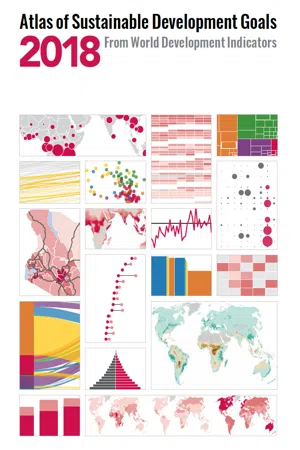 eBook - PDF
Atlas of Sustainable Development Goals 2018
From World Development Indicators
- World Bank(Author)
- 2018(Publication Date)
- World Bank(Publisher)
WDI (SH.H2O.SMDW.ZS; SH.BASW.ZS). SDG 6.1 SDG 6.1 SDG 6.1 Atlas of Sustainable Development Goals 2018 23 Bangladesh Congo, Dem. Rep. Niger Tanzania Nigeria Haiti Ethiopia Mozambique India Indonesia Pakistan Yemen, Rep. Tunisia Guatemala 0 25 50 75 100 Poorest 40 percent Richest 60 percent Source: World Bank (2017). http://hdl.handle.net/10986/27831 Under 50 50–75 75–90 90–100 No data Source: WHO/UNICEF Joint Monitoring Programme for Water Supply, Sanitation and Hygiene. World Development Indicators (SH.H2O.BASW.ZS). At least basic water requires only an improved water source within a 30-minute roundtrip, but 42 percent of people in Sub-Saharan Africa lack even that. People using at least basic water services, 2015 (% of population) Rural dwellers are less likely than their urban counterparts to have access to at least basic water. People using at least basic water services (%) Poorer people are less likely to have the convenience and potential safety of water piped to their homes. People using piped water on premises, most recent value (%) Outside Sub-Saharan Africa, Afghanistan, Haiti, Kiribati, Papua New Guinea, and the Solomon Islands each have a rate below 65 percent. Only 19 percent of Eritreans have access to basic water. Of those who do not, about half travel too far to qualify, and about half use an unimproved source. Piped water is not always safer. For example, in Bangladesh 80 percent of piped water is contaminated with E. coli —no different from surface water. 0 25 50 75 100 SDG 6.1 SDG 6.1 SDG 6.1 2000 2015 39 29 8 12 12 Source: WHO/UNICEF JMP for Water Supply, Sanitation and Hygiene, https://washdata.org. WDI (SH.STA.SMSS.ZS; SH.STA.BASS.ZS). Uganda Papua New Guinea Liberia Somalia Congo, Rep. Sierra Leone Ghana Togo Benin Niger Eritrea South Sudan Madagascar Chad Ethiopia 0 10 20 30 Note: The 15 countries with lowest access to at least basic sanitation (out of 210 countries with data).
- Jain, Ashok Kumar(Authors)
- 2021(Publication Date)
- Daya Publishing House(Publisher)
3 Agenda 21 and Sustainable Water Development The Agenda 21 drawn in RIO EARTH SUMMIT (1991) had been a watershed in terms of sustainable water development. It deals with water, people, environment and health, institutions in a synoptic manner. The Agenda recommends that all States, according to their capacity and available resources, and through bilateral or multilateral co-operation, including the United Nations and other relevant organizations as appropriate, could implement the following activities: Environment and Health Establishment of protected areas for sources of drinking-water supply, Sanitary disposal of excreta and sewage, using appropriate systems to treat waste waters in urban and rural areas, Expansion of urban and rural water-supply and development and expansion of rainwater catchment systems, particularly on small islands, in addition to the reticulated water-supply system, Building and expansion, where appropriate, of sewage treatment facilities and drainage systems, Treatment and safe reuse of domestic and industrial waste waters in urban and rural areas, Control of water-associated diseases. People and Institutions Strengthening of the functioning of Governments in water resources management and, at the same time, giving of full This ebook is exclusively for this university only. Cannot be resold/distributed.
Index pages curate the most relevant extracts from our library of academic textbooks. They’ve been created using an in-house natural language model (NLM), each adding context and meaning to key research topics.

