History

Ali ibn Abi Talib
Ali ibn Abi Talib was a cousin and son-in-law of the Prophet Muhammad, and the fourth caliph of Islam. He is revered by both Sunni and Shia Muslims for his wisdom, piety, and bravery. Ali played a significant role in the early Islamic community and is known for his contributions to Islamic jurisprudence and spirituality.
Written by Perlego with AI-assistance
Related key terms
1 of 5
5 Key excerpts on "Ali ibn Abi Talib"
- Ingvild Flaskerud(Author)
- 2010(Publication Date)
- Continuum(Publisher)
2 The use of concepts reflect the idea that Muhammad was both a spiritual and a political leader, whereas the subsequent Caliphs were the custodians of the moral and material heritage of the Prophet and acted as political leaders, but not as spiritual leaders and interpreters of God’s word. It did, however, become the position of the Twelver branch of Imam Ali in Shia Memory 33 Shiism that Ali was qualified to hold both a spiritual and a political office. The theology of the Imamate, as it developed during the centuries, perceived the Imams to be God’s viceregents and representatives on earth, and the guardians of His revelation. Like the greatest Prophets the Imams are infallible, or pro-tected, ma’sum , from error. 3 This idea has influenced the Shia perception of Islamic history, and consequently the role of Ali and his family in that history. The history, as recorded by Shia writers, therefore tends to underline Ali’s excellence, and argue that his right to the Caliphate was usurped. Conflicts between the Prophet’s family and the new Caliphs is said to have begun from the day after the death of the Prophet. An emblematic example of the injustice imposed on the Prophet’s family is Fatemeh’s, Muhammad’s daughter’s, failed claim to the estate of Fadak, which had been the personal property of the Prophet. Caliph Abu Bakr refused this claim, stating that the property belonged to the whole community, since the Prophet had said, ‘nobody should inherit from me, but what I leave is for alms’. 4 Ali did not inherit any-thing from his own father, since the father had been an unbeliever and it was forbidden for a Muslim to inherit from unbelievers. As a result, Ali and Fate-meh are said to have lived in poverty. Ali did not, however, challenge the rule and position of the three Caliphs. Instead, he is said to have adopted a strategy of silence, waiting patiently for his turn. eBook - PDF
- Clinton Bennett(Author)
- 1998(Publication Date)
- Continuum(Publisher)
Finally, however, he did become leader of the Muslims. As he had himself anticipated, his greatest challenge was trying to unite the community. His reign was in fact marked by civil war and was short-lived (as noted above). He was universally respected as a soldier (having played a vital role in the early battles against the Makkans) as well as for his piety and learning. His Nahjul Balaaghah, compiled by as-Sayyid ar-Raddhi (I have cited from the 1996 Ahlul-Bayt Assembly of America translation) is regarded by Shi'a as 'the greatest literary and theological composition ... after the Holy Qur'an and the Sunnah'. 'AH remains an important figure within Sunni as well as Shfa Islam. For the former, he was the fourth 'rightly guided' Khalif; although all four 'rightly guided' Khalifs were virtuous, the first, Abu Bakr, was the most virtuous (see Ibn Hanbal's creed which places the Companions in 'order of excellence' -Abu Bakr, eBook - ePub
The Shi’a of Samarra
The Heritage and Politics of a Community in Iraq
- Imranali Panjwani(Author)
- 2012(Publication Date)
- I.B. Tauris(Publisher)
exemplifies the heavy burden on his shoulders to guide the Muslim community. It also showed that the oppression against himself and his family was unrelenting, which immediately restricted how he could demonstrate his knowledge and moral leadership. I now turn to his life.Ali al-Hadi’s early life and the political situation of the Abbasid caliphateLike all other Imams, al-Hadi was also born in Madinah. Another narration states that there was a small village near Madinah called ‘Sarayya’ where he was born.12 His actual name was Ali. His mother was called Sumanah, also known as Umm al-Walad or Umm al-Fazal. She was from the offspring of Ali b. Abi Talib’s close companion, Ammar b. Yasir. The birthplace of al-Hadi points to an interesting trend; all the Shi‘i Imams were born in the Hijaz. Ali b. Abi Talib was born in Makkah whereas the ten Imams after him were born in or around Madinah. This demonstrates the level of loyalty the Prophet’s descendants had with the Prophet’s burial place of Madinah and the importance they gave in preserving the Shi‘i faith in the nucleus city of the Muslim state. Al-Hadi’s date of birth is documented as 15th Dhu al-Hijjah 212/5th March 828,13 though some historians have given his date of birth as 5th Rajab 214/7th September 829.14 Although his name was Ali he was called by his titles (as per Arab tradition). His most famous titles are al-Naqi (the pure), al-Hadi (the guide), al-Qayam (the one who rises), al-Faqih (the jurist), al-Amin (the trustworthy) and al-Tayyab (the pure). He was also known as Abu al-Hasan al-Thalith (father of Hasan, the third).15Al-Hadi was born during the reign of al-Ma‘mun. Al-Ma‘mun died in 217/833 after he got food poisoning whilst eating dates and river water. He was buried in Tarsus in current south central Turkey16 and was succeeded by his half-brother, Abu Ishaq al-Mu‘tasim. Al-Mu‘tasim summoned al-Hadi’s father, Muhammad al-Taqi, to Baghdad in 219/835 for the second time. In al-Taqi’s previous trip to Baghdad, he got married to al-Ma‘mun’s daughter, Umm al-Fazal and narrations say that after her marriage, she moved to Madinah. However, she never liked living there and wrote to her father complaining about al-Taqi. Al-Ma‘mun did not pay any attention to her grievances but after al-Ma‘mun’s death, al-Mu‘tasim, who had vocally opposed this marriage, summoned them back to Baghdad where al-Taqi was imprisoned and then poisoned in 219/835.17 Ali al-Hadi was only eight years old when he became an orphan in Madinah. Al-Hadi’s age and distance from Baghdad lessened the political worries of al-Mu‘tasim in watching al-Hadi’s influence on the Muslim communities in Arabia. However, al-Mu‘tasim did keep an eye on al-Hadi by appointing the scholar, Ubaydullah Junaydi, as his teacher. The aim was to brainwash the young al-Hadi and to monitor his movements. Interestingly, however, it is reported that Ubaydullah Junaydi was unable to teach al-Hadi anything since he was extremely knowledgeable, despite his young age.18 eBook - ePub
Ethics in Islam
Friendship in the Political Thought of Al-Tawhidi and his Contemporaries
- Nuha Al-Shaar(Author)
- 2014(Publication Date)
- Routledge(Publisher)
72 The matter of the succession to the Prophet was at the heart of the religious conflict of the day. By presenting ‘Alī’s pledging of allegiance to Abū Bakr, al-Tawḥīdī could be seen as offering a moderate stance intended to influence attitudes concerning contemporary political–religious antagonism, rather than an attempt to advocate Sunnī claims. Furthermore, al-Tawḥīdī provides reports that offer different views of the ‘Alī-Abū Bakr claims. For instance, he reports on the authority of Muḥammad al-Naḥawī that Muḥammad b. Sallām al-Jumaḥī said to al-Khalīl:“What is the matter with the Companions of the Prophet (peace be upon him)? They behave as if they were twins, while ‘Alī [seems] to them as if he were the son of a different mother.” He said: “How did you arrive at this idea?” I said: “I want you to tell me.” He said: “Only if you keep it secret as long as I am alive.” I said: “Yes.” He said: “‘Alī preceded them in Islam, and exceeded them in honour and knowledge, and surpassed them in his wisdom and asceticism, and therefore they became envious of him, and people are inclined to their example and model.”73Furthermore, al-Tawḥīdī admires ‘Alī for his eloquence, wisdom, and his extensive religious knowledge of the Qur’ān, ḥadīth, law, theology, and genealogy.74 He also reports the sayings of different figures who acknowledged ‘Alī’s piety, integrity, courage, and asceticism.75 In fact, al-Tawḥīdī’s esteem for the family of the Prophet is evident.76 He cites the Prophet’s saying: “I am the tree, its twigs are Fāṭima, its branches are ‘Alī, its fruits are al-Ḥasan and al-Ḥusayn, and our Shī‘a are its leaves.”77 He also quotes the saying of one of the eloquent men (al-bulaghā’) who describes the Banū Hāshim as the substance of tawḥīd, the tree of Islam, the protectors of goodness, the house of mercy, the wellspring of wisdom, the refuge for the fearful, the cradle of Gabriel, the place of the descent of revelation, and the guardians of the Qur’ān.78 He adds:Loyalty to them is infallability from sin (muwālātuhum ‘iṣma), loving them is purity, proximity to them is salvation, enmity towards them is a curse. When Almighty God has chosen a man, He makes him from them. When He completed the Book, He revealed (anzala) it to them. When He guided a community, He directed it to them. The first among them is the sacrificial victim for God (dhabīḥ Allāh), the middle one is the Messenger of God (peace be upon him), and the last [ones] are God’s caliphs on His earth. On the basis of obedience or disobedience to them, humankind and jinn are divided into two groups: one group will enter heaven, while the other will enter hell.79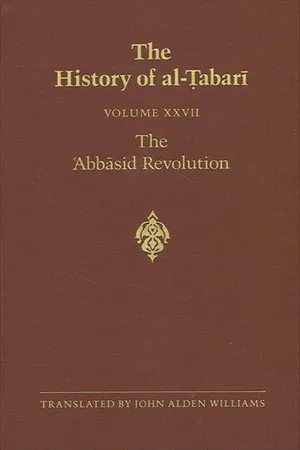 eBook - PDF
The History of al-Ṭabarī Vol. 27
The ʿAbbāsid Revolution A.D. 743-750/A.H. 126-132
- John Alden Williams(Author)
- 2015(Publication Date)
- SUNY Press(Publisher)
Receive with gratitude what God has given you, cleave to our allegiance, and practice not deceit against yourselves, for surely this authority is your authority; surely every dynasty has its center-point, and you are our center-point?“ Has any succes sor to God's Messenger ascended this your minbar save the Commander of the Faithful ‘Ali b. Abi Talib and the Com mander of the Faithful 'Abdallah b. Muhammad?u and he gestured with his hand toward Abfi al-‘Abbas So know that the authority is with us, and shall not depart from us until we surrender it to Iesus the son of Mary‘“—God's benediction be on him—and praise be to God, Lord of the uni verse, for that with which He has tried us and entrusted us! Then Abu al-“Abbas descended from the minbar, with Dawud b. “Ali in front of him until they entered the palace. He had Abu la'far sit and receive the handclasp of allegiance (buy'ah) from the people in the mosque. He kept on receiving it until he had prayed both the afternoon and the sunset prayer with them and night had enfolded them. Then he entered (the palace). It is mentioned that when Dawud b. 'Ali and his son Musa were in Iraq, or somewhere else, they had left wishing to reach Sharat. Abu al-“Abbas met them at Dumat al-Iandal while on his way to Ki'ifah. With him were his brother Abii al-la'far 'Abdallah b. Muhammad, 'Abdallah b. ‘Ali, 'Isa b. Musa, and Yahya b. Ia‘far b. Tammam b. al ‘Abbas and a party of their mawlas. Dawud asked them, Where are 382. This reference to Kiifah was hardly reflected by 'Abbasid practice. They imme diately withdrew to Hirah and eventually established their administrative center at a new capital, Baghdad. See n. 35 3 above. 383. The question has a twofold thrust: that all caliphs between ‘Ali and Abu al 'Abbas were in fact illegal usurpers, and that there is a special relationship between the Ki'ifans and the Prophet’s family. 384. That is, at the Messianic age which will precede the end of the world.
Index pages curate the most relevant extracts from our library of academic textbooks. They’ve been created using an in-house natural language model (NLM), each adding context and meaning to key research topics.

