History

Mu'awiya
Mu'awiya was the founder of the Umayyad Caliphate and a prominent figure in early Islamic history. He played a significant role in the expansion of the Islamic empire and is known for establishing a hereditary system of succession within the caliphate. His reign marked a transition from the Rashidun Caliphs to the Umayyad dynasty, shaping the future of Islamic governance.
Written by Perlego with AI-assistance
Related key terms
1 of 5
9 Key excerpts on "Mu'awiya"
 eBook - PDF
- Armando Salvatore(Author)
- 2018(Publication Date)
- Wiley-Blackwell(Publisher)
Respected Arab tribal chiefs known as ashraf (pl. of sharif , of noble Arab descent) acted as intermediaries between this small ruling coterie and the mass of tribesmen (Crone 1980: 30–3). 120 The High Caliphate (ca. 661–946) Nonetheless, Mu‘awiya’s caliphate was not a tribal chieftainship and it broke with the past in important ways. He perceived his authority as religious, not simply political, and his use of terms such as sultan Allah (“the power of God”) for his government (Humphreys 2006: 115–16) prefigured the more overt claims to religious authority of the later Umayyads, expressed in the controversial title khalifat Allah (God’s “deputy” or “vicegerent”: Crone and Hinds 1986: 4–23). Although the Umayyad position was later rejected by Muslim religious scholars as contrary to the spirit of the caliphate, it drew on Near Eastern traditions of kingship and was part of the necessary experimentation in the first phase of the history of Islam, which was extended into the early ‘Abbasid Caliphate (see al‐Azmeh 1997). Mu‘awiya also transferred the geopolitical center of the Islamic empire from Medina to Damascus, his seat of many years. This move alienated Muslims who believed that Medina, the Prophet’s city, should remain the seat of the caliphs. However, it made sound political and military sense given Mu‘awiya’s reliance on the Arab tribes of Syria. The transfer of the seat of caliphal power from the Hijaz to ex‐Byzantine territory established a new imperial trajectory for the Muslim empire which ultimately led to ‘Abbasid Iraq. In the event, Mu‘awiya’s most divisive act was to nominate his son Yazid as his successor in 680, which reopened conflict over the issue of legitimate rulership. From a tribal political perspective, his decision made sense: Yazid’s mother was the daughter of a chief of the Kalb tribe that represented the core of Mu‘awiya’s Syrian support base. eBook - ePub
Mu'awiya ibn abi Sufyan
From Arabia to Empire
- Stephen Humphreys(Author)
- 2012(Publication Date)
- Oneworld Academic(Publisher)
LAYING THE FOUNDATIONS OF POWER: MU‘AWIYA AS MASTER OF SYRIA (632–656) MU‘AWIYA AND THE CONQUEST OF SYRIALittle is known of Mu‘awiya in the years immediately following Muhammad’s death in 632. In 636, he emerged from the mist slightly, when he was given command of an advance force that had been roughly handled by the Byzantines near Damascus and whose defeat threatened the Muslim position in Syria.1 He held this command, of 3000 men or even fewer, at the decisive Battle of the Yarmuk in the same year. He led his troops ably but is not mentioned as one of the battle’s heroes. After Yarmuk, his older brother, Yazid, led Muslim forces up the coast of Lebanon, occupying Sidon, Beirut and several other cities. Mu‘awiya served with great distinction as commander of the vanguard of this expedition.Then he moved into more visible roles. He is named as one of the four Muslim witnesses who signed the treaty of capitulation for Jerusalem, which surrendered in December 637 (or February 638) after a two-year siege. The Patriarch Sophronius, who governed Jerusalem on behalf of the Byzantines, demanded that the caliph ‘Umar come to Syria and personally negotiate the terms of surrender; later, they visited Jerusalem together.2 The fall of Jerusalem was immensely significant for the Muslims; for the Byzantines, it was apocalyptic:Sophronius … received a promise of immunity for the whole of Palestine. ‘Umar entered the Holy City dressed in filthy garments of camel-hair and, showing a devilish pretence, sought the temple of the Jews – the one built by Solomon – that he might make it a place of worship for his own blasphemous religion. Seeing this, Sophronius said, ‘Verily this is the abomination of desolation standing in a holy place, as has been spoken through the prophet Daniel’. And with many tears the defender of piety bewailed the Christian people. eBook - PDF
Princely Authority in the Early Marw?nid State
The Life of ?Abd al-?Az?z ibn Marw?n
- Joshua Mabra(Author)
- 2017(Publication Date)
- Gorgias Press(Publisher)
Hinds, “Muʿā wiya I,” EI 2 ; Patricia Crone, Slaves on Horses: The Evolution of the Islamic Polity (Cambridge, 1980), 34 ff; Bo s-worth, “Marwān,” EI 2 ; Madelung, Succession to Mu ḥ ammad , 61; Madelung, “Apocalyptic Prophecies,” 184; Andrew Marsham, Rituals of Islamic Monar-chy: Accession and Succession in the First Muslim Empire (Oxford, 2009), 115. 14 P RINCELY A UTHORITY first century CE. By the fifth century CE, they had migrated farther north to Palestine, Jordan, Syria, Egypt and southern Iraq, where t hey became auxiliary forces and client kingdoms for the Byza n-tines and Sassanians. Quḍāʿī tribes like Ghassān, Kalb and Lakhm guarded the borderlands between the Arabian Peninsula and the lands of the great empires of Late Antiquity, acting a s gatekeepers for the great empires. 2 The Kalb were particularly important to the Byzantines in guarding the Sirḥān valley, which was a major trade route connecting Arabia with Greater Syria. D ū mat al-Jandal, the city ruled by ʿAbd al -ʿ Az īz’s maternal ancestors, sat at the southern edge of this valley, and Latin inscriptions in this Arab city mark its incorporation into the Byzantine military network. 3 Julius Wellhausen emphasizes Quḍāʿa’s long tradition of kin g-ship and the culture of obedience and loyalty that they developed during their association with the Byzantines. He writes: The influence of the Graeco -Aramaic culture, the Christian church, and the Roman kingdom under which they had come had not failed to leave traces upon them. A regulated state government and military and political discipline were not new ideas to them; they had an old line of princes, which they had long obeyed, and they transferred their wonted obedience to Muawiya as the rightful suc cessor of their former dynasty. 4 Wellhausen places Muʿāwiya’s marriage to Maysūn bt. Baḥdal at the center of his political strategy in Syria. eBook - ePub
The Meaning of Mecca
The Politics of Pilgrimage in Early Islam
- M. E. McMillam, M E McMillan, M. E. McMillan(Authors)
- 2011(Publication Date)
- Saqi Books(Publisher)
par excellence as Mu‘āwiyah sought to justify his authority in the name of his murdered kinsman.For this to retain its potency as a propaganda tool, it had to be repeatedly demonstrated. One strategy Mu‘āwiyah adopted was to curse ‘Uthmān’s rival, ‘Alī, on a regular basis during the khuṭbah .91 Another was his choice of governor for the city which had witnessed ‘Uthmān’s murder. And so, for nearly fifteen years of his reign, Mu‘āwiyah relied on two men who were closely related to ‘Uthmān to govern Medina. In doing so, he effectively made Marwān and Sa‘īd the living embodiment of the ideology underpinning his rule.It was a point the caliph chose not to limit to Medina. By appointing Marwān and Sa‘īd to lead the ḥajj for him, and on such a recurrent basis, Mu‘āwiyah was able to communicate his message to the cross-section of the Muslim community gathered in Mecca for their pilgrimage.However, the very reasons which made Marwān and Sa‘īd useful to Mu‘āwiyah also gave him cause for concern. Marwān and Sa‘īd were with ‘Uthmān to the bitter end on the Yawm al-Dār , whereas Mu‘āwiyah was nowhere to be seen. If ‘Uthmān’s fate provided the legitimacy for Umayyad rule, then the political claims of men who had stayed with him right to the end could be considered more valid than the current caliph’s. Or his son’s.92 While Mu‘āwiyah was content to use their political merits to legitimize his own authority, he had no wish to see them use their position as a springboard to further their own careers. His aim in rotating so prestigious a governorship as that of the Prophet’s City – and leadership of the ḥajj – between the two of them was one of the oldest political tricks in the book: to divide and conquer.He executed this strategy in several ways. When Sa‘īd was governor, the caliph wrote to him ordering him to demolish Marwān’s house. Sa‘īd refused and the refusal was said to have cost him his job.93 He was also ordered to confiscate Marwān’s property but declined on the grounds of their close kinship. He wisely decided to keep all the correspondence he received from the caliph on this matter.94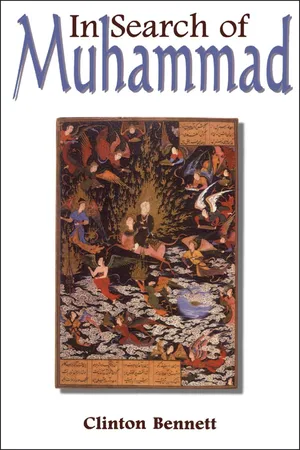 eBook - PDF
- Clinton Bennett(Author)
- 1998(Publication Date)
- Continuum(Publisher)
The result was that religion was sidetracked and political considerations given precedence in affairs of state' (p. 64). Arabs were given special privileges over and above Muslims from other racial groups. Mucawiyah also used the Bait-al-Mal (House of Property, into which taxes, war booty and treasure trove are paid) 'as if it were his personal property' instead of for the conduct of state business, for which it had been established by Muhammad. 'The dynasty', says Glasse (1991), 'became notorious for running the Empire as if it were a personal fief (p. 408). We shall return to Ibn Khaldun below. Umayyad history, of course, is refracted through the lens of its detractors. Some Umayyad rulers, according to Ahmed (1988), 'approximated to [the] ideal', for example, 'Umar II, who 'placated the Shi'a, stopp[ed] the condemnation of'Ali which Mu c awiyah had instituted in the pulpits, and treated all Muslims, whether Arab or not, alike' (pp. 38-9). 'Umar II also commissioned, as noted in Chapter 2, the collection of hadith, and 'appointed paid teachers to teach the Qur'an to the ignorant Bedouins' (Siddiqi, 1993: 6). Another Umayyad, 'Abd al-Malik (685-705), gave us the oldest (extant) and arguably the most beautiful Muslim building -Jerusalem's Dome of the Rock. The Dome's inscriptions are replete with Islamic dogma; they proclaim Islam as the culmination of Judaism and Christianity and include texts about the status of Muhammad, whilst 'the 150 Muhammad in Muslim Life and Thought copper inscription over the north door ... refers to Muslims as those who believe in God [and] what He revealed to Muhammad' (Rippin, 1990: 54). Incidentally, this does not, in my view, support the view that Muhammad was of relatively little importance during this period or that the Umayyads were totally indifferent to Islam. No longer available |Learn more
- Alexander Knysh(Author)
- 2016(Publication Date)
- Routledge(Publisher)
This is not to say that there was no opposition to Mu‘awiya’s rule. The old grievances and slights still rankled, and the imposition of strict centralized rule and discipline on the freedom-loving and independent Bedouins fed resentment among the rank-and-file members of the Muslim military units. The Kharijites remained active in Iraq, Iran, and parts of Arabia. Many Quraysh families in Medina and Mecca were also disturbed by what they perceived as Mu‘awiya’s high-handedness in treating the Quraysh nobility and his favoritism toward certain families to the exclusion of others. The caliph also had a formidable rival in the person of Marwán, the former advisor to the caliph ‘Uthman and an erstwhile ally of Mu‘awiya’s against ‘Ali, who now served as governor of Medina. Marwán, who belonged to a different branch of the Umayyad clan, considered himself and his descendants to be more worthy of the caliphate than the descendants of Abu Sufyán headed by Mu‘awiya. Finally, in the Hijáz, there emerged several claimants to the caliphate. One of them was al-Husayn, the younger son of ‘Ali, the other ‘Abdallah b. al-Zubayr, a son of the Prophet’s companion al-Zubayr, who, as we remember, had participated in the rebellion against ‘Ali’s rule and was murdered after the Battle of the Camel in 656. ‘Abdallah b. al-Zubayr’s bid for the caliphate would prove a serious challenge to Umayyad authority, as we shall soon see. As it became clear that Mu‘awiya was grooming his only son Yazíd as his successor, 83 the anti-Umayyad opposition grew stronger and more vocal. Seeing that so far no caliph had been succeeded by his son, Mu‘awiya’s intention was interpreted by many as a gross violation of the principles of succession established by the first two caliphs eBook - PDF
Early Islamic Institutions
Administration and Taxation from the Caliphate to the Umayyads and Abbasids
- Abd Al-Aziz Duri(Author)
- 2011(Publication Date)
- I.B. Tauris(Publisher)
146 However, the frequent reliance of the caliph on inheritance rendered the form of rule gradually oriented more and more towards despotism. 147 On the other hand, the fuqah Æ≥ considered the caliphate of the Umayyads to be a worldly possession because it was incompatible with the divine law ( al-shar ≤ ). The fuqah Æ≥ in Medina were against the Umayyads. This 26 EARLY ISLAMIC INSTITUTIONS divergence between the caliphs and the fuqah Æ≥ influenced the theory of the caliphate, since it had been formulated against the will of the fuqah Æ≥ who were far from rule and continued to be far-removed from the knowledge of the political practice of it. So they did not pay heed to reality but neglected it, intentionally or inadvertently. 148 Thus, religion had its influence in the Umayyad age, with the caliph adhering to certain religious protocols. He led the people in prayers, delivered the sermon ( khu π bah ) to them on Fridays and sent his armies to distant regions to bring them under the banner of Islam. Moreover, religion had an influence on some of the Umayyad caliphs. For example, it has come down to us that Mu ≤Æ wiyah II was deeply devout; ≤ Umar bin ≤ Abdul ≤ Az ∞ z was influenced by religion in his policies; and Yaz ∞ d III came to rule in the name of Islamic principles. 149 Finally, we can assert that the caliphate system in the Umayyad era was a period of transition from the stage of election to that of absolute inheritance, which obtained in the ≤ Abb Æ sid era. The first ≤ Abb Æ sid era (132 AH /750 AD ) until the death of al-Mutawakkil (247 AH /861 AD ) The coming to power of the ≤ Abb Æ sids had an impact on the development of the system of caliphate. eBook - PDF
- Wael B. Hallaq(Author)
- 2016(Publication Date)
- Routledge(Publisher)
One telling instance of the caliph's engagement with religious trends and attitudes in the (post-Mil}na) society over which he presided is worth considering here. In 284/897, the caliph al-Mu'tac;lid intended to have a document cursing Mu'iiwiya, the first Umayyad caliph, read to the populace, but it is said that his advisers eventually dissuaded him from putting this intention into effect. al-Ma'miin had had a similar intention, and ai-Tabari notes that the document al-Mu'tac;lid wanted to have read out may, in fact, have been based on the one which had been prepared at al-Ma'miin's behest.ll7 The following passages are among some of its more remarkable: Praised be God Who made the Commander of the Faithful and his rightly guided and directed forbears the heirs of the Seal of the prophets and Lord of the messengers! He has put them in charge of the religion of Islam, charged them with setting straight God's believing servants, and entrusted them with the preservation of the pledges of wisdom and the heritage of prophethood .... The Commander of the Faithful has learned· that a number of ordinary people have been beset by doubt (shubha) in their religious beliefs and have been affected by corruption in their faith .... [He] takes a very serious view [of this, and] ... consi-ders a failure to express his disapproval as harmful to himself regard-ing the religion of Islam, as detrimental to the Muslims whose affairs God has entrusted to him, and as a neglect of the duty imposed upon 114 al-Mas'iidi, Muruj a/-dhahah, ed. M. Mu:Jyi a-din 'Abd al-l:lamid (Cairo: Maktabat al-tijariyya al-kubra, 1958), IV, 1!l3, and 183-94, passim. 11 5 Ibid., IV, 186. a-Muhtadi's piety served his later image well. According to a report transmitted by the historian Muf:tammad b. Yal)ya ai-Siili, many a faqlh and mul}addith agreed that ai-Muhtadi ought to be counted among a select group of caliphs comprising the four khulajii' al-riishidun and 'Umar b.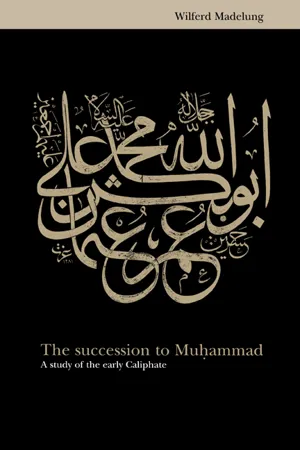 eBook - PDF
The Succession to Muhammad
A Study of the Early Caliphate
- Wilferd Madelung(Author)
- 1996(Publication Date)
- Cambridge University Press(Publisher)
196 The succession to Muhammad in Damascus would back him to the hilt. 242 To be reassured he needed broader support. Mu'awiya immediately wrote to l Amr b. al- ( As. It was time to bury al-Walld's silly private vendetta against someone who could be so useful for the Umayyad cause as the wily man of Quraysh, Mu'awiya's unacknowledged bastard brother. Matters of high politics were now at stake where the ends justify the means. Mu'awiya had just declared himself the next-of-kin of his somewhat remote cousin. 'Uthman's brother must now stand back and dance to his, Mu'awiya's, whistle. Mu'awiya wrote to ( Amr: 'You have heard what happened in the affair of ( Ali, Talha, and al-Zubayr. Now Marwan b. al-Hakam together with the rejectionists (rdfida) of the people of Basra has joined us, and Jarir b.
Index pages curate the most relevant extracts from our library of academic textbooks. They’ve been created using an in-house natural language model (NLM), each adding context and meaning to key research topics.

