History

Bleeding Kansas
"Bleeding Kansas" refers to the violent political and social conflicts that occurred in the Kansas Territory in the mid-1850s. These conflicts arose from the debate over whether Kansas would enter the Union as a free state or a slave state. The events in "Bleeding Kansas" foreshadowed the larger national conflict that would erupt into the American Civil War.
Written by Perlego with AI-assistance
Related key terms
1 of 5
10 Key excerpts on "Bleeding Kansas"
- Sara M. Benson(Author)
- 2019(Publication Date)
- University of California Press(Publisher)
Jayhawk Nation’s commemoration of Bleeding Kansas is part of a larger cultural remembrance that takes place in sports and politics, in classrooms and feld trips, in state memorials and museum exhibits, and during stories over family dinners. What is forgotten in these moments of recollection is that Bleeding Kansas was fundamentally about slavery’s relationship to law and order. 58 Chapter Three Brown’s position in the mural, between proslavery and union forces, refected this claim to an alternative practice of law, a legal tradition that emerged in an environment where federal control was a symbol of slavery. Bleeding Kansas was therefore a diferent kind of legal moment, one in which John Brown and many others created the idea of abolition Kansas, a place in which “the people” refused to recognize the foreign law of slavery. Afer the 1854 territorial election, when crowds of Missourians crossed the border and voted slavery into existence, aboli-tion Kansas refused to recognize the authority of the elected Bogus Legislature as a proslavery government backed by the force of federal law. A particular legal time of Bleeding Kansas emerged, as military, federal, territorial, and state legal rituals existed alongside the people’s procedures of arrest, imprisonment, and execution. Tis chaotic legal arrangement was the result of the region’s transition from Indian Territory to Kansas Territory, when the law of popular sovereignty (the people’s right to vote slavery in or out of existence) was mapped onto the colonial structure of squatter sovereignty, a prior legal arrangement that gave certain self-enforced rights to “illegal” white residents in the Indian Territory. In the context of these multiple and overlapping legal arrangements, the idea of abolition justice as the work of the people was condemned and then forgotten by the time Curry painted the mural at the Kansas capitol. eBook - ePub
Bleeding Kansas
Slavery, Sectionalism, and Civil War on the Missouri-Kansas Border
- Michael Woods(Author)
- 2016(Publication Date)
- Routledge(Publisher)
CHAPTER 3 Bleeding Kansas and the NationL ydia Maria Child was miserable. For an abolitionist and woman’s rights activist, the fall of 1856 was a discouraging time. Kansas had bled profusely but free-staters were no closer to victory over a federally-backed proslavery territorial government. The upcoming presidential election might help, but voting was reserved almost exclusively for white men. Would they support black freedom? Still worse was Child’s isolation in Massachusetts, far from Kansas and Washington alike. She used her pen to champion the free-state cause, and her money to assist free-state settlers, but she longed to do more. Late in October, Child vented her frustration in a private letter. “This is the death-grapple between Slavery and Freedom … and one or the other must go down!” she wrote. “Oh, what a misery it is, to feel in such a fever-heat of anxiety as I do, and yet be shut up … where I cannot act!”1Many Americans shared this anxiety over Kansas, despite the fact that most, like Child, never traveled there. But the controversy, and even the violence, from Bleeding Kansas came to them. Newspaper subscribers couldn’t avoid reading about it. Politicians couldn’t avoid discussing it. Anyone interested in the future of free labor, slave labor, and the American republic, had a deep interest in Kansas. Even those who tried to ignore politics had to cope with the bitterness that spread eastward across the entire country. And despite their distance from Kansas, thousands of northerners and southerners participated in the conflict. With their money, their voices, their votes, and sometimes their own weapons, pro- and antislavery Americans nationwide battled over Kansas just as fiercely as territorial settlers did.⋆ ⋆ ⋆Kansas settlers aggressively sought outside help. Public lecturers thrilled audiences with tales of bravery and betrayal on the plains. Articles, letters, pamphlets, and books poured from the territory, captivating readers across the continent. These were deeply partisan accounts, but their role as propaganda made them important. Many were written to solicit outside aid, in the form of money, supplies, manpower, and votes. But in order to enlist this support, Kansas writers had to prove that outsiders had a personal interest in the struggle. So, they presented it not merely as a clash over one territory, but as part of a grand battle for control of the entire republic. Folks who never visited Kansas noticed, and many agreed with Child that this was indeed “the death-grapple between Slavery and Freedom.” eBook - ePub
Colonel Henry Theodore Titus
Antebellum Soldier of Fortune and Florida Pioneer
- Antonio Rafael de la Cova(Author)
- 2016(Publication Date)
- University of South Carolina Press(Publisher)
Chapter TwoBleeding in Kansas
1856
The Florida Republican announced on April 2, 1856, that Henry Titus “proposes to leave for Kansas in a few weeks.” The article predicted that Titus would be successful in the new territory due to his “adaptation by experience, as well as by physical proportions for a frontier life.” During the spring season river transit to Kansas was renewed, and thousands of new migrants were heading there. Titus had various motivations for moving, including a desire for cheap preemptive land, economic profit, and the defense of slavery.1The Kansas-Nebraska Act of May 30, 1854, had opened both those territories to settlement and allowed for the status of slavery to be decided by popular sovereignty, annulling the Missouri Compromise of 1820. To keep the balance of power in Congress, the South “was willing to give Nebraska to the north, [and] they asked and demanded that Kansas should be ceded to the south.” Preemptors began pouring into the Kansas river valleys and rolling prairies in search of fertile soil, land speculation, and government jobs. Northern free-soilers were encouraged by the abolitionist press, pulpit, and emigrant aid societies. Proslavery men, mostly from neighboring Missouri and dubbed “Border Ruffians” by their opponents, were driven by the political rhetoric of border leaders. Both sides eventually made “Bleeding Kansas” a battleground over slavery and land acquisition. By the summer of 1855, some twelve hundred armed New Englanders had arrived in the new territory. Sectional violence erupted in Kansas after the dubiously elected territorial legislature passed laws legalizing slavery and making Lecompton the territorial capital and the seat of federal authority. Free-soil settlers refused to succumb or pay taxes and in the fall of 1855 fraudulently elected a rival government at Topeka under a constitution outlawing slavery. In a special message on Kansas to Congress, President Franklin Pierce backed the Lecompton legislature and denounced the free-state movement as being “engaged in revolutionary acts which must be suppressed.” Republican leaders made the status of Kansas the focal point of the 1856 presidential campaign.2 eBook - ePub
- Paul Kirkman(Author)
- 2020(Publication Date)
- The History Press(Publisher)
4 Bleeding Kansas (CITY)The same forces that created a thriving city at the edge of the western frontier nearly destroyed it in the mid-nineteenth century. The acquisition of new territories in the West, coupled with improved communication and travel through railroad and telegraph connections, Kansas City was poised to be a central hub, connecting the East and the West. In the 1850s, however, the only things that seemed to matter were North and South.As territories vied to become states, the balance of power between the slave-holding Southern states and the free Northern states was upended. The war of words in the East escalated into a war of guns and cannons on the western frontier. The older settlements in Missouri had grown out of a slave economy, and there was a presumption that this way of life would naturally expand into the nearby Kansas Territory. But when Congress passed the Kansas-Nebraska Act in 1854, the territories themselves were left to decide whether they would be free or slave states.Beginning in 1854, Kansas was besieged with competing legislatures, constitutions and governors. When the first vote was taken to decide whether Kansas would be a free or slave state, large numbers of Missourians crossed the border and skewed the election by casting illegal ballots, threatening free-state voters and chasing them from the polls at gunpoint. The violence between the free-state and proslavery forces led to the 1856 Sacking of Lawrence, in which proslavery forces burned down the Free-State Hotel, destroyed newspaper offices and looted the town of Lawrence, Kansas. When the smoke cleared, the reaction back East resulted in a brawl in Congress, a three-way split in the Democrat Party and howls at the injustice of Missourians crossing the border and sullying the vote. Kansas City soon found itself awash in new traffic heading for the Kansas Territory. Proslavery settlers crossed into the territory, and Immigrant Aid Societies sprang up across the North, hoping to out-populate and out-vote the proslavery settlers. Towns like Lawrence (named after Amos Adams Lawrence, the treasurer of the New England Emigrant Aid Society) grew up to counter proslavery towns, like Atchison and Leavenworth. eBook - PDF
Revolts, Protests, Demonstrations, and Rebellions in American History
An Encyclopedia [3 volumes]
- Steven L. Danver(Author)
- 2010(Publication Date)
- ABC-CLIO(Publisher)
He did not understand the divisiveness of the slavery issue or that neither side would simply accept the popular will when principles they held sacred were threatened. The violence surrounding the organization of the Kansas Territory would expose the shortcomings of popular sovereignty. —Walter F. Bell Further Reading Etcheson, Nicole. Bleeding Kansas: Contested Liberty in the Civil War Era. Lawrence: University Press of Kansas, 2004. Pottawatomie Massacre (1856) This incident was a central event in the cycle of political violence between pro- and antislavery forces in the Kansas Territory, which gave it the name “Bleeding Kansas.” It occurred on May 24 and 25, 1856, when John Brown and a band of Bleeding Kansas (1854–1858) 359 abolitionist settlers killed five proslavery men near Pottawatomie Creek in Frank- lin County near the Kansas-Missouri border. The massacre was a reprisal for the sacking of Lawrence, Kansas—a stronghold of antislavery sentiment—on May 21 by a proslavery sheriff’s posse led by Frank- lin County sheriff Samuel Jones sent by the territorial government to arrest several antislavery activists. The raid resulted in the destruction of a newspaper office, the destruction of several private homes, and the burning of a church. Brown learned of Lawrence’s misfortune on May 23 while camped with a com- pany of antislavery militia from Osawatomie on patrol near Lawrence. For him and several of his followers, the attack on Lawrence was the last straw. Brown led a faction of Free Soilers that advocated violence against proslavery elements. Their arguments were strengthened by reports of widespread violence against anti- slavery settlers by “border ruffians” from Missouri and abuses and fraud in the March 1855 territorial elections that had resulted in the seating of a proslavery territorial legislature. eBook - PDF
Politics and America in Crisis
The Coming of the Civil War
- Michael Green(Author)
- 2009(Publication Date)
- Praeger(Publisher)
When the free-state legislature met in Topeka on July 4, the U.S. Army dispersed them without a fight, but with ample jostling and criticism on both sides. Later that summer, the arrival of new territorial governor John Geary, a Mexican-American War veteran and former San Francisco mayor, gave Kansas a leader who strove for fairness. He tried to remove the proslavery slate of territorial officials, whom he accused of “a virulent spirit of dogged determination to force slavery into this Territory,” but proved unsuccessful: the Senate refused to confirm their replacements. That left Geary stuck between supporters of slavery who resented him and antislavery leaders with little faith in him. Kansas remained the battleground for trying to settle the question of whether slavery would indeed expand into the West, but under his leadership for the rest of 1856, it proved to be a more peaceful battleground. The same could not be said for the nation’s capital, 90 Politics and America in Crisis where the issue of slavery and its growth bred violence that stunned northerners and pleased southerners far more than events in Bleeding Kansas. 35 BLEEDING SUMNER The rhetoric in Kansas paled in comparison with what was said elsewhere about Kansas. For Brown, the last straw before his assault at Pottawatomie had been an assault of a different kind in Washington, D.C., after a lengthy speech that offended defenders of slavery and popular sovereignty, and produced even more offensive results. But, like Brown’s mutilations, the crime against Charles Sumner over “The Crime Against Kansas” had a long history. While Sumner seemed to exemplify the description of the “idealist in politics,” that oversimplifies both him and politics. Born in Massachusetts in 1811, Sumner went to Harvard, toured Europe, and returned home to become bored with his law practice and more interested in foreign affairs and legal scholarship. eBook - ePub
Bleeding Kansas, Bleeding Missouri
The Long Civil War on the Border
- Jonathan Earle, Diane Mutti Burke(Authors)
- 2014(Publication Date)
- University Press of Kansas(Publisher)
Part II
Making the Border Bleed
 Passage contains an image
Chapter 6
The Illusion of Security: The Governments’ Response to the Jayhawker Threat of Late 1860
Tony R. MullisThe fearful consequences liable to result to the nation from any conflict of arms between citizens of the State of Missouri, and those of the Territory of Kansas, even though resulting from an effort to maintain the law and to shield the innocent from harm, cannot now be estimated, owing to the fact, that exaggerated reposts of any such occurrences are very certain to be circulated, and the minds of the people to become unduly excited.Robert Stewart to James Denver, August 7, 1858By late 1860, Bleeding Kansas no longer dominated the national media as it had during the brutal summer months of 1856 or with the Lecompton Constitution debate that followed from 1857 to 1858. The large-scale assaults by proslavery Missourians, whom many had characterized as “border ruffians,” had ceased after the 1856 elections. In response to the border ruffian threat, many free-state supporters formed defensive associations to protect their communities against these attacks. Once these threats dissipated, several of these groups went on the offensive. These Jayhawker bands freed slaves in western Missouri, aided fugitive slaves, and hoped to abolish the evil institution through violent means.1 Not all Jayhawkers were ideologically motivated; some simply sought revenge against those who had committed depredations against them. With the exodus of the most virulent proslavery zealots from the territory by 1860, Kansas appeared to have transitioned to a peaceful era where rule of law would dominate.The relative calm that characterized the territory in late 1860, however, was illusory. Underneath the territory’s fractured veneer were significant centripetal and centrifugal forces converging to disrupt that tenuous façade of peace. Like a fault zone between tectonic plates exerting tremendous pressure on each other beneath the earth’s surface, Kansas appeared relatively secure to the contemporary citizen, but just under the surface, it was on the verge of disaster. The southeast Kansas and southwest Missouri regions served as the virtual epicenter of a potential catastrophe. From a national perspective, the Dred Scott eBook - PDF
- P. Scott Corbett, Volker Janssen, John M. Lund, Todd Pfannestiel, Paul Vickery, Sylvie Waskiewicz(Authors)
- 2014(Publication Date)
- Openstax(Publisher)
One hundred yards down the road, Owen and Salmon Brown hacked their captives to death with broadswords and John Brown shot a bullet into Doyle’s forehead. Before the night was done, the Browns visited two more cabins and brutally executed two other proslavery settlers. None of those executed owned any slaves or had had anything to do with the raid on Lawrence. Brown’s actions precipitated a new wave of violence. All told, the guerilla warfare between proslavery “border ruffians” and antislavery forces, which would continue and even escalate during the Civil War, resulted in over 150 deaths and significant property loss. The events in Kansas served as an extreme reply to Douglas’s proposition of popular sovereignty. As the violent clashes increased, Kansas became known as “Bleeding Kansas.” Antislavery advocates’ use of force carved out a new direction for some who opposed slavery. Distancing themselves from William Lloyd Garrison and other pacifists, Brown and fellow abolitionists believed the time had come to fight slavery with violence. Click and Explore 404 Chapter 14 | Troubled Times: the Tumultuous 1850s This OpenStax book is available for free at https://cnx.org/content/col11740/1.3 Figure 14.14 This undated image shows the aftermath of the sacking of Lawrence, Kansas, by border ruffians. Shown are the ruins of the Free State Hotel. The violent hostilities associated with Bleeding Kansas were not limited to Kansas itself. It was the controversy over Kansas that prompted the caning of Charles Sumner, introduced at the beginning of this chapter with the political cartoon Southern Chivalry: Argument versus Club’s (Figure 14.1). Note the title of the cartoon; it lampoons the southern ideal of chivalry, the code of behavior that Preston Brooks believed he was following in his attack on Sumner.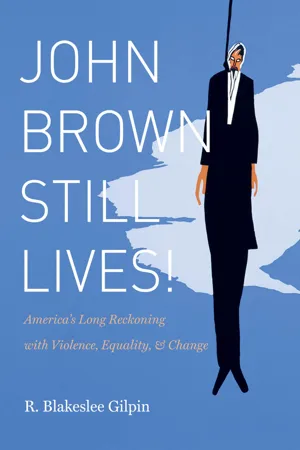 eBook - ePub
John Brown Still Lives!
America’s Long Reckoning with Violence, Equality, and Change
- R. Blakeslee Gilpin(Author)
- 2011(Publication Date)
- The University of North Carolina Press(Publisher)
That battleground soon housed as diverse a set of strivers as existed anywhere in the United States. There, “fire-eaters” (Southerners eager for secession and even war) lived alongside abolitionists trying to rid the nation of slavery, Unionists seeking to maintain the status quo, and countless others. 8 From the moment these clashing groups arrived, there was conflict. “Civil war exists in Kansas,” one settler wrote, and it “will spread throughout the land. 9 Throughout the next decade, the twin stars of opportunity and mission attracted Americans from every segment of the political and moral spectrum. This stew of personalities and attitudes escalated the slavery struggle in 1850s Kansas, lending uncertain momentum to a truly catastrophic national conflict. In his move to Kansas, Brown sought to improve his fortunes and accelerate this struggle. He arrived at the opportune moment. The Kansas Territory’s electoral process had already gotten off to a disastrous start. On March 30, 1855, Missouri Senator David Atchison led several thousand armed and drunken citizens into Kansas to vote in the first territorial election. Free Soilers immediately denounced the election and refused to honor the results. “For freedom of speech [we] have imprisonment, for the sight of suffrage, dictation, and for giving liberty [to] the oppressed, Death,” one settler described. “Is this America? The land of Freedom?” 10 These outrages convinced John Brown to leave North Elba. News of similar violations of freedom and justice arrived nearly every day of Brown’s trip west. Anticipating the new opportunities, Brown preserved his likeness in a daguerreotype en route to the territory (figure 2.1)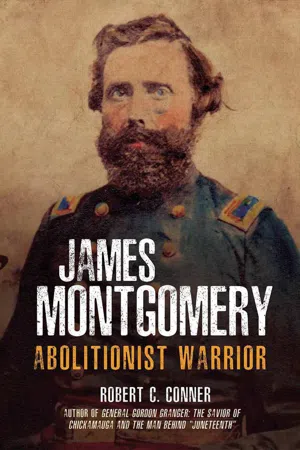 eBook - ePub
James Montgomery
Abolitionist Warrior
- Robert C. Conner(Author)
- 2022(Publication Date)
- Casemate(Publisher)
CHAPTER 2 Bleeding Kansas and John BrownThe Kansas-Nebraska Act was signed into law by President Franklin Pierce on May 30, 1854. Its main sponsor was Illinois Senator Stephen Douglas, a Democrat, and its main provisos included the creation of Kansas Territory (which extended well into modern-day Colorado) and Nebraska Territory to its north (also extending far to the west and north of the state’s present-day boundaries).More important, the new law allowed voters (meaning adult White males) of the western territories to decide for themselves whether future states to be created out of them should permit or prohibit slavery. This had the effect of overturning the geographic Missouri compromise line of 1820, which was mostly kept in place by its successor law of 1850, the preceding two major efforts by the federal government to peaceably resolve the issue of slavery. The 1850 law also had produced the Fugitive Slave Act, which was detested by all anti-slavery people and remained in effect. The Fugitive Slave Law which compelled northern states to act as slave catchers convinced many abolitionists that the federal government was profoundly corrupt on this issue, and that no peaceful or law-abiding advocacy for their cause was likely to succeed.Under the old Missouri compromise line, still in effect in the central part of the country until 1854, Kansas would have been designated a free state. Its repeal was seen by abolitionist and other anti-slavery politicians, including moderates like Abraham Lincoln, as the latest outrage perpetrated by the “slave power” which had such a grip on the federal government. But the new Kansas-Nebraska Act meant that the fate of Kansas was up for debate—and more direct action—by both sides of the slavery issue.Many Democrats, including Douglas, Pierce, and the future president James Buchanan, along with the mayors of major cities like New York, were northerners. But the party’s base was the slave-holding South. Most Democrats expected that residents of Missouri, a slave state, would move west across the border into Kansas, and turn that territory slave, too. In fact, in 1854, that appeared the most likely outcome to most independent observers, with Kansas becoming a slave state and Nebraska (to its north) a free one. Both sides, supporters and opponents of slavery, saw this struggle for the geographic heartland of the continent as crucial for the long-term success of their cause. In that judgment, both sides were correct.
Index pages curate the most relevant extracts from our library of academic textbooks. They’ve been created using an in-house natural language model (NLM), each adding context and meaning to key research topics.

