History

California Gold Rush
The California Gold Rush was a significant event in American history that began in 1848 when gold was discovered at Sutter's Mill. This discovery led to a massive influx of people from around the world seeking their fortunes, resulting in a population boom in California and significant economic growth for the region. The Gold Rush had a lasting impact on the development of California and the United States.
Written by Perlego with AI-assistance
Related key terms
1 of 5
8 Key excerpts on "California Gold Rush"
 No longer available |Learn more
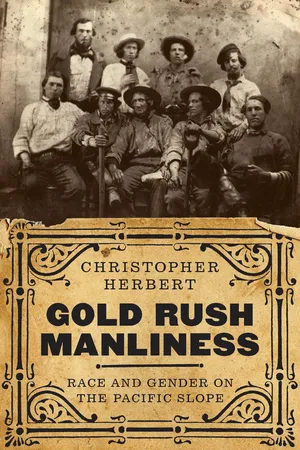
Gold Rush Manliness
Race and Gender on the Pacific Slope
- Christopher Herbert(Author)
- 2018(Publication Date)
- University of Washington Press(Publisher)
4 INTRODUCTION those pebbles would unleash. 3 Marshall’s discovery sparked one of the largest voluntary migrations in world history and accelerated the incorporation of California into the United States. In turn, the California Gold Rush catalyzed a series of rushes throughout the western United States, Canada, the South Pacific, and eventually, Alaska. 4 In each case, the discovery of precious metal was a watershed moment in local histories of colonialism. The sudden and massive influx of outsiders, and their intense focus on extracting wealth from the landscape, forced sweeping changes on preexisting colonial societies, with especially disastrous results for aboriginal populations. Newly arrived colonizers faced their own challenges. Gold rush society forced a group of predominately male English-speakers of European descent who shared a set of values to contend with a complex and unfamiliar envi-ronment and to challenge, experiment with, and ultimately, reconfigure ideas of race and gender. Exploring how these men used ever-changing ideas of race and gender to define acceptable identities for both themselves and a range of racialized and gendered Others provides an interesting case study that suggests our understanding of white manliness has been fixated on the eastern United States and Britain, whereas much of the national attention and imagination at the time was focused on the West, where new ideas of white manliness prefigured later formulations undertaken elsewhere. The process of movement was crucial to the development of these new understandings of white manhood. While English-speaking men brought cultural beliefs with them to the goldfields, they soon found themselves both creating new ideas and adapting old ones. This process began en route to California, but as other gold discoveries were made throughout the Pacific Rim, these ideas were transmitted to each new rush.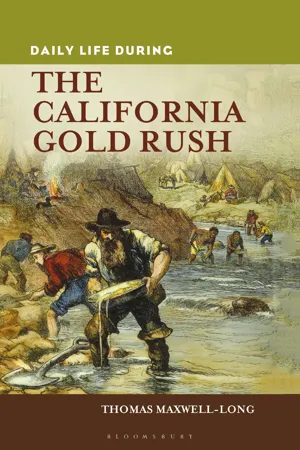 eBook - ePub
- Thomas Maxwell-Long, Thomas . Maxwell-Long(Authors)
- 2014(Publication Date)
- Greenwood(Publisher)
3 THE GOLDEN YEARS OF THE RUSH, 1848–1850: ECONOMIC EXPANSION, POPULATION EXPLOSION, AND RUSH TO STATEHOODThe physical appearance of life in the gold fields went through a series of evolutionary changes after 1848 that no one could have foreseen. In the first year, when John Sutter’s workers made up the majority of the gold miners along the American River, life was exciting for these few, lucky individuals, though it was peaceful as well. By the spring of 1849, mining camps had come and gone, and in the process, the future state of California had its first ghost towns. Additionally, the numbers of miners had increased from several hundred to several thousands, with the majority of these hearty individuals still hugging the American River and its tributaries. At the start of 1849, the majority of the miners were from relatively local points of origin and primarily from California. By the midpoint in that same year, California had been transformed into a polyglot society, and along the way, the population of those directly connected with the Gold Rush reached over 50,000. Throughout 1849, the diggings were productive, sparsely populated and plentiful. Miners were able to locate “color” with relative ease. By early 1850, that reality was seemingly lost to history. While an incredible amount of gold was recovered in 1850, the laborious effort needed to fill one’s sack had increased tenfold. Society itself grew more complex in the diggings, boom towns, and cities. Indeed, anyone who bore witness to California before and during these years witnessed a social and physical transformation, the likes of which the world had not seen before or since. The changes wrought out in California also propelled the territory into statehood and in the process pushed the United States closer to being a truly continental nation and also to the brink of civil war.TOOLS OF THE TRADEOf all the tools utilized in the California Gold Rush, none is more common than the stamp iron pan. These flat-bottomed pans, typically measuring between 18 and 24 inches at the base with a rising side between 3 and 5 inches, were the first and most prevalent tool throughout the period. Miners would scoop up stream or riverbed pebbles, usually a handful at a time, and, in a swirling motion, use the water to separate the particles. Since gold was the heaviest, the slight angle at which the miners held the pan while putting it through the motions would result in a settlement of the gold toward the most elevated part of the base as the alluvial was washed down. Additionally, the bright yellow color and shimmer of the gold distinguished it from all other materials. As the miners swirled away with the pans, they would pluck the gold dust, gold pebbles, or gold nuggets out and carefully store them in a secured manner. Pans were also used in so-called dry diggings, which took place away from a waterway on dry land. With nearly the exact principal method, miners would sift through the earthen materials in their quest for “color,” simply without the aid that water provided. eBook - PDF
- Benjamin Mountford, Stephen Tuffnell, Benjamin Mountford, Stephen Tuffnell(Authors)
- 2018(Publication Date)
- University of California Press(Publisher)
The focus here will be on California’s rush, but that experience had paral-lels among the others that followed, and by that they shed some light on wider connections between gold rushes and global imperialism. To that end, it is helpful to lay down a few defining points of the California experience— points that might well apply to others. lots of money far away First, and most obvious, the California rush brought an explosive production of wealth in its most widely recognized form: gold. The flake that Marshall picked up was worth about half a dollar. Estimates vary of how much fol-lowed, but by the most reasonable of them, about $1.4 billion came from the California diggings by the end of the century. Put in context, by one early estimate California, aided by the strikes in New South Wales and Victoria, produced more gold in the five years after discovery than had been produced across the world during the previous 356 years, from 1492 until 1848. California produced more in its banner year, 1852, than was produced glob-ally during the entire eighteenth century. 2 If anyone needs a more kinesthetic image: in 1856 the new San Francisco mint was processing so much gold that its furnaces could not accommodate it, and someone discovered that gold dust was being blown out of its smokestacks. Men were sent out to sweep it up from gilded rooftops around the neighborhood. 3 The second factor, nearly as obvious, followed naturally—the almost instantaneous creation of a large and rapidly growing population. California’s non-Indian population expanded from under 10,000 to about 100,000 44 • ch a p t er 2 within two years. Ten years later it stood at 380,000. With this growth came an instantaneous demand for the full range of needs of such numbers— services and goods, infrastructure, government, human networks, and more. We might think of this as the opposite of the Christian evangelical notion of the rapture, the sudden elevation to heaven of the saved at the end-time. eBook - PDF
The American West
A New Interpretive History
- Robert V. Hine, John Mack Faragher(Authors)
- 1993(Publication Date)
- Yale University Press(Publisher)
Mining, lumbering, ranching, and commercial farming were all enterprises in which western workers produced raw materials and sent them to distant markets. Each was highly suscep-tible to wild economic swings of boom and bust. Each was financed in large part by eastern capitalists with little regard for the balanced economic development of the West. According to American mythology, of course, a gold rush was supposed to be a golden opportunity for the little man, and more than enough success stories lent credibility to that legend. But the idea of frontier social mobility best applied to ear-240 M I N I N G F R O N T I E R S lier Wests,not to the industrial Far West born during the California Gold Rush. In the words of historian Richard Hofstadter,“The westward movement involved the con-quest of resources and their incorporation into the machinery of American capital-ism.” The California experience pointed the way to a new kind of economic colo-nialism. 9 The gold rush jump-started the California economy.Within months of Marshall’s discovery, the state had become the center of a booming Pacific market that made everything that had come before seem mere prelude. The “creation of large new mar-kets out of nothing,”Friedrich Engels wrote with some shock to his collaborator Karl Marx in 1852 , was something they had “not provided for in the Communist Mani-festo. ” Western mining booms were a vivid demonstration of the growing interde-pendence of the world’s economies. Into the port of San Francisco in 1849 came dozens of foreign ships loaded with Chilean wheat, Mexican coffee and cocoa, Aus-tralian potatoes, Chinese sugar and rice, Alaskan coal, fish, and even ice. As soon as they docked their ships and unloaded their cargoes, the foreign crews jumped ship and rushed for the diggings. San Francisco’s waterfront soon was clogged with rot-ting hulks from all over the world. 10 Gold rush society was composed of the most polyglot collection of nationalities since Babel. eBook - ePub
Golden Rules
The Origins of California Water Law in the Gold Rush
- Mark Kanazawa(Author)
- 2015(Publication Date)
- University of Chicago Press(Publisher)
The point here is not merely that each of these factors can vary, with resulting different influences on judges’ rulings. At any particular point in time, a judge can experience these different factors with quite different force. In certain institutional contexts, constitutional or legislative mandates may be salient in comparison with direct political pressures. In other cases, the opposite may be true. To the extent that there is a grey area in terms of what is constitutionally or legislatively acceptable, and judges have latitude in how they respond to these different, potentially conflicting forces, the rulings they hand down may well vary considerably depending upon the circumstances. Recognizing this fact will be important toward understanding the experience of California during the period studied here.1.5. Some Currents in Gold Rush Historiography
Another contribution of this study is to shed light on various aspects of the California Gold Rush of the early 1850s and the subsequent development of the gold mining industry that dominated the state economy for the first fifteen years of statehood. There is an enormous scholarly literature that addresses various dimensions of the Gold Rush and its immediate aftermath, including its cultural, sociological, political, institutional, environmental, and economic aspects. The vastness of this literature reflects in part the grip that the episode continues to exert on our collective imagination. But it also reflects the sheer volume of evidence that we have at our disposal, including contemporaneous accounts, news articles, government reports, and numerous miner’s journals and diaries. I will make no attempt to be exhaustive here in describing existing scholarship but rather, I will focus on those sources that speak to various components of my argument.Gold Rush scholarship has undergone a distinct evolution over time, reflecting greatly increased sophistication in our thinking about the Gold Rush and the methods of analysis we have at our disposal. The early miners themselves left behind a great many records of their experiences in the form of journals, diaries, and letters home to their families. Many accounts need to be taken with a hefty serving of salt and a few were little more than frauds perpetrated on unsuspecting readers, but some of the better accounts by the more observant and insightful miners have enabled scholars to gain a good qualitative sense for what life in the gold fields was like. Needless to say, economic historians must be careful in drawing conclusions based on what is largely anecdotal evidence contained in these accounts. However, when combined with other sources of information, they are useful for obtaining a sense of what issues were important and how they were viewed by the participants in the Gold Rush and its aftermath. This study will rely in part on a number of these first-hand accounts.26 eBook - PDF
- William Deverell, David Igler, William Deverell, David Igler(Authors)
- 2013(Publication Date)
- Wiley-Blackwell(Publisher)
As regards the Gold Rush, the historian Susan Johnson deserves to be singled out here as well; her Roaring Camp (2000) takes readers into the complicated social realms of miners and others in California’s so-called “southern” mines. Her often lyrical reconstruction of the overlapping worlds of racial and gendered identity in the diggings demonstrates indeed that “Gold Rush California was an unusual time and place,” but also that its very eccentricity is an invitation to learn a great deal about 1850s America more generally. 5 Leonard Richards’ recent book, The California Gold Rush and the Coming of the Civil War (2007), offers a refreshing refiguring of the Gold Rush in the coming of fratricide and national catastrophe. What Richards reminds us of is that even in the midst of the coming of the Civil War and, in fact, precisely because of those tensions, Americans thought about California, and they did so intensely. And while he does not employ the concept, his book really is all about the “long 1850s” in California, stretch-ing back before 1850 and forward to the outbreak of the war itself. Ameri-cans thought about 1850s California because of the Gold Rush, of course, insofar as that event seemed to promise something mid-nineteenth-century 170 william deverell people could scarcely imagine: life free of farming drudgery, for a time or for ever. But they thought about California because California meant for them the far West; it epitomized those new territories brought into the Union by way of war, and California and the West were the big question marks over the fate of national unity. In this ever-hotter debate, California was the key locale. The West: slave or free? Tied to North or South? Would there be peace or war? Environmental historians, heed a call. The landscape and sea coast of 1850s California beckons to be more closely examined by scholars wishing to analyze environmental change in the midst of regime transition. eBook - PDF
From Mission to Microchip
A History of the California Labor Movement
- Fred Glass(Author)
- 2016(Publication Date)
- University of California Press(Publisher)
The few who became wealthy did so “mining the miners” by one means or another. The real money came from supplying the miners with food, cloth-ing, and equipment; employing them; and in the profits from constructing a huge boomtown in San Francisco from scratch. The Gold Rush swept away the agrarian Spanish economy on a tide of American enterprise, throwing figure 5. Hardrock miners and ore carts in the Savage Silver Mining Works, Washoe, Nevada, 1868. Timothy O’Sullivan, photo. Courtesy of the Bancroft Library, University of California, Berkeley. St r i k i ng Gold • 31 dispossessed Indians and disappointed miners into an emerging capitalist labor market. As gold mining settled into something resembling one indus-try among others, overseen by a state government, the possibilities of the early days for instant riches receded. The new society would, like the rest of the United States, have a large working class, a small capitalist class, and various middle classes in between. 32 An almost hallucinogenic landscape and social atmosphere reflected the tremendous changes taking place in San Francisco as, for a few years, California produced close to half the world’s gold. During that time Yerba Buena grew from a tiny frontier outpost in 1848, with six hundred people clustered near a decaying mission, into San Francisco, the feverishly expanding capital of the western United States, containing 50,000 people by 1853 and 150,000 in 1870. People from all over the world mingled in the streets. Their interactions were aided by extravagant use of the great social lubricant, alcohol. Gambling, drinking, and prostitution—and shortly, more respectable forms of enter-tainment—fi lled the time outside work. At first most work in the new city supported the Gold Rush and supplied the miners. Early manufacturing focused on mining equipment. But mining technologies were also steadily redirected to the industries necessary to raise up a large city. eBook - PDF
- Blake Allmendinger(Author)
- 2015(Publication Date)
- Cambridge University Press(Publisher)
Its literary history is marked by a variety of noteworthy prose efforts to report, mediate, and meliorate the experiences of those affected by it. A second generation of writers in the 1860s and 1870s used the fictional short story to define the event retrospectively as some- thing other than a time of disruption and trauma. 76 witschi In an era before the telegraph and the transcontinental railroad, when word of any newsworthy event in the West might take weeks or months to spread, newspapers were the primary form of mass communication. Of course, news outlets in such large cities as Boston, New York, Philadelphia, Washington, New Orleans, and St. Louis reported on the Gold Rush. As the examples collected in Peter Browning’s To the Golden Shore: America Goes to California – 1849 (1995) demonstrate, Gold Rush reporting com- prised a mix of good and bad news that could range in tone from wild boosterism to cautious optimism to extreme warnings to stay away. Among the first professional journalists to offer eyewitness accounts were the prominent travel writers Bayard Taylor, sent by Horace Greeley to report for the New York Herald Tribune, and Frank Marryat, who had come from England to the goldfields more interested in sport hunting than in mining. Their respective books, El Dorado (1850) and Mountains and Molehills (1855), paint a picture of a people and a region in the midst of a dazzlingly great adventure. Both the optimistically cheerful Taylor and the delight- edly amoral Marryat depict the virtually overnight rise of often chaotic human communities and urban spaces. Neither one suggests that such developments are anything but the inevitable and much-wished-for pro- gress of civilization. A more realistically sober assessment may be found in the Scottish journalist J. D. Borthwick’s Harper’s Weekly stories, which were eventually gathered together under the title Three Years in California 1857).
Index pages curate the most relevant extracts from our library of academic textbooks. They’ve been created using an in-house natural language model (NLM), each adding context and meaning to key research topics.

