History

Donner Party
The Donner Party was a group of American pioneers who set out for California in a wagon train in 1846. They became stranded in the Sierra Nevada mountains during the winter and resorted to cannibalism to survive. Only 48 of the original 87 members of the party survived.
Written by Perlego with AI-assistance
Related key terms
1 of 5
6 Key excerpts on "Donner Party"
 eBook - ePub
- Lewis Petrinovich(Author)
- 2020(Publication Date)
- Routledge(Publisher)
Ordeal by Hunger, first published in 1936, and reissued in an expanded edition in 1960 (the edition referred to here). Stewart (1962) later published a general history of the experiences of others who migrated west over the California Trail. There is also a volume containing fascinating letters, narratives, and memoirs written by survivors or based on interviews with them (Johnson, 1996), and a history of the Donner Party based on direct interviews with survivors (McGlashan, 1947; first published in 1880). Although there are minor differences of opinion regarding certain details, and some disagreement regarding the assignment of relative blame for the unfortunate events (see King, 1992, for a revisionist view), there is general agreement concerning the sweep of events as described here.The Donner Party was composed mainly of a group of substantial midwestern farmers and businessmen who had packed up their possessions, formed a wagon train, and undertook the arduous journey west to enjoy the benefits of California abundance. They were mainly American-born inhabitants of the Mississippi Valley, and although they may have been pioneers they could not be called frontiersmen—they were country-folk and townspeople, not mountaineers. They were not accustomed to camping, most had never seen a mountain, and there was a great deal of sickness early in the trip.There was considerable dissension among members of the company from the very beginning of the journey, and many petty differences of opinions and interests surfaced as the trip progressed. McGlashan (1947) considered these factors to be among the fundamental causes of the calamities that befell the party. Stewart (1962) and Brodhead (1997) agreed that the Donner Party was too small (only about 10 wagons), with too few mature, sturdy adults to make it possible for them to overcome the adversities encountered at the journey’s end. Also, the natural leader of the party (James Reed) was driven off for killing another male member of the party during a fight. Following Reed’s banishment, George Donner, a prosperous farmer who was 62 years old and the father of 15 children, was elected captain of the train on the basis of his kindly, patrician manner. Stewart characterized the party, even in the early stages of the trip, as a shattered and beaten army, over which hung the threats of death from starvation, snow in the mountains, and Indians who shot at hunters from ambush and stole oxen and cattle. eBook - ePub
The Passing of the Frontier
A Chronicle of the Old West
- Emerson Hough(Author)
- 2002(Publication Date)
- Perlego(Publisher)
There is a book done by C. F. McGlashan, a resident of Truckee, California, known as "The History of the Donner Party," holding a great deal of actual history. McGlashan, living close to Donner Lake, wrote in 1879, describing scenes with which he was perfectly familiar, and recounting facts which he had from direct association with participants in the ill-fated Donner Party. He chronicles events which happened in 1846—a date before the discovery of gold in California. The Donner Party was one of the typical American caravans of homeseekers who started for the Pacific Slope with no other purpose than that of founding homes there, and with no expectation of sudden wealth to be gained in the mines. I desire therefore to quote largely from the pages of this book, believing that, in this fashion, we shall come upon history of a fundamental sort, which shall make us acquainted with the men and women of that day, with the purposes and the ambitions which animated them, and with the hardships which they encountered."The States along the Mississippi were but sparsely settled in 1846, yet the fame of the fruitfulness, the healthfulness, and the almost tropical beauty of the land bordering the Pacific, tempted the members of the Donner Party to leave their homes. These homes were situated in Illinois, Iowa, Tennessee, Missouri, and Ohio. Families from each of these States joined the train and participated in its terrible fate; yet the party proper was organized in Sangamon County, Illinois, by George and Jacob Donner and James F. Reed. Early in April, 1846, the party set out from Springfield, Illinois, and by the first week in May reached Independence, Missouri. Here the party was increased by additional members, and the train comprised about one hundred persons....In the party were aged fathers with their trusting families about them, mothers whose very lives were wrapped up in their children, men in the prime and vigor of manhood, maidens in all the sweetness and freshness of budding womanhood, children full of glee and mirthfulness, and babes nestling on maternal breasts. Lovers there were, to whom the journey was tinged with rainbow hues of joy and happiness, and strong, manly hearts whose constant support and encouragement was the memory of dear ones left behind in homeland. eBook - ePub
History of the Donner Party
A Tragedy of the Sierra
- C. F. (Charles Fayette) McGlashan(Author)
- 2004(Publication Date)
- Perlego(Publisher)
California was thoroughly aroused over tidings which had come from the mountains. It was difficult to get volunteers to undertake the journey over the Sierra, but horses, mules, provisions, and good wages were allowed all who would venture the perilous trip. The trouble with Mexico had caused many of the able-bodied citizens of California to enlist in the service. Hence it was that it was so difficult to organize relief parties.The following extracts are made from the California Star, a newspaper published at "Yerba Buena," as San Francisco was then called. They do justice to the sentiment of the people of California, and indicate something of the willingness of the pioneers to aid the Donner Party. From the Star of January 16, 1847, is taken the following article, which appeared as an editorial:"Emigrants on the Mountains.""It is probably not generally known to the people that there is now in the California mountains, in a most distressing situation, a party of emigrants from the United States, who were prevented from crossing the mountains by an early, heavy fall of snow. The party consists of about sixty persons—men, women, and children. They were almost entirely out of provisions when they reached the foot of the mountains, and but for the timely succor afforded them by Capt. J. A. Sutter, one of the most humane and liberal men in California, they must have all perished in a few days. Capt. Sutter, as soon as he ascertained their situation, sent five mules loaded with provisions to them. A second party was dispatched with provisions for them, but they found the mountains impassable in consequence of the snow. We hope that our citizens will do something for the relief of these unfortunate people."From the same source, under date of February 6, 1847, is taken the following: "Public Meeting.""It will be recollected that in a previous number of our paper, we called the attention of our citizens to the situation of a company of unfortunate emigrants now in the California mountains. For the purpose of making their situation more fully known to the people, and of adopting measures for their relief, a public meeting was called by the Honorable Washington A. Bartlett, alcalde of the town, on Wednesday evening last. The citizens generally attended, and in a very short time the sum of $800 was subscribed to purchase provisions, clothing, horses, and mules to bring the emigrants in. Committees were appointed to call on those who could not attend the meeting, and there is no doubt but that $500 or $600 more will be raised. This speaks well for Yerba Buena."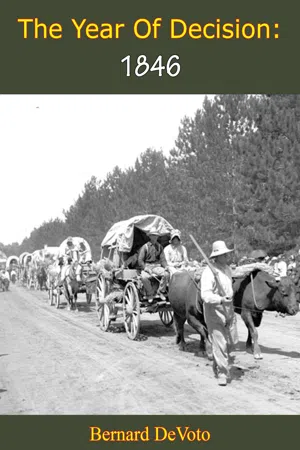 eBook - ePub
- Bernard DeVoto(Author)
- 2016(Publication Date)
- Golden Springs Publishing(Publisher)
No part of the tragedy is unique. There is more horror in the Mountain Meadows massacre of September, 1857. An armed band of Mormons led by John D. Lee, and under the superior command of William Dame and Isaac Haight, murdered one hundred and twenty men, women, and children. (In the entire history of the West no massacre by Indians was so large-scale or so complete.) Equal folly and suffering, and equal heroism, can be found in the story of the “Jayhawkers” and the Bennett-Arcane party who, in the autumn of 1849, tried to find another shorter way to California. Jefferson Hunt, of the Mormon Battalion, was guiding them by a safe route which had been blazed to escape the Salt Desert where the Donners foundered, but they left him and wandered off to disaster in the region which, because of them, has ever since been known as Death Valley. The Donners were not the only emigrants who disintegrated in panic, and the fact which the public chiefly remembers about them, their cannibalism, was no novelty in the West. It had occurred along the route they traveled, and when, in the last days of 1848, Frémont’s fourth expedition stalled in the San Juan snows, Bill Williams’ detachment probably killed and certainly ate one of their companions. Kit Carson remarked of Bill Williams that in starving times no man should walk ahead of him on the trail, and old Bill shared that reputation with numerous others. In fact, the last resource of starving men is a commonplace.It is as the commonplace or typical just distorted that the Donners must be seen. Beyond Fort Laramie every stretch of the trail they traveled, at some time during the history of emigration, saw one or another party just escaping disaster, and a number of stretches saw some parties not altogether escaping it. Just west of the Salt Desert the Donners crossed the trail of the Bartleson party of 1841 (mentioned earlier in a footnote), who had no trail at all across the Sierra, wandered lost for weeks in the mountains, starving, and just contrived to live till they could reach the universal succorer, John Augustus Sutter. The cabin which some of the Donner Party camped in at the foot of Truckee Lake had been built two years before, in November, 1844, by the Stevens-Murphy party in the fear that they might have to spend the winter in the snow. One member of that party, Moses Schallenberger, did in fact spend the winter in that cabin alone. The others got across the divide which the Donners could not cross only because they had a master mountain man with them. Old Caleb Greenwood got them over by a heroic feat of will, intelligence, and ingenuity. And we have seen how close the Harlan-Young party, under Hastings’ personal direction, came to disaster in the Salt Desert....Finally, there is not much difference between dying of starvation in the snow and dying of exhaustion, as some of their former companions had done before they reached Truckee Lake, or dying of pneumonia in the Oregon rains, as others of their former companions did a month after the Donners turned back from the divide. Death on the trail was a hazard of emigration. You took your chances. Our concern with the Donners comes from the fact that the common chance turned against them. eBook - PDF
Ken Burns's America
Packaging the Past for Television
- G. Edgerton(Author)
- 2016(Publication Date)
- Palgrave Macmillan(Publisher)
I mean measured by any realistic yardstick, an event that took 134 K E N B U R N S ’ S A M E R I C A place very, very recently. And it was a time [1846] when the country was still so nascent, so underformed, so much in the process of becoming what it was going to become . . . here sort of like a dark shining parable at the very origin of California of the Western dream is this tale of people who are reaching too far too fast, not because they’re bad, but because they’re human. And I think the story tells us a lot about the possibilities but also the perils of what we now call, glibly, “The American Dream.” 96 Burns, in fact, was so compelled by the account of the Donner Party that he pitched the idea to Judy Crichton for possible inclusion in The American Experience. He did not want to restrict his telling of what for him was an emblematic moment in Western history to an abbreviated 10 to 15 minute sequence lost within a much larger epic plot line for his upcoming miniseries on the West. Crichton admits her first reaction to his proposal was highly skeptical: “I was terrified of the subject matter and I didn’t know how the hell he was going to pull it off. Margaret Drain [then senior producer for the series] just leapt on faith, and the two of them talked me into it.” 97 Welcoming the challenge, Ric Burns’s storytelling skills reached new heights in his reconstruction of this legendary American tragedy. Having only 20 available period images to work with, he and Ades expanded their formal repertoire out of necessity, moving well beyond what had now become the PBS house style for historical documentaries established by Ken Burns. They successfully imbued The Donner Party (1992) with an almost hypnotic, dreamlike quality by utilizing an assortment of expressionistic techniques such as mood-enhancing filters, slow-motion cinema- tography, and a haunting electronic score. eBook - ePub
- Priscilla L. Walton(Author)
- 2010(Publication Date)
- University of Illinois Press(Publisher)
Oregon and California in 1848 , which itself was based on the remembrances of survivor William H. Eddy. King’s is a more scholarly and meticulous text, drawing its information from a number of archival sources. Yet while there are many disparities between the two, they agree that although “the adventure of the Donner Party is thus, historically considered, a minor incident, its spectacular qualities have caused it to become one of the most widely known of western stories” (Stewart 278).It is not inconsequential that, as in Poe’s narrative, some of the blame for the Donners’ ordeal is laid at the feet of people of color. According to both historians, First Nations unrest indirectly caused the party’s travails: “As long as the wagon-train was in Shoshone country, there was no trouble. The depredations commenced as soon as the emigrants came into contact with the Piutes” (Stewart 304). King documents how the natives stole the party’s food supply: “The Indians ran off eighteen oxen and a milk cow” (40). Each writer elides why the natives might be upset (their lands were being invaded by the settlers) and locates the unexamined “Native unrest” as a primary reason for the Donners’ slow progress, ultimately leaving them stranded in the mountains for the winter. As in the Essex saga, the people of color were the first to be killed for food.8 King notes,Salvador and Luis had fled the party, fearing for their own lives. They were overtaken a few days later. Eddy claimed that the Indians had gone without food for three days, were almost dead, unable to move, and could not have had more than a couple of hours to live. They were shot in the head, said Eddy, by William Foster. Their starved bodies, with little meat or fat on them, were quickly consumed. In his Personal Reminiscences
Index pages curate the most relevant extracts from our library of academic textbooks. They’ve been created using an in-house natural language model (NLM), each adding context and meaning to key research topics.

