History

Little Crow's War
Little Crow's War, also known as the Dakota War of 1862, was a conflict between the Dakota Sioux and the United States. It was sparked by broken treaties, starvation, and mistreatment of the Dakota people. The war resulted in the largest mass execution in U.S. history, with 38 Dakota men hanged in Mankato, Minnesota.
Written by Perlego with AI-assistance
Related key terms
1 of 5
10 Key excerpts on "Little Crow's War"
 eBook - ePub
The Wild West
History, myth & the making of America
- Frederick Nolan(Author)
- 2019(Publication Date)
- Arcturus(Publisher)
Little Crow, who had fled to Canada with some of his people, unwisely decided in June of the following year to return to Minnesota to steal horses; he seems not to have known that the state had instituted a bounty for Sioux scalps. On the afternoon of 3 July 1864, farmer Nat Lampon and his son Chauncey, out hunting, spotted Little Crow and his son picking raspberries and (although he had no idea who they were) opened fire, killing Little Wolf. The state presented the hunters who had killed him with the promised bounty of $25 plus a bonus of five hundred dollars. The old chief’s son learned later that his father’s scalp and skull had been placed on display in St Paul.Little Crow’s ‘war’ was in many ways a template of all the ‘wars’ between the Native American tribes and the white man that followed: there would not be a single State or Territory west of the Mississippi that did not experience one. The only difference between them was one of scale. Everywhere the sheer volume of white expansion forced the two sides into more and more contact, with increasingly violent reactions on the part of the Indians as they resisted the advance.That such resistance was doomed from the start, the Indians could not know; but it was. Not only were the Indians comprehensively outnumbered and catastrophically outgunned but also because of the very nature of their concept of warfare. In almost every tribe there existed a cult of bravery, one that considered individual acts of courage or cunning far more admirable than mere killing. Their inter-tribal wars were a state of permanent hostility punctuated by raids to capture booty and to exhibit courage; because symbolic death –‘counting coup’ by touching an enemy with a stick and escaping unharmed – was valued far more than killing an enemy, deaths in battle were comparatively few. It was a concept the white man never could and never would understand. Their outlook was brutally pragmatic: dead men don’t shoot back.So in Colorado, when white settlers became convinced the local Arapaho and Cheyenne were only waiting for their opportunity to attack them, as Little Crow had attacked the settlements of Minnesota, white leaders reacted quickly. Prominent among these was a former Methodist minister named John Milton Chivington (1821-1894). A hero of the war against the Confederates in New Mexico who had been named commander of the Military District of Colorado, Chivington was, it was said, keen to run for Congress and anxious to earn promotion to the rank of brigadier general. eBook - PDF
- Clarissa Confer(Author)
- 2010(Publication Date)
- Greenwood(Publisher)
Marsh took his troops back to the fort, Galbraith left on a trip, and Little Crow attended Christian church services. However, mere flour and pork could not undo decades of injustice or soothe the tensions of a racially and culturally divided area. Resentment of whites and their treatment of Dakotas lay just below the surface and could break forth at anytime. The first rupture came on August 17, 1862. Four young Dakota men had been on an unsuccessful hunting trip. It was harder and harder to find game in a country overrun by whites and they were still hungry. When they found a nest of chicken eggs on the edge of white property the realities of their lives seemed stark. Here was food to be foraged on the homelands of their fathers yet they dare not touch it for fear of white retribution. What was the point of being a Dakota warrior if they had to live like this? Their own frustration led to boasting and challenges and accusations of cowardice. One young man claimed he would prove his bravery by shooting a white man and dared the others to accompany him. A dare like that is hard for young, agitated men to resist. The chal- lenges to honor resulted in the haphazard killing of five whites, Dakota leader Little Crow reluctantly agreed to lead his people against white settlers in Minnesota. (Library of Congress) 118 Daily Life during the Indian Wars including two women. Once done such a deed cannot be reversed so all that remained was to inform the elders of the act. The chiefs’ reactions were mixed. On one hand they were proud of the young men for their courage, for acting like warriors. However, the impulsive violence ensured retribution that would fall on all the people. The whites would execute the men for their actions and penalize the bands. The Soldiers’ Lodge members decided that it was better to declare war on the whites than suffer more indignities against the people. eBook - PDF
Illusive Shadows
Justice, Media, and Socially Significant American Trials
- Lloyd E. Chiasson(Author)
- 2003(Publication Date)
- Praeger(Publisher)
Little Crow seemed the least likely of Indians to lead the Sioux in a war ILLUSIVE SHADOWS 46 against whites. About 52 years old at the time, he was recognized as the titular head of all the Santee Sioux. His father, Big Thunder, had been head chief of the Mdewakanton Sioux. Little Crow was known to his people as Taoya- teduta (His Red Nation). He had become a “cut-hair,” a Sioux who cut his long hair short, took up farming or some trade, and adopted the white set- tlers’ ways. He lived in a two-story house and wore white men’s clothes. He had accommodated himself to the white man and owed his status and power to the whites’ greater power as much as to his own tribe. Although he was considered assiduous in negotiating with the federal government, some of his people accused him of accepting bribes in return for trading away Indian lands and threatened to kill him. 3 Despite appearances, Little Crow, described as an “individual rife with contradictions and torn by cultural confusion,” would become responsible for the greatest calamity involving white civilians on the American frontier in the nineteenth century. 4 It started with an argument over eggs. Four male Mdewakantons in their 20s were returning from a hunting trip 40 miles northeast of the Rice Creek village of the Lower Sioux Agency on August 17, 1862, when they came upon eggs in a hen’s nest near a split-rail fence marking the property of Robinson Jones, a farmer. The hunt was un- successful, and the young men—Brown Wing, Breaking Up, Killing Ghost, and Run Against Someone When Crawling—were hungry. They began to argue about whether to take the eggs and risk incurring the white man’s anger. Posturing and dares followed, and soon the eggs were “hurled down and war splattered from the broken shells.” 5 That’s the popular, uncompli- cated explanation for a war in which more than 400 white settlers, 113 federal soldiers, and approximately 200 Sioux lost their lives. eBook - PDF
Radical Hope
Ethics in the Face of Cultural Devastation
- Jonathan Lear(Author)
- 2009(Publication Date)
- Harvard University Press(Publisher)
According to oral tradition, half of the population was killed. 26 In principle, every bearer of a coup-stick was willing to give his life so that something like that should never happen again. The Crow had been fighting the Sioux for decades, but, as White points out, By the 1840s . . . the once formidable Crows were a much weakened people. As late as the 1830s they had possessed more horses than any other tribe on the upper Missouri and estimates of their armed strength had ranged from 1,000 to 2,500 mounted men, but the years that followed brought them little but disaster. Smallpox R A D I C A L H O P E 22 and cholera reduced their numbers from 800 to 460 lodges, and rival groups pressed into their remaining hunting grounds. 27 The historian Frederick Hoxie titled his chapter on this period “Life in a Tightening Circle.” In brief, it is a story of painful choices made against a background of external threat and ever-in-creasing confinement. At the beginning of the century, the Crow were surrounded by enemy tribes—the Sioux, Cheyenne, Arap-aho, and Blackfeet—and all of them increasingly realized how dependent they were on knives, hatchets, tools, and guns for sur-vival. The Crow hunted beaver in the first half of the century, buffalo in the second—in large part to be able to trade their fur and hides for American-and European-made goods. By the 1850s the Crow were regularly facing attacks by the Sioux from the east and the Blackfeet from the north. As Hoxie puts it, “The era of vague borders and friendly mountain men was over . . . To be without guns, blankets and ammunition in the Yellowstone in the 1850s was suicide.” 28 This is the period in which Plenty Coups grew up: it is the pe-riod in which, by his own account, things were still happening. Even this thumbnail sketch of the historical context should suf-fice to show that the Crow not only knew what they were fighting for; they also had a vivid sense of what they were fighting against.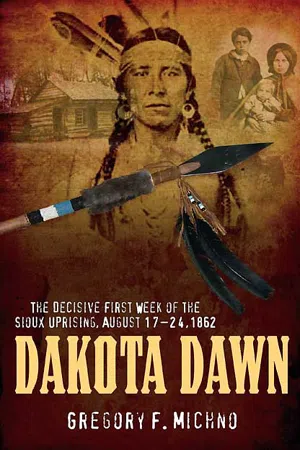 eBook - ePub
Dakota Dawn
The Decisive First Week of the Sioux Uprising, August 1862
- Gregory Michno(Author)
- 2011(Publication Date)
- Savas Beatie(Publisher)
Seeing the destructive results of drunkenness, Little Crow encouraged temperance and invited Presbyterian Dr. Thomas Williamson to establish a mission at his village—yet he would not call himself a Christian. He supported farming efforts and wore white man’s clothing—but he still preserved his Indian identity by not personally tilling the soil. Little Crow became a power broker who sought to get the best deal for his people while trying “to satisfy an insatiable personal hunger for power.” He “was a politician who happened to be an Indian….” 5 The chief showed what he was made of during the negotiations at Mendota. Wabasha again broached the subject of unpaid money from the 1837 treaty when the Dakotas sold their lands east of the Mississippi. Lea and Ramsey promised that the money would be included in the new treaty, but the Indians were not convinced. As the talks progressed, Little Crow supported the Indians’ interests, but was willing to compromise. Another point of contention was the boundary of the new reservation. The government wanted the southeastern boundary to be where the Redwood River enters the Minnesota River; the Mdewakantons and Wahpekutes wanted it as far east as Traverse des Sioux—these Dakotas were essentially woodland Indians and did not want to live out on the open prairies as did the Nakotas and Lakotas. Little Crow gained the support of a few other chiefs, and it appeared that they would sign, if only the boundary could be settled. Lea and Ramsey suggested a compromise line about halfway between the two points, at the mouth of the Little Rock River. The Indians appeared willing, but Wabasha turned to the crowd and asked if anyone intended to kill the first chief who signed. Red Middle Voice said it would not happen and indicated his willingness for a treaty. Ramsay took the quill and asked Medicine Bottle who should be the first eBook - ePub
- Hanford Lennox Gordon(Author)
- 2005(Publication Date)
- Perlego(Publisher)
From him personally I obtained much information in regard to Little Crow's participation in the "Sioux War," and minutely the speech that Little Crow made to his braves when he finally consented to lead them on the war-path against the whites. A literal translation of that speech will be found further on in this note. I knew Ta-ó-ya-te-dú-ta, and from his own lips, in 1859-60 and 61, obtained much interesting information in regard to the history, tradition, customs, superstitions and habits of the Dakotas, of whom he was the recognized Head-Chief. He was a remarkable Indian—a philosopher and a brave and generous man. "Untutored savage" that he was, he was a prince among his own people, and the peer in natural ability of the ablest white men in the Northwest in his time. He had largely adopted the dress and habits of civilized man, and he urged his people to abandon their savage ways, build houses, cultivate fields, and learn to live like the white people. He clearly forsaw the ultimate extinction of his people as a distinct race. He well knew and realized the numbers and power of the whites then rapidly taking possession of the hunting-grounds of the Dakotas, and the folly of armed opposition on the part of his people. He said to me once: "No more Dakotas by and by; Indians all white men. No more buffaloes by and by; all cows, all oxen." But his braves were restless. They smarted under years of wrong and robbery, to which, indeed, the most stinging insults were often added by the traders and officials among them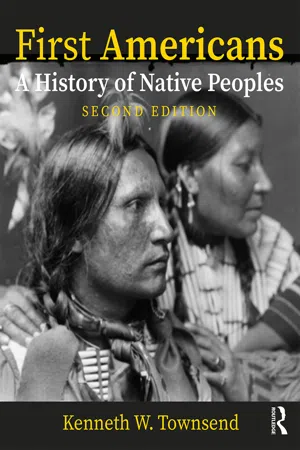 eBook - ePub
First Americans: A History of Native Peoples, Combined Volume
A History of Native Peoples, PowerPoints
- Kenneth Townsend(Author)
- 2018(Publication Date)
- Routledge(Publisher)
By 1862, the war between the Union and Confederacy was draining money and necessary supplies from the Santee, and Indian agents and suppliers also channeled additional funds and material earmarked for Indians into their own coffers. Moreover, white settlement in Minnesota surged, making greater demands on land. Following a series of confrontations and facing further threats to their existence, the Santee responded with a series of attacks on Minnesota farms, communities, and militia posts. Little Crow agreed with some hesitation to lead warriors into battle, knowing as he did that the Indians were at a military disadvantage. Throughout summer 1862, Little Crow and his warriors battled the Minnesota militias and citizens until the Indians were soundly defeated at the Battle of Wood Lake on September 23. He fled to Canada with many followers. In mid-June the following year, Little Crow and his son slipped back into Minnesota to gather horses and desperately needed supplies for his family and followers. On July 3, near the town of Hutchinson, a farmer named Nathan Lampson spotted Little Crow and fired on him. Little Crow fell dead. The townspeople were informed of Little Crow’s death and shared in the mutilation of the Santee’s body. Lampson earned not only the traditional bounty offered by Minnesota for killing an Indian but also an additional $500 for having shot Little Crow specifically. The bones of Little Crow were displayed in a local museum and later held by the Minnesota Historical Society until 1971, when his remains were sent to a surviving grandson for proper burial.The resulting schism shattered Santee communities. The rapidly growing white population around them exacerbated Santee disunity. Hunger and malnutrition settled over the Santee as white settlement depleted hunting grounds of game and Washington failed to provide farm extension agents to aid agricultural development as promised in the treaties. Only the annual annuity payments Washington gave to the Santee averted further disaster, but these soon disappeared as they increasingly filtered into the hands of traders and reservation agents. Congress absolved itself of guilt, contending that the Santee food shortage of the 1850s was the product of the Indians’ limited initiative to learn farming techniques, and annuities deferred to the war’s end might compel the Santee to create the agricultural base intended by treaties.The winter of 1861–1862 proved particularly brutal on the Santee as remaining food stores were consumed and death rates rose among the Indians. Washington’s attention was focused solely on the government’s withering war in the East. By summer 1862, hunger, disease, and depression shrouded every moment of Santee life. “We have no food,” said Little Crow, “but there are stores, filled with food. We ask that you, the agent, make some arrangement by which we can get food … or else we may take our own way to keep ourselves from starving.” The deep divide that had earlier corrupted Santee unity now shrank quickly, the Indians finding a common target for their anger in white settlers and Washington, especially as malnourished and dying Sioux saw all around themselves a white population fattened on former Santee lands and Indian annuities. In August, a group of Indians residing in the southern section of the reservation requested food rations from their appointed agent, Thomas Galbraith. Galbraith, backed by heavily armed local white merchants, refused the Santees’ appeal. “So far as I am concerned,” sneered merchant Andrew Myrick, “if they are hungry, let them eat grass or their own dung.” eBook - ePub
- Charles A. Eastman(Author)
- 2008(Publication Date)
- Perlego(Publisher)
The white traders and Government employees, those of them who were up and about, heard and saw the advancing column of warriors. Yet they showed no sign of anxiety or fear. Most of them thought that there might be some report of Ojibways coming to attack the Sioux,—a not uncommon incident,—and that those warriors were on their way to the post to replenish their powder-horns. A few of the younger men were delighted with the prospect of witnessing an Indian fight.On swept the armed band, in numbers increasing at every village.It was true that there had been a growing feeling of distrust among the Indians, because their annuities had been withheld for a long time, and the money payments had been delayed again and again. There were many in great need. The traders had given them credit to some extent (charging them four times the value of the article purchased), and had likewise induced Little Crow to sign over to them ninety-eight thousand dollars, the purchase-price of that part of their reservation lying north of the Minnesota, and already occupied by the whites.This act had made the chief very unpopular, and he was ready for a desperate venture to regain his influence. Certain warriors among the upper bands of Sioux had even threatened his life, but no one spoke openly of a break with the whites.When, therefore, the news came to Little Crow that some roving hunters of the Rice Creek band had killed in a brawl two families of white settlers, he saw his opportunity to show once for all to the disaffected that he had no love for the white man. Immediately he sprang upon his white horse, and prepared to make their cause a general one among his people.Tawasuota had scarcely finished his hasty preparations for war, by painting his face and seeing to the loading of his gun, when he heard the voice of Little Crow outside his lodge.“You are now my head soldier,” said the chief, “and this is your first duty. Little Six and his band have inaugurated the war against the whites. They have already wiped out two families, and are now on their way to the agency. Let my chief soldier fire the first shot.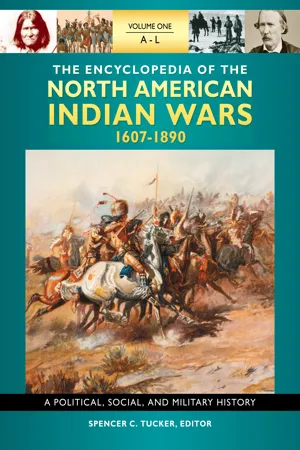 eBook - PDF
The Encyclopedia of North American Indian Wars, 1607–1890
A Political, Social, and Military History [3 volumes]
- Bloomsbury Publishing(Author)
- 2011(Publication Date)
- ABC-CLIO(Publisher)
On August 4, 1862, representatives of the Minnesota Sioux approached the Upper Sioux Agency to plead for food. After suc- cessful negotiations, they returned on August 15 to receive their promised supplies. However, Minnesota state senator and Indian agent Thomas Galbraith refused to distribute the supplies without payment, regardless of the previous agreement. At a subsequent meeting of the Sioux, U.S. government officials, and local trad- ers, the Native Americans pleaded with the lead trader, Andrew Myrick, for his support, to which he essentially replied that they should go away and eat grass. This offensive and dehumanizing comment enraged the Sioux. With the U.S. Army occupied by the American Civil War (1861– 1865), the Dakota chiefs seized the opportunity for an armed uprising. The violence began on August 17, 1862. Four Sioux men, stealing food from a settlement in Meeker County, killed five white settlers. Although Chief Little Crow initially opposed a violent solution to the problem, given the uproar among the Native Americans the other chiefs were able to convince him to lead further attacks. At the council of war, the chiefs decided to attack without warning. Myrick was one of the first to die in the subsequent attacks. He was found dead with grass stuffed in his mouth, a macabre allusion to his earlier comment. Captain John March then led a force of 44–46 men from Fort Ridgely, but the Sioux attacked them as they were attempting to cross the Minnesota River on the 504 Missionaries In the Southeast, the Spanish founded missions beginning in 1565; the last one was created in 1763. Mostly in Florida and coastal Georgia, these missions were created to control the region and safeguard Spanish holdings in the nearby Caribbean. But equally important, the goals of missionaries here were to convert local Indians to Catholicism and try to assimilate them to Euro- pean/Spanish culture. eBook - PDF
Uncommon Defense
Indian Allies in the Black Hawk War
- John W. Hall, John William Hall(Authors)
- 2010(Publication Date)
- Harvard University Press(Publisher)
Re-ferring to the disaster occasioned by Warner’s invitation earlier that year, Keokuk quipped, “we hope you will see that your Agents and Sub Agents observe it like-wise, and not make themselves too busy.” 13 This exchange at Prairie du Chien illustrates two persistent themes in Indian-U.S. relations in the Old Northwest. First, the In-dians acknowledged the U.S. government’s role as a peacekeeping agency, but they typically did so only to achieve some relative ad-vantage over their antagonists. The Dakotas, having achieved satis-faction in their recent attack, were more than willing to enlist the gratis assistance of the U.S. Army in preventing a reprisal. It is therefore not surprising that a Dakota, Little Crow, expressed a steadfast desire for peace and confidence that the United States would fairly settle the boundary dispute. 14 Based on the govern-ment’s prior performance, Little Crow’s trust was misplaced, but his was likely a disingenuous gesture designed to effect a de facto alliance with the United States. Second, tribes and their assigned agents often formed affiliations with each other that transcended nationality. Keokuk’s aspersion against Wynkoop Warner was less an indictment of the Indian agents as a body than an attack on 102 u n c o m m o n d e f e n s e those agents who were aligned with the enemies of the Sauks and Mesquakies, which were many. The Sauks and Mesquakies enjoyed the ardent support of their own agent, Thomas Forsyth, until June 1830, when “public policy and the public service combine[d] to make it advisable to appoint another person in his place.” 15 Ostensibly relieved because he frequently absented himself from his place of duty, Forsyth was both one of the most capable Indian agents in the region and a vocal critic of Jacksonian Indian policy, and his dismissal no doubt contributed to the Sauk and Mesquakie sense of disenfranchisement. Having served as a fur trader in the re-gion since 1804 and a U.S.
Index pages curate the most relevant extracts from our library of academic textbooks. They’ve been created using an in-house natural language model (NLM), each adding context and meaning to key research topics.

