History

Diet of Worms
The Diet of Worms was a historic assembly held in 1521 in the city of Worms, Germany. It is most famous for the trial of Martin Luther, where he was called to recant his teachings that opposed the Catholic Church. Luther's refusal to recant led to his excommunication and the start of the Protestant Reformation.
Written by Perlego with AI-assistance
Related key terms
1 of 5
8 Key excerpts on "Diet of Worms"
 eBook - ePub
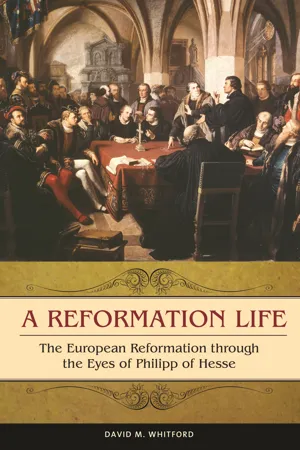
A Reformation Life
The European Reformation through the Eyes of Philipp of Hesse
- David M. Whitford(Author)
- 2015(Publication Date)
- Praeger(Publisher)
Chapter 31521—The Diet of Worms : Martin Luther and the Beginning of the ReformationA Momentous Diet
Charles von Hapsburg, Duke of Burgundy, Duke of Austria, and king of Spain was elected Holy Roman emperor in Frankfurt on June 28, 1519. It took time to organize his coronation, which took place—according to ancient tradition—in the city of Aachen on October 26, 1520. His entry into Aachen was a grand event, with hundreds of mounted knights, archers, foot soldiers, and magnificently clothed courtiers. He took an oath that day to defend the empire and his Christian faith. Almost as soon as the ceremonies were over, he announced that he would soon gather together an imperial parliament to meet in the central German city of Worms. These imperial parliaments were called diets after the Latin word dies or day, for a general meeting day of the empire. As Charles left Aachen for the journey to Worms, he sent summonses to all the great nobles and prelates of the empire.Philipp of Hesse, who would have turned sixteen about the time the summons arrived, surely greeted it with excitement. Like Charles, it would be Philipp’s first diet. Also like Charles, he intended to make an impression when he arrived. Philipp arrived in Worms in late January 1521 guided by more than four hundred armed knights and soldiers. Philipp would attend nearly every major diet of the empire for the next forty years. The Diet of Worms, however, is not remembered today because it was the first diet attended by either Charles or Philipp or because it was to deal with the increasing threat from Turkish armies. Five hundred years later, the Diet of Worms is remembered because of the presence of a single man born to commoner parents: Martin Luther.Martin Luther (1483–1546)
According to his mother, Martin Luther was born in Eisleben in Saxony, late in the evening of November 10, 1483. Early the next morning, he was taken (probably by the women who aided his mother) to the closest church, the Church of Saints Peter and Paul, where he was baptized and named in honor of Saint Martin of Tours. His parents were Hans (d. 1530) and Margaretta (d. 1531) Lüder. When Martin changed his last name to Luther is unclear, though he continued to use Lüder as late as 1508. His father was a miner in Eisleben, but soon after Martin was born, Hans moved the family to Mansfeld in the hopes of earning a better living. Throughout his life, Luther would consider Mansfeld his hometown. It was a small city and Hans’s hope of finding prosperity there turned out to be well founded, for he became a rather successful copper miner and ore smelter there. His increasing wealth allowed him to enroll young Martin, his eldest son, in a Latin school in town in 1491, when Martin was seven. Over the next ten years, Martin continued his primary and secondary education. For a time he went to school in Magdeburg, then finished his studies in Eisenach, where he roomed with relatives. eBook - ePub
Fallible Heroes
Inside the Protestant Reformation
- Stephen Fortosis, Harley T. Atkinson(Authors)
- 2022(Publication Date)
- Wipf and Stock(Publisher)
5Luther
Diet at Worms and the Wittenberg Crisis—Roland Bainton“On the sixteenth of April, Luther entered Worms in a Saxon two-wheeled car with a few companions. The imperial herald preceded, wearing the eagle upon his cloak. Although it was the dinner hour, two thousand turned out to conduct Luther to his lodging. On the following day at four o’clock Luther was waited upon by the herald and the imperial marshal, who conducted him furtively, to avoid the crowds, to a meeting of the emperor, the electors, and a portion of the estates. The monk stood before the monarch, who exclaimed, ‘That fellow will never make a heretic of me.’”161“—V. H. H. GreenThe Diet of Worms might well appear as the climacteric of Luther’s career, and in a sense it was so, since as a result of his meeting with the Emperor Charles V the latter decided to implement the papal decision. As a result the principal secular and ecclesiastical authorities combined to stamp out the challenge to their order. The drama of the ensuing situation has so gripped the historians’ imagination that the importance of the Diet itself has been sometimes obscured.”162In 1500 , a son was born to Philip the Handsome, King of Castille. He was named Charles, and could accurately be called a prodigy. He learned to speak German, Spanish, Italian, and French; he pretended to piety but carefully studied the art of war and intrigue; he read Phillippe de Commines and learned early on the tricks of diplomacy and the immoral affairs of state. At age fifteen, he assumed the governments of Flanders, Holland, Franche Comte, and Burgundy. At age sixteen, he became Charles, King of Spain, Sicily, Sardinia, Naples, and Spanish America. When only nineteen, he aspired to be emperor and spent 850 ,000 florins to gain the office. Now he was thrust into a no-win situation regarding an “errant monk.” Having exhausted ecclesiastical means to bring Luther to his knees, the Church in Rome urged Charles V to summon the professor before a council of German leaders in Worms, Germany, in 1521 . Plans for such were on-again, off-again for six months as the parties jockeyed for acceptable conditions. Then the Church did an about-face. The pope sent Jerome Aleander to convince Charles to cancel the Diet and send Luther in chains to Rome. As Aleander journeyed to meet Charles, he was amazed to find that “nine-tenths of the Germans cried ‘Luther,’ and the other one-tenth, ‘Death to the pope.’”163
- J. W. (James Walton) Shepherd(Author)
- 2019(Publication Date)
- Perlego(Publisher)
The emperor, too, felt the difficulty. He was a politician from his youth, and his conduct toward the pope, even from the first, was affected by political considerations; but apart from these things, there was sufficient reason for his hesitation and vacillation. He was influenced now by one party now by the other or, as is likely, now by his own independent judgment and now by what seemed to be required of him by his position as the civil head of the Church. On November 28, 1520, he wrote to the Elector of Saxony, directing him to bring Luther to Worms, “in order to give him there a full hearing before the learned and competent persons,” and promising that no harm should come to him; in the meantime, the elector was to require of Luther to write nothing against the pope. The emperor was acting on the suggestion of the elector, but between the time of this suggestion and the time of the elector’s receiving the letter things had been changed—by the burning of his books he had been treated as a condemned heretic. This offended the elector, and he wrote the emperor declining to require Luther’s presence at the diet. The emperor, too, had changed; he had begun to realize that Luther was under the papal ban, and that any place in which he might be was declared under the interdict. Luther, therefore, could not be permitted to come to Worms. If he would not retract what he had said against the papacy he was to stay at home until the emperor should have opportunity to confer with the elector personally.BEFORE THE Diet of Worms
The diet met on January 22, 1521, and on February 10th there came a brief from Rome making final Luther’s excommunication, urging his condemnation by the diet and emperor. But there was evident reluctance to proceed against him; something might be accomplished by negotiations. The pope had selected Marino Carraccioli and Jerome Aleander to wait on the young emperor and to represent his case before the diet. Aleander was a clearsighted, courageous and indefatigable diplomatist, a pure worldling, a man of indifferent morals, who believed that every man had his price, and that law and selfish motives were alone to be reckoned with. The defeat of the papacy at Worms was not due to any lack of thoroughness of his work. He had spies everywhere—in the households of the emperor and of the leading princes, and among the population of Worms. He did not hesitate to lie when he thought it useful to the Roman Church. The Roman court had put upon him the difficult task of putting Luther under the ban of the empire at once and unheard.His speech before the diet was long and eloquent, but weakened by his bitterness and vehemence. He said he spoke in defense of the papal throne, which was so dear to them all. He enumerated the heresies taught in Luther’s works. Luther was obstinate, disobedient to the pope’s summons, refused to be instructed; the pope had condemned him, and it was the emperor’s duty to enforce the condemnation; the laity had nothing to do with such questions except to carry out the pope’s decrees; ruin would follow if Luther was not condemned; a decree from the diet and the emperor would restore quiet, and preserve the Church and empire. Such were the considerations urged by Aleander. He sat down amid murmurs of approbation, but he had made no new points, given no fresh reasons. eBook - ePub
- Carter Lindberg(Author)
- 2020(Publication Date)
- Wiley-Blackwell(Publisher)
LW 40: 273). This provisional arrangement solidified into the form of a territorial or “state” church for which government retained responsibility in Germany until 1918. Other territories followed Electoral Saxony’s example, including the Catholic territory of Jülich–Cleves where the government implemented an Erasmian reform program. The princes’ desire for political liberty and the Reformers’ emphasis on Christian freedom mutually strengthened each other in an interplay of understanding and interest.The governmental consolidation of the Reformation in the German territories developed through the three decisive imperial diets in the 1520s: Worms (1521), Speyer (1526), and Speyer (1529).The Diet of Worms, 1521
We have already sketched Luther’s development to the Diet of Worms. From the perspective of imperial responsibility it was understood that the imperial ban of a heretic would follow the ecclesiastical ban. However, the election capitulation that accompanied the election of Charles V in 1519 stated that no German could be declared under the ban of the Empire without a hearing and the agreement of the imperial estates. The Luther affair was therefore immediately drawn into the contemporary political struggles between the emperor and the estates; its outcome would be an index of the strength or weakness of the emperor with respect to the princes. Faced by the potential conflict between the claims of the papacy on the Empire and the chances of carrying out these claims in the Empire, Charles as well as the princes sought a compromise. It was thought that a formal retraction by Luther, which did not have to be understood as a renunciation of his theology, would satisfy all parties. This of course ran aground when Luther refused to recant, and led to the proclamation of the imperial ban against Luther.However, already a broad front of evangelical princes had arisen in the Empire. Until there is more research on these princes it is difficult to generalize about their motives. It cannot be gainsaid that faith convictions played a role in their decisions; at the same time there is little doubt that Luther was perceived as an important piece on the political chessboard. There was also sensitivity to the possibility of a mass uprising of the commoners if Luther was prosecuted. In any case, in 1521 the princes were inclined to leave the religious issue in the balance with the hope for its resolution in either a general or a national council. A national council was the preference of the princes, reflecting their anti-Roman feelings already expressed in their lists of grievances against the Roman church presented at Worms as well as at previous diets. eBook - PDF
Western Civilization
A Brief History, Volume II: Since 1500
- Jackson Spielvogel(Author)
- 2016(Publication Date)
- Cengage Learning EMEA(Publisher)
All Rights Reserved. May not be copied, scanned, or duplicated, in whole or in part. Due to electronic rights, some third party content may be suppressed from the eBook and/or eChapter(s). Editorial review has deemed that any suppressed content does not materially affect the overall learning experience. Cengage Learning reserves the right to remove additional content at any time if subsequent rights restrictions require it. ON APRIL 18, 1521 , a lowly monk stood before the emperor and princes of the Holy Roman Empire in the city of Worms. He had been called before this august gathering to answer charges of heresy, charges that could threaten his very life. The monk was confronted with a pile of his books and asked if he wished to defend them all or reject a part. Courageously, Martin Luther defended them all and asked to be shown where any part was in error on the basis of “Scripture and plain reason.” The emperor was outraged by Luther’s response and made his own position clear the next day: “Not only I, but you of this noble German nation, would be forever disgraced if by our negligence not only heresy but the very suspicion of heresy were to survive. After having heard yesterday the obstinate defense of Luther, I regret that I have so long delayed in proceeding against him and his false teaching. I will have no more to do with him.” Luther’s appearance at Worms set the stage for a serious challenge to the authority of the Catholic Church. This was by no means the first crisis in the church’s fifteen-hundred-year history, but its consequences were more far-reaching than anyone at Worms in 1521 could have imagined. Throughout the Middle Ages, the Christian church continued to assert its primacy of position. eBook - ePub
- Carter Lindberg(Author)
- 2011(Publication Date)
- Wiley-Blackwell(Publisher)
LW 40: 273). This provisional arrangement solidified into the form of a territorial or “state” church for which government retained responsibility in Germany until 1918. Other territories followed Electoral Saxony’s example, including the Catholic territory of Jülich–Cleves where the government implemented an Erasmian reform program. The princes’ desire for political liberty and the Reformers’ emphasis on Christian freedom mutually strengthened each other in an interplay of understanding and interest.The governmental consolidation of the Reformation in the German territories developed through the three decisive imperial diets in the 1520s: Worms (1521), Speyer (1526), and Speyer (1529). The Diet of WormsWe have already sketched Luther’s development to the Diet of Worms. From the perspective of imperial responsibility it was understood that the imperial ban of a heretic would follow the ecclesiastical ban. However, the election capitulation that accompanied the election of Charles V in 1519 stated that no German could be declared under the ban of the Empire without a hearing and the agreement of the imperial estates. The Luther affair was therefore immediately drawn into the contemporary political struggles between the emperor and the estates; its outcome would be an index of the strength or weakness of the emperor with respect to the princes. Faced by the potential conflict between the claims of the papacy on the Empire and the chances of carrying out these claims in the Empire, Charles as well as the princes sought a compromise. It was thought that a formal retraction by Luther, which did not have to be understood as a renunciation of his theology, would satisfy all parties. This of course ran aground when Luther refused to recant, and led to the proclamation of the imperial ban against Luther.But already a broad front of evangelical princes had arisen in the Empire. Until there is more research on these princes it is difficult to generalize about their motives. It cannot be gainsaid that faith convictions played a role in their decisions; at the same time there is little doubt that Luther was perceived as an important piece on the political chessboard. There was also sensitivity to the possibility of a mass uprising of the commoners if Luther were prosecuted. In any case, in 1521 the princes were inclined to leave the religious issue in the balance with the hope for its resolution in either a general or a national council. A national council was the preference of the princes, reflecting their anti-Roman feelings already expressed in their lists of grievances against the Roman church presented at Worms as well as at previous diets. eBook - ePub
How the Reformation Began
The Quincentennial Perspective
- Anna Marie Johnson, Nicholas Hopman, Anna Marie Johnson, Nicholas Hopman(Authors)
- 2022(Publication Date)
- Pickwick Publications(Publisher)
239Before his premature departure from the Diet, Luther’s electoral prince asked the emperor not to send the expected mandate against Luther to Electoral Saxony. The emperor agreed to this, and since it was not published in the very territory where Luther lived, the Edict of Worms was not put into effect there. A peculiar irony of the history of the Reformation! Certainly, Luther’s freedom of movement was restricted by the edict, yet he was less affected by it than were his followers outside of Electoral Saxony. The Nuremberg Imperial Diet officially adopted the Worms edict into its final document (Reichstagsabschied ) in 1524 and issued a mandate to execute it, but with the ambiguous addition that the estates should follow the edict “as much as possible.”240 Luther, annoyed by this, published the Worms edict as well as the Nuremberg mandate with short critical remarks.241 In 1526 , the Diet of Speyer allowed the estates to carry out the edict as they “hope and believe they can answer for it before God and imperial majesty.”242 But at the second Diet of Speyer in 1529 , the majority decided that the Edict of Worms should again be strictly enforced. The estates that adhered to the Reformation protested against this and confessed that the relevant provisions concerning the edict had been passed “against God and his holy word, the salvation of all our souls and good conscience” and were therefore considered invalid by them.243The Edict of WormsThe beginning of the edict resembles the confession of the emperor as his response to Luther’s final statement. It is said that the imperial office has two great tasks: to enlarge the empire, inherited from the ancestors, and to keep the Christian faith pure against heresies. This responsibility is all the greater for Charles, because none of his ancestors possessed such a wealth of power. To give space to heresies would violate both the conscience and the glory of the emperor. The heresies that have arisen in Germany in the previous three years have already been condemned by councils, which of course means that they must not be debated. Thus the widespread demand to “hear” Luther, to have him present at the Diet, to offer him the opportunity to explain and defend his views in a disputation and to try to refute them, is in fact meaningless. The matter is already decided and needs no further disputation: “[I]t is plain to you all how far these errors and heresies depart from the Christian way, which a certain Martin Luther, of the Augustinian order, has sought violently and virulently to introduce and disseminate within the Christian religion.”244 The edict describes the consequences if the authorities did not fight against the heresies quickly and energetically: “disorder, and mighty dissolution and pitiable downfall of good morals, and of the peace and the Christian faith” would follow.245 eBook - ePub
Martin Luther
Catholic Dissident
- Peter Stanford(Author)
- 2017(Publication Date)
- Hodder Faith(Publisher)
Chapter Eight The Diet of Worms: ‘Here I Stand’‘ I can do no other than what our dear God wills. ’Martin Luther, Table Talk 1Within a month of Martin Luther’s very public act of defiance in burning copies of Exsurge Dominein Wittenberg, he was excommunicated by the Catholic Church. On 3 January 1521, Rome formally issued the decree censuring him, but once again there was a delay in sharing the news with Germany. It arose because of the delicacy of the political situation there, and the Pope’s wish to exert as much influence as he could in fractious times. Leo was only too aware that his authority would be dented further if his definitive judgement on the heretic Luther was ignored on the ground.For Luther, confirmation of his excommunication did not come as a surprise. For all his brave words, though, it was still a significant moment. He was now officially set apart from the Church of his baptism, the Church which he had served as a Hermit of Saint Augustine for fifteen years, and which he sincerely believed he was being guided by God to reform. Though he was never to express any regret at no longer being officially a Catholic, in some of his later tirades against ‘papists’ there was an unmissable note of nostalgia, at least for the ‘externals’ of the Catholic world he had inhabited for so long. ‘The papists despised me, even though I wanted to go more than half way with them in external matters, such as vestments, celibacy, abstinence from meat, Lenten observances and so on.’2Luther may have given every appearance of taking excommunication in his stride, but others were not quite so casual. By the terms of the decree, those who gave shelter to a heretic – including Elector Friedrich, Wittenberg university and, indeed, the whole of Saxony – were guilty by association, and potentially faced sanctions for their actions that ranged from the refusal of access to the sacraments right up to excommunication themselves.
Index pages curate the most relevant extracts from our library of academic textbooks. They’ve been created using an in-house natural language model (NLM), each adding context and meaning to key research topics.

