History

Ethnogenesis
Ethnogenesis refers to the process through which distinct ethnic groups are formed, often involving the merging of different cultural, linguistic, and social elements. This concept is significant in understanding the development and evolution of various ethnic identities and communities over time. Ethnogenesis can be influenced by factors such as migration, intermarriage, and interactions with other groups.
Written by Perlego with AI-assistance
Related key terms
1 of 5


4 Key excerpts on "Ethnogenesis"
 eBook - ePub
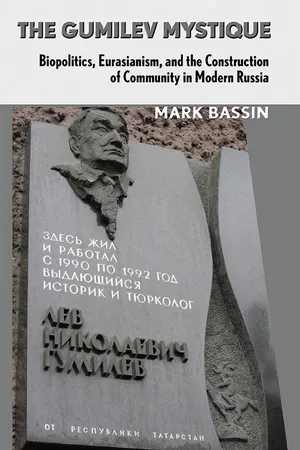
The Gumilev Mystique
Biopolitics, Eurasianism, and the Construction of Community in Modern Russia
- Mark Bassin(Author)
- 2016(Publication Date)
- Cornell University Press(Publisher)
82Over much of their life histories, Gumilev maintained, ethno-organisms remained dependent on their respective geographical environments. Landscape acted to condition the ethnos in its earliest stage, in the sense that the process of Ethnogenesis itself could only be initiated in regions that possessed significant landscape variability.83 Certain geographical regions offered more favorable conditions for Ethnogenesis, a point Gumilev illustrated through complex maps and tables correlating landscape zones to specific incidences of Ethnogenesis in history.84 Ethnogenesis had occurred at a rapid rate in Europe—where there was a great variety of contrasting landscape types—and much more slowly in Central Asia.85 And from the moment of their emergence as discrete entities, ethnies were compelled to adapt to the geographical conditions they encountered. This was “above all a process of active adaptation (adaptatsiia ) of human collectives in a milieu—ethnic and natural—in the course of which the landscape compels people to develop complex adaptive skills, that is, ethnic behavioral stereotypes. Consequently, the unique combination of landscapes in which a given ethnos originated determines (opredeliaet ) its distinctive character—behavioral and even in many respects cultural.”86 The most important evidence for this was the behavioral stereotype itself, a bundle of reflexes shaped by external environmental influences and passed down through the generations, which enabled the ethnos to sustain itself in a similar environment over its entire life history.87Ultimately, ethnic diversity itself was a product of the ecological dependency of ethnies on the landscape. The differences that set ethnies apart “reflect the deep ties between a human population and the surrounding landscape, which comprises an area for habitation, provides food, and even shapes aesthetic and moral values.”88 Precisely because geographical landscapes themselves are so different across the globe, “the biocenoses they support are unique, and thus the respective forms of adaptation in each one must be different.”89 In all of this, Gumilev saw a basic biological principle at work. Adaptation to external geographical conditions was a method deployed by all organisms in order better to meet their evolutionary tasks of survival and reproduction. Because humankind is in principle able to live in such a wide variety of environments, the adaptive challenges it faces are uniquely complex and diversified. The division of homo sapiens into ethnic groups, Gumilev suggested, was essentially a response to this challenge, that is to say, a natural species strategy for survival. As discrete ethnies, each with its own adaptive response to the unique conditions of the particular geographical landscape it occupies, the chances for sustaining its existence and enhancing its welfare are maximized, for each individual group and for the species as a whole. The fact that this adaptation was “in the behavior and not the [genetic] structure” of the ethnic groupings in no way altered its character as a biological mechanism as far as Gumilev was concerned.90 eBook - PDF
The Ethnic Process
An Evolutionary Concept of Languages and Peoples
- Levic Jessel(Author)
- 2019(Publication Date)
- De Gruyter Mouton(Publisher)
It, therefore, required only a little more evolutionary insight for Gellner to perceive that the ethnic process, in its present phase, is as equally qualified as an anatomical attribute to be an outgrowth of the human endowment. F. TOWARD A WORLD OF ETHNIC NEIGHBORHOODS Potentially dynamic, the ethnic process of any social group may lie fallow, awaiting its fertilization like the ovum, arrested by unfavor-able sociopolitical conditions, prepared to be stimulated by whatever situa-tions or external factors possess the capacity for activating it. In an age of nationalism such as ours, however, contemporary experience is equally lavish with illustrations: with nationalism as one's guide to the present efflorescence of the ethnic process, an ideology of nationalism has evolved universally, prompted by the conditions of an oppressed or in any other wise underprivileged existence. In a genuinely free world, nationalism should be a matter of history as the ethnic process continues its dynamic path toward a society of ethnic neighborhoods. The life history of the ethnic process covers the whole course of human life from its animal origins to the present moment. Advancing from one social stage to the next, its ineluctable unfoldment necessarily followed the economic and social practices of a given community in accordance with its traditional behavior, always subject to external human influences. The recognizable social stages themselves were thus the ethnic consequences of mutual interactions between the ethnic process and the events around it. 250 Evolution and the ethnic process Such a development enables the observer to detect and to judge the influences brought to bear upon the ethnic process and its operational effects as it responds to the provocational aspects of the social scene. eBook - PDF
- Yu. Bromley(Author)
- 2011(Publication Date)
- De Gruyter Mouton(Publisher)
On the Concept of Ethnic Community 77 be applied to the diverse combinations and groupings of people that are based on actually existing links. The individuals belonging to them are conscious of their social membership, distinguish their group from others of the same kind by certain characteristics, and are capable in certain circumstances of acting as a single social whole. This qualification guards us against considering all the groupings of people encountered in scientific literature that are differentiated by researchers for one purpose or another (for example, the dolichocephalics and brachycephalics of anthropology; the cholerics and sanguines of psychology). As to social formations proper, it is useful to differentiate them, first, into two groups according to origin: those consolidated in the course of mankind's historical development, irrespective of the will and conscious- ness of separate individuals, and those created at a definite time according to the wishes of the people joining them. There is no need here to demon- strate that the first group embraces ethnic communities, and that trade unions, for example, belong to the second category. For the next stage of classification it is pertinent to employ Semenov's category of social organism, with certain qualifications. In our view the term should only be used for social formations that can exist and evolve independently of others. This condition is linked above all with a definite minimum size of the social formation and is manifested in three principal processes: first, the production of the material values needed for the existence of the people constituting the social organism; second, the biological reproduction of the organism through the birth of a new generation; and third, the social reproduction through the passing on of certain social and cultural values and traditions to the new generation. eBook - PDF
- Dermot Anthony Nestor(Author)
- 2010(Publication Date)
- T&T Clark(Publisher)
1. The Emergence of “Ethnicity” While it is not possible to describe a coherent series of discoveries which culminated in the conceptual and theoretical shifts embodied in the notion of ethnicity, a signicant factor was a growing sense of dissatis-faction with the explanatory potential of those concepts which had tradi-tionally formed the basis of anthropological research. For, while virtually all anthropological reasoning rested on the Romantic premise that cultural variation is discontinuous, that there were aggregates of people who, in essence, shared a common culture and interconnected differences which distinguish each such culture from all others, 6 during the 1950s and 1960s critiques of such assumptions not only emphasized the non-correlation of different boundary phenomena, but in some instances questioned the very existence of discrete socio-cultural entities. 7 For example, in his inuential study of the Kachin and Shan of Burma, Edmond Leach argued that, There is no intrinsic reason why the signicant frontiers of social systems should always coincide with cultural frontiers… The mere fact that two groups of people are of different cultures does not necessarily imply—as has always been assumed—that they belong to two quite different social systems. 8 It is important to realize, however, that such internal critiques were connected in a plurality of ways with the processes of colonization and de-colonization within the developing world, and the increasing politi- cal signicance attached to “minority” voices within the Western 5. Clifford, The Predicament of Culture , 234. See also R. Handler, Nationalism and the Politics of Culture in Quebec (New Directions in Anthropological Writing; Madison: University of Wisconsin Press, 1988), 7–8. 6. Barth, “Introduction,” 9. 7. M. Jaspan, “Comment on Narrol: On Ethnic Unit Classication,” Current Anthropology 5, no. 4 (1964): 287–302 (298). See also Leach, Political Systems , 299. 8. Leach, Political Systems , 284.
Index pages curate the most relevant extracts from our library of academic textbooks. They’ve been created using an in-house natural language model (NLM), each adding context and meaning to key research topics.

