History

Father Coughlin
Father Charles Coughlin was a controversial Catholic priest and radio personality in the 1930s known for his populist and anti-Semitic views. He used his platform to criticize the government and promote social justice, but also spread conspiracy theories and fascist sympathies. Coughlin's influence waned as his extreme rhetoric alienated many listeners and political allies.
Written by Perlego with AI-assistance
Related key terms
1 of 5

4 Key excerpts on "Father Coughlin"
 eBook - PDF
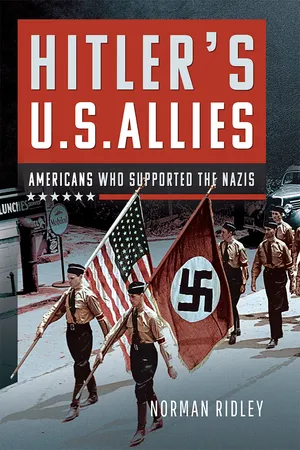
Hitler's U.S. Allies
Americans Who Supported the Nazis
- Norman Ridley(Author)
- 2024(Publication Date)
- Frontline Books(Publisher)
86 Chapter 5 FATHER CHARLES COUGHLIN It is his aim to replace the American democracy with a regime patterned after Hitler’s Germany. Samuel Dickstein 1 One man most often associated with fascism in America in the 1930s was the ‘silver-tongued [and] golden-voiced’ Catholic priest, Charles Edward Coughlin. 2 Between the years 1926 and 1942 he was a man with significant political power in the United States. He would become the first American demagogue to achieve international fame through the medium of his radio broadcasts. His ‘Golden Hour of the Shrine of the Little Flower’ and his incendiary weekly newspaper Social Justice reached tens of millions of homes railing against the political elite with a message describing American society as being controlled by ‘atheistic Marxists [and] international financiers’. His coded anti- Semitism blamed Jews for everything from the Great Depression to the Second World War. He was the first of what would become a long line of media evangelists with his heady brew of religion, politics and entertainment. Millions of confused and discontented Americans, suffering the effects of economic hardship, tuned into his broadcasts every week comforted by his reassuring words and promises of better things to come. By exploiting his status and popularity, he formed a grassroots lobbying movement called the National Union for Social Justice (NUSJ) and then later transforming it into a political party which he called the Christian Front. Like Pelley’s Silver Shirts, Coughlin and his followers would become some of the most violent anti-Semites of the Great Depression era. While Pelley’s mobs had counted among their number many violent Ku Klux Klan activists and thousands of nonviolent FATHER CHARLES COUGHLIN 87 sympathizers, Coughlin’s Christian Front would be seen to include one of the most organized alleged terrorist cells of the decade. eBook - ePub
The Populist Persuasion
An American History
- Michael Kazin(Author)
- 2017(Publication Date)
- Cornell University Press(Publisher)
The fate of every insurgent movement was bound up with its success at developing themes suggested by FDR or accusing the president of betraying his own stated convictions. No group could blaze a more radical path—by drawing strict class lines, endorsing either communist or fascist aims, or flagrantly appealing to anti-Semitism—without suffering a sharp and permanent drop in popular support. Catholics engaged in firing up the “grassroots” (a ubiquitous term in the 1930s) had to recognize the great appeal of the president’s brand of populist talk—without loosening the bonds of faith and community that had brought them this far.MAGICIAN ON THE AIR
Father Charles Edward Coughlin had little trouble capturing the public’s ear. In 1926, this Canadian-born cleric, the son of Irish immigrants, began broadcasting sermons for children and attacks on the Ku Klux Klan from his Shrine of the Little Flower in Royal Oak, Michigan, a working-class suburb twelve miles north of Detroit. Within a year, listeners in twenty neighboring states could hear him on WJR, a powerful Detroit station owned by a supportive Irish-Catholic businessman. By the fall of 1930, Coughlin was preaching more about the tumbling economy and the paralysis of the Hoover administration than about the catechism or the Klan. One network estimated that 30 million Americans tuned him in every Sunday afternoon—many, perhaps, after returning from church. Weekly, tens of thousands of admiring letters flooded into a new post office set up to handle the load. Most remarkably, Coughlin retained at least that many listeners and correspondents up to the election of 1936, when he broke decisively with the New Deal and created his own political party.10What explains the tremendous popularity across denominational lines of a parish priest who never ran for elective office or sought to scale the hierarchy of his church? No doubt, Coughlin attracted millions of casual listeners who took him no more seriously than they did other radio orators. But an undeterminable number looked to him for political guidance because he stirred a potent blend of convictions: the fervent advocacy of Catholic social doctrine, hostility toward high finance and a shadowy state, and the desire for an uncompromising leader to point the way out of the Depression. Coughlin was a new kind of evangelical populist. Like the moribund prohibitionists, he spoke more to his followers’ loss of psychological security and the nation’s apparent fall from social harmony than to the oppression of American workers. eBook - ePub
A Nation with the Soul of a Church
How Christian Proclamation Has Shaped American History
- O. C. Edwards Jr., James Dunkly(Authors)
- 2013(Publication Date)
- Praeger(Publisher)
That move prompted an enormous number of letters to the Vatican asking that Coughlin be permitted to continue broadcasting. With the permission of the Apostolic Delegate, he resumed on January 9, 1938. When Coughlin began broadcasting again, he revealed how greatly he had deteriorated. Apparently in losing the election he had lost confidence in the democratic process. It is commonly said that he became a fascist, but Charles Tull argues that “[t]he priest was a frustrated, disgruntled demagogue lashing out at the world around him, but he was no fascist,” 35 a judgment for which there is much to be said. It is true that at times he expressed admiration for the governments of Mussolini and Hitler, but some of that admiration can be put down to ethnic prejudice. Many of his followers were Catholics of Italian, German, or Irish lineage. Like many Irish, Coughlin despised the English for their treatment of his people. Yet his ranting and raving became progressively more embarrassing after the beginning of World War II in Europe in 1939, and especially after the entry of the United States in late 1941. The most distressing aspect of his new subject matter was a virulent anti-Semitism. While some have assumed that he had held such attitudes all along and only later felt free to express them, a more convincing explanation has been offered by Mary Christine Athans. 36 At the time Coughlin was feeling so vulnerable, he encountered the writings of an Irish priest, Father Denis Fahey, C.S.Sp., who gave him a thought-system onto which he could project all his anxieties. Building on a Thomist framework that had never led anyone else into such ideas, Fahey taught that anyone not in the Holy Catholic Church, the mystical body of Christ, was a part of its opposing group, the “Body of Organized Naturalism,” headed by its Natural Messiah, the Antichrist, who was probably the Jewish Messiah eBook - ePub
Opposing the Money Lenders
The Struggle to Abolish Interest Slavery
- Kerry Bolton(Author)
- 2019(Publication Date)
- Black House Publishing Ltd(Publisher)
He started a church in Royal Oak, Michigan, with a congregation of 28 families. He called it the Shrine of the Little Flower Church. A baseball fan, he met Dick Richards owner of the Detroit Tigers, who offered to sponsor a half hour talk on his radio station. Father Coughlin began his Sunday radio broadcasts on WJR in 1926. The themes were the family, with emphasis on speaking to children. One anti-Coughlin critic, Wallace Stegner, recalled that in the midst of despair Father Coughlin’s voice was ‘of such mellow richness, such manly, heart-warming, confidential intimacy, such emotional and ingratiating charm, that anyone tuning past it almost automatically returned to hear it again. It was without doubt one of the great speaking voices of the twentieth century’. (‘The Radio Priest and His Flock’, The Aspirin Age, London, 1950). The popularity was quick and donations flowed in to purchase time on other stations. The show was picked up by CBS. His congregation increased to 2,600 families, and a 180 foot tower was added to the Church which was used for broadcasting. On 30 January 1930 Father Coughlin broadcast his first political talk, referring to ‘the Bolsheviks and the bankers who support them’. He attacked President Herbert Hoover. Senator Hamilton Fish Jr., asked Coughlin to testify in Washington about Communism. His broadcasts were suddenly dropped by CBS in 1931. However, Coughlin appealed to his listeners for funds and with mail reaching 80,000 letters a week, he soon developed his own radio network reaching an estimated ten million listeners. (Stegner, ibid.). In Royal Oak a new post office was built just to handle the amount of mail Coughlin was receiving. During the 1932 Presidential election Coughlin avidly promoted the candidacy of Franklin D. Roosevelt with the slogan ‘Roosevelt or ruin’, describing Roosevelt’s plan of a ‘New Deal’ to get the American economy running again as ‘Christ’s Deal’
Index pages curate the most relevant extracts from our library of academic textbooks. They’ve been created using an in-house natural language model (NLM), each adding context and meaning to key research topics.

