Politics & International Relations

Anti-clericalism
Anti-clericalism refers to the opposition to the power and influence of the clergy in political and social affairs. It is often associated with movements that seek to limit or eliminate the role of religion in public life, and promote secularism and rationalism instead. Anti-clericalism has been a significant force in many countries throughout history, particularly in Europe and Latin America.
Written by Perlego with AI-assistance
Related key terms
1 of 5

8 Key excerpts on "Anti-clericalism"
 eBook - PDF
Religion, Power and Protest in Local Communities
The Northern Shore of the Mediterranean
- Eric R. Wolf(Author)
- 2015(Publication Date)
- De Gruyter(Publisher)
It is not always possible to distinguish between those who opposed the Church's power in 'secular' affairs from those who opposed the very institution of religion since these often over-lapped. However, we should analytically recognize a distinction between an anticlericalism that is fundamentally 'anti-Church' because of the Church's institutional position in a given state, and a broader anticlericalism that is equivalent to 'anti-religion'. In each of these dimensions, however, the attacks against the clergy are part of a larger attack on the Church as an institution. Another set of concerns focus directly on the behavior of the parish priest and do not seem to question the larger socio-political Popular Antialerioalism and Religiosity 97 institutional structure within which the secular clergy acts as local emissary, although the issues, namely, the priest's political and economic activities, can be traced to the larger structure. Finally, and again not always clearly separable from the above, are a range of anticlerical criticisms that are explicitly directed against the way in which a local priest handles his religious duties and that often appear to question the sacerdotal structure of Cath-olicism. In both of these 'anticlerical' attitudes, the priest, qua priest, is the target, not the institution of the Church nor re-ligion. It is within this general range of anticlericalism — the antagonism of parishioners to their local priest -- that this discussion shall focus. Working within the southern latifundist region of Portugal, Jose Cutileiro (1971:265-269) also encountered widespread local Anti-clericalism. In his excellent discussion, he distinguishes pious anticlericalism (criticisms that focus on the way in which the priest conducts the religious life of the parish) from secular anticlericalism (criticisms that focus on the 'worldly' activities of the priest).
- Virginia Garrard-Burnett, Paul Freston, Stephen C. Dove(Authors)
- 2016(Publication Date)
- Cambridge University Press(Publisher)
With a view to describing this plurality of anticlericalisms, it may be useful to define the term in the abstract. One venerable theory views it as bourgeois mystification, a way of sublimating class antagonisms in symbolic violence. In a similar vein, others see anticlericalism as a feature of new democra- cies with Catholic parties and peasant electorates: “in these conditions,” Liberalism and Anticlericalism 253 Chadwick writes, “God was a political slogan, anti-God another slogan.” 1 These definitions are unworkably Eurocentric, and also collapse anticleri- calism’s ideological dimension, reducing it to a function of mass democracy. Others define anticlericalism as opposition to the power of the clergy, which makes the concept dynamic and allows anticlericalism to evolve in response to diversifying clericalisms (hence “political,” “social,” and “educational” variants exist). This, though, presents us with an excessively determined con- stant, anticlericalism as eternal riposte. That is correct in that the word’s pre- fix carries a negative charge, but ideological in that it echoes the Manichean tropes of anticlericals themselves: hence, clergy are ominous black birds, cas- socks flapping like vulture’s wings, or sinister papists plotting in the sacristy gloom; anticlericals, by contrast, are the permanent guardians of a nation under siege, like torch-carrying sentinels minted on silver coins. Yet, as we have stressed, anticlericalism is not objectively a bringer of light, the sun moving across a dial. It can precede clericalism empirically, if not semantically, as at independence. Both Church and state, in addition, thought their association would continue beyond 1820: the discovery that it could not was painful and slow and gave rise to a dialectical hardening of positions on both sides. Yet it still took many anticlericals forty years to abandon the princi- ple of an established Church. eBook - ePub
Explaining Religious Party Strength
State Capacity, Social Services, and Religious Civil Society
- Mário Rebelo(Author)
- 2022(Publication Date)
- Routledge(Publisher)
Skocpol 1982 :274).There are four reasons why anticlerical policies create a favourable environment to the political mobilization of religious activists. First, the feeling of injustice and persecution generated by anticlericalism can politicize religious individuals who might have been apolitical, making them more receptive to mobilization by a confessional party (Ivarsflaten 2008 :4–5; Simmons 2014 :513–516; Snow and Soule 2010 :23; Tilly 1978 :134–135). Contexts of state repression generate bonds among people who might previously been strangers to one another or did not conceive of themselves as having a common purpose. Typically, negative feelings such as resentment or moral outrage tend to translate into a broader rejection of the perceived perpetrator of injustice – in this case the secular state or the anticlerical political groups in control thereof (Balcells 2012 :314–315).Second, religious elites become more legitimate in the eyes of individuals in the religious community when they bear the brunt of anticlerical attacks. This is a typical “rallying around the flag” phenomenon that increases the popularity of political leaders when faced with an outside threat. Third, anticlericalism facilitates collective action by binding the religious community closer together. The experience of facing a powerful and fearsome adversary fosters a siege mentality that supresses intra-religious differences and imposes overwhelming pressures towards uniformity and groupthink (Forsyth 2019 :397; Tajfel 1982 :15). Norms of collective dependence enforced by the religious group solidify shared communal understandings and dissuade free-riding (Clark 2003 :16–18; LeBas 2011 :44–47; Levitsky and Way 2013 :5–17; Lipset 1960 :83–87). In general, episodes of intense social conflict tend to generate strong partisan attachments and robust in-group cohesion, attributes which facilitate successful party-building (Huntington 1968 :415–417; Levitsky, Loxton, and Van Dyck 2016 :3; Lipset and Rokkan 1967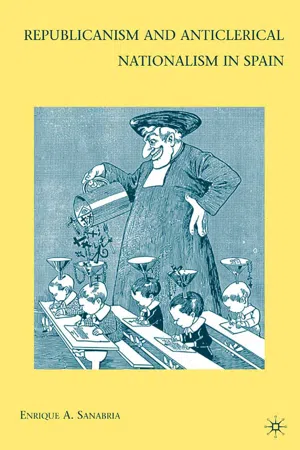
- E. Sanabria(Author)
- 2009(Publication Date)
- Palgrave Macmillan(Publisher)
The emergence of clericalism, both in private pastoral form and public demonstrations, triggered the anti- clerical actions and words of liberal statesmen and special interest groups that were not willing to concede any ground to clericalism. Struggles over Nation-Building 17 With John N. Schumacher’s claim that “the struggle of the Catholic Church against Liberalism in the nineteenth century nowhere, per- haps, took such extreme forms as it did in Spain” 8 as an important point of departure, this chapter explores nineteenth-century anticleri- calism in Spain to demonstrate how the battle between anticlericalism and clericalism permeated the political and cultural efforts to create a liberal and national identity. It continues with a comparison of the clerical/anticlerical battles in other European countries during this time of nation-building. I show modern anticlericalism has been a common expression of liberalism, which seeks to erase restraints on individual progress. In Spain, modern anticlericalism is principally rooted in a tension born out of the struggle to establish the param- eters of the clergy’s function in a society that has become conscious of its own autonomy. 9 Of particular concern here is to understand anti- clericalism, especially as put forward by radical republican politicians and journalists, as an expression of Spanish nationalism. Building the Spanish nation proved to be very difficult for nineteenth-century rulers and elites alike because of the peculiari- ties of Spanish national identity before the Napoleonic Wars. Alvarez Junco writes that the ethno-patriotic identity of Early Modern Spain was characterized by a fusion between political and religious iden- tity; deep-rooted xenophobia; eurocentrism, or the tendency to eval- uate Spain vis-à-vis the rest of Western Europe; and a victimized, self-pitying tone. eBook - PDF
Towards Just Gender Relations
Rethinking the Role of Women in Church and Society
- Gunter Prüller-Jagenteufel, Sharon Bong, Rita Perintfalvi(Authors)
- 2019(Publication Date)
- V&R Unipress(Publisher)
© 2019, V&R unipress GmbH, Göttingen ISBN Print: 9783847109853 – ISBN E-Book: 9783847009856 Eamonn Conway (Limerick) A Church beyond Clericalism 1. Introduction Clericalism has been identified by Pope Francis as the key current impediment to the mission of the Church. Moving beyond clericalism is, therefore, an absolute priority for the Church’s future. The topic is important for another reason. We also need to acknowledge that some in our Church have experienced the effects of this evil (we should not hesitate to use the word) in a deeply personal way. I will begin by offering a brief description of clericalism. I will then explore the relationship between the sexual abuse crisis and clericalism. I will then go on to summarise what Pope Francis has been saying about the topic. This will be followed by a brief consideration of professed and operative understandings of priesthood and how they may dispose clergy towards clericalism. I will then conclude with some suggestions concerning how we might arrive at “a Church beyond clericalism”. 2. What is clericalism? The US Conference of Major Superiors of Men considered the issue of clericalism as far back as 1983. 1 They described it as “the conscious or unconscious concern to promote the particular interests of the clergy and to protect the privileges and power that have traditionally been conceded to those in the clerical state.” Their report highlights the fact that clericalism becomes manifest in the behavior of individuals, but that it also can be evident in the church as an institution. It can be inherent in church structures and be reinforced by church procedures and processes. Clericalism is at work when we encounter “an authoritarian style of ministerial leadership, a rigidly hierarchical worldview, and a virtual identi- 1 In solidarity and service: reflections on the problem of clericalism in the Church, Conference of Major Superiors of Men, Washington DC, 1983. eBook - PDF
For Christ and Country
Militant Catholic Youth in Post-Revolutionary Mexico
- Robert Weis(Author)
- 2019(Publication Date)
- Cambridge University Press(Publisher)
117 Roumagnac, Los criminales en México. The Enforcement of Anticlericalism 53 Catholicism. It soon became clear, though, how broad and diffuse clerical influence was. Hundreds of ordinary parishioners had formed lay associ- ations. They cherished, supported, and relied on the influence of the church. Although these organizations and institutions had a degree of autonomy from the clergy, they acted as extensions of the institutional church. For them, the government’s argument that the laws referred only to clerics was false. Any attack on the institutional church was also an attack on the activities and the beliefs of the laity. They understood anticlericalism as an assault on their personal liberties – on their ability to assemble, organize, express themselves, and engage with society. Their attackers’ barbarism belied any suggestion that anticlericalism aimed to bolster the rule of law. For them, the corruption of the police forces confirmed that the removal of the church’s influence from public spaces (and from living rooms) would not expand democracy. No, these “savage cuicos” were illegitimate usurpers of the moral and social territory wrenched away from the church and respectable households. 54 For Christ and Country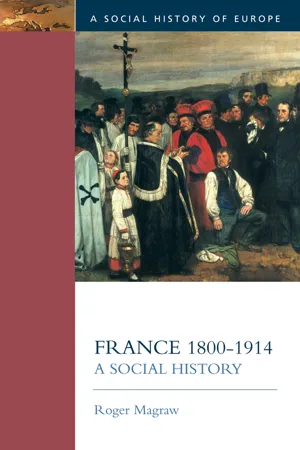 eBook - ePub
France, 1800-1914
A Social History
- Roger Magraw(Author)
- 2014(Publication Date)
- Routledge(Publisher)
Chapter 4Religion and Anti-clericalismIntroduction
Secularisation or religious revival?
The authors of an authoritative religious history of modern France claim that the historiography of French Catholicism is overdependent on a discredited metanarrative which assumes that ‘modernisation’ entails secularisation (Cholvy and Hilaire 1985–86). Secularists once rejoiced at the prospect of science, education and democracy consigning ‘obscurantist’ religion to richly deserved oblivion. Zola depicted the last priest saying the last Mass in the last church. It is struck by lightening, the curé crushed by a falling crucifix. His body turns to ashes, which blow away in the wind! By 1950, with the Catholic hierarchy discredited by collaboration with Vichy and workers voting Communist, sociologists assumed that the Church had ‘lost’ the popular classes. Worker-priests blamed their own church for this, arguing that its alliances with the wealthy rich and its reactionary politics had betrayed the poor and ignored aspirations for social justice (Pierrard 1984). Ironically, Marxism, not Catholicism, now risks consignment to the rubbish heap of history. Unilinear narratives of secular progress are no longer in vogue. Too many historians, it is now claimed, assumed that a decline in religious practice in a particular region at a particular moment constituted the watershed – that thereafter ongoing decline was inevitable. Studies of dioceses such as Orléans were taken to show that 1830, or 1848, marked decisive moments in the rise of popular Anti-clericalism or religious indifference (Marcilhacy 1964).The new orthodoxy accepts that Catholicism suffered blows in the 1790s and in the early Third Republic, but sees no definitive victories for the forces of secularisation. The decades after 1810 witnessed a religious revival, marked by the post-Concordat reconstruction of the Church, a rise in vocations, expansion of Catholic education, ‘ultramontane’ piety and the emergence of a more ‘personal’ religion involving frequent communion. In some dioceses the nadir of religious practice was reached in the 1900s, after which indices of religious vitality pointed upwards. The ‘new social history’ exhibited little sympathy for religion, treating it as an expression of ‘false consciousness’ or an instrument of social control. Younger historians suggest that religion offered positive ‘resources’ for the weak and powerless. Feminists claim that it provided a ‘site’ of ‘female agency’ in a society which denied women access to the public sphere. Regionalists have emphasised its contribution to the vitality of peripheral cultures struggling against centralisation. eBook - PDF
After Secularism
Rethinking Religion in Global Politics
- E. Wilson(Author)
- 2011(Publication Date)
- Palgrave Macmillan(Publisher)
As we have seen, religious thought has influenced the rise of political principles such as the separation of church and state and the public/private divide. It is somewhat paradoxi- cal that the very phenomena secularists sought to exclude from political life in the West influenced the development of arguments to justify the separation of religion and politics. Promoting secularism and the exclusion of religion as the ideal or model for a progressive, ‘developed’, ‘civilized’ society The fourth move of dominant modes of secularist thinking in International Relations further contributes to the subordination of religion to politics by constructing religion as primordial and premodern, something that decreases in influence with processes of secularization and moderniza- tion. With economic development and political modernization, religion would no longer exercise any influence in the public sphere, being restricted to individual personal matters. Secularism’s fourth move has arguably had the most pervasive influence on International Relations scholarship. Despite renewed interest in religion following the end of the Cold War and the events of September 11, 2001, this attention was mostly directed towards non-Western areas, with little consideration of the role of religion in Western and international politics until the mid-2000s. Authors such as David Apter (1965) and Donald E. Smith (1974) exemplify this attitude. In his study titled The Politics of Modernization, Apter (1965) discusses the role of religion in the formation of political values. ‘Religion’, he states (1965: 267), ‘is to be understood as tran- scendental ends … ultimate commitments that become personal ends for individuals and cultural ends for societies. Such commitments are non-rational in character.’ Apter here upholds the secularist assump- tion that religion is antithetical to rationalism. Note also his designa- tion of religion as purely concerned with the transcendental.
Index pages curate the most relevant extracts from our library of academic textbooks. They’ve been created using an in-house natural language model (NLM), each adding context and meaning to key research topics.

