History

Guangzhou
Guangzhou, historically known as Canton, is a major port city in southern China. It has a rich history dating back over 2,000 years and has been a key trading hub and cultural center. Guangzhou played a significant role in the maritime Silk Road and has been an important city in the development of Chinese history and culture.
Written by Perlego with AI-assistance
Related key terms
1 of 5


10 Key excerpts on "Guangzhou"
- (Author)
- 2017(Publication Date)
- Rough Guides(Publisher)
Guangzhou 广州 , guăngzhōu Guangzhou , once known to the Western world as Canton , was for centuries where China met the rest of the world – commercially, militarily and otherwise. Increased competition from elsewhere in China may have diminished Guangzhou’s role as a centre of international commerce, but with the money continuing to roll in from the industrial and manufacturing complexes which cover the surrounding Pearl River Delta, there is little suggestion that the city is a fading power. 8 484 FUJIAN, GUANGDONG AND HAINAN ISLAND GUANGDONG For visitors, however, Guangzhou’s attractions are limited and mainly business-oriented, as the biannual Canton Trade Fair attests. The city is vast, untidy and unbelievably crowded, and actual tourist sights are relatively trivial, though a peek at the European colonial enclave of Shamian Island and the fascinating 2000-year-old tomb of the Nanyue King prove the city’s lengthy and varied cultural heritage. eBook - ePub
Multilingual China
National, Minority and Foreign Languages
- Bob Adamson, Anwei Feng(Authors)
- 2021(Publication Date)
- Routledge(Publisher)
During the Ming (1368–1644 ad) and Qing (1644–1912 ad) Dynasties, Guangzhou was the only port in China open to the outside world. The only port in the world which has prospered for more than 2,000 years, Guangzhou continues to thrive since China’s reform and opening-up in 1979. From 1979 onwards, Guangdong Province has taken the lead in economic development in 32 Chinese provinces, municipalities and autonomous regions (excluding Hong Kong and Macao). Between 2011 and 2017, Guangdong has remained No 1 in terms of GDP in China (National Bureau of Statistics, 2019a). Guangzhou, the capital city, ranked first in GDP in Guangdong Province until it was overtaken by Shenzhen in 2016 (Guangdong Bureau of Statistics, 2018). The tremendous business opportunities in Guangzhou attract both foreigners and Chinese from other parts of the nation. By the end of 2017, the number of foreigners recorded as entering the city had increased to 2.28 million, up 7.1 per cent from the previous year, while there were over 80,000 foreign residents in Guangzhou with the top three origins being South Korea, Japan and the US (Guangzhou Daily, 2018). Geographically, Guangzhou is adjacent to Hong Kong and Macao, the former colonies of the United Kingdom and Portugal respectively. Cantonese is the mother tongue of most of the residents in the three regions. In early 2019, the Chinese government issued the Outline Development Plan for the Guangdong-Hong Kong-Macao Greater Bay Area (hereafter the Development Plan), aiming at maintaining the prosperity of Hong Kong and Macao, deepening cooperation between the mainland, Hong Kong and Macao and building a first-class international bay area. It has both economic and political vision, playing an important role in China’s global ‘Belt and Road Initiative’ No longer available |Learn more
Aspects of Urbanization in China
Shanghai, Hong Kong, Guangzhou
- Gregory Bracken(Author)
- 2012(Publication Date)
- Amsterdam University Press(Publisher)
However, throughout the history of China there have been many significant changes in political attitude towards foreign trade and globalization. These changes have had a major impact on the cities, which have experienced a high degree of opening up, and even on the entire process of China ’ s urbanization. For this reason, it is meaningful to grasp the role of China ’ s urbanization against the background of globalization. China has a long and proud history of foreign trade. Guangzhou, which is located in the southwest of China, possesses a rich history of foreign trade that dates back to the Qin Dynasty. As the only city per-mitted to trade during most of China ’ s dynasties, Guangzhou occupied a leading position among Chinese cities and contributed greatly to the economic development of ancient China. During almost a century of colonial rule, Guangzhou developed at a far faster pace than the other inland cities and mushroomed into a highly cosmopolitan city. Today, Guangzhou is still the bridgehead for foreign trade in China and con-tinues to play an important role as a model for Chinese cities exploring the path towards global importance. The First Opium War (1839-42) marked the beginning of Guang-zhou ’ s semi-colonization and semi-feudalization. The colonists brought two notable benefits to Guangzhou that accelerated the process of urban construction. First, the industrialization process in Guangzhou was accelerated: an industrial base developed rapidly, as did municipal infra-structure, with the agricultural civilization soon being replaced by an 60 XIANGMIN GUO AND CHANGTAO LIU industrial civilization. Second, there was an appreciable expansion in the range of foreign trade, with trade routes increasing during the colo-nial era, most of which remain important for the development of Guangzhou to this day. Guangzhou ’ s path towards globalization during the colonial era objectively met its needs for city development for a long time. eBook - PDF
Tombs and Transnational History in Greater China
A collection of case studies
- Gotelind Müller(Author)
- 2022(Publication Date)
- LIT Verlag(Publisher)
Whereas Guangzhou was mainly connected to trade during the so-called Canton System period (18th to mid-19th century), but also to Christian mission, Shanghai was connected to both after becoming a treaty port in 1842. Thus, issues of trade and religion play into these places. And both cities are characterised by a multi-cultural history which present-day Chinese heritage politics needs to deal with, while paying heed to the fact that foreign relations to a number of countries are potentially involved. Guangzhou Guangzhou 广州 has a very long history of contact with foreigners. 1 As a major port in the very South of China in the delta of the Pearl River, its early contacts included notably also Arab Muslim traders who came to China during Tang times. Thus, up to today the earliest Muslim tombs in all 1 For an overview on those connected to trade, see Chen Xuejun 陈学军: Gudai Guangzhou de waiguo shangren 古代广州的外国商人 (Foreign merchants in Guangzhou in former times). Guangzhou: Guangdong renmin chubanshe 2002. Between History, Heritage, and Foreign Relations 57 of China are located here. 2 Since the Sino-Muslims (Hui 回) 3 trace their ancestry back to these early Muslims, they are somewhat “integrated” into the Chinese social fabric and thus less perceived in hindsight as purely “foreign” in China, and subsequent local Muslims were buried with them. In this sense, the cemetery as such is, strictly speaking, not a “foreigners’ cemetery”, but a “faith-specific” one. The largest influx of foreigners, and thus in consequence foreigners’ graves, however, set in with the so-called Canton System. Trade relations with the various Western Powers who “knocked at the door of China” had started to grow since the late Ming times, until the Qing dynasty finally restricted them in the 18th century to this port far away from the Court in Beijing – only the Russians being separately assigned to the trading city of Kyakhta at the border between the Russian and the Qing empires.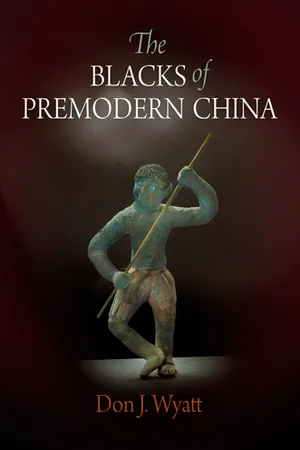 eBook - PDF
- Don J. Wyatt(Author)
- 2012(Publication Date)
- University of Pennsylvania Press(Publisher)
Therefore, for their parts, the three regions have undergone repeated 50 chapter two fluctuations in prosperity. The imperial court once [even] aggregated all of Quanzhou’s ships and ordered them to proceed to Guangzhou. That was an occasion on which the merchants were much inconvenienced. 19 The conspicuous importance of this opening passage is clearly the ex-tent to which it confirms the primacy of Guangzhou as the hub of Chinese southeast-coastal commercial maritime affairs—a status the provincial capital had in fact enjoyed since the Han Dynasty ( 202 b.c.e. – 220 c.e. ). 20 This status became considerably more enhanced after the city was officially decreed open to interstate trade in 971 . 21 However, significantly, up until the ninth century and, in certain respects, even well beyond it Guangzhou was also considered by many to be a cultural wasteland. At the very least, it was widely recognized in official circles for its cultural distinctiveness, situated as it is on what was at that time the most remote coastal extremity of the Chinese Empire. Neverthe-less, on the basis of Zhu Yu’s description, the fact that Guangzhou had—by the beginning of the twelfth century—become fully accepted, at least in terms of overseas commerce, as perhaps the maritime pivot of the empire seems incontrovertible. Before turning in earnest to the promised primary evidence on foreign slaves, we are well served by noting that pursuant to the region’s flourishing as a bustling and thriving commercial center there was the establishment in Guangzhou of a foreign community whose members were not slaves. eBook - PDF
China's Economic Powerhouse
Economic Reform in Guangdong Province
- T. Bui, D. Yang, W. Jones, J. Li, T. Bui, D. Yang, W. Jones, J. Li(Authors)
- 2002(Publication Date)
- Palgrave Macmillan(Publisher)
In putting three out of four of China’s earliest special economic zones in Guangdong, the central government obviously took full consideration of Guangdong’s geo- graphical location and economic status. Guangdong was the southern- most province within Chinese territory before Hainan was made a province. It borders the South China Sea, neighbours Vietnam, and faces Malaysia, Indonesia and the Philippines across the sea, thus affording close marine access to Southeast Asia, Oceania, the Middle East, the Near East and Africa. Guangdong was an open region even in ancient China. Prior to the Tang dynasty (618–907), Xuwen and Hepu (Hepu now belongs to Guangxi Zhuang Autonomous Region) were vital arteries for marine communica- tion. During the Tang dynasty, Guangzhou became a world-renowned oriental seaport, and the Ocean Silk Road starting from Guangzhou was the longest shipping route in the world. In the Song dynasty (960–1279), Guangzhou’s merchant ships sailed across the Indian Ocean to Arabia and East Africa, and in the Ming dynasty (1368–1644), two ocean shipping Joanna Z. Li and David C. Yang 213 lines from Guangzhou to Latin America and to Lisbon in Portugal were opened. In the early period of the Qing dynasty (1644–1911), shipping lines from Guangzhou to North America and Oceania were also established. 2 During the course of centuries of contact with foreign countries, many Cantonese emigrated. According to historical records, as far back as the late Tang dynasty and the Song dynasty, Cantonese began to migrate overseas. After the Opium War, colonialists contracted to send large batches of Chinese labourers to America, Australia and Southeast Asia. In 1862, the United States Congress approved the Pacific Ocean Railway Bill, which resulted in more than 10,000 Chinese labourers, mostly from Taishan in Guangdong Province, being sent to the United States. eBook - PDF
Globalization and Networked Societies
Urban-Regional Change in Pacific Asia
- Yue-man Yeung(Author)
- 2000(Publication Date)
- University of Hawaii Press(Publisher)
The vital overseas links that Chinese provide in technology transfer, capital accumula-tion, and information access have been critical in Guangdong’s recent transformation. In this way, Hong Kong Chinese have been playing, since 1978, the role of Guangdong’s window to the world exceed-ingly well. 146 China and Hong Kong ■ Figure 6.1 Administrative Divisions of Guangdong, c. 1997 The early exposure to Western influence with Guangzhou as the only port of external trade for 100 years prior to the Opium War (1839 –1842), coupled with the overseas Chinese link, has traditionally facilitated Guangdong to nurture political and cultural leaders whose thinking was ahead of their times. Prominent leaders of political move-ments include Hong Xiuquan, Kang Youwei, Liang Qichao, and Sun Yat-sen. They have left indelible marks on the history of modern China. Of special interest is the historical development of Guangdong from an economic perspective. The rise of Guangzhou and Foshan was due largely to the flourishing commerce and trade that the province experi-enced as a result of the single-port policy and the use of the Meiguan Pass as the sole north-south conduit for the movement of goods be-tween Guangdong and other parts of China. A PROFILE OF SOCIETAL TRANSFORMAT I O N Over the past two decades since China adopted an open policy, Guang-dong has become a transfigured land. Hardly any facet of society has been left untouched by the people’s passion for change, so much so that a societal transformation has occurred in the province. From the abyss of stagnation in the late 1970s that was the bitter legacy of the Cultural Revolution, Guangdong has dramatically turned the corner and, by the late 1990s, could proudly show its face of modernity and breathtaking economic gains in its SEZs and in the bustling cities in the Pearl River delta and elsewhere.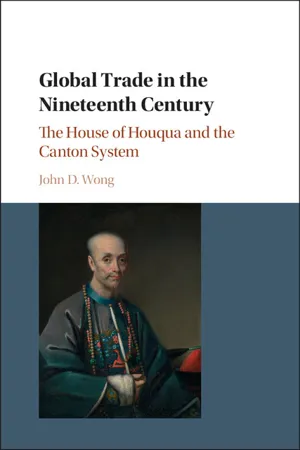 eBook - PDF
Global Trade in the Nineteenth Century
The House of Houqua and the Canton System
- John D. Wong(Author)
- 2016(Publication Date)
- Cambridge University Press(Publisher)
1. A Study of the Structural Context 31 China’s trade with the West in this city at the southern tip of the empire. Official policies on the Canton trade intertwined with the unsettling mil- itary struggle in southeastern China in the seventeenth and early eigh- teenth centuries, disrupting the preexisting trade networks that linked the coastal cities in China to Southeast Asia and beyond. However, for Houqua’s family and other resourceful merchants, this reconfiguration also offered opportunities. In the seventeenth century, the Cantonese Wu family fled from Fujian to escape political turmoil. But by the beginning of the nineteenth century, they made a deliberate decision to firmly estab- lish the family in Canton because the city was the center of international commerce. The clash between East and West would erupt in this city in southern China, but it would not occur for another four decades. In the mean- time, the meeting of the New Worlds engendered a dynamic commercial environment where fortunes were made and lost many times over. By the beginning of the century, it was already evident that the New Worlds colliding in Canton were developing along different paths. Although commercial ties bound China and Southeast Asia, these ties did not flourish into the economic specialization of Europe and its New World in the Americas, a critical step in the enhancement of productivity. More importantly for Houqua and his fellow Hong merchants in Canton, by the mid-eighteenth century Western vessels had managed to chart new courses around the South China Sea. Although the Chinese Hong mer- chants held a monopoly over the supply of Chinese tea, they could only deliver the products to markets in the West through their Western trad- ing partners. These were the business opportunities in Canton and the challenges with which Houqua had to contend. In Canton, strangers were at the gates but they too were busy estab- lishing a foothold in this nexus of trade. eBook - PDF
Foreign Investment and Socio-Economic Development
The Case of Dongguan
- G. Yeung(Author)
- 2001(Publication Date)
- Palgrave Macmillan(Publisher)
With its long history and strategic location, it is to be expected that Dongguan has a rich historical past. The most important period was when the Qing dynasty’s imperial commissioner, Lin Zexu, destroyed 1.4 million kg of British opium (largely shipped by the East India Company) between 3 June and 25 June 1839 in Humen, which triggered 44 45 Source: Thoburn et al., 1990, p. xii. Figure 3.1 Location of Dongguan Shaoguan Qujiang Yingde Fugang Huaxian Wongyuan Xinfeng Cong Hua Heyuan Longmen Zengcheng Bo Luo Huizhou Huidong Haifeng Lefeng Huilai Chaoyang Shantou Cheng Hai Nan Ao Xingning Meixian Wuhua Fengshun Chaozhou Huiyang Dongguan Foshan Panyu Nanhai Shunde Zhaoqing Kaoyao Yunfu Xinxing Gaoming Guangzhou Heshan Jiangmen Xinhui Zhongshan Zhuhai Doumen Shekou Baoan Shenzhen Kaiping Enping Taishan Gaozhou Maoming Dianpai Yangchun Yangjing Macau Hong Kong Key: Railway Administrative area boundary Name of administrative area City or town name Zhanjiang Guangning Si Hui Heyuan Huizhou Zhaqing Guangzhou Guangzhou Foshani Guangzhou Dongguan Shenzhen Zhongshan Maoming Yangchun Jiangmen Zhanjiang Shanwel Shantou Meizhou Qingyuan Qing Yuan the first Opium War with Britain. 2 The Opium War led eventually to the Treaty of Nanking, by which Hong Kong Island was ceded to Britain. 3 Dongguan was also used as the headquarters of the ‘East Pearl River Guerrilla Forces against Japanese Aggression’ during WWII (DMBFT, 1988). After the establishment of the People’s Republic of China (PRC) in 1949, Dongguan was governed by the Dongguan County Revolutionary Committee before the formal establishment of the Dongguan county government in July 1980. In September 1985, the 1700-year-old city was upgraded by the State Council to a county-grade city, under the jurisdiction of Huiyang of Guangdong province, and included in the Pearl River Delta Open Economic Area. eBook - ePub
- Chee-Beng Tan(Author)
- 2006(Publication Date)
- Routledge(Publisher)
9 Out-migration has been an important feature of Hong Kong since its early days as a British colony. It was a funnel for substantial numbers of rural migrants, especially from the Pearl River Delta region, as they went to labor in the mines, on the plantations, and on the railroads of Southeast Asia, the West Indies, and the Americas, until well into the twentieth century (Sinn 1995: 11–34). Out-migration from the late 1960s, especially to Australia, Canada, New Zealand, and the United States—states that had imposed severe restriction on Chinese immigration—has been an important aspect of modern Hong Kong. It furthers the internationalized character of the Hong Kong population, more so given a degree of return migration in which foreign passport holders of Chinese origin have returned to Hong Kong to work, sometimes leaving family members behind in the countries of migration (the “astronaut” phenomenon). There are some important class issues involved in this process (Salaff and Wong 1994: 205–90; Skeldon 1994).10 Nostalgia about the past is reflected in televised soap operas set either in the 1950s or in the 1920s and 1930s, and by documentary efforts to capture the rapid disappearance of popular cultural forms. A recent television program on Guangzhou television portrayed the popular culture of Xiguan, the prewar commercial center in the western part of Guangzhou, which emphasized food traditions, the rickshaw, letter writers, street-side beauticians, Cantonese popular ballads, all of which, in both Hong Kong and Guangzhou, have disappeared from public view, although they can still be found in Macao.11 It is only underscored by the enormous apparent proclivity of the Hong Kong population to travel. There are few statistics available on the amount of travel that residents of Hong Kong make. Much of the tourism to China (about 88 percent) consists of visitors from Hong Kong, Macao, and Taiwan, Hong Kong visitors the most numerous. Travel to other world venues, often by packaged tour, is a profitable business. Impressionistically, it involves all social classes and all ages. Familiarity with the non-Chinese world is substantial. Partly, such travel is to visit relatives who have moved abroad, but tourist activities to those parts of the world, which have few Chinese immigrants, appear to be considerable.12
Index pages curate the most relevant extracts from our library of academic textbooks. They’ve been created using an in-house natural language model (NLM), each adding context and meaning to key research topics.

