History

Little Ice Age
The Little Ice Age was a period of cooling that occurred from the 14th to the 19th century, leading to colder temperatures and adverse weather conditions in various parts of the world. This period saw phenomena such as harsh winters, crop failures, and glacial expansion. The Little Ice Age had significant impacts on human societies, influencing agriculture, economies, and even contributing to social unrest.
Written by Perlego with AI-assistance
Related key terms
1 of 5

10 Key excerpts on "Little Ice Age"
- Patrick D. Nunn(Author)
- 2007(Publication Date)
- Elsevier Science(Publisher)
~|174 !iiiiiiiiiiiiiiii i!iiiiiiNiiii?i!iiiiii iii!!iiii i!iiiiiiiiiiiiiiii!ii!i!!i !i i!i!!i! i!i~ i}!i~ i!iN i~i iiiiiiiiiiiiiiiiiii The Little Ice Age (A.D. 1350-1800)in the Pacific Basin The 450-year long Little Ice Age in the Pacific Basin- and indeed in most parts of the world - was generally cooler than the Medieval Warm Period that preceded it (Chapter 4) and the period of Recent Warming that followed it (Chapter 8). The A.D. 1300 Event between the Medieval Warm Period and the Little Ice Age was a time of rapid climate change marked in many parts of the Pacific Basin by cool- ing, sea-level fall and an increase in storminess linked to an increase in the frequency of E1 Nifio events (Chapter 5). Yet it is misleading to portray the Little Ice Age as simply a period of cool conditions contrasting with the warmer conditions before and after. For the Little Ice Age was a time of highly variable climate compared to the Medieval Warm Period. It is likely that this variability caused as much of a problem for humans during the Little Ice Age in the Pacific Basin as did the general coolness. For people living off the land and accustomed to the seasonal reappearance or re- growth of key food items, climate variability will inevitably lead to insecurity and may, in places (especially smaller, more remote islands), eventually induce a food crisis, marked perhaps by aggressive competition for a diminished food-resource base. This chapter is organized into major sections on climate, environment and society. Climate (Section 6.1) is divided into accounts of primarily Little Ice Age temperatures and precipitation in various subregions of the Pacific Basin. The section dealing with environment (Section 6.2) discusses mainly coastal envi- ronments and their responses to cool, often stormier, climate conditions, and a lower sea level compared to the Medieval Warm Period. eBook - PDF
The Crisis of the 14th Century
Teleconnections between Environmental and Societal Change?
- Martin Bauch, Gerrit Jasper Schenk, Martin Bauch, Gerrit Jasper Schenk(Authors)
- 2019(Publication Date)
- De Gruyter(Publisher)
For the problems of periodization, see: Christian Pfister, Five Centuries of Little Ice Age Climate in Western Europe, in: Takehiko Mikami (ed.), The Little Ice Age Climate, Tokyo 1992, pp. 208–213; Jean M. Grove, The Initiations of the ‘Little Ice Age’ in Regions Round the North Atlantic, in: Climatic Change 48 (2001), pp. 53–82; Jean M. Grove, The Little Ice Age, London 268 András Vadas In the 1990s, however, scholars started to classify this earlier transitional period as part of the LIA itself, not primarily because of average temperatures or precipitation levels but due to the growing frequency of weather anomalies and weather-related environmental crises (famines and floods).11 Recent scholarship suggests a rapid transition to the LIA in the first decades of the fourteenth century.12 As a result of these changes in the climate, the conditions for practicing agri-culture changed significantly in most parts of western Europe and probably also in east central Europe. The most dramatic changes, however, occurred in northern and northwestern Europe and in mountainous regions (especially the Alps), where the possible zone in which certain grains and grapes could be cultivated shifted to lower altitudes and lower latitudes causing significant economic crises in a number of areas.13 The situation in the Carpathian Basin during this period was somewhat different: a deep political struggles at the turn of the thirteenth century was followed by the consolidation of the Angevin rule in the early 1320s, which introduced a period of more or less constant economic growth.14 Contemporary narrative and legal sources do not mention country-wide famines during this period, and there is little documentation from the Hungarian kingdom on the great plague epidemics of the 1340s. 15 Taken together, this has been read as 2003; Raymond S. Bradley and Philip D. Jones, The ‘Little Ice Age’: Local and Global Perspectives, in: Climatic Change 48 (2001), pp.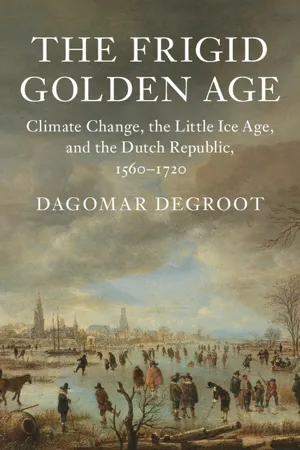 eBook - PDF
The Frigid Golden Age
Climate Change, the Little Ice Age, and the Dutch Republic, 1560–1720
- Dagomar Degroot(Author)
- 2018(Publication Date)
- Cambridge University Press(Publisher)
35 John Brooke, Climate Change and the Course of Global History, 446. Parker, Global Crisis, xix, 166, 410, 479. Parker, ‘Crisis and Catastrophe: The Global Crisis of the Seventeenth Century Reconsidered’, 1053. William M. Cavert, ‘Winter and Discontent in Early Modern England’. In Governing the Environment in the Early Modern World: 40 The Little Ice Age Temperatures across the Northern Hemisphere recovered by around 1720. In subsequent decades, only frigid winters in the early 1740s inter- rupted a warmer and in many places drier and more tranquil climatic regime. Then, beginning in the 1760s, Earth’s average temperature started falling again. Volcanic eruptions compounded the cooling influence of dropping solar radiation, the NAO switched to a strongly negative posi- tion, the AMO cooled considerably, and the Siberian High strengthened. This final cold phase of the Little Ice Age is called the Dalton Minimum (1760–1850), after yet another sunspot-tracking astronomer. At last, between 1850 and 1900, the world escaped from the Little Ice Age, although it soon fell into the human-made crisis of global warming. 36 the Little Ice Age in the dutch republic Changes in average annual temperatures in the Low Countries roughly mirrored broader Northern Hemisphere trends. Average annual tempera- tures in the region declined sharply with the onset of the Spörer Minimum, rose in the early sixteenth century, and collapsed in all seasons with the coming of the Grindelwald Fluctuation in around 1561. Average spring, summer, autumn, and winter temperatures were especially frigid in the final decade of the sixteenth century and the first decade of the seventeenth century. Thereafter, both summers and winters slowly started to warm. Yet the chilly, unpredictable weather of the Grindelwald Fluctuation endured in the Low Countries, as it did across the Northern Hemisphere, until the ‘year without summer’ in 1628 (Figure 1.2).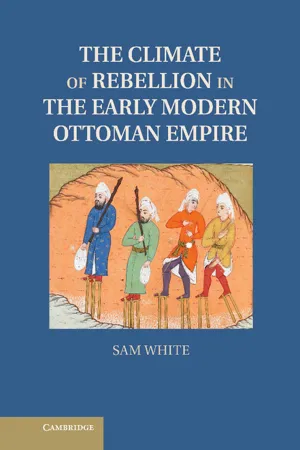
- Sam White(Author)
- 2011(Publication Date)
- Cambridge University Press(Publisher)
Grove, “Little Ice Age Climates in the Eastern Mediterranean,” in European Climate Reconstructed from Documentary Data: Methods and Results, ed. B. Frenzel (Stuttgart: Fischer, 1992); E. Xoplaki et al., “Variability of Climate in Meridional Balkans During the Periods 1675–1715 and 1780–1830 and Its Impact on Human Life,” Climatic Change 48 (2001): 581–615; C. Repapis et al., “A Note on the Frequency of Occurrence of Severe Winters as Evidenced in Monastery and Historical Records from Greece During the Period 1200–1900 A.D.,” Theoretical and Applied Climatology 39 (1988): 213–17; Lajos R´ acz, “The Climate of Hungary During the Maunder Minimum (1675–1715),” in Climatic Trends and Anomalies in Europe, ed. B. Frenzel et al. (Stuttgart: Fischer, 1994); Lajos R´ acz, “Variations of Climate in Hungary (1540–1779),” in European Climate Reconstructed from Documentary Data: Methods and Results, ed. B. Frenzel (Stuttgart: Fischer, 1992); and Lajos R´ acz, Climate History of Hungary Since 16th Century: Past, Present and Future (P´ ecs: Centre for Regional Studies of the Hungarian Academy of Sciences, 1999). The Little Ice Age in the Near East 137 longest drought in the past 600 years. Around the time that Huayna- putina erupted in 1600, weather grew extraordinarily wet and winter temperatures plunged even further. In 1607, severe drought struck once more, and a succession of freezing dry winters brought on the worst suf- fering of the entire crisis. While cold persisted over the following years, particularly during the freezing of the Bosphorus in 1621, the next seri- ous drought came in the late 1650s. Finally, from the late 1670s to the 1700s the so-called “Late Maunder Minimum” brought new extremes of precipitation and probably the worst winters since the 1620s. This published climate data receive ample confirmation in the Ottoman and Venetian sources I have employed in this book. eBook - PDF
- Suzanne Simard(Author)
- 2010(Publication Date)
- IntechOpen(Publisher)
A regional approach to the Medieval Warm Period and the Little Ice Age 1 1 A regional approach to the medieval warm period and the Little Ice Age Fredrik Charpentier Ljungqvist Stockholm University Sweden 1. Introduction In order to gain knowledge of the temperature variability prior to the establishment of a widespread network of instrumental measurements c. AD 1850, we have to draw information from proxy data sensitive to temperature variations. Such data can be extracted from various natural recorders of climate variability, such as corals, fossil pollen, ice-cores, lake and marine sediments, speleothems, and tree-ring width and density, as well as from historical records (for a review, see IPCC 2007; Jones et al. 2009; NRC 2006). Considerable effort has been made during the last decade to reconstruct global or northern hemispheric temperatures for the past 1000 to 2000 years in order to place the observed 20 th century warming in a long-term perspective (e.g., Briffa, 2000; Cook et al., 2004; Crowley and Lowery, 2000; D’Arrigo, 2006; Esper et al., 2002; Hegerl et al., 2007; Jones et al., 1998; Jones and Mann, 2004; Juckes et al., 2007; Ljungqvist, 2010; Loehle, 2007; Mann et al., 1999; Mann et al., 2008; Mann et al., 2009; Mann and Jones, 2003; Moberg et al., 2005; Osborn and Briffa, 2006). Less effort has been put into investigating the key question of to what extent earlier warm periods have been as homogeneous in timing and amplitude in different geographical regions as the present warming. It has been suggested that late-Holocene long-term temperature variations, such as the Medieval Warm Period (MWP) and the Little Ice Age (LIA), have been restricted to the circum-North Atlantic region (including Europe) and have not occurred synchronic in time with warm and cold periods respectively in other regions (Hughes and Diaz, 1994; Mann et al., 1999; Mann and Jones, 2003). eBook - ePub
Weather, Climate and Human Affairs (Routledge Revivals)
A Book of Essays and Other Papers
- H. H. Lamb, Hubert H. Lamb(Authors)
- 2013(Publication Date)
- Routledge(Publisher)
The changes in prevailing temperature level over the last 20,000 years range from the final climax of the last Ice Age to the warmest postglacial times, some 4000 to 8000 years ago, and a wavering decline since (see figure 2.2). The salient features which may have affected human history seem to be: (i) the temperature levels established in the warmest and coldest times, including the mediaevel warm epoch around AD 900–1300 and the Little Ice Age in more recent centuries, and how these may have affected the extent of land available for human activities – cultivation, settlement, and so on; (ii) the rapidity of the changes, and the still largely unknown detail of year-to-year variations during the periods of rapid change between one more stable regime and another; the year-to-year variability must, it seems, have been abnormally great at such times and there are indications in some tree-ring sequences that this was so (see Lamb 1977, and data in Fürst 1963); disappointing harvests, sometimes leading to famine, and disasters of quite various kinds (droughts, landslides, great snows and frosts, storm floods and incursions of the sea) are most likely to have occurred at these times; (iii) changes in the ocean are also implied, which presumably affected fish stocks, spawning grounds, etc. – they are known to have done so within the last 400–500 years and continue to do so today; (iv) changes in the penetration of polar water southwards from the East Greenland Current into the Atlantic, passing both sides of Iceland (i.e. along the coast of Greenland, also round the east coast of Iceland and at times near to the Faeroe Islands) are observed to occur on all time-scales (Lamb 1977, 1979, 1982; McIntyre et. al. 1972) from days and weeks at the present time up to many thousands of years eBook - ePub
- Michael J. Tooley, Gillian M. Sheail(Authors)
- 2019(Publication Date)
- Routledge(Publisher)
6The Little Ice Age period and the great storms within it
HUBERT H. LAMBThe introductory section of this chapter gives a brief description of Gordon Manley’s derivation of the monthly mean temperatures in central England, and their reliability, back into the climax period of the Little Ice Age in the 17th century and presents it in an updated diagram. The later sections describe various other probes with which the writer has been concerned, and which have to do with the causation, or mechanism, of the cold climate period of recent centuries: changes in the sea temperature and ocean current situations, the mean atmospheric circulation patterns prevailing, and the individual daily synoptic pressure and wind maps during several great storms in the period between the late 16th and 18th centuries are diagnosed, and the analyses tested, by techniques described in the chapter.6.1 Introduction: air temperatures
Gordon Manley’s work (carried out over 30 years) on the production of his now famous series of monthly mean temperatures in central England from 1659 to 1973 has provided a landmark in the development of our knowledge of the past record of the climate. No doubt, he was inspired by the earlier efforts of Labrijn (1945), in producing a 200-year series of temperatures and rainfall in the Netherlands, and of Birkeland (e.g. 1925 and 1949), who published long series, in some cases extending back over 150 to nearly 200 years, of values of the atmospheric pressure and temperature at Bergen, Oslo, Trondheim and Vardø in Norway. It IS said that Birkeland had a team of assistants who filled a large room and were not allowed to speak or to disturb the work, even during a lunch break by rustling their sandwich papers. But Manley did the work himself, without the benefit of modern computing aids and virtually without assistants. Among the most valuable parts of his effort are his meticulous accounts in a series of articles (Manley 1946, 1953, 1959, 1974) of the sources he used and of the methods by which the overlapping records from different places were scrutinised and applied to the construction of a single series of monthly values for representative lowland sites in central England. The resulting historical temperature series, the longest based directly on thermometer readings for anywhere in the world, is widely quoted in the literature and treated as the firmest piece of our knowledge of climatic events since the middle of the 17th century. eBook - ePub
- C. P. Summerhayes, Colin P. Summerhayes(Authors)
- 2015(Publication Date)
- Wiley-Blackwell(Publisher)
In support of this conclusion, Steinhilber's solar data (Figure 15.1) 22 show that cosmic intensity (the inverse of the intensity of sunspots) was not much stronger during the Medieval Warm Period than it was during warm periods within the Little Ice Age. The main difference from those warm intervals, which lasted ∼50 years, was that the Medieval Warm Period lasted longer, at ∼200 years. Thus, in terms of absolute global warming, the Medieval Warm Period is no more than a small upward blip on the orbitally driven downward curve of Holocene cooling. This picture emerges time and time again, for example in 2014, as shown in Figure 15.12 142. Figure 15.12 Global temperature for the last 2000 years, represented by 30-year means. The zero on the temperature scale represents the average from 1950 to 2000, which is also the last data point. In retrospect, then, Mann is just one of a number of palaeoclimatologists confirming that, over the past 2000 years, there was a brief and modestly warm period in the Middle Ages, followed by a long, cold Little Ice Age punctuated by warm periods and terminated by rapid warming into the middle of the 20th century. These changes were driven primarily by fluctuations in solar output superimposed on the slowly declining base of orbitally imposed insolation that formed a distinctly cool end to the Holocene. Volcanoes contributed additional minor short-term cooling during this time, locally accentuating the depth of cooling events within the Little Ice Age. The regional redistribution of heat by the ocean, particularly through the operations of the North Atlantic Oscillation, probably underpinned by the Atlantic Meridional Overturning Circulation, smeared the impact of the relatively weak solar signals, making it difficult to identify global signals and enhancing the effects of the Medieval Warm Period and Little Ice Age in Europe. In effect, the Little Ice Age has not ended eBook - ePub
- Hubert H. Lamb(Author)
- 2002(Publication Date)
- Routledge(Publisher)
86 ) to much warmer conditions which lasted just a decade or two some time soon after 1700. In the case of north Greenland the warmth built up more gradually to an impressive peak in the late eighteenth century. In Europe it was the 1730s which produced a run of warmth equalling the warmest part of the present century. The warmth of that decade produced a significant improvement in the health and length of life statistics in Sweden and Iceland. In Scotland the annals of Dunfermline record that moves were made in 1733–4 to relax the strict puritanical rule which had long prevented the holding of an annual dance in the Town House, but after one year the ban was imposed again. The same annals record also that in 1733 ‘wheat was first grown in this district’ (though it seems almost certain that it had been grown in the sixteenth century and earlier). Everywhere, however, one or more abrupt reversions to climatic conditions not unlike the coldest periods of the sixteenth and seventeenth centuries followed. And—apart from rather notable warmth of the European summers in and about the later 1740s and 1750s, and around 1780 and 1800–8—it was not until the late nineteenth or early twentieth century that a more lasting warmth was established.In the eighteenth and nineteenth centuries the characteristic wide variability of the Little Ice Age kept recurring. Thus, even in the warming period there were several more cold winters. The winter of 1708–9 was of historic severity in Europe, although Ireland largely escaped and even in Scotland it was hardly severe. People walked across the Baltic on the ice, and there was once more ice along the coast of Flanders. In England and Scotland it was very snowy, but in France it was dry and tremendous numbers of trees were killed there by the severity of the frost. Vine cultivation was permanently given up in the northernmost districts of France, and all the orange trees were lost in Provence. This is the pattern of a winter dominated by continental east winds. Seven years later, in 1716, the River Thames in London was frozen again, so firmly this time that a high spring tide in January lifted the ice 4 m without interrupting the frost fair. There was so much activity on the ice that London’s theatres were almost deserted. Yet the winter of 1723–4 and no less than eight of the winters in the 1730s in England would rank with the mildest winters of the present century. Similarly, the summers of 1718 and 1719 produced great heat and drought over most of Europe and the summers of the late 1720s and 1730s in England would rank among the best of the present century, yet 1725 produced the coldest summer in the entire thermometer record with a mean temperature over June, July and August of 13.1 °C. July 1725 was described in London as ‘more like winter than summer’. The mean temperature of that summer in central England was what is now regarded as normal for the north of Scotland. In Paris the remarkable feature was the continual rains. Nevertheless, the predominance of warm years about that time, with a month or more added to the growing season, with abundant sunshine and good harvests, must have made a very strong impression on the minds and spirits of those who had lived through the latter end of the previous century. Perhaps it was the sunshine of those years which determined the planning of the famous Georgian terraces of the city of Bath up the open hillside, a novel fashion indeed for any English city at that time. eBook - PDF
The West without Water
What Past Floods, Droughts, and Other Climatic Clues Tell Us about Tomorrow
- B. Lynn Ingram, Frances Malamud-Roam(Authors)
- 2013(Publication Date)
- University of California Press(Publisher)
Helens in 1980. 164 • Cli m at e H istory of th e A m er ic a n W est ice age cycles The relatively rapid climate fluctuations of the past 11,000 years are super-imposed on more gradual changes in the orbit of the earth around the sun. The earth’s climate has fluctuated in and out of ice ages over the past two and a half million years, as described in chapters 5 and 6. What caused these recurring ice ages, how were they discovered, and how have they affected climate during the Holocene? The theory of the nature and causes of these longer-term variations in climate has evolved over the past two centuries with the help of a distin-guished group of astronomers, geologists, mathematicians, climatologists, and physicists. One of the earliest and most unlikely, and thus remarkable, contributors to our understanding of these cycles was James Croll. He grew up in Scotland in the early nineteenth century and was forced to drop out of school at the age of thirteen to work on the family farm. After his long and arduous days in the fields, Croll returned home to study physical science late into the night. He had a passion for understanding the forces governing the natural world. His family could not afford a formal university education, so, when Croll reached his late teens, he was forced to embark on a series of jobs in which he had little interest or aptitude, including millwright, carpenter, salesman, shopkeeper, hotel keeper, and life insurance salesman. Only in his spare time could he study his true passion—earth science. A major turning point for Croll came in middle age, when he accepted a job as a janitor at the Andersonian College and Museum during the 1860s. His salary was meager, but he had access to an extensive scientific library where he spent evenings studying physics and geology. He was drawn to a hotly debated topic of the day: the features and causes of past ice ages.
Index pages curate the most relevant extracts from our library of academic textbooks. They’ve been created using an in-house natural language model (NLM), each adding context and meaning to key research topics.

