Geography

Cold Environments
Cold environments refer to regions characterized by low temperatures, typically found at high latitudes or altitudes. These areas are often covered in snow and ice, with permafrost being a common feature. Cold environments have unique ecosystems adapted to the extreme conditions, and they play a crucial role in regulating the Earth's climate system. Human activities in these regions can have significant environmental impacts.
Written by Perlego with AI-assistance
Related key terms
1 of 5
10 Key excerpts on "Cold Environments"
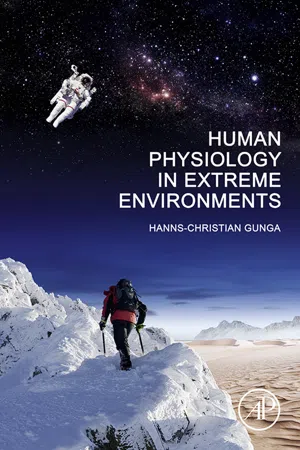 eBook - ePub
- Hanns-Christian Gunga(Author)
- 2014(Publication Date)
- Academic Press(Publisher)
This chapter differs distinctly from the previous and the following ones. We decided to use this chapter on Cold Environments to report on research of our own working group on extreme environments, which is currently ongoing in the Arctic and Antarctic regions. We intended to illustrate on one hand the extraordinary human capabilities to live and work in extreme environments, and on the other hand, we thought it might be of interest to the reader to participate, at least in one chapter, in such ongoing research studies.6.1 Introduction
Cold Environments are environments in which the ambient temperature of the atmosphere is close to or below 0 °C. There are four main types of cold environment: polar, high mountain, glacial, and periglacial, the latter mainly represented by the Arctic and Antarctic regions that receive less intensive solar radiation because the sun’s light hits the earth at an oblique angle, that is, spreading over a larger area and passing through the earth’s atmosphere in a longer distance. Thus the energy gets absorbed, scattered, and reflected. The present-day global distribution of these four environments is shown in Figure 6.1 [1 ].Figure 6.1 The different polar regions of the earth,created from [1 ].Usually the Arctic region is defined as north of 60° north latitude, or the region from the north pole south of the timberline; the Antarctic is defined as south of 60° south latitude. About 10% of the earth’s land surface is covered by ice today. Antarctica accounts for 85% of the total and Greenland for 10%; the rest is comprised of vast periglacial regions in Russia and Canada. These regions are characterized by low-growing tundra vegetation and permanently frozen soils. Extremely cold conditions can also be found in the mountain regions, such as the Himalayas, Andes, and Rocky Mountains. In the past, as mentioned in chapter 1 , large parts of the Earth were covered with ice, and only about 20,000 years ago, the United States and northern Europe were covered with an extremely large ice shield. Today, in Antarctica and Siberia, extremely low temperatures can be observed in winter, sometimes reaching below − 70 °C. Antarctica and northern polar regions are very dry environments with relatively low amounts of precipitation (i.e. snow accumulation). Periglacial eBook - ePub
- Martin Beniston(Author)
- 2016(Publication Date)
- Routledge(Publisher)
2 Characterization of mountain environments 2.0 Chapter summaryThis chapter provides an overview of different aspects of physical and human systems in mountain regions as they are perceived today. There is a strong bias towards climate and atmospheric processes, because climate is one of the dominant environmental controls on natural systems in mountains. Climate determines to a large degree the amount and timing of runoff in the main hydrological basins of the world; it plays a key role in snow and ice formation; and it exerts a major influence on the distribution of plant species and ecosystems, both altitudinally and latitudinally. The major interactions between mountains and climate, from the global down to the local scales, are reviewed; there is a subsequent overview of specific issues related to mountain hydrology, cryosphere, soils and vegetation, as well as the interlinks between all these systems.Problems related to the human presence in mountains and uplands, in both the developed and the developing world, are discussed towards the end of the chapter. Issues of health, tourism and resource use are also addressed. Distinctions are made for the level of economic activity taking place in different mountain regions of the world, as well as the environmental impacts which these imply.2.1 ClimateClimate is the principal factor governing the natural environment on short time scales (as against plate tectonics, which is responsible for the formation of mountains). Climate characterizes the location and intensity of biological, physical and chemical processes. It is for this reason that a large part of the present chapter will be devoted to the climatic component of the environment. Mountain climates consist of four major factors (Barry, 1994), which will be addressed in the following subsections, namely:• continentality • latitude • altitude • topography. 2.1.1 ContinentalityContinentality refers to the proximity of a particular region to an ocean. The diurnal and annual ranges of temperatures in a maritime climate are markedly less than in regions far removed from the oceans; this is essentially due to the large thermal capacity of the sea, which warms and cools far less rapidly than land. Because the ocean represents a large source of moisture, there is also more precipitation in a maritime climate than in a continental one, provided the dominant wind direction is onshore. Examples of maritime mountain climates include the Cascade Ranges in Oregon and Washington States of the USA, the Alaskan coastal mountains, the New Zealand Alps, the Norwegian Alps and the southern Chilean Andes. Mountains under the dominant influence of continentaltype climates include the Tibetan Plateau, the mountains of Central Asia (Pamir, Tien Shan, the Urals) and the Rocky Mountains in Colorado, Wyoming and Montana. However, many other mountain regions often define and separate climatic regions; for example, the European Alps act as a boundary between Mediterranean-type climates and Atlantic and continental climates to the north. eBook - ePub
- Andrew Palmer, Ken Croasdale(Authors)
- 2012(Publication Date)
- WSPC(Publisher)
Chapter TwoThe Physical and Biological Environment
2.1 Climate
The Arctic covers a vast area, and has many diverse environments. Almost every physical environment found in other parts of the world can also be identified in the Arctic, where there are high mountains and featureless plains, deserts and rolling hills, cliffs, great rivers and huge deltas. It would make no more sense to think of a single undifferentiated ‘Arctic’ Environment' than it would to think of a single ‘tropical’ Environment.One factor is climate, and climate too is diverse. Table 2.1 lists a series of Arctic places, and the temperature and wind at each place on December 8 2008 (morning in the eastern hemisphere, evening in the western hemisphere). Obviously another day and another year would be different, and the table is no more than a snapshot that does not replace the detailed and careful statistical work carried out by climatologists. Websites [1 ,2 ] give almost immediate information. Recall that the distances are immense: at 60°N, 10 degrees of longitude correspond to 556 km on the ground going east or west, so that many of these places are thousands of km apart.Several striking features emerge. The northernmost places are not the coldest. Oymyakon is below the Arctic Circle, far to the south of many places along the Arctic Ocean coast, but it has the lowest temperature in the list, and is reputedly the coldest continuously-inhabited place in the world, a distinction it took over from Verkhoyansk when its weather station was moved to the airport, which lies in a frost hollow. The diamond-mining centre of Mirnyi has almost as low a temperature.Pevek in Chukhotka is further north but much warmer. Similarly in Alaska, Fairbanks too is below the Arctic Circle, but its temperature is lower than Barrow on the Arctic Ocean. Places like Mirnyi and Fairbanks have continental climates with warm summers and extremely cold winters, whereas near the ocean the climate is moderated by the ocean, which has a large thermal inertia and can relatively exchange heat with the air. eBook - ePub
- Colin K. Ballantyne(Author)
- 2017(Publication Date)
- Wiley-Blackwell(Publisher)
2 Periglacial Environments2.1 Introduction
As outlined in Chapter 1 , the geographical extent of present‐day periglacial activity is not easily defined, but here we adopt the view that the present periglacial realm encompasses all unglacierized regions where frozen ground and/or freezing and thawing of the ground significantly influences landform development. The present operation of frost‐action processes and the distribution of resultant landforms thus define the extent of the periglacial domain. The driving influence on frost action is climate, which represents the primary control not only on the distribution of permafrost and the depth of seasonal ground freezing and thawing, but also on the frequency of ground‐level freeze‐thaw events, the depth of winter snowcover, the seasonal availability of liquid water in the upper levels of the ground, the runoff regime of rivers and the propensity for erosion and deposition of sediment by strong winds. At a more local level, however, the effects of climate on ground temperature and geomorphological processes are modulated by vegetation cover and substrate characteristics. This chapter sets the scene for analysis of the processes operating in periglacial environments by outlining the characteristics of periglacial climates and briefly summarizing those of soils and vegetation cover in Cold Environments.2.2 Periglacial Climates
No single climatic parameter adequately defines the limit of periglacial climates, though French (2007) suggested that this can be approximated by a mean annual air temperature (MAAT) of +3 °C. This is a useful criterion that encompasses not only the polar, subpolar and high‐altitude regions of the Earth, but also areas of shallow seasonal ground freezing. Classification of periglacial climates is inevitably rather arbitrary, as boundaries between climatic zones are gradational, and even within particular areas there may be marked climatic variation relating to such factors as altitude, slope aspect and distance from the coast. French (2007) employed a fourfold classification of periglacial climates (high arctic, continental interiors, alpine and climates with low annual temperature range) and identified two areas (the Qinghai‐Tibet Plateau and Antarctica) that do not fall readily into any of his classes. A similar but modified approach is adopted here. Note that precipitation figures cited here and illustrated in Figures 2.3 –2.5 eBook - PDF
- Chenghai Wang(Author)
- 2023(Publication Date)
- Wiley-Blackwell(Publisher)
195 Climatology in Cold Regions, First Edition. Chenghai Wang. © 2023 John Wiley & Sons, Inc. Published 2023 by John Wiley & Sons, Inc. In the past few decades, global temperature have risen rapidly. In this context, climate changes in cold regions are more significant, which threaten the vulnerable human living and ecological environment in cold regions. Under global warming, changes of climate in cold regions occurred in both histori- cal periods and future periods. This chapter will discuss the climate changes in cold regions, including historical changes in the past few decades and the projected changes for the next 50–100 years. 10.1 Climate Change in Cold Regions in the Past Decades Global surface temperatures have generally been warming for the entire length of the instrumental record. The most significant and highest warming occurred in recent decades. The most up-to-date consensus from global climate models predicts warming during the boreal winter. The linear trends of January surface air temperature show increases in most of regions (Figure 10.1). Changes of surface air temperature will greatly affect the thermal state of the cryosphere components (such as permafrost, snow, etc.). Recent climatic changes are pronounced in permafrost regions. Since 1980, the Arctic has been warming at approximately twice the global rate. The strongest tempera- ture changes (~1°C decade −1 ) occur in winter and spring, and the smallest changes occur in autumn (IPCC 2013). The Tibetan Plateau (TP) has the largest extent of high-altitude frozen ground at middle and low latitudes in the northern hemisphere (NH) and is surrounded by dozens of seasonally frozen ground. Rising air temperatures have resulted in frozen ground degradation over the TP since the last century. Based on the daily frozen soil depth, annual mean daily minimum air temperatures and annual mean air temperatures obtained from 19 in situ observations in the TP for the period of 1960–2019, Wang et al. eBook - PDF
- James Petersen, Dorothy Sack, Robert Gabler, , James Petersen, James Petersen, Dorothy Sack, Robert Gabler(Authors)
- 2021(Publication Date)
- Cengage Learning EMEA(Publisher)
All Rights Reserved. May not be copied, scanned, or duplicated, in whole or in part. Due to electronic rights, some third party content may be suppressed from the eBook and/or eChapter(s). Editorial review has deemed that any suppressed content does not materially affect the overall learning experience. Cengage Learning reserves the right to remove additional content at any time if subsequent rights restrictions require it. 280 C H A P T E R 1 0 • M I D L A T I T U D E , P O L A R , A N D H I G H L A N D C L I M A T E R E G I O N S Tundra climates are named after the treeless low-growing vegetation that survives in these difficult forbidding environments. It consists of lichens, mosses, sedges, flowering herbaceous plants, small shrubs, and grasses (● Fig. 10.24). 10-3b Ice-Sheet Climate The ice-sheet climate (EF) is the Earth’s most severe and restric- tive climate. As Table 10.3 indicates, it covers large areas in the Northern and Southern Hemispheres, about 20% of Earth’s land area. Every month averages below freezing, and most of the land is covered with glaciers. Antarctica is Earth’s the coldest place, although Siberia has more severe periods of cold in winter. The world’s coldest tem- perature, −89.28C (−128.68F) however, was recorded at Vostok, Antarctica. Climographs for the Amundsen-Scott South Pole Station, and Eismitte, Greenland, present the cold temperature regimes and the dryness of ice-sheet climates (● Fig. 10.25). The primary reason for the continually low temperatures of ice-sheet climates is the minimal effective solar radiation that these regions receive. Not only is little or no insolation received during half of the year, during the other half of the year the sun’s rays arrive at sharply oblique angles. In addition, the high albedo of the perpetual snow and ice cover reflects away much of the incoming solar radiation. An additional factor in both Greenland and Antarctica is elevation. eBook - ePub
- Denis Mercier(Author)
- 2021(Publication Date)
- Wiley-ISTE(Publisher)
6 Spatial Impacts of Climate Change on Periglacial Environments Denis MERCIER1 and Etienne COSSART2 1 Sorbonne University, Paris, France 2 Jean Moulin University Lyon 3, France6.1. Introduction
Periglacial environments now represent 25% of the Earth’s surface, of which 13 to 18% is permafrost, in the high latitudes of both hemispheres and in the mountains and highlands of the mid and low latitudes (Ballantyne 2018).In the context of current climate change, knowledge of periglacial processes and the degradation of permafrost are challenges for a global understanding of our planet, the consequences of which do not solely affect periglacial areas. According to Ballantyne (2018, p. 371):“The battle to limit global change has barely begun, but periglacial environments are in the front line of a conflict that will affect humanity and ecosystems throughout the world.”Spatial Impacts of Climate Change, coordinated by Denis Mercier. © ISTE Ltd 2021.6.1.1. Definition of periglacialFigure 6.1 . Vertical profile of permafrost. The active layer (gray) thaws each summer and refreezes in winter when air temperatures become negative. The temperature of the permafrost (in blue) remains constantly < 0°C. Dotted line represents the mean annual ground surface temperature (MAGST). For a color version of this figure, see www.iste.co.uk/mercier/climate.zip(source: based on Ravanel 2010)The term periglacial is composed of the Greek prefix peri, meaning around, and glacial derived from the Latin glacies, meaning ice. The term was proposed in 1909 by the Polish geologist Walery Lozinski. It refers to processes that are mainly driven by the alternation of freezing and thawing in rocks and soils (gelifraction, gellifluxion, geliturbation). The term also includes the shapes created by these same processes, such as cones and scree slopes, stone circles, pingos, palsas, etc. The term periglacial is more widely used to refer to Cold Environments in which these processes associated with the freeze-thawing of soils and rocks are predominant (French 2017; Ballantyne 2018). Although etymologically the term means “around glaciers”, periglacial environments may be geographically hundreds or thousands of kilometers away from the nearest glacier, such as in Canada, Alaska, or northern Eurasia. These periglacial spaces are characterized by low temperatures and are often associated with areas of permafrost. The term permafrost refers to ground or rocky outcrops that have a negative temperature for at least two consecutive years. The presence of permafrost fundamentally influences periglacial processes and surface shaping by providing an impermeable barrier and high subsurface moisture during the melting season, allowing freeze-thaw processes to develop within the active layer that is typically 0.5 to 2 m thick (see Figure 6.1 eBook - ePub
- Antoinette Mannion(Author)
- 2002(Publication Date)
- Routledge(Publisher)
7 Environmental change in high latitudes (latitudes 60–90°N and 60–90°S)7.1 Introduction
Whilst the last 3×10⁶ years have been characterised by a dynamic environment globally, high latitudes have been particularly severely affected because they have experienced the direct impact of glacial advance. As is demonstrated by ocean-sediment records (Chapter 3 ), there were many cold stages during the last 3×10⁶ years, possibly as many as fifty. Consequently high latitude regions, i.e. those regions north of 60°N and south of 60°S were actively glaciated for numerous periods, each lasting c. 100K years. Today, the high Arctic and Antarctic zones are experiencing glaciation and thus provide modern analogues against which to assess past processes and conditions.Most of the evidence for high-latitude environmental change derives from the Northern Hemisphere. This is because of the greater extent of land area compared with the same latitudes in the Southern Hemisphere. Moreover, research on glacial deposits and processes traditionally has been most intense in Northern Hemisphere countries (Section 1.2 ). In recent years, however, ocean-sediment cores from the Southern Ocean have contributed to the current understanding of environmental change in the region. In combination with ice-core data from the Antarctic (Chapter 4 ), and increasing evidence from a variety of sources in southern Argentina and Chile, it is becoming possible to reconstruct some of the detail of environmental change.Indeed, in both the Northern and Southern hemispheres the most complete record of environmental change is present in ocean sediments, with data from ice cores augmenting this record and, in some cases, notably the Greenland ice cores, creating considerable controversy. This is itself beneficial because it promotes research and calls results into question. It should also be noted that research in high latitudes is particularly important because of the predicted high susceptibility of such regions to global warming. Examining the impact of past periods of warming (and cooling) will contribute to the refinement of predictive models, and thus facilitate future planning. eBook - PDF
The Russian Cold
Histories of Ice, Frost, and Snow
- Julia Herzberg, Andreas Renner, Ingrid Schierle, Julia Herzberg, Andreas Renner, Ingrid Schierle(Authors)
- 2021(Publication Date)
- Berghahn Books(Publisher)
As well as giving an overview of general climatic conditions, the chapter gives a detailed analysis of the radiation and thermal conditions of the summer period; atmospheric circulation in the warm months and associated phenomena such as wind, humidity, and precipitation; and an account of the climatic regime in the winter half of the year. In later studies of the subarctic belt, which compared this belt with other belts, the subarctic was defined as a region of excessive moisture supply in the environment and a low radiation balance (see table 4.1). In other words, there is insuffi cient heat to evaporate the moisture available. In Grigor’ev’s view, this explained the entire character of the physical environment. Chapters 3 and 4 are devoted to a discussion of hydro-geomorphological processes (notably, the effects of permafrost on hydro-geomorphological pro-cesses, the regimes of rivers and lakes, erosion and denudation, and micro-relief) and soil-formation processes. Soils are, of course, essential to vegeta-tion, but in cold, northern environments their evolution from ahumic soils (little more than fine rock debris in the simplest cases) to humic or organic soils may take hundreds or even thousands of years, inhibited by cold, per-mafrost, ground ice, and other factors. The character of these soils naturally restricts the kinds of vegetation that they can support. Chapter 5, which runs to thirty pages, considers the vegetation of the sub-arctic or tundra. Tundra soils usually contain relatively little organic matter and are characterized by low levels of biological activity. Tundra vegetation 104 Denis J. B. Shaw develops during the limited period of the absence of snow cover and typically consists of mosses, lichens, and, in the south, bushes and stunted trees. The principal feature of the landscapes of the subarctic is the fact that the region lies north of the tree line. eBook - ePub
Coastal Problems
Geomorphology, Ecology and Society at the Coast
- Heather Viles, Tom Spencer(Authors)
- 2014(Publication Date)
- Routledge(Publisher)
Chapter Seven COLD COASTS: PERMAFROST, GLACIERS, SEA ICE AND FJORDS IntroductionCold coasts may be defined as those ‘where there is or has been abundant sea ice, lake ice, water-terminating glaciers or deeply frozen ground’ (Taylor and McCann, 1983, after Nichols, 1961). These various types of ice exert a major control on the morphodynamics of cold coasts, which stretch from Antarctica to the fjord coast of New Zealand and Patagonia in the southern hemisphere, and from the fjord coast of Scandinavia, the Maine coast on the eastern side of North America and Vancouver Island on the west, up to the northern shores of Russia, Greenland, Canada and Alaska in the northern hemisphere (Fig. 7.1 ). Ice is not, of course, ever-present on these shores, as there are temporal variations in sea ice cover, permafrost depths and glacial extent, and furthermore other ‘normal’ shore processes operate here, but it is ice which makes these coasts unique.There are key differences between the Arctic and Antarctic areas, in terms of the arrangement of land and sea, which have important ramifications for their coastal environments. The Arctic Ocean is fringed by wide continental shelves, backed by generally low-lying terrain. Conversely, the ice-covered Antarctic continent is fringed by relatively thin continental shelves and surrounded by a large ocean. The Antarctic terrestrial ecosystem has been described as very poor (in terms of species diversity, nutrient levels and primary productivity) whereas the marine system seems very rich. Conversely, in the Arctic the terrestrial ecosystem is rich and the marine system poor (Sugden, 1982). Many workers have started to question such simple statements, however, finding that marine primary productivity is more variable and perhaps overall less high in the Antarctic waters than previously thought (Knox, 1983).Fig. 7.1 Present day world distribution of cold coasts. After Williams et al. (1991) and Syvitski et al
Index pages curate the most relevant extracts from our library of academic textbooks. They’ve been created using an in-house natural language model (NLM), each adding context and meaning to key research topics.

