History

Notting Hill Riots
The Notting Hill Riots were a series of racially motivated clashes that occurred in London, England, in 1958. Sparked by growing tensions between white and black communities, the riots resulted in violence, property damage, and numerous injuries. The events prompted a national conversation about race relations and immigration in post-war Britain.
Written by Perlego with AI-assistance
Related key terms
1 of 5
11 Key excerpts on "Notting Hill Riots"
 eBook - PDF
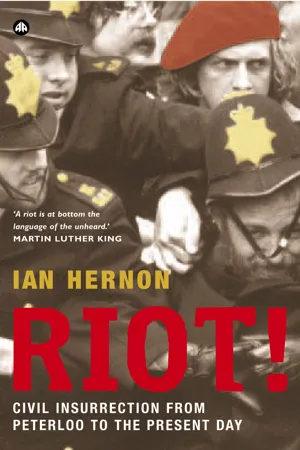
Riot!
Civil Insurrection From Peterloo to the Present Day
- Ian Hernon(Author)
- 2006(Publication Date)
- Pluto Press(Publisher)
16 The Notting Hill Race Riots ‘We were not prepared to go down like dying dogs’ Notting Hill was the setting for a series of running battles in which a generation of immigrants, proud to be British but aggrieved at being confronted with blatant bigotry, fought back against the sons of the Blackshirts. In doing so the mainly Afro-Caribbean minority regained some of their pride but faced a backlash, both in the streets and in the legislature, which would have profound effects on future generations. In the context of this book, the riots were also an example of politically motivated hooliganism failing in the short term but succeeding in its wider aim of inciting racial hatred and imposing immigration controls. * * * Britain’s major ports have had ethnic populations for centuries. The trades in slaves and other commodities linked the nation to the Caribbean, West Africa and India, while the nineteenth century saw an influx of Africans, Arabs, Chinese and other diverse peoples who worked the great trade ships and, later, the liners. Inevitably there were violent clashes – in 1910 Cardiff’s Chinese community was attacked – but they were relatively rare. Britain’s first major modern race riots erupted in the immediate aftermath of the First World War. During that global conflict lascars increasingly found work ashore due to manpower shortages. The return of servicemen at the war’s end, the competition for jobs, housing and women, and a decline in the merchant shipping 170 THE NOTTING HILL RACE RIOTS 171 industry all contributed to heightened tensions. Shipping companies increased them by recruiting firemen and stokers in colonial ports at cheap rates. In South Shields the town’s black population increased fourfold during the war as West Indian and West African seamen joined an established community of Somali and Arab seafarers. Violence erupted in January 1919 when a number of Arabs, who had just paid their £2 stamp to clear their union book, were refused work.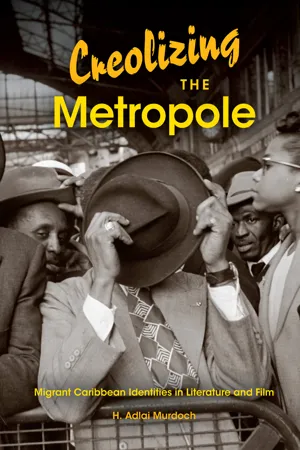 eBook - ePub
Creolizing the Metropole
Migrant Caribbean Identities in Literature and Film
- H. Adlai Murdoch(Author)
- 2012(Publication Date)
- Indiana University Press(Publisher)
Empire Windrush in 1948 brought 492 West Indian passengers to British shores. Within this postwar framework of population shift and its related encounters, ethnoculture arguably became the preferred site of identitarian contestation. The diasporic conditions propelled and instigated by migration produced a series of hyphenated, cross-cultural simulacra that mirrored the fissures and conflicts that were increasingly characteristic of modern urban Britain. These numbers engendered the transformation of such neighborhoods as Brixton, Shepherd’s Bush, and Notting Hill into veritable centers of West Indian peoples and cultures, and coincided with the instantiation of London’s now emblematic West Indian Carnival. It came into being in early 1959 as an attempt at cementing cultures and fostering integration and pluralism following the infamous Notting Hill Riots of the previous year, and it was reinaugurated on August Bank Holiday in 1965. As the size and influence of this concatenation of music, dance, and mas’ grew, its public articulation of the cultures of black-dominated neighborhoods became paradigmatic of that critical intersection of tradition, identity, and performance that lends continuity to West Indian communities wherever they implant themselves. However, the riots themselves, which took place over the weekend of August Bank Holiday 1958, were preceded by a period of growing social resentment at the rapidly increasing numbers of people of color, and particularly people of West Indian origin, in specific areas of London. Many of them chose to settle in the area now known as Notting Hill, today one of the city’s most gentrified, sought-after, and expensive neighborhoods, but one which was an impoverished, lower-class slum in the late 1950s. Chronic housing shortages and outright rejections of West Indians and other black renters were exacerbated by overt patterns of racism and segregation. It was not uncommon to see signs in the windows of rooming houses that read, “No blacks, no Irish, no dogs,” and leaflets and wall slogans urged “Keep Britain White.” As a result, large numbers of migrants were crowded into filthy, insanitary spaces, often sleeping six or more to a room, in grim conditions that were often worse than those in which they had lived back home, and were the culmination of a vicious circle driven by the pervasive housing shortage that was itself catalyzed by segregated rental practices.Time and space do not permit me to provide an in-depth analysis of the Notting Hill Riots themselves; others eminently more qualified have done so far more effectively than I can, and in any event they serve mainly as a historical precursor providing cultural background to the exegetical readings of this study. As ignorance of foreign cultures apparently led the credulous to believe that the hovel-like existence forced on the migrants was their natural state, increasingly pervasive patterns of British racial discrimination – arguably a response to integrative practices such as interracial relationships and rentals, the patronizing by blacks and other migrants of bars and pubs, and the absorption of immigrants into the labor pool with its concomitant accusations of jobstealing – led to ever-larger crowds of West Indian males, often from as far away as Brixton, arriving nightly in Notting Hill to defend their increasingly vulnerable brothers and sisters from gangs of so-called Teddy Boys, who were becoming increasingly open about their aggressive intentions toward anyone who was black. Caribbean cafés were smashed, and increasing numbers of individuals were harassed. On the morning of 24 August, nine white youths, engaging in what they called “nigger-hunting,” assaulted five black men in Shepherd’s Bush and Notting Hill, injuring three. The 29 August 2008 issue of the Independent eBook - PDF
- Stuart Hall, Paul Gilroy, Ruth Wilson Gilmore(Authors)
- 2021(Publication Date)
- Duke University Press Books(Publisher)
But here—looking lat-erally—it is important to note that the Notting Hill Riots have a double his-tory. They are part of the history of emergent racism: but they are also part of the moral panic of the mid-1950s about the antisocial attitudes of youth in an “affluent” and materialist world. If the presence of blacks within the area itself touched the sources of public anxiety about competition over scarce urban resources, the spectacle of black and white youths, locked in confron-tation around the tube station and backstreets of North Kensington, fed into those deep and troubled anxieties about the rapid process of postwar social change—a process for which “Youth” had come to stand as a vivid cultural symbol. In a famous editorial, the Times mapped the Notting Hill events directly into hooliganism, teenage violence, lawlessness and anarchy. These together with the football spectator and the railway carriage wrecker—“All are manifestations of a strand of our social behavior that an adult society can do without” (our emphasis). The editorial was not headed “ ‘Race Riot’ in Notting Hill.” It was entitled “Hooliganism Is Hooliganism.” Nevertheless, as the economic downturn began in earnest, Britain introduced—in 1962— the first Commonwealth Immigration Act, imposing controls on the “flow of immigrants.” The second turning point is 1964. By now, the economic boom had tapered of, and the classes which have to be addressed about these growing material 62 | chapteR 4 problems—which in the 1950s had been defined as never again likely to appear—are no longer runaway Teddy Boys, but adult white workers and their families. The location of the new turning point in the emergence of postwar racism, therefore, takes place, not in the decaying “colony” of a tran-sitional zone like Notting Hill, but in the very heartland of the traditional and conservative nation: Smethwick. eBook - ePub
The Policing of Protest, Disorder and International Terrorism in the UK since 1945
Britain in Comparative Perspective Since 1945
- Peter Joyce(Author)
- 2017(Publication Date)
- Palgrave Macmillan(Publisher)
1983 : 142), and the fact that black people who were involved were mainly youths who had been born in Britain and adhered to many facets of British cultural behaviour.The initial emphasis which was placed on the link between race and riotous behaviour subsequently gave way to a more general critique of the moral values of young people as an explanation for events which by the 1990s occurred in white as well as in multi-ethnic areas. Social unrest was attributed to their personal shortcomings such as the loss of respect for authority, greed or drug abuse.Timeline of Key Events
Notting Hill Race Riots, 1958
These events consisted of a series of racially motivated attacks instigated by ‘teddy boys’ directed at African-Caribbeans in August and September in an area in which right wing extremist groups (the Union Movement and White Defence League) were active. Violence of this nature initially occurred in Nottingham and then spread to London, being triggered by an assault on a white woman by her Black husband which led to bystanders intervening from which the violence subsequently escalated.A key issue was the perceived lack of police indifference to preventing the violence, which caused the black community (including many from Brixton) to mobilise to defend itself, some of whom were then arrested for carrying offensive weapons. This perception soured the relationship between the black community and the police for many future decades. However, a number of arrests of white participants were made and nine white youths received 5 years’ imprisonment for their involvement in the disorder – an exemplary sentence that was designed to prevent further outbreaks of this nature. eBook - PDF
Violent London
2000 Years of Riots, Rebels and Revolts
- C. Bloom(Author)
- 2010(Publication Date)
- Palgrave Macmillan(Publisher)
Of course they walked in gangs, wouldn’t you? 2 From 1955 settlers were also arriving from India, Pakistan and other areas known as the ‘New Commonwealth’. In all, Indian immi- gration rose from 5,800 to 19,050 by 1962 and Pakistani immigration from just under 2,000 to over 25,000. In the same period 18,000 immigrants arrived from other areas and these included white fami- lies. Concentration of immigrant groups, especially those made up of single men in poor areas and in a limited number of bed-sits and run-down houses, soon attracted unwelcome attention from white neighbours and teenage gangs. Jamaican and Barbadian clubs and restaurants were often obvious and conspicuous. Nevertheless, the rioting that broke out in Notting Hill, West London, in 1958 was entirely manufactured by white racist groups and not a spontane- ous reaction of disgruntled locals. The Notting Hill Riots occurred over a number of days in August 1958: Colin Jordan’s White Defence League (WDL) had joined with elements of John Bean’s National Labour Party (NLP) and Oswald Mosley’s Union Movement. Their actions were coordinated from Arnold Leese House in Notting Hill (now Jordan’s headquarters). The result of the alliance was not only the terrorization of local black people but also the death of Kelso Cochrane, who was murdered a year later. Bean’s NLP and Jordan’s WDL eventually came together to form the original British National The Tiber Flowing with Much Blood 353 Party (BNP) and, alongside other elements, these again merged to form the National Front in 1967. Despite the violence that flared during 1958, most of Notting Hill’s black residents were determined to make a go of things in London and create an atmosphere which echoed that which they had left in Trinidad and Barbados.* The concept of the Notting Hill Carnival turned a little piece of grey rundown west London into a colour- ful facsimile of Georgetown. eBook - ePub
White Working-Class Voices
Multiculturalism, Community-Building and Change
- Beider, Harris, Harris Beider(Authors)
- 2015(Publication Date)
- Policy Press(Publisher)
Government interventions to legislate on even more restrictive immigration controls has often been justified as responding to popular concerns (Small and Solomos, 2006; Tomlinson, 2013). In some cases, the white working class is viewed as being in direct conflict with newly arrived immigrants or the implications of multiculturalism. For example, the 2001 riots involved British-Asian and white working-class communities in Burnley, Oldham and Bradford, where the latter were seen as being concerned about the supposedly favourable treatment given to minorities by local government in contrast to the lack of investment and support in white working-class neighbourhoods (Home Office, 2001). The theme of a micro-clash of civilisations is repeated in local and national narratives (Rex and Tomlinson, 1979; Ford and Goodwin, 2014).The role of the white working class as active and racist participants may be illustrated by three momentous events that shaped the discussion and policy responses in race relations in Britain: the 1958 Notting Hill race riots, the 1964 Smethwick election and the 1969 ‘Rivers of Blood’ speech made by Enoch Powell.Today, Notting Hill is viewed as one of the most sought-after neighbourhoods in London. It is a diverse place in a global city that has become known for celebrating cultural difference through the Carnival that takes place each year during August Bank Holiday weekend. Its current depiction as a desirable, ethnically diverse and harmonious community has not always been the case. Back in the post-war period, the contrast could not have been sharper. The area was a warren of poor-quality private-sector housing maintained by slum landlords such as Peter Rachman, whose actions – Rachmanism– became synonymous with poor-quality housing, minimal housing rights and threats of violence in order to ensure that tenants either moved out or paid their rent despite the deplorable conditions. The availability of cheap housing made Notting Hill a popular choice for migrants, especially from the Caribbean, who as colonial subjects, and in accordance with the Nationality Act 1948, had free movement to the UK in order to seek work in a fast-growing economy (Joshi and Carter, 1984; Solomos, 2003). eBook - ePub
The Other Special Relationship
Race, Rights, and Riots in Britain and the United States
- R. Kelley, S. Tuck, R. Kelley, S. Tuck(Authors)
- 2016(Publication Date)
- Palgrave Macmillan(Publisher)
The Afro-Caribbeans were hardly London’s first immigrant community, but they were the first for whom skin color was most distinctive point of difference. Awareness of US precedents engendered a concern that race would become the explanatory variable for any friction caused by the arrival of a new population with unfamiliar customs and attitudes. Initial reaction to Notting Hill was therefore characterized by a strained insistence that the events had not been primarily racially motivated. At an LCSS conference on West Indian integration in October 1958 the social anthropologist Sheila Patterson insisted that it would beerroneous, and indeed harmful, to compare the British situation with that of South Africa or the Southern States, where the colour bar has for generations been fixed in law, custom and the way of thinking of each individual inhabitant.Drawing on her fieldwork in Brixton, she argued that the problems were those of immigration rather than race, and that “the new West Indian migrants to Britain are passing through the same kinds of process in their relationships with the local population as do all other working-class economic migrants—the same processes as the Puerto Ricans in New York, the East European Jews in London’s East End in the last century, or the Poles, Balts and Southern Irish in Britain since the end of the war . . . If all visible differences were expunged, we should still be facing precisely the same problems of social and cultural differences and frictions.” In a statement as revealing of her fears as of her beliefs, she suggested that “if we label it as a colour or racial situation now, or allow others to do so, we are half-way to making it into one.”20The belief that racial tension reflected a wider malaise in the inner city was exemplified by the report of the Special Committee appointed by the Mayor of Kensington shortly after the 1958 riots. The disturbances were attributed to ingrained social problems characteristic not merely of inner London, but of Notting Hill in particular. “Many social workers,” it concluded, “are . . . of the opinion that the ‘racial riots’ were merely one symptom of the serious social disintegration which has existed in this district for a long time,” namely mental health problems, a high suicide rate, juvenile delinquency (“there has been extensive adolescent violence—not by any means exclusively against coloured people”), problem families, etc.21 Similarly, Ivy Harrison, the social worker appointed by the neighboring Metropolitan Borough of Paddington to work with the area’s black community, argued that working-class hostility to blacks in her borough “appears to be largely due to material problems rather than innate prejudice.”22 It followed, of course, that the underlying problems should be addressed—the Kensington Special Committee called for “the immediate development of a combined sociological and social welfare operation” in the area23 eBook - ePub
Attack on London
Disaster, Rebellion, Riot, Terror & War
- Jonathan Oates(Author)
- 2009(Publication Date)
- Pen & Sword(Publisher)
Despite earlier ministerial complacency, the government was forced to act. After the initial considerations of law and order had been addressed, politicians discussed the issues that lay behind the rioting with representatives from the Commonwealth, in order to preserve Britain’s image abroad. In 1962 an Act was passed to limit the number of immigrants to those who were skilled workers or who had a secure job in the UK. Though criticised by the Labour opposition, this Act was popular with the majority of the white population, including the trade unions. A more interventionist approach was taken in 1965 with the creation of the Race Relations Board and subsequent legislation to outlaw discrimination.The Notting Hill Riots were not the last ‘race’ riots in London — there were others at Deptford, Southall, Brixton and the Broadwater Farm Estate in the late 1970s and early 1980s. These tended to be much larger and often more violent affairs, in which people were killed. Yet they also concerned the hostility of youths of all races towards the police, and some were also explicitly political — the National Front’s supporters came up against extreme left-wing groups. In 1966 the Notting Hill Carnival — now an annual celebration of Caribbean culture — was instituted, so at least something positive came out of the violence of 1958.But race riots were not the only form of trouble to erupt on London’s streets in the later twentieth century. Although terrorism was not born in the twentieth century, it did become increasingly prominent in the world after 1945. Terror is a tactic employed by a movement or force frustrated by conventional politics, which cannot take to the field and fight a conventional war against its adversaries. Terrorists seek to destabilise a state by attacking the civilian population or ‘soft’ military targets. Capital cities are particularly tempting to terrorists: the potential for physical and collateral damage is high, as is the publicity value generated by atrocities. Another terrorist aim is to invite extreme countermeasures by the state so the latter will alienate itself from its people. A senior policeman, Sir David McNee, wrote:
- Michael Rowe(Author)
- 2017(Publication Date)
- Routledge(Publisher)
Much of the recent literature discussing the disorders of 1958–59 ignores an important and interesting kind of response which involved the establishment of voluntary groups intending to promote ‘racial tolerance’ and integration (Fryer, 1984; Miles, 1984; Pilkington, 1988; Solomos, 1993). On the surface, it appears that these initiatives were based upon different assumptions to those implied in many of the arguments above, because they were more sympathetic to the position of the black victims of the disturbances. Such initiatives were reinforced by the statements condemning racial discrimination that were issued by various bodies, including the Labour Party, the British Council of Churches, the Conservative Commonwealth Council. The ‘Keep Britain Tolerant’ (Glass, 1960) groups varied in their membership and longevity, with many of them apparently fading as soon as the initial violence waned. The local authority for the Notting Hill area appointed a black social worker and the Mayor established a ‘Racial Integration Coordinating Committee’ consisting of representatives of various local organisations and members of the public with ‘the general, rather vague purpose of promoting harmony in the borough’ (Glass, 1960: 195). As a direct result of the disorders, the British-Caribbean Association was established in order to develop ‘friendship and understanding’ between the peoples of the Caribbean and Britain.Although apparently divergent from the more common arguments outlined in earlier sections, the operations of these groups were based upon a similar model of ‘race relations’ which assumed that racial discrimination was a ‘real’ phenomenon — arising from cultural differences and misunderstanding. Educational initiatives, in the broadest sense, could enlighten those sections of the white population whose ignorance led to antipathy towards ‘strangers’. Forty years later many of the initiatives seem naive and patronising to all concerned and they certainly failed to consider the structural and ideological nature of racism. Other objections were raised at the time. Malik (1968: 79) recalled with some incredulity how:As a result of the trouble, Notting Hill gained official recognition as a problem area and sociologists, professional and amateur, began to flood the area, together with their cohorts of students, titled ladies and do-gooding young middle-aged women. They literally came in droves — all of them terribly well-intentioned, quite clueless and full of questions. They all wanted to do something for the poor, unfortunate residents of Notting Hill and they were desperate to meet us.The objections raised by others assumed that the initiatives would be unlikely to succeed. Glass (1960: 197) cited an interview with Councillor Olive Wilson, reported in the Kensington News on 30 October 1958. Under the headline WILL TOO MANY DO-GOODERS PAVE THE PATH TO NOTTING HELL eBook - ePub
- Suman Gupta, Satnam Virdee, Suman Gupta, Satnam Virdee(Authors)
- 2020(Publication Date)
- Routledge(Publisher)
Policing the Crisis (Hall etal.1978),race and policing issues have commonly been interconnected as a site of crisis in academic analyses. Rioting in the U.K. in the early 1980s deepened that nexus, and for many years this has been a prism through which most riots or violent disorder has been understood (Benyon and Solomos 1987;Keith 1993; Smith 2013).By understood I am referring not to media commentary or to public debate, although it may also occur there, but to academic and scholarly coverage of events in the 1980s and since that has made racialization a predominant approach to think through disorder and policing (Holdaway 1996; Keith 1993; Rowe 1998). The racial connection of the 2011 riots as primarily another instance of this history is due to its perceived echoes of events from the 1970s and 1980s when there were riots at the Notting Hill Carnival, and then in various inner cities, most notably Brixton in 1981 (Scarman 1981) and Brixton and Broadwater Farm in 1985 (Gifford 1986). In this vein, riots became an episodic but familiar part of the British landscape that made them an archetypal form of protest or mobilization associated with race issues and racial minorities. Yet, while the 2011 riots seem to speak to this history (Smith 2013), some interpretive frames can also erase race in curious ways, and the 2011 events are notable for the scholarly expression of a counter-view in which the riots were treated as marking a crisis of “post-politics” and in which race and racism are given no or very limited significance.In setting these out as two prominent “ways of seeing” (Berger 1972), my purpose is threefold. First, to highlight how events are captured for particular ends in critical scholarship, either as a sign of continuing racism policing or of the state of politics. Those ends are not illegitimate and they may even account for some aspects of riots, but their explanatory overreach is a problem. They lack specificity to times and places as they attempt to “shoehorn” disparate events into somewhat singular frames, which itself signals the limits of these accounts.The sources included here appear in conventional academic publications such as books and journal articles; it also draws official reports, blog posts and social media. In Hammersley’s (2014) terms, they are explanations, and go beyond description, because they infer or claim to know the causes of rioting. My aim is not to offer a counter-narrative of what “really happened” in August 2011; timelines and a sense of how events unfolded are available in Morrell et al. (2011) and the Riots, Communities and Victims Panel report (2012). Second, while riots are often not amenable to any comprehensive account, their “critical” framing often does not allow for qualifiers or explanatory limits. This is about more than language and terminology. Rioting, as a set of messy and dispersed events in which the agency and identity of actors are disputed, lends itself to this argument,but it is also evident in thewaysthatraceis made significant. Even where race is centred, it is done in a way that lends weight to some kinds of connections while obscuring others, as I will show later. Third, I suggest that this argument may bear a wider claim about what is “a” or “the” crisis. What if instead of seeing the events as a “race crisis” or a “post-political crisis” it was called something else, for instance, a “legitimacy crisis”? The intended echo of Habermas (1975) here is instructive. Habermas’ concern with tendencies of capitalist and liberal welfare states perhaps matters less here than his more general invocation of a legitimation crisis as a decline in or loss of confidence in the administrative and leadership capabilities of the state.Viewed in this light,riots and protests may be thought of as small instances that reflect failures of policing and of politics, though in a different manner to the accounts of the events to be discussed. eBook - ePub
Windrush (1948) and Rivers of Blood (1968)
Legacy and Assessment
- Trevor Harris(Author)
- 2019(Publication Date)
- Routledge(Publisher)
Empire Windrush docked in 1948 it carried inside it the seeds of a new Britain. Windrush would herald a new multicoloured and multifaceted world of fashion, music, food and, most importantly, people. However, in the decade that followed Windrush, there would also be an open political resistance to this fledgling multicultural society. Political organisations openly hostile to Caribbean immigration began to organise, in particular, Oswald Mosley’s Union Movement (UM) and the newly formed White Defence League (WDL). Both organisations established their headquarters in Notting Hill, West London, and began sustained campaigning, the culmination of which saw two events place immigration at the forefront of British politics: the Notting Hill Riots of 1958 and the General Election of 1959. The purpose of this chapter is to examine these events and the role played by the far-right inside them. It is also to introduce to the reader an important political and cultural opposition to the far-right, a hitherto “lost history” of anti-racist struggle in British history. It examines the Stars Campaign for Interracial Friendship (SCIF), an anti-racist/-fascist organisation of musicians and celebrities that grew out of the ashes of the Notting Hill Riots of 1958. SCIF’s sole purpose was to use the music of its members to counteract the racism of Oswald Mosley’s Union Movement and Colin Jordan’s White Defence League. This chapter will deal solely with SCIF, but is the first part of a wider work that will examine the relationship between music and anti-fascism in post-World War II Britain. My research will go on to compare and contrast the three main organisations that have sought to marry music and a political opposition to racism. These organisations are SCIF in the 1950s, Rock Against Racism (RAR) in the 1970s and Love Music Hate Racism (LMHR), active from 2002 to the present day.In the summer of 1958 riots broke out on the streets of Nottingham and Notting Hill. Like all riots, at their origin were many complicated social, economic and political factors that had contributed to their eruption. Against a backdrop of slum housing, “concerns” over employment and interracial marriage was a nascent racism against the newly arrived Afro-Caribbean and Asian communities. However, the riots did not follow the same narrative in Nottingham and Notting Hill, so what was different? Why did the violence in Nottingham not escalate and what was the response to the rioting in Notting Hill?Windrush arrivesBritain has always been a multi-racial society – sometimes seen and sometimes hidden. As the possessor of the largest empire in history, a slave-trader par excellence and with London for centuries the financial capital of the world, the movement and exchange of cultures and peoples were inevitable. There has been a black community in London for five hundred years; Liverpool has housed the biggest Chinese community outside China since the 1850s; Bristol has records of a slave or freed slave enclave for some four hundred years; and following the arrival of the East India Company in the Indian sub-continent, there has been an Asian presence in the United Kingdom since the early seventeenth century. As Britain impacted upon the world, so the world affected change on her. Revolutionary upheavals in Europe, the collapse of rival empires and war all contributed to the ever-changing ingredients that became modern Britain.
Index pages curate the most relevant extracts from our library of academic textbooks. They’ve been created using an in-house natural language model (NLM), each adding context and meaning to key research topics.

