Politics & International Relations

Claudia Jones
Claudia Jones was a Trinidadian-American political activist, journalist, and community leader. She is best known for her work in founding the Notting Hill Carnival in London and for her activism in the Communist Party USA. Jones was a strong advocate for the rights of Black women and is considered a pioneer in the intersectional feminist movement.
Written by Perlego with AI-assistance
Related key terms
1 of 5

2 Key excerpts on "Claudia Jones"
 eBook - PDF
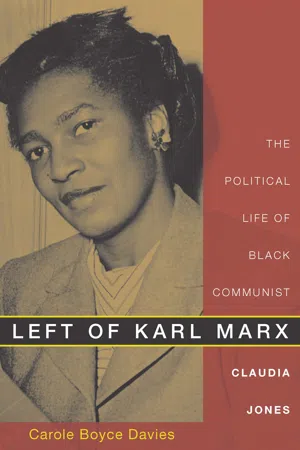
Left of Karl Marx
The Political Life of Black Communist Claudia Jones
- Carole Boyce Davies(Author)
- 2008(Publication Date)
- Duke University Press Books(Publisher)
In this re-gard, her ideas, as this book argues, have significant implications for contem-porary articulations of transnational African diaspora/feminist politics. Recovering Claudia Jones for the Caribbean Claudia Jones was in effect a ‘‘sister outsider,’’ as Audre Lorde ≥π described herself in a variety of discourses, and she definitely remains a sister outside the Caribbean intellectual-radical tradition. The fact is that she is not well known in the Caribbean, just as she is also not remembered in the United States. This, we can say, is the result of emigrating from Trinidad to the United States as a child, and then being deported as an adult from the United States to the United Kingdom. But this lack of recognition is also related to the fact that women are not generally assigned importance as intellectual subjects, for she was sufficiently known in London, as was her compatriot C. L. R. James and many other writers who would be subsequently hailed as contributors from the United Kingdom to Caribbean politics and culture. One of the purposes of this book is to challenge the status quo in which Claudia Jones escapes a certain belonging in Caribbean feminist history and the larger Ca-ribbean intellectual and political genealogy as well. The tendency has until recently been to identify only the men in this tradition, beginning with the early pan-Africanists and continuing up to our contemporaries. ≥∫ The particular process of recovery, for Claudia Jones, has meant beginning at the end: in London, the place where she spent the last ten years of her life and, paradoxically, the place where she is still best known. This period of her life began in 1955, when she was deported from the United States under the Smith and McCarran-Walter Acts for being a thinking and practicing com-munist. eBook - PDF
We Shall Be Free!
Black Communist Protests in Seven Voices
- Walter T. Howard(Author)
- 2012(Publication Date)
- Temple University Press(Publisher)
Claudia Jones Claudia Jones (1915–1964) was a protean radical historical figure who should be remembered as a Black Nationalist, a political activist, a radical journalist, and an important American Communist. Histori-cal opinion is coming around to the point of view that Jones is at least important as her friend Elizabeth Gurley Flynn in the history of Ameri-can radicalism. Born in the West Indies (Trinidad), Jones moved to New York City as a child, where she suffered a uniquely American poverty and oppres-sion that only an African American woman can understand. She used her native intelligence and highly developed social conscience to articu-late a response to this state of affairs. ■ ■ ■ The Struggle for Peace in the United States (1952) Excerpt from Carole Boyce Davies, ed., Claudia Jones—Beyond Containment: Autobiography, Poetry, Essays (Banbury, UK: Ayebia Clarke, 2011). President Truman, in his capacity as chief political servitor of US imperialism, once again proposed, in his recent State of the Union Message to Congress, a criminal crusade of force and violence 142 ■ Claudia Jones against the vast majority of the human race. Truman, though dema-gogically prattling on about peace, glorified Wall Street’s aggressive expansionism which is now flagrantly directed against the colored peoples of Asia and Africa and proposed an unrestrained arma-ments race. Mr. Truman cynically boasted of the colossal size of US imperi-alism’s armed strength, and its pile of A-bombs. By way of perspec-tive for peace, he urged even more intensive arming to be accom-panied by further cuts in consumer goods output and in real wages. While he lectured the people about the need for “sacrifice,” in a year marked by the largest total profits in the history of American capitalism, he proposed an additional five billion in new taxes.
Index pages curate the most relevant extracts from our library of academic textbooks. They’ve been created using an in-house natural language model (NLM), each adding context and meaning to key research topics.

