History

Scopes Trial
The Scopes Trial, also known as the "Monkey Trial," was a highly publicized legal case in 1925 in which a high school teacher, John Scopes, was accused of violating Tennessee's Butler Act by teaching evolution in a public school. The trial became a symbol of the clash between modernism and traditionalism in American society, and it highlighted the debate over the teaching of evolution in schools.
Written by Perlego with AI-assistance
Related key terms
1 of 5

11 Key excerpts on "Scopes Trial"
 eBook - ePub
Trying Biology
The Scopes Trial, Textbooks, and the Antievolution Movement in American Schools
- Adam R. Shapiro(Author)
- 2013(Publication Date)
- University of Chicago Press(Publisher)
10 The consequences of his doing so have become legendary. Scopes volunteered to be tried in a test case meant to challenge the validity of a new antievolution law enacted by Tennessee in March 1925. He was indicted and convicted and became a symbol of the (perceived) ongoing warfare between science and religion. He was hailed by some as a martyr, compared to the likes of Socrates and Galileo. Often linked to the epithet Monkey Trial, the name Scopes also became a label of derision employed by those who saw evolution as an irreligious and immoral doctrine.The Scopes Trial is one of the best-known events in the history of science and religion in the United States. Subsequent trials concerning the teaching of evolution have been referred to as “Scopes II,” and even court cases in other countries have been compared to Scopes. The trial’s fame stems in part from the participation of two men—the acclaimed attorney Clarence Darrow and the prominent politician William Jennings Bryan. Their debate over the truth of the Bible and its relation to science captivated the country and was reported throughout the world. Because of this spectacle, this misdemeanor trial in a rural county seat in Tennessee has often been referred to as one of “the trials of the [twentieth] century.”11 In the twenty-first century, interest in the trial has shown no sign of waning. Evolution, and its presence in schools, has become even more politically polarized and more deeply connected to claims of conflict between science and religion than it was in the 1920s. The Scopes Trial introduced new ways of thinking about science and religion and their roles in public life throughout the United States and even across the globe.12 eBook - PDF
- David C. Lindberg, Ronald L. Numbers, David C. Lindberg, Ronald L. Numbers(Authors)
- 2008(Publication Date)
- University of Chicago Press(Publisher)
The Scopes Trial in History and Legend Edward J. Larson he Scopes Trial may be the most famous encounter between sci-ence and religion to have occurred on American soil. It took place in , soon after Tennessee enacted a statute forbidding public school teachers to instruct students about the theory of human evolution. The new law attracted national attention, with some conservative re-ligious leaders praising it but many mainstream cultural leaders scorn-ing it. Interest soon focused on the small Tennessee town of Dayton, where a local science teacher named John T. Scopes accepted the in-vitation of the American Civil Liberties Union to challenge the new law in court. As this young teacher (backed by the nation’s scienti fi c, educational, and cultural establishment) stood against the forces of fundamentalist religious lawmaking, the news media promptly pro-claimed the encounter “the trial of the century.” The trial gained attention in part because it captured so many of the contradictions that characterize America. In the eighteenth cen-tury, the United States had become the fi rst modern nation o ffi cially to separate church and state—and yet this trial involved a state stat-ute that linked church and state by seeking to conform public ed-ucation to religious belief. During the nineteenth century, American cultural leaders had generally embraced a civil religion that endorsed Protestant Christian norms and values for society and public educa-tion—and yet in this case the cultural elite turned against Tennes-see for placing the biblical story of Creation above the established scienti fi c theory of evolution. By the twentieth century, the United States had risen to the forefront in scienti fi c research, especially in the biological sciences— and yet the enactment of the Tennessee statute suggested that signi fi cant politi-cal support existed for accepting religion over science on a matter central to mod-ern biology. eBook - PDF
- Christopher L. Eisgruber, Lawrence G. Sager(Authors)
- 2009(Publication Date)
- Harvard University Press(Publisher)
. V . the scopes monkey trial of 1925 is an iconic event in American legal history. Arranged as a test case, and pitting Clarence Darrow against William Jennings Bryan, it resulted in the conviction of John Scopes, who had been charged with the crime of teaching evolution. The trial was a media sensation when it occurred and later became the basis for a successful drama and film, Inherit the Wind. 1 More than eighty years have passed since the Scopes Trial, yet the controversy about teaching evolution in the public schools is still raging. In 2005 a Pennsylvania court created a media sensation by prohibiting a school district from teaching “intelligent design” alongside evolution as a theory of human origins, one more acceptable to those who accepted the biblical ac-count of Genesis. 2 During the year preceding the court’s decision, both President George W. Bush and Senate Majority Leader Bill Frist en-dorsed the teaching of intelligent design, the Kansas Board of Educa-tion adopted standards designed to accommodate the intelligent de-sign position, and science teachers in some school districts reported that they avoided mentioning evolution in their classrooms out of fear that they might incur the wrath of school officials. 3 Deep and durable as controversies concerning religion and the pub-159 lic school curriculum have proven to be, questions about school prayer have provoked more intense passions. Prayer exercises are near the core of religious experience for many Americans, and they touch a very sensitive constitutional nerve. The Supreme Court’s decisions banning official prayer in public schools have been the focus of sus-tained and bitter criticism. Together, prayer and religiously inflected curricular prescriptions have made America’s public schools the roiled site of sustained constitutional concern and contentious disagreement. 4 Throughout, the Supreme Court has been remarkably firm and con-stant. eBook - ePub
Darwin and the Bible
The Cultural Confrontation
- Richard H. Robbins, Mark Nathan Cohen(Authors)
- 2015(Publication Date)
- Routledge(Publisher)
Ronald Numbers (1998) points out, in spite of hundreds of scholarly studies of the antievolution movement, Christian fundamentalism, and, most of all, the role of William Jennings Bryan, the Scopes Trial remains, as he put it, “a grotesquely misunderstood event” (p. 76).Any discussion of the trial must focus on the role of Bryan. He led the campaign against Darwinism, and, although he didn’t demand that evolution not be taught, he stipulated that it should be as theory only, and that the story of creation in Genesis be taught with it. Yet if the Scopes Trial remains grotesquely misunderstood, Bryan’s views have been even more greatly distorted (see Kazin, 2006 ). As I’ll try to demonstrate, Bryan not only had some sound arguments to make, but his views on politics, religion, and science still have relevance today.The facts of what led up to the Scopes Trial are relatively straightforward. In January of 1925, the Tennessee legislature voted 71 to 5 to make it unlawful for public schools “to teach any theory that denies the story of the Divine Creation of man as taught in the Bible, and to teach instead that man has descended from a lower order of animals.” Violation of the law carried a fine of $100 to $500. The Tennessee legislature was not the first to take up the issue; Oklahoma had already adopted a law prohibiting textbooks that promoted evolution, and Florida had condemned the teaching of Darwinism as “improper and subversive” (Numbers, 1998 , pp. 77–78).The American Civil Liberties Union (ACLU), alarmed over government restrictions placed on individual freedoms during and after World War I, wanted to use the Tennessee law to highlight the constitutional right to freedom of speech. It advertised for someone to violate the Tennessee law, promising to defend him or her in court and pay the expenses of the prosecution. In Dayton, Tennessee, citizens of the town, concerned about the economic decline of their community, convinced John Scopes to be a test case, hoping that the publicity of the trial would help revitalize the town’s economy. In one of the many ironies of the case, Scopes was not a biology teacher; he had been hired to coach the football and basketball team and teach algebra and physics. He substituted in a biology class, but, in fact, couldn’t actually remember whether or not he had mentioned evolution, although students testified that he had (see Larson, 1997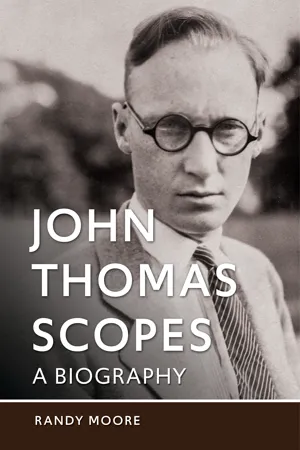 eBook - ePub
John Thomas Scopes
A Biography
- Randy Moore(Author)
- 2023(Publication Date)
- Bloomsbury Academic(Publisher)
The jury in this court heard only the evidence of two school boys who were put on the stand by the prosecution. The expert testimony of scientists, which the jury was not allowed to hear, will be in the records that will be taken before the upper courts, and will enable us to overturn this verdict.If the higher courts of Tennessee decide against us, the fight will be taken to the Supreme Court of the United States. Defeat will not be admitted unless the highest court of the land goes against us. We will stay by the ship and every possible interest will be fought out bitterly. Success is ultimately with us.10In many newspapers, Scopes’s article was positioned beside a photo of yawning chimpanzee Jo Mendi, under the headline “Monkey Yawns; Glad Trial’s Over.”11In the August 1925 issue of the Forum, Scopes published another article, titled “Understanding through Conflict” (Appendix 3 ). Scopes claimed that his trial was “not a case to determine the outcome of the fight between science and religion. It is not to decide whether this country will be fundamentalist or liberal in its religious views. It is not to see if the State has the right to dictate to the schools what is to be taught. It is not to determine whether we have religious tolerance or not. . . . Any institution that lasts through ages must, ever so often, be cleansed of the reactionary principles that it acquires.” He then challenged Bryan’s argument that the public should control the school curriculum:Whether a state can regulate the exact things that are taught in the schools or not is a useless question to discuss. They may have the power, but who would ever expect a state to exercise such authority? The school system was created to educate the youth of the country. Education means broadening. If the state is now going to dictate what is taught, why do they not set down a table of hard facts for each pupil to learn so that every one that attends our schools will be of one mind and one thought? How far could we progress under such an educational system? If that is to be the only thing to come out of the evolution trial, why not dissolve the schools? For they will have lost their use. eBook - PDF
The Taming of Free Speech
America’s Civil Liberties Compromise
- Laura Weinrib(Author)
- 2016(Publication Date)
- Harvard University Press(Publisher)
146 I F THERE is a single case that defines the interwar ACLU in the popular imagination, it is State of Tennessee v. John Thomas Scopes. In the summer of 1925, iconoclastic attorney Clarence Darrow sparred with populist hero and three-time Democratic presidential nominee William Jennings Bryan over the legal status of the Tennessee antievolution law that Bryan himself had inspired. Their dramatic showdown in the other-wise unremarkable town of Dayton, Tennessee, pitted (said observers) sci-ence against sectarianism and freedom against forced conformity. Journal-ists, historians, even playwrights and screenwriters have masterfully told the story of the Scopes “monkey trial,” to borrow H. L. Mencken’s colorful coinage. None of them, however, fashioned the narrative of the trial more deliberately than the ACLU itself. 1 The Scopes Trial was many things to many people. To John T. Scopes, the affable young teacher turned national celebrity who accepted the ACLU’s invitation to challenge the law, it was an entrée to exclusive social circles and grist for a budding flirtation with radical causes. To Bryan, who con-sidered religion the foundation of morality, it was a capstone in a decades- long crusade against the pernicious effects of social Darwinism, “the merciless law by which the strong crowd out and kill off the weak.” To Mencken, the journalist and scathing social critic who sensationalized the trial, it was a chance to lampoon southerners and humiliate Bryan. And to Darrow, who took the case pro bono, it was a grand stage for exposing the “absurdities” of the Bible. Many years after the McNamara bombing trial, Darrow still believed that Americans clung to Christianity because it was 5 The New Battleground The New Battleground ✦ 147 “cheaper to pay workingmen in religious dope” than in decent wages. “Christianity functions as a sop to keep people satisfied, and almost nothing else,” he explained.
- Intelligent Education(Author)
- 2020(Publication Date)
- Influence Publishers(Publisher)
THE SCOPES MONKEY TRIAL INTRODUCTIONIn the summer of 1925, as American prosperity under President Calvin Coolidge attempted to erase bitter memories of World War I, the attention of the American people and of much of the world was drawn to a sleepy Tennessee town where a schoolteacher by the name of John T. Scopes had volunteered to test the newly enacted Butler Act, a law which forbade the teaching of evolution in the state’s public schools. For Jerome Lawrence and Robert E. Lee the trial served as the genesis of Inherit the Wind. It is hoped that an understanding of the events which preceded the trial, of the major participants who gathered at Dayton, and of the trial itself will aid the student in his appreciation of the play, his knowledge of this particular period in American history, and his role as an individual in a society where the freedom of speech can never be taken for granted.The text of the Butler Act follows:The Butler ActAn Act prohibiting the teaching of the Evolution Theory in all the Universities, Normals and all other public schools of Tennessee, which are supported in whole or in part by the public school funds of the State, and to provide penalties for the violation thereof.Section 1. Be It Enacted By The General Assembly Of The State Of Tennessee, That it shall be unlawful for any teacher in any of the Universities, Normals and all other public schools of the state which are supported in whole or in part by the public school funds of the State, to teach any theory that denies the story of the Divine Creation of man as taught in the Bible, and to teach instead that man has descended from a lower order of animals.Bible, and to teach instead that man has descended from a lower order of animals.Section 2. Be It Further Enacted, That any teacher found guilty of the violation of this Act, shall be guilty of a misdemeanor and upon conviction, shall be fined not less than One Hundred ($100.00) Dollars nor more than Five Hundred ($500.00) Dollars for each offense.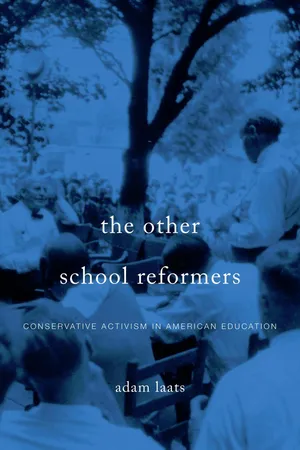 eBook - ePub
The Other School Reformers
Conservative Activism in American Education
- Adam Laats(Author)
- 2015(Publication Date)
- Harvard University Press(Publisher)
CHAPTER TWOMonkeys, Morality, and Modern America
Conservative Educational Activism in the Scopes Era
No one at the trial that day went home disappointed. As the world-famous antagonists squared off on the outdoor platform, trading gibes and taunts, the crowd laughed, shouted, and applauded. They had come to see a big show, and they got one.There had been some doubts in their minds that this much-ballyhooed “Trial of the Century” would live up to its name. So far, the audience had heard a few terrific speeches, but they had also sat through hour after hour of technical discourse on the nature of science and religion. They had endured long hot days of monotonous recited statements. Judge John T. Raulston had moved the trial outside, to mitigate the July heat and to relieve some of the pressure on the overloaded courtroom floors. Workers had built a wooden platform adjoining the courthouse, under the shade of Dayton’s cottonwood trees. Under those trees on this seventh day of the trial, they witnessed a once-in-a-lifetime confrontation that made little legal sense, but a world of dramatic sense.1Clarence Darrow, the 1920s embodiment of skepticism and modern doubt, planned to interrogate William Jennings Bryan, the personification of traditional Presbyterian public religion. Darrow appeared for the defense, Bryan for the prosecution. In a regular court case, there would be no reason for defense lawyers to go head-to-head with prosecutors on the witness stand. But this was no ordinary case. Beyond the carnival streets of Dayton, Tennessee, the rest of the nation and the world also watched this trial with bated breath. One sociologist at the time guessed that the newspaper output from the trial would have filled almost a million pages.2 Film crews appeared as well, as did what the Chicago Tribune called the world’s first radio broadcast of the event.3Clarence Darrow (standing with hands in galluses) confronts William Jennings Bryan on the witness stand. (Courtesy Smithsonian Institution Archives, image SIA2007–0124) eBook - PDF
The Creation/Evolution Controversy
A Battle for Cultural Power
- Kary D. Smout(Author)
- 1998(Publication Date)
- Praeger(Publisher)
However, these implications were not borne out in any detail. Religious historians such as Ferenc Morton Szasz point out that in fact, the antievolution campaign was even more active after Bryan’s death. Fundamentalism clearly did not disappear, but only regrouped. 61 Several studies have also shown that high school biology textbooks significantly lessened their emphasis on evolution after the trial because of the strength of public opinion against it. 62 Edward Larson concludes: “The bewildering disparity in opinion about the impact of Scopes on the antievolution movement ... highlights the unexpected resilience of this cause despite its pounding at Dayton.’’ 63 The Scopes Trial began to seem important again in the early 1950s, after the onset of McCarthyism and the Cold War. As a result of increasing political upheaval and suspicion during this time, a new outpouring of scholarly work attempted to make sense of the 1925 trial. What to many had seemed an aberration in American history now began to look like the repetition of a pattern; many scholars wanted to explain what they took as a new outbreak of irrationality by understanding the outbreak of thirty years ago. The most influential representation of the Scopes Trial produced during this time period was the play Inherit the Wind by Jerome Lawrence and Robert E. Lee. The publishing history of the play was directly influenced by its political milieu. After twelve years of intermittent research and writing, Lawrence and Lee finished drafting the play in 1950, but they decided not to publish it at that time because, as Lee told a reporter who interviewed them in 1955, “the intellectual climate was not right.” 64 In February 1950 Senator Joseph McCarthy had begun his anticommunist campaign with a famous speech denouncing 205 communists he claimed were working for the State Department. eBook - ePub
Christianity’s Role in United States Global Health and Development Policy
To Transfer the Empire of the World
- John Blevins(Author)
- 2018(Publication Date)
- Routledge(Publisher)
See Noah Adams, Timeline: Remembering the Scopes Monkey Trial, on All Things Considered (radio news show, Washington, DC, 5 July 2005). The audio recording of the piece can be found at www.npr.org/2005/07/05/4723956/timeline-remembering-the-scopes-monkey-trial and the transcript at www.npr.org/templates/transcript/transcript.php?storyId=4723956 , accessed February 10, 2018.Ms. REED: It belittled our town. They showed all of the ugliness that they could get into it to make it look like a little bitty borough or something, you know. It was the way they portrayed us because we didn’t believe in the theory, or maybe not that, but we didn’t want it taught. We didn’t care. We didn’t give a hoot whether they taught it in the school or not. That’s all right. They couldn’t make the people ‘round here believe it.45 Matthew Tontonoz, “The Scopes Monkey Trial Revisited: Social Darwinism Versus Social Gospel,” in Science as Culture 17, no. 2 (2008): 121–143. Bryan never made the closing argument at the trial. Darrow was afraid that he would be bested by Bryan’s rhetorical skills and so he did not offer a closing argument. As a result, Bryan was not permitted to offer one either. The text of his argument was published in the New York Times on July 29, 1925 following Bryan’s unexpected death.46 Andrew Nolan, “Making Modern Men: The Scopes Trial, Masculinity and Modern Progress in the 1920s United States,” in Gender and History 19, no. 1 (2007): 129.47 Fishburn, pp. 220–225.48 Ron Chernow, Titan: The Life of John D. Rockefeller, Sr. (New York: Vintage, 1998), 52–53.49 Ibid., p. 189.50 Ibid.51 Ida M. Tarbell, “John D. Rockefeller: A Character Study,” in McClures 25, no. 3 (1905): 233.52 John Steele Gordon, “John D. Rockefeller Sr.” Philanthropy Roundtable: Strengthening our Free Society, accessed February 16, 2018. www.philanthropyroundtable.org/almanac/hall_of_fame/john_d._rockefeller_sr eBook - PDF
- Charles J. Russo, Charles Russo(Authors)
- 2008(Publication Date)
- SAGE Publications, Inc(Publisher)
It was bitterly fought before a partisan crowd of what H. L. Mencken of the Baltimore Sun described as “yokels,” a derogatory term for unso-phisticated country folk who made up the town and the jury, one member of which was illiterate. The Scopes defense team set up a dense battery of prominent scientists regarding the efficacy of the theory of evolution. However, the prosecution suc-ceeded in overcoming this plan by showing that the trial was not about the theory of evolution, but rather was a simple question of whether Scopes had violated the Butler Act. After Judge John T. Raulston ruled that expert testimony on evolution was inadmissible, many considered the trial to be over and began to leave town. What then occurred propelled the Scopes Trial into infamy. The defense team called William Jennings Bryan to the stand as an expert on the Bible. While his prosecutorial colleagues strenuously objected, Bryan succumbed to the lure of being a defender of the faith before the cross-examination skills of his legal nemesis Clarence Darrow, whose agnosticism was widely known. What then ensued was a clash of legal titans in a set piece battle that has subsequently become the verbiage of Broadway plays and Hollywood celluloid. Darrow walked, weaved, and sucker-punched Bryan through the Biblical story of Jonah and the whale, the fable of Joshua making Scopes Monkey Trial ——— 743 the sun stand still, the unnamed wife of Cain, and into the length of a day in the act of creation set forth in Genesis. In an acerbic courtroom fight in which both exchanged clenched fists at one another, Darrow showed plainly that in the face of textual ambiguity, a reader of the Bible had to interpret what was written, because a literal interpretation was not consistent with what was generally accepted as scientific fact, even by Christian literalists such as Bryan.
Index pages curate the most relevant extracts from our library of academic textbooks. They’ve been created using an in-house natural language model (NLM), each adding context and meaning to key research topics.

