Law

Trials
Trials are formal proceedings in which evidence is presented and legal arguments are made to determine the guilt or innocence of a defendant. They are conducted in front of a judge and/or jury, and the outcome of a trial can result in a verdict and, if applicable, a sentencing. The process is governed by rules of procedure and evidence.
Written by Perlego with AI-assistance
Related key terms
1 of 5
11 Key excerpts on "Trials"
 eBook - PDF
The Trial on Trial: Volume 2
Judgment and Calling to Account
- R A Duff, Lindsay Farmer, Sandra Marshall, Victor Tadros, R A Duff, Lindsay Farmer, Sandra Marshall, Victor Tadros(Authors)
- 2006(Publication Date)
- Hart Publishing(Publisher)
This royal juris-diction was part and parcel of the civil law tradition, of which a written law, professional judges and a trial based on written documents are still central features. The idea that a trial is part of the implementation of the substantive law is—historically—also typical for the civil law tradition, with its emphasis on law as a system of legal rules that pre-exists the trial. However, the trial is currently seen as both a means of identifying a defendant as an offender, and a means to protect defendants against abuse of state powers. The former * I would like to express my thanks to all the participants in the workshops in Glasgow and Stirling (March and September 2005) for their very interesting and challenging interventions, with special thanks to Lindsay Farmer for his written comments. implies much more than a mechanical search for the truth, because it involves censure of the criminal act (calling to account). Further, the most salient aspect of our ‘fair trial’ is the fact that the procedure by which citizens are identified as offenders not only constitutes but also limits the competence of the state in crim-inal matters. In this paper I will speak of the ‘fair trial’ whenever I refer to a trial that embodies this double instrumentality: in the democratic constitutional state a ‘fair trail’ is at the same instance constitutive for and restrictive of the exercise of the ius puniendi . I will argue that even though the inquisitorial inspirations of the ‘fair trial’ in continental Europe differ substantially from the adversarial inspirations in Anglo-American jurisdictions, both can be seen as demonstra-tions of this ‘fair trial’ model. On the basis of a historical and systematic analy-sis of this trial model I will raise a number of questions around the status of the victim in the trial.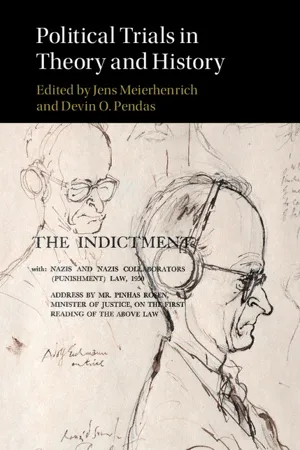 eBook - PDF
- Jens Meierhenrich, Devin O. Pendas(Authors)
- 2017(Publication Date)
- Cambridge University Press(Publisher)
163 Jaconelli, “What Is a Trial?,” p. 24. 164 Frederick Schauer, “Formalism,” Yale Law Journal, Vol. 97 (1988), p. 510. 165 On formality more generally, see Arthur L. Stinchcombe, When Formality Works: Authority and Abstraction in Law and Organizations (Chicago: University of Chicago Press, 2001). See also Robert S. Summers, “The Formal Character of Law,” Cambridge Law Journal, Vol. 51 (1992), pp. 242–262. 166 Feeley, “Trials,” p. 15899. 44 Jens Meierhenrich and Devin O. Pendas procedure concerning the allocation of responsibilities in the trial practices of the common law and the civil law. 167 From a doctrinal perspective, Mirjan Damaska and John Langbein have perhaps done more than most to shed light on the nature and history of the institution of the trial – both civil and criminal – in these legal families. 168 In their long careers, both have been very much aware of the changing character of the trial across space and time. For a comparative historical endeavor such as ours, this insight cannot be overestimated because an important part of the analytical challenge that our contributors faced was to come to terms with the meaning of the trial in the empirical context of their case study. The kind of interpretive scholarship that we encouraged required careful contextual political analysis. 169 If scholars are steeped too deeply in a particular legal tradition, they can lose sight of the fact that the rules governing a courtroom are constitutive in the sense that they not only enshrine what is permissible but also shape the self-understandings of participants in the trial. As Judith Resnik explains, “rules of procedure embody, express, and help create values and attitudes about what constitutes fair decision making by, or through, the powers of the state. Procedure is laced with questions of legal policy and political philosophy.” 170 Simply put, procedure is concerned with the configuration of Trials. eBook - PDF
Criminal Injustice
An Evaluation of the Criminal Justice Process in Britain
- F. Belloni, J. Hodgson(Authors)
- 1999(Publication Date)
- Palgrave Macmillan(Publisher)
8 The Trial Trials and miscarriages of justice: the role of lawyers, magistrates and judges The goal of the trial is to determine whether the accused person is guilty as charged. This requires a decision on the basis of evidence put before the court by the prosecution, and on the countervailing argu- ments of the defence. In the Crown Court, which tries indictable offences, 1 the presiding judge is educated in the law and has acquired considerable trial experience before being appointed to the bench. She regulates the proceedings, determines the admissibility of evidence, and ensures that the trial is conducted fairly. Following presentation of evidence by the prosecution and the response of the defendant, the judge sums up the case and charges a jury (whose members are ran- domly selected 2 ) with the task of determining, on the facts of the case, whether the accused has been proven guilty beyond a reasonable doubt. Proceedings in the magistrates’ courts, where more than 93 per cent of all cases are processed, differ from those in the Crown Court. 3 First, whereas the accused in Crown Court Trials must be present to plead to the indictment, and should normally be in court throughout her trial, summary Trials may take place in the absence of the accused. 4 Secondly, some safeguards for accused which apply to Crown Court Trials do not apply to summary Trials. For example, prosecution disclo- sure is required in Crown Court, but in the magistrates’ courts the accused have no legal right to have the prosecution case disclosed prior to trial; 5 and while Code E, PACE requires that all police station inter- views with persons suspected of indictable offences must be tape- recorded, this does not apply to summary offences. Thirdly, summary 147 court Trials are less formal and more hurried, and the magistrates who process them generally lack formal legal training. 6 Thus they are less schooled in due process rights than judges. eBook - ePub
The Impact of Scientific Evidence on the Criminal Trial
The Case of DNA Evidence
- Oriola Sallavaci(Author)
- 2014(Publication Date)
- Routledge(Publisher)
1 Principles and features of the criminal trialThis study is concerned with the challenges that DNA, as a form of scientific evidence, poses for the traditional features and procedures of the contested English criminal trial, as well as the impact that the latter have on its use for fact-finding purposes. As Damaska observes, there are three pillars upon which the Anglo-American trial and fact-finding style are built.1 These refer to the peculiar organisation of the trial court, the temporal concentration of the proceedings and the prominent role of the parties and their counsel in legal proceedings. These main features, which this research claims are affected by and in turn affect the utilisation of scientific evidence in court, will be reviewed briefly below from a theoretical level. First, a few words are needed about the purpose of the criminal trial, for it is this which shapes its features and procedures.The criminal trial: a search for truth and beyondIt is certainly difficult to give a precise and comprehensive definition of the criminal trial. Starting from a simple and straightforward approach, the criminal trial could be defined as a formal, legal process through which is to be determined whether or not a person is guilty of committing a criminal offence, and thus whether he/she is liable to punishment for it.2 It follows from this definition that an obvious central aim of the criminal trial is to establish the truth about whether the person being tried has committed the alleged offence. This is an important process as it enables the identification of those who, having committed the criminal offence, should be punished. As Duff et al. observe, in this way criminal Trials connect the substantive criminal law to penal law, and enable the state to apply legal sanctions to those on whom they should be imposed.3 Thus the trial could be defined as ‘the institutional device for realising the rule of law where there are disputes of fact’.4 The truth is, in this context, simply instrumental: a means to the proper application of penal sanctions.5 From an instrumentalist perspective, the primary reason for having Trials is to make accurate decisions.6 eBook - PDF
Courts and Trials
A Reference Handbook
- Christopher Smith(Author)
- 2003(Publication Date)
- ABC-CLIO(Publisher)
Are these good methods for making important decisions? The answer to that question depends on the values, beliefs, and goals that underlie the choice of methods. The use of Page 41 Trials is typically based on the desire to make accurate decisions within a framework of fair procedures. In a trial, evidence is presented to and examined by decisionmakers according to an established set of procedures. Depending on the country in which the trial is held, the decisionmaker may be a single judge, a panel of judges, a mixed jury of judges and citizens, or a lay jury of citizens drawn from the community. In developing trial procedures, each country must decide what rules and procedures are necessary for a fair proceeding and a reliable decision. In the United States, for example, criminal proceedings involve preliminary hearings to ensure that sufficient evidence exists to carry a prosecution forward; a period of time for prosecutors and defense attorneys to prepare the evidence that they will present in court (discovery); and then the actual trial, during which each side presents evidence and arguments in front of a decisionmaker. Although the procedures and rules for Trials vary from state to state and country to country, most processes are similar, except as to the roles of lawyers and judges. Most countries that use lawyers and judges in a trial process can be divided into one of two systems: adversary or inquisitorial. The adversary system involves battles between opposing attorneys as the judge listens passively to the presentations, whereas the inquisitorial system requires the judge to take a more active role in investigating the case and examining the evidence. Many people disagree about which approach produces the most reliable decisions in the trial process. The Adversary System In accordance with the tradition of English law, Trials in the United States and other former British colonies are conducted by using an adversary system. eBook - PDF
The Appeals Chamber of the International Criminal Court
Commentary and Digest of Jurisprudence
- Fabricio Guariglia, Ben Batros, Reinhold Gallmetzer, George Mugwanya(Authors)
- 2018(Publication Date)
- Cambridge University Press(Publisher)
62 In addition, the Appeals Chamber held that internationally recognised human rights law does not limit a Trial Chamber’s discretion on the issue, nor does its choice to adopt an adversarial trial structure. The Court’s legal framework combines features of Common Law and Romano-Germanic legal traditions. It includes fair trial guarantees that are not typically found in Common Law procedures, including the Prosecutor’s duty to investigate incriminating and exonerating circumstances equally pursuant to article 54(1)(a), and the Trial Chamber’s duty under article 61(7) to establish whether there are substantial grounds to believe that the person committed the crime prior to referring a case to trial. These safeguards ensure, on the whole, that the accused before the Court receives a fair trial. As such, references to particular national or international systems do not establish that the accused’s rights were violated. 63 Jurisprudence “The ordinary meaning of the word ‘trial’, according to Black’s Law Dictionary, is ‘[a] formal judicial examination of evidence and determina- tion of legal claims in an adversary proceeding’.” Prosecutor v. Bemba, Judgment on the Provisional Release Appeal, ICC- 01/05-01/08-3249-Red, OA11, 20 May 2015, paras. 36–37. “[A] reading of article 58(1)(b)(i) of the Statute in context and in light of its purpose confirms that the word ‘trial’ was intended to cover the entire period of the trial until the final determination of the matter.” Prosecutor v. Bemba, Judgment on the Provisional Release Appeal, ICC- 01/05-01/08-3249-Red, OA11, 20 May 2015, para. 40. 62 Ibid., paras. 46–47. 63 Ibid., paras. 48–56. jurisprudence 319 I Admission of Evidence 1 The Principle of Orality and its Exceptions 1.1 General Considerations “The direct import of the first sentence of this provision [article 69(2)] is that witnesses must appear before the Trial Chamber in person and give their evidence orally. eBook - ePub
- Jeffrey D. Lane(Author)
- 2016(Publication Date)
- Routledge(Publisher)
1West’s Encyclopedia of American Law defines due process of law as:A fundamental, constitutional guarantee that all legal proceedings will be fair and that one will be given notice of the proceedings and an opportunity to be heard (have a hearing) before the government acts to take away one’s life, liberty, or property.2In essence, government must follow certain established procedures that are fair and protect the rights of those accused of violations of law whether it be criminal, civil, or administrative law.2 In his article, “Some Kind of Hearing,” the late judge Henry Friendly cites 10 elements of a fair hearing:1. An unbiased tribunal or decision-maker 2. Notice of the proposed action and the grounds asserted for it 3. An opportunity to present reasons why the proposed action should not be taken 4. The right to call witnesses and cross examine opposing witnesses 5. To know the evidence against them 6. To have the decision based solely on the evidence presented 7. The right to have legal counsel 8. The creation of a record of the proceedings 9. A statement of findings of fact and reasons for the decision10. Judicial review (right to appeal to the courts)3 ,4The provision of required due process is not only relevant to criminal proceedings but it is equally relevant to administrative proceedings to include actions for licensure sanctions. Procedures that guide administrative government agencies in contested administrative cases (such as a licensure disciplinary matter) are codified in what is commonly referred to as an administrative procedure act or administrative practice act eBook - PDF
Justice for the Poor
A Study of Criminal Defence Work
- Debra S. Emmelman(Author)
- 2018(Publication Date)
- Routledge(Publisher)
Although the defense attorney is not legally responsible for proving anything, he or she attempts at the very least to cast doubt onto the prosecutor’s evidence. After the presentation of evidence during a trial, the jury may reach one of several possible types of verdicts. These are 1) that the defendant is guilty of all the criminal counts, 2) that the defendant is not guilty of all the counts, 3) that the defendant is guilty of some and not guilty of other counts, and 4) that they cannot reach a consensus on any or all of the criminal counts and are therefore ‘hung’. It is only in the second instance that the defendant is set completely free. Although certainly there are some major differences among the hearings, there are also some important similarities. Among them, all types of formal hearings involve some type of legal story-telling that leads to a conclusion regarding the defendant’s guilt of crime. In addition, all are structured by similar kinds of background understandings (or story-telling frames of reference) and employ similar types of litigation procedures (or techniques for telling legal stories). The remainder of this section examines these shared dimensions of formal litigation hearings. Taking Cases to Trial 79 Background Understandings: The Story-Telling Frame of Reference A number of sociologists have found that social life is structured by tacit, taken-for-granted background understandings.4 Likewise, formal litigation proceedings are structured by the attorneys’ largely unspoken awareness of the relevant laws and legal procedures for the hearing,5 witnesses’ prior accounts of incidents (or the evidence story which is likely to be told) and common sense. Two sorts of legal codes structure the Defenders’ behavior during court proceedings. These are the law(s) which one of the attorneys is liable to corroborate (e.g., a penal code or Constitutional principle) and rules of evidence. eBook - PDF
The Trial on Trial: Volume 1
Truth and Due Process
- R A Duff, Lindsay Farmer, Sandra Marshall, Victor Tadros, R A Duff, Lindsay Farmer, Sandra Marshall, Victor Tadros(Authors)
- 2004(Publication Date)
- Hart Publishing(Publisher)
12 They have also been critical of the manner in which testimony before the court is elicited by means of examination and cross-examination and of the over-reliance on demeanour evidence. 13 The exclusionary rules of evid-ence associated with the adversary trial have also come in for criticism, even from lawyers themselves. This criticism can be traced as far back as Jeremy Bentham who devoted much energy to a critique of the rules of evidence and a growing number of critics have advocated a freer process of proof at trial whereby all relevant evidence is admitted. 14 In more recent years the trial process has come under the direct scrutiny of actual participants in the legal process—victims of crime, witnesses and police officers—who have been horrified at the way in which their stories have been misrepresented at trial. 15 It is not perhaps surprising that critics have focused so particularly on the criminal trial, even though today only a minority of cases actually end up in trial. Common lawyers have for long identified the guilt determining stage of the trial with the criminal process as a whole. Damaska has pointed out how to this The Function of the Criminal Trial in Legal Inquiry 123 11 P Pringle, ‘We return to Derry under Fire’, The Observer , 24 February 2002. For their account of the events, see P Pringle and P Jacobson, Those are Real Bullets: Bloody Sunday, Derry, 1972 (Berkeley, Grove/Atlantic Inc, 2002). 12 J Marshall, Law and Psychology in Conflict (New York, Anchor/Doubleday, 1969). 13 See, eg J Marshall, K H Marquis and S Oskamp, ‘Effect of Kind of Question and Atmosphere of Interrogation on Accuracy and Completeness of Testimony’ (1971) 84 Harvard Law Review 1620; O G Wellborn III, ‘Demeanor’ (1991) 76 Cornell Law Review 1075. eBook - PDF
Criminal Justice Processes NQF4 SB
TVET FIRST
- M Johnson, J Lotz J van Vuuren(Authors)
- 2019(Publication Date)
- Macmillan(Publisher)
l The court can and must recall witnesses to clear up uncertainties in the interest of justice. Figure 3.13: A witness needs to be questioned in a way that does not upset him or her 3.3.4 Arguments of the public prosecutor and the defence Section 175 of the CPA authorises the public prosecutor to address the court after all the evidence has been adduced. The defence may then also address the court. This address sums up the arguments of the respective parties, expounding how they view the points in dispute after the debate has been concluded. The public prosecutor is expected to present the facts of the case objectively as he or she is still under an obligation to ensure the administration of justice. These addresses may be regarded as a factual summary of the cases of the respective parties, which they have commissioned the court to decide. 3.3.5 Verdict or judgment After the state and the defence have closed their cases and addressed the court, the presiding officer must deliver a verdict of guilty or not guilty. If a verdict of not guilty is delivered, the accused is acquitted. If the accused is found guilty, the investigation into a proper sentence starts. 90 Topic 3 Unit 3.4: The processes of giving evidence in court The purpose of testimony is to provide evidence in accordance with the law of evidence to determine guilt or innocence in a case. The law of evidence may be defined as the rules that regulate the manner in which facts are proved and the admissibility, or not, of evidence. Evidence refers to all the evidential material that is placed before a court which the court considers to determine with objective certainty which version of the issues in dispute can be accepted as the truth. 3.4.1 Evidence Evidence is presented in different forms to the court. 3.4.1.1 Direct evidence Direct evidence refers to the evidence of a person such as an eyewitness who actually observed a fact in issue. eBook - PDF
- Austin Sarat(Author)
- 2009(Publication Date)
- Emerald Group Publishing Limited(Publisher)
The percentage of federal criminal cases going to trial has dropped from 15 percent in 1962 to 5 percent in 2002 ( Galanter, 2004, pp. 492–493 ). Similar trends exist in the state courts. This decline in the number of Trials does not at all mean that the law is a less pervasive institution in American life. Indeed, virtually every other aspect of the legal world has grown: ‘‘there are more statutes, more regulations, more case law, more scholarship, more lawyers, more expenditure in public consciousness’’ ( Galanter, 2004, pp. 522–523 ). Commentators have just begun to try to explain these developments, and these very preliminary explanations have taken quite different forms. Some have noted that there appears to be some convergence between American litigation and continental styles of adjudication. These ‘‘inquisitorial’’ styles do not have a single plenary, oral, and dramatic event like the American trial. Rather they involve an ongoing inquiry in which the presiding magistrate takes the lead. It ends only when that magistrate is satisfied that he or she has enough information and in which searching reexamination at the appellate level is an expected, rather than an extraordinary aspect of the process ( Damaska, 1986 ). I have suggested that these inquisitorial methods may be more appropriate for hierarchically structured ‘‘organic’’ societies ( Burns, 2003a, p. 465 ). Others have suggested that Trials have been replaced by other ‘‘trial-like’’ events such as arbitrations and administrative hearings. These other forms of adjudication are often significantly different from the common law trial. They never employ the lay jury and so do not naturally provide for the centrality of life-world norms in the way that the jury trial does. The judges are professionals and so can ‘‘get used to it’’ in a way that prevents them from seeing the significance of the details of each case. Sometimes they are subject to bureaucratic controls.
Index pages curate the most relevant extracts from our library of academic textbooks. They’ve been created using an in-house natural language model (NLM), each adding context and meaning to key research topics.

