History

Siege of Jerusalem
The Siege of Jerusalem refers to the military campaign in 70 CE when the Roman Empire captured and destroyed the city of Jerusalem, including the Second Temple. This event marked the end of the First Jewish-Roman War and resulted in significant loss of life and the dispersal of Jewish residents. The siege had lasting implications for both Jewish and Roman history.
Written by Perlego with AI-assistance
Related key terms
1 of 5
8 Key excerpts on "Siege of Jerusalem"
 eBook - PDF
Cultural Diversity in the British Middle Ages
Archipelago, Island, England
- J. Cohen(Author)
- 2008(Publication Date)
- Palgrave Macmillan(Publisher)
By presenting the Jews of Jerusalem as resolute soldiers and figuring their military leader Josephus as an ethical instructor to a bru- tal and morally ambiguous imperial army , The Siege of Jerusalem produces a fundamentally ambivalent interrelation of Jew and Christian on a battlefield largely emptied of theological significance. Though The Siege of Jerusalem, , as Ralph Hanna cogently argues, may well speak to the regional traumas of the 1190 siege of Clifford’s Tower and other twelfth-century atrocities in northern England, the focus on Jews as primarily brash defenders and as victims of the cruelties of medieval siege warfare allows the text to recall just as readily the ghosts of Scots, English, and Welsh foot-soldiers fighting just as readily the ghosts of Scots, English, and Welsh foot-soldiers fighting the nation-building wars on the borders of an expanding late medieval England. Through its sympathetic portrayal of Jews decimated by an army that proves to behave in ways incompatible with the Christianity its leaders claim to uphold, The Siege of Jerusalem would seem to find affiliation with alliterative works interested in undermining the legitimacy of brutal, mili- tary expansionism, such as the Alliterative Morte Arthure , which attributes King Arthur’s violent felling by the Wheel of Fortune as judgment due to T H E I N ST RU C T I V E OT H E R W I T H I N 145 his aggressive expansionism. 40 But The Siege of Jerusalem would also link up with the literary figure with which we began. Just as Langland’s Wit depends upon a simultaneous repulsion and admiration of Jews in order to urge contemporaries to revise their own civic behavior, so does the poet of the Siege stoke anti-Semitic tendencies at the same time as he presents Jews in secularized terms as bold, but broken victims of unrestrained militarism. Notes 1. William Langland, The Vision of Piers Plowman, rev. ed., ed. A.V.C. Schmidt (London: J.M. Dent, 1995), l.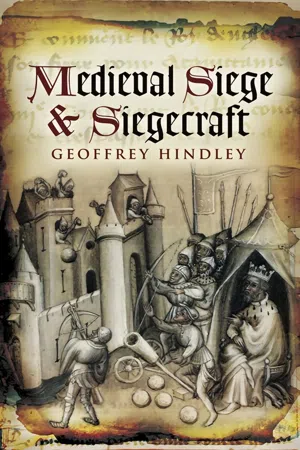 eBook - ePub
- Geoffrey Hindley(Author)
- 2009(Publication Date)
- Pen & Sword History(Publisher)
The extended account of this catastrophe is recorded by a native of Parma, so there may be exaggerations. A few days later, having regrouped his scattered forces, Frederick returned, perhaps to renew the siege. But following a council of war he abandoned the project. The people of Parma had delivered a severe setback to his policy. In far-away England, the monastic historian Matthew Paris heard that the emperor ‘groaned openly as if deeply wounded’.Decisive moments
The chroniclers of the medieval period record many grand sieges, though few as elaborate as the siege described above, in which the prestige of the participants was as important as any military objective in prospect. Time and again an immense army was concentrated to besiege some fortress or walled city even though, as the twentieth-century military analyst Alfred Burne observed, ‘only a limited number of troops could play an effective part in the siege of a town’. For him, such overkill, as we might term it, breached the principle of ‘economy of force’ – a principle that evidently played little part in the plans of the emperor Frederick before Parma.It was his mastery of siegecraft that enabled that more pragmatic monarch, Henry II Plantagenet, King of England and lord of large parts of France, to remain master of his vast domains. In 1161, for example, he took the stronghold of Castillon in Gascony in a matter of days and thoroughly intimidated the local lords so that they dared not take the field against him.A master of siegecraft had to be able to tell, merely by riding round outside the walls of a hostile fortress, whether he could capture it, and, if so, whether the expense of the siege would be worthwhile. In the normal run of things several hostile castles would bar his campaign, and he could attack only one at a time. The defender, by contrast, had to be able to judge to a nicety how long the castle he commanded could hold out against any form of attack, so as to arrange his surrender on terms after the longest possible delay.The Battle of Hastings or Saladin’s victory at Hattin (1187) were, beyond question, key events which (not to labour the metaphor) unlocked developments that can be said to have redirected the course of history in those regions. But there is equally little doubt that the crusaders’ capture of the city of Antioch was as decisive in securing victory in their campaign for Jerusalem as even their brilliant set-piece victory against the odds at Dorylaeum the year before when, in July 1097, they crushed the Turkish army bent on their destruction; while the French capture of Château Gaillard (1204) was epoch-making in a way that even Agincourt could not match. And, in any case, both Hastings and Hattin, being engagements determined by the defence and capture of a hilltop, though both completed within the day and though fought in open terrain, displayed the characteristic feature of the siege, the defence of a strong point. And even at Dorylaeum the action was more in the nature of a siege defence than a battle of manoeuvre: the crusading army, stranded in open desert terrain rather than defending a strong prepared position, it is true, survived only by holding out over a daylong remorseless attack from the Turkish army, rather than by counter-attack. Indeed, it seems that the army’s commanders, having been alerted to the enemy’s presence in the vicinity by their vanguard scouting on ahead, had deliberately taken up something approaching a siege position by pitching camp on a site protected on one flank by marshy ground.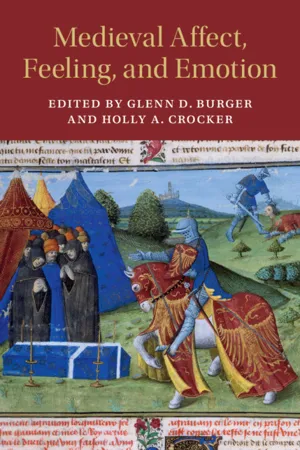 eBook - PDF
- Glenn D. Burger, Holly A. Crocker(Authors)
- 2019(Publication Date)
- Cambridge University Press(Publisher)
chapter 2 Imagining Jewish Affect in the Siege of Jerusalem Patricia DeMarco Written in the last quarter of the fourteenth century, the alliterative poem the Siege of Jerusalem tells the story of the conquest of Jerusalem in AD 70 by the Roman leader Waspasian and his son, Titus, who seek, as newly converted Christians, to avenge Christ’s death by conquering Jerusalem, destroying the temple, and expelling the Jews from the city. In the Prologue to the Siege of Jerusalem, the poet describes the violence done to Christ during the events known collectively as the “Passion”: A pyler pyght was doun upon the playn erthe, His body bonden thereto, and beten with scourgis. Whyppes of quyrboyle by-wente His white sides Til He al on rede blode ran, as rayn in the strete. *** Suth stoked Hym on a stole with styf mannes hondis, Blyndfelled Hym as a be and boffetis Hym raghte: “Gif thou be prophete of pris, prophecie!” they sayde, “Whiche berne here aboute bolled Thee laste?” *** A thrange thornen croune was thraste on His hed, Unbecasten Hym with a cry and on a Croys slowen. 1 Beholding such scenes, late medieval readers were expected to feel – and indeed were guided by writers and artists to feel – powerful emotions. 2 But if graphic depictions of the Crucifixion could be sure to elicit strong emotion, which emotions were evoked – and which subject positions readers were thereby called to inhabit – depended much on context, genre, and audience. 3 Even an apparently simple emotion – compassion – was variously and complexly determined. For instance, devotional litera- ture testifies to complexly differentiated religious postures, especially in the 47 ways in which a reader/viewer imaginatively beholds Christ’s suffering.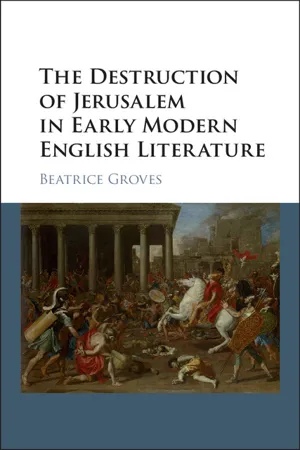
- Beatrice Groves(Author)
- 2015(Publication Date)
- Cambridge University Press(Publisher)
The destruction of Jerusalem is no longer read as a narrative celebrating the military and ideological triumph of Christianity but as a warning about the consequences of sin. Medieval Catholic texts tended to conclude on a triumphant note, as both the Temple treasure and an important new relic (the Vernicle) were relocated to Rome from Jerusalem. The fifteenth-century Siege of Jerusalem in Prose, for example, describes how ‘the Emparour let close þe warnacul in syluyr and in golde and put hit into a crystal stone, þat men may hit see but not hondyle. And dame Weroyny hit yaf to þe churche of the Veronica legend and death of Pilate but lacks an account of the destruction of Jerusalem: F. E. Halliday, The Legend of the Rood with The Three Maries and The Death of Pilate from the Cornish Mystery Plays (London: Gerald Duckworth & Co., 1955). 14 C. W. Marx, ed., The Devil’s Parliament . . . and the Harrowing of Hell and Destruction of Jerusalem [ . . . ] (Heidelberg: Universit¨ atsverlag C. Winter, 1993), l. 437. The harshly punitive nature of this text is made clear by the way the fall of Jerusalem is paired with the harrowing of hell: Jerusalem with its ‘gatis faste’ becomes a parallel to the citadel of hell and both are vanquished by Christ. For a discussion of the romance nature of medieval poems and plays on this topic, see: Millar, Siege of Jerusalem, 112; Wright, Vengeance, 157–60; Peter Happˆ ae, Cyclic Form and the English Mystery Plays: A Comparative Study of the English Biblical Cycles and their Continental and Iconographic Counterparts (Amsterdam: Rodopi, 2004), 167. 15 R. W. Ingram, ed., Coventry, Records of Early English Drama (Manchester University Press, 1981), 303. 16 Francis Meres, Palladis Tamia (1598), ed. Don Cameron Allen (New York: Scholars’ Facsimiles & Reprints, 1938), 283. From Roman to Jew 17 seynte Pettur in Rome.’ 17 The Vernicle, and its veneration, embodies the charisma that has passed from Jerusalem to Rome.
- Caryn A. Reeder(Author)
- 2018(Publication Date)
- Cambridge University Press(Publisher)
2 Cf. 2 Kgs. 24:10–17, 25:1–21; Isa. 29:3; Jer. 6:3–8, 34:1–2. 73 Siege was perhaps the most common form of war across the Near East and the Mediterranean worlds. Representations of siege are frequent in Greco-Roman historiographies, military manuals, and epics and plays. In the first century, eyewitness testimony would also have been widely available across the Roman Empire in the stories told by soldiers and veterans, captive slaves, and traders or other camp followers. 3 Luke’s authorial community would have the necessary knowledge of siege warfare to understand its abbreviated representation in 19:41–44 and 21:20–24. They would also have recognized what is left out of the story. These two warnings move directly from the early stages of a siege to its devastating end. In neither is there a defense for Jerusalem, nor even a clear representation of mature men, the expected participants in warfare, according to the gendered constructions of the Bible and Greco-Roman literature. Instead, the warnings emphasize the victimization of women and children in defeat. Chapters 3 and 4 offer a reconstruction of the conceptual world of siege warfare in the Roman Empire through a survey of representations and potential realities of siege, with particular attention given to the involvement of women and children. Because the Gospel of Luke interacts with biblical and Jewish traditions, descriptions of various sieges of Jerusalem in the Bible and Second Temple sources will also be addressed. Luke’s warnings will be a constant referent, but the reconstruction also reaches beyond their incomplete representation of siege, and beyond the lists of biblical and Greco-Roman parallels sometimes provided by com- mentators. 4 While parallels to the elements of siege in Luke can offer helpful insights, they only tell part of the story. The intent of Chapters 3 and 4 is instead to develop the conceptual world into which the minimal story of siege in Luke’s warnings fits.
- D. Hulme(Author)
- 2016(Publication Date)
- Palgrave Macmillan(Publisher)
CHAPTER 3 THE MEANING AND SIGNIFICANCE OF JERUSALEM TO THE JEWISH, ISRAELI, ARAB, AND PALESTINIAN PEOPLES The Jewish and Israeli Perspective The emergence of Zionism in all of its facets-religious, political, socialist, synthetic, and revisionist-was the outgrowth of a long historical process. Understanding the centrality ofJerusalem as an aspect of identity and ideology in Jewish and Israeli thought necessitates consideration of religious, political, and cultural aspects. It is a story that stretches across millennia and conti- nents, and across ancient and modern empires as the Hebrew people and their Jewish descendants were settled and exiled, enslaved and freed, perse- cuted and rescued time after time. An enduring aspect of their journey is their religious heritage, no less the symbols of their faith, including an attachment to the land of ancient Israel and its primary religious and political center, Jerusalem. For 2,500 years, since the Babylonian captivity (605-459 B.C.E.), Jewish sentiment has been stirred by the exiles' oath: "If! forget you, 0 Jerusalem, let my right hand forget its skill! If I do not remember you, let my tongue cling to the roof of my mouth-if I do not exalt Jerusalem above my chief joy.'" Each year since the Roman destruction of Herodian Jerusalem and its temple in 70 C.E., the Jewish community in the Diaspora has repeated to itself "Next year in Jerusalem" at two of Judaism's annual religious convoca- tions: Pesach (the Passover) and Yom Kippur (the Day of Atonement). What has become the State of Israel's national anthem, "Hatikvah" (The Hope), composed circa 1878, was inspired by the founder-settlers ofPetah Tikvah, near Tel Aviv. It, too, speaks the language of redemptive return to Jerusalem and the land of Zion: As long as deep in the heart, The soul of a Jew yearns, And towards the East eBook - PDF
Literary Motifs and Patterns in the Hebrew Bible
Collected Essays
- Shemaryahu Talmon(Author)
- 2013(Publication Date)
- Eisenbrauns(Publisher)
Rather, the decisive factors in the elevation of Jerusalem to a status unequalled by any other city in the Western World are the symbolic value and the religious and social concepts with which the city became invested in the wake of its conquest by King David, irrespective of whether the biblical traditions accurately mirror history or are embellished by fancy. What matters in the last count are the reverberations over centuries, nay, over millennia, of those ancient reports, which were and still are an inspiration for faith systems and creative thought, for literature and the arts, in a world that has made the Bible a keystone of its culture. * Originally published in Jewish Art, 23–24: The Real and Ideal Jerusalem in Jewish, Christian and Islamic Art (1997–1998), 1–12. 292 Literary Motifs and Patterns in the Hebrew Bible [Type text] II I propose to delineate in swift strokes the early past of Jerusalem, as it can be ascertained from extra-biblical sources. Historically, Jerusalem preceded the “people of Israel.” Finds of potsherds prove that the site on which the city was built, foremost a quarter known by the designation “the Ophel,” had been settled since the early Bronze or even the Chalcolithic age. Burial grounds of the third and the early second millennium BCE, and caves showing signs of inhabitation, have been unearthed in the area. Epigraphic evidence from the second millennium provides further information about a local, sedentary population. “Execration texts” of the nineteenth century BCE, that is potsherds from Egypt inscribed with curses against the Pharaoh’s enemies, make reference to a “governor of Rushalimum,” the Egyptian version of “Jerusalem.” The name also turns up in similar texts of the sixteenth century BCE.
- Catalin-Stefan Popa, Adrian Mladinoiu, Catalin-Stefan Popa, Adrian Mladinoiu(Authors)
- 2020(Publication Date)
- Harrassowitz Verlag(Publisher)
Jerusalem’s Sacred Space and the Weaponization of Faith Daniel Seidemann (Jerusalem) Background The Old City of Jerusalem is less than 1 sq. km. in size, and the visual basin surrounding it approximately an additional 4 sq. km. No other limited geographical area on earth is replete with more numerous and varied sacred sites, which cumulatively display and embody the conflicting narratives of Judaism Christianity and Islam, the foundational reality of the city for more than 1.300 years. In the confines enclosed by the ramparts of the Old City, the tectonic plates of Judaism, Christianity and Islam, of the Arab world and the West, both mesh and collide with one another, and in a location of cardinal importance to all three. In each of the monotheistic faiths, there are traditions attributing to Jerusalem a role in the Creation, and a central role in their respective views of the end-of-days, while between the Creation and Redemption Jerusalem is very much at the center of their sacred histories, and their theologies. Jewish, Christian and Muslim believers not only often view each other against the backdrop of Jerusalem, but also understand themselves in a context not unrelated to their understanding of Jerusalem. In Judaism, the two Temples in Jerusalem were, at the time, at the core of Jewish ritual and devotion, and the site of large-scale pilgrimage on the festivals of Passover, Shavuot, and Sukkot. With the destruction of the Second Temple, Jerusalem’s devastation became a symbol of exile while remaining a focus of faith, accompanied by a yearning to return and a belief that this is the location of future messianic redemption, for which the devout pray every day. For Christianity, Jerusalem is the place where the sacred history of the life and death of Jesus was played out—symbolic of two existential poles of Christian faith, the journey from nativity to crucifixion.
Index pages curate the most relevant extracts from our library of academic textbooks. They’ve been created using an in-house natural language model (NLM), each adding context and meaning to key research topics.

