History

Siege of Vienna
The Siege of Vienna took place in 1683 when the Ottoman Empire, under the leadership of Grand Vizier Kara Mustafa, attempted to conquer the city of Vienna, the capital of the Habsburg Monarchy. The siege was ultimately unsuccessful due to the joint forces of the Holy Roman Empire, Polish-Lithuanian Commonwealth, and other allies, marking a significant turning point in the Ottoman-Habsburg wars.
Written by Perlego with AI-assistance
Related key terms
1 of 5
5 Key excerpts on "Siege of Vienna"
 eBook - ePub
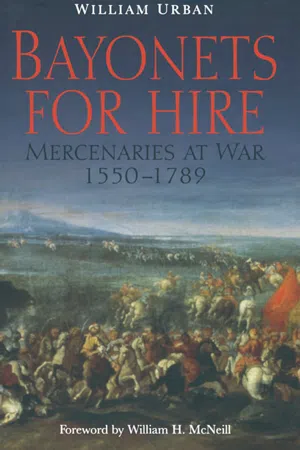
Bayonets For Hire
Mercenaries at War, 1550-1789
- William Urban, William H. McNeill(Authors)
- 2007(Publication Date)
- Frontline Books(Publisher)
Chapter 6Europe Under AttackThe Siege of Vienna
The Turk – as Europeans somewhat inaccurately called the multi-ethnic Ottoman Empire – had been on the march since the eleventh century. With each victory the sultans and their grand viziers smiled at European panic and despair – it was proof that God was on their side and that the infidels were doomed; their armies had taken fortress after fortress, city after city: Constantinople in 1453, Belgrade in 1456, Budapest in 1512. Then came the setback at Vienna in 1529. But surely that was temporary.The European nightmare never materialised, however, as the Ottoman armies were drawn east and south. Although the Ottomans occupied most of Hungary in 1541, they never mobilised fully for another attack on the Habsburg capital. That was partly because they first needed to take the fortresses south of Vienna, and Croatian and Slovenian resistance proved difficult to overcome. Almost annually some Ottoman force, large or small – mostly Turks, with their local allies, Serbs, Bulgarians, Hungarians and, occasionally, Tatars – ravaged the Christian borderlands.* This kept their men in fighting trim, but it made their Croatian victims into excellent warriors. As Turkish attacks slackened, the Croatians could sell their talents to European employers; they became the most sought-after mercenaries in Central Europe.The Habsburg Army
Habsburg military responsibilities ran from the Rhineland to Italy to Hungary; while facing down the excellent French army required armies with artillery and engineers, fighting Hungarian Protestants and Muslim Turks was best done by cavalry.This diversely equipped army was the first line of defence for western Christendom.* eBook - PDF
The Causes of War
Volume IV: 1650 - 1800
- Alexander Gillespie(Author)
- 2021(Publication Date)
- Hart Publishing(Publisher)
The Siege of Vienna 381 50 The ‘Serb Privilege’ of 1691. This is reprinted in Macartney, C (ed.) The Habsburg and Hohenzollern Dynasties in the Seventeenth and Eighteenth Centuries� (Harper, NYC). 79, 80. Bromley, J (ed.) The New Cambridge Modern History: The Rise of Great Britain and France . (Cambridge University Press, Cambridge, 1969). IV: 161, 189, 234–35, 683. 51 Hochedlinger, M (2003). Austria’s Wars of Emergence� (Routledge, NYC). 160–62, 164. 52 Clodfelter, M (2017). Warfare and Armed Conflict: A Statistical Encyclopedia . (McFarland, North Carolina). 59; Finkel, C (2005). Osman’s Dream: The History of the Ottoman Empire . (Basic, NYC). 292–93, 308. to which Nis (today, south-east Serbia) and Vidin (today, north-western Bulgaria) fell in the middle of 1689. The Ottomans reeled, but they swung back, augmented with forces from the Crimea, Egypt and even some French artillery (as Louis and the Sultan had now reconciled) pushing back into a small corner of Transylvania and what is modern-day Serbia. Emperor Leopold I responded to this in April 1690 by issuing a manifesto to Christian peoples in the Balkans, exhorting them to: [T]ake up arms against the most inveterate enemy of the name of the Christian … avenge the injuries, calamities and miseries most unjustly and cruelly inflicted on you. In return, you may feel the very outset of the gentleness and sweetness of Our [Habsburg] Empire and rule. 50 Such overtures came to little, as the Ottomans, promising tolerance to the Christian communities under their rule, regained the offensive, retaking Vidin, Nis and then Belgrade in early October 1690. However, in 1691, the new Sultan, Ahmed II (the son of Sultan Ibrahim, who replaced Suleiman II who died a natural death at the end of June, 1691) saw the tide turn back, with another sequence of military reverses for the Ottomans. eBook - ePub
Famous Battles and How They Shaped the Modern World, 1588–1943
From the Armada to Stalingrad
- Beatrice Heuser, Athena S. Leoussi(Authors)
- 2018(Publication Date)
- Pen & Sword Military(Publisher)
3 ripe for the picking.In 1529, Sultan Süleyman the Magnificent stood before the gates of Vienna. The siege did not last long: as winter set in early, the Ottoman forces withdrew after ravaging surrounding areas. But they held on to their many other conquests, consolidating their hold on the Balkans, the very name derived from a Turkish word for mountain. Still yearning for Vienna, they extended their conquests to Hungary, the South Slav lands, and the Greek islands.Events leading up to the Turkish campaign of 1682/83
The scope and speed of Ottoman expansion had lost some of its momentum in the early seventeenth century, but had picked up again around 1660. It was mainly directed East, away from the Holy Roman Empire, after the Ottoman defeat at the Battle of Saint Gotthard in the Burgenland (today Szentgotthárd in Hungary) in 1664. Nevertheless, the Turks also still made further conquests in Europe, as far to the North as Nové Zámky (in today’s Slovakia). While after Saint Gotthard, a twenty-year armistice was concluded, before this time was up, the two empires came to blows again over Hungary. A part of the Magyar-populated lands in the West was ruled by the Habsburgs; two principalities in the North and East were Turkish vassal states, while the southern parts were fully integrated into the Ottoman Empire as vilayets . A Protestant uprising in the Habsburg-controlled area under Imre (Emmeric) Thököly received Turkish support and he was recognised by the Sublime Porte as prince of Upper Hungary.4 eBook - PDF
The Croatian-Slavonian Kingdom
1526–1792
- Stanko Guldescu(Author)
- 2014(Publication Date)
- De Gruyter Mouton(Publisher)
THE SIEGE OF SZIGET (1566) AND THE PEASANT REVOLT OF 1573 Instead of following the Danube route as heretofore the great Turkish invasion of 1566 passed through western Hungary. On July 12 the Ottoman host arrived at Osiek and commenced the crossing of the Drave. Hastily Maximilian convened the Hungarian diet at Pressburg to provide for the defense of Vierma and his hereditary lands. From Nikola Zrini, who from 1542 to 1556 had functioned as Croatian ban, the sovereign received a promise that the Moslem advance would be contained long enough for the Austrian capital to prepare its defenses. When, towards the end of the summer, Suleiman's masses reached the town and fortress of Sziget in Hungary, they were surprised to find that apparently they had blundered upon some kind of a celebra-tion. Vari-colored bunting streamed in the wind from the walls and towers which were surmounted by gaily tossing flags. Thunderous artillery salvos, fired as salutes rather than with the intent to molest the invaders, heralded Zrini's final cavalier defiance to his old ene-mies. In the weeks that followed the Ottomans lost twenty thousand men under the walls of the dourly held stronghold. On September 14 Zrini and 600 survivors of the original Magyar-Croatian garrison of 2500 men retired into the inner fortifications. Suleiman had offered all of Croatia to Zrini if he would surrender the town but the Croat proudly refused this tempting bait.^ Suleiman died soon after Zrini's rejection of the offer, but the Turkish generals every day seated the dead sultan, his cheeks rouged to give him the appearance of life, in full view of the Ottoman troops. They feared that if the soldiers ever learned that the stare fixed upon them by the stem old ruler was a sightless one they would mutiny and abandon the siege. Finally, on September 16, Zrini donned his most gorgeous raiment, filled his pockets with gold coins so that those who recovered his body 1 Sisic, Pregled, 278. eBook - ePub
The Siege of Vienna
The Last Great Trial Between Cross & Crescent
- John Stoye(Author)
- 2008(Publication Date)
- Pegasus Books(Publisher)
5
The Siege
I
On the day the choirmaster first came to St Pölten, 100 miles distant to the east Kara Mustafa was in Ungarisch-Altenburg; and his Master of Ceremonies speaks of the dust rising thickly as the troops marched, so that one man could not recognise another.1Three days later the Grand Vezir reconnoitred the ground between Schwechat and Vienna. He made his way first to the Neugebäude, a palace built by the Habsburg emperors on the spot where Sultan Suleiman the Lawgiver was believed to have camped during the siege of 1529. For this reason, and because it faintly imitated the Turkish style of architecture, and overlooked superb gardens with clipped alleys, with aviaries orchards and a menagerie, Turkish travellers in the past had greatly admired the palace.2 Kara Mustafa may have wished to show his respect for that mighty predecessor whose venture against Vienna he hoped to surpass, but he also quite certainly regarded the building as a prize worth protection. There could be no question of sacking or despoiling it; and a strong guard was put there. He enjoyed his siesta, he rode forward to look at the city ahead, and then returned to Schwechat. But he was not a wise commander and it was already clear that he was unable to control his forces. The same day, and only a few miles off to the right, Fischamend on the shore of the Danube was raided and, according to the Master of Ceremonies, large stocks of timber were utterly destroyed: but a siege of the kind which Kara Mustafa had in mind required timber for the galleries and trenches of the miners.On the next day, Wednesday 14 July, he moved forward to the slopes which look down towards the city from the south; the valley of the Wien was immediately in front and farther back were all the other features of military significance—the Canal, the Danube, the hills of the Wiener Wald behind the city, and the contours around the suburbs.* Here he called his council. Obviously, his lieutenants and engineers had been making their plans, and the time had come to settle finally and formally the dispositions for an assault on Vienna. They were based on a conviction (which appeared to justify the whole general strategy of an attack), that the fortifications could be breached in the sector adjoining Leopold’s palace, the Hofburg.3
Index pages curate the most relevant extracts from our library of academic textbooks. They’ve been created using an in-house natural language model (NLM), each adding context and meaning to key research topics.

