History

Soviet Constitution 1936
The Soviet Constitution of 1936 was the fundamental law of the Soviet Union, outlining the structure and functions of the government. It emphasized the rights of citizens, including freedom of speech, assembly, and religion, while also promoting socialist ideals. The constitution established the Supreme Soviet as the highest organ of state power and enshrined the leading role of the Communist Party.
Written by Perlego with AI-assistance
Related key terms
1 of 5

10 Key excerpts on "Soviet Constitution 1936"
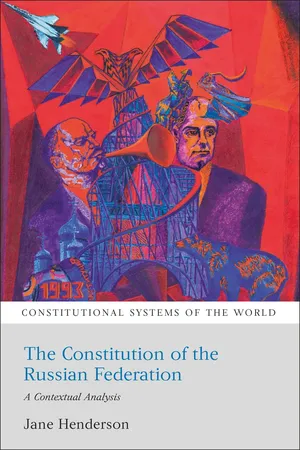 eBook - PDF
The Constitution of the Russian Federation
A Contextual Analysis
- Jane Henderson(Author)
- 2011(Publication Date)
- Hart Publishing(Publisher)
42 Antagonistic classes had been eliminated, leaving the two fraternal classes, workers and peasants, symbolised by the hammer and sickle in Soviet iconography. The 1936 Constitution was adopted at a time when the official line called for stability of law to achieve ‘socialism in one country’ under conditions of ‘capitalist encirclement’. It was therefore ‘more akin in both style and content to the “bourgeois” constitutions so much despised in the early years’. 43 The timing of its adoption was significant. Stalin was prepared to overlook the class war to have more influence on the world stage. The USSR had joined the League of Nations in 1934 on Germany’s exit, and was keeping a wary eye on Nazi developments. As well as its external ‘propaganda’ role, 44 the Constitution also signalled stability for the domestic population decimated by forced collectivisa-41 A Evans, ‘Developed socialism in Soviet ideology’ (1977) 38 Soviet Studies 409; K Ruutu, ‘Past, present and future in Russian constitutional politics: Russian Constitutions in conceptual historical perspective’ (2010) 35 Review of Central and East European Law 77. 42 JV Stalin, ‘On the Draft Constitution of the USSR’ from Collected Works, vol 14 (London, Red Star Press, 1964), available at accessed 7 January 2011. 43 AL Unger, Constitutional Development in the USSR: a Guide to the Soviet Constitutions (London, Methuen, 1981) at 79. 44 The word propaganda exists in Russian but does not have the same negative overtones it has in English. The Constitution propagates information, hence it is a propaganda document. The Constitution During the Soviet Era 35 tion and industrialisation. It was a welcome distraction; as Areyah Unger notes, the coincidence in time between the adoption of the constitution and the terror of the so-called Great Purge is too striking to go unmentioned. eBook - ePub
Stalin’s Constitution
Soviet Participatory Politics and the Discussion of the 1936 Draft Constitution
- Samantha Lomb(Author)
- 2017(Publication Date)
- Routledge(Publisher)
In order to appreciate what aspects of European constitutional theory the Soviet leadership incorporated into the 1936 Stalinist Constitution, it is imperative to understand what role Bolsheviks believed that a constitution should play in Soviet society. Party and state leaders viewed the Constitution as the codification of the achievements of socialism, rather than a document that identified aspirational goals or guiding principles. In his November 1936 speech to the 8th Congress of Soviets, Stalin made it clear that the Constitution should not be confused with a program:a program talks about what does not yet exist and that which must be obtained and won in the future, the Constitution on the other hand, must speak about what already exists, what has already been obtained and won now, in the present.15Nikolai Krylenko,16 People’s Commissar of Justice (July 20, 1936–September 15, 1937) and the Procurator General for the Russian Socialist Federated Soviet Republic (1929–1931), penned several works explaining why the new Constitution was drafted.17 Krylenko argued that the USSR had become a democracy of the majority and that the tightly regulated and limited dictatorship of the proletariat was no longer needed.18 For many Soviet leaders like Krylenko, the 1936 Constitution represented a shift in the balance of power. In 1918, Bolsheviks and the support base for a Soviet state were seen as a beleaguered minority, but by 1936 many of the perceived enemies had been dealt with, leaving the Soviet leaders confident that they finally had majority support and could use this position of strength to further develop participatory politics in the USSR.The Soviet leadership viewed popular participation as a powerful weapon against bureaucratism and corruption and were quick to solicit popular involvement to remedy these problems.19 To this end, Stalin advocated the expansion of the electoral franchise and multi-candidate elections, which were introduced in the draft 1936 Constitution and were to be applied to the elections to the Supreme Soviet in 1937. In his interview with Roy Howard on March 1, 1936, Stalin addressed the issue of open elections.20 While he dismissed the idea of multi-Party elections, he strongly supported the idea of multi-candidate elections. Stalin noted that under the new draft Constitution, social organizations of all varieties, not just the Communist Party, would have the right to nominate candidates for election.21 These contests, not between different parties but between different individuals, would allow the proletariat to effect change in the government and policy through mass participation.22 eBook - ePub
- Richard W. Nice(Author)
- 2023(Publication Date)
- Philosophical Library/Open Road(Publisher)
XII.
THE SOVIET CONSTITUTION
 Passage contains an image
Russia
Passage contains an image
Russia
THE SOVIET CONSTITUTION*
The Soviet Constitution of 1922 retained the dictatorship of the proletariat and public ownership of the land and of the means of production such as had been proclaimed in 1917. There have been several revisions of the Soviet Constitution, but the underlying factors of the 1922 version were preserved in the Constitution of 1936 which continues to remain in effect. The country is ruled and administered by three separate hierarchies, with the legislative portion vested in counselors ranging from a local level to the supreme constitution of the USSR. The supreme constitution elects a permanent committee whose chairman acts as president of the republic. The executive portion is vested in a council of ministers appearing before this council.The following excerpt tells of the organization of Soviet society, the right of work, the right of education, and equal rights of men and women as well as other “rights” given the Soviet citizen. THE ORGANIZATION OF SOCIETY1. Chapter I of the Constitution of the USSRArt . 1. The Union of Soviet Socialist Republics is a socialist State of workers and peasants.Art . 2. The Soviets of Working People’s Deputies, which grew and attained strength as a result of the overthrow of the landlords and capitalists and the achievement of the dictatorship of the proletariat, constitute the political foundation of the USSR.Art . 3. In the USSR all power belongs to the working people of town and country as represented by the Soviets of Working People’s Deputies.Art . 4. The socialist system of economy and the socialist ownership of the means and instruments of production firmly established as a result of the abolition of the capitalist system of economy, the abrogation of private ownership of the means and instruments of production and the abolition of the exploitation of man by man, constitute the economic foundation of the USSR.Art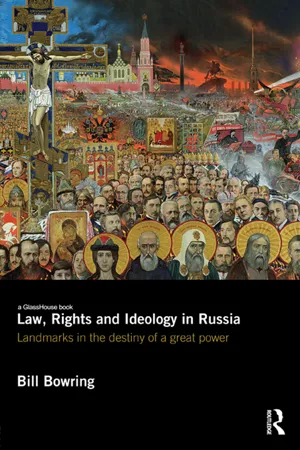 eBook - ePub
Law, Rights and Ideology in Russia
Landmarks in the Destiny of a Great Power
- Bill Bowring(Author)
- 2013(Publication Date)
- Routledge(Publisher)
3 A new Soviet Constitution was unanimously approved on 5 December 1933. In September 1934 the USSR joined the League of Nations and was elected a permanent member of the Council. According to Andrey Vyshinsky, notorious as prosecutor of the Moscow show trials, the 1936 (Stalin) Constitution reflected the following changes:The first Constitution of the USSR was adopted on 31 January 1924.The complete triumph of the socialist system in all branches of the national economy, the fundamental realisation of socialism, the liquidation of the exploiter classes, the annihilation of man’s exploitat ion by man … all these factors evoked the necessity of changing the Constitution of the USSR so that the new Constitution should reflect all the changes … since 1924.4Nikolai Bukharin, one of the most sophisticated and intellectually attractive members of the Bolshevik leadership, was a member of the drafting Commission, and later boasted that he had written the document from the first word to the last. He was reported as saying that the new Constitution was a document ‘which would make it impossible for the people any longer to be pushed aside’.5The 1936 Stalin Constitution
The Stalin Constitution6 contained Chapter X eBook - ePub
The Constitution of the Russian Federation
A Contextual Analysis
- Jane Henderson(Author)
- 2022(Publication Date)
- Hart Publishing(Publisher)
Civil war in the former Russian Empire eventually ended with the formation of other revolutionary states: the Ukraine, Belorussian, Azerbaijan, Armenian and Georgian Soviet Socialist Republics, and the Bukhara and Khorezm Soviet People’s Republics. In December 1922 the ‘voluntary’ amalgamation of these by treaty with the RSFSR formed the Union of Soviet Socialist Republics (USSR; Soviet Union). 66 The first USSR Constitution was in January 1924. The RSFSR consequentially issued its second Constitution in May 1925. Further constitutions followed: for the USSR in 1936 and 1977; and for the RSFSR in 1937 and 1978. The roles of Soviet Constitutions are summarised below. Lenin instituted a system of soviets as representative agencies to harness the masses’ revolutionary zeal, forming in theory a ‘bottom-up’ State structure, although always under the watchful eye of the Communist Party of the Soviet Union (or ‘the Party’, as it was later known) which had a monopoly on political activity. Over time, soviets’ name changed: from 1918 (soviets of ‘workers’, soldiers’ and peasants’ deputies’) through 1936 (‘working people’s deputies’) to 1977 (‘people’s deputies’) as the ‘State of the whole people’ was declared to have been achieved. The 1918 RSFSR Constitution had a class-based voting system, but the 1936 USSR Constitution introduced universal suffrage, with direct election to all soviets. In its developed form, this was a hierarchy headed by the USSR Supreme Soviet, with local soviets at the bottom, and federal regional soviets and Union Republic (UR) Supreme Soviets in between. The USSR Supreme Soviet was bicameral, having the Soviet of the Union and the Soviet of Nationalities. From 1936, Soviet terminology distinguished between agencies of State power and agencies of State administration. Soviets were the agencies of State power and were both representative and legislative bodies eBook - ePub
- Rudolf Schlesinger(Author)
- 2014(Publication Date)
- Routledge(Publisher)
S. G., 1940, Nos. 8–9.(b)The 1936 Constitution and the Conception of LegalityThe avowed25 intention of the 1936 Constitution was to describe the political and social structure achieved, not to develop a mere programme, nor to detail that structure by concrete legislation. There was no change in the political structure of dictatorship. Only wishful thinking by Western Constitutionalists could overlook the fact that26 the freedoms of association, of the Press and of public meetings are only granted “in order to strengthen socialist society” and that (art. 126) the Communist Party is recognised as the organisation of the politically leading citizens, working in the key positions of the State. Consequently, those critics were bound to construct alleged contradictions between the content and the working of the Soviet constitution. In fact, the State has proceeded along its traditional lines, confirmed by the 1936 Constitution: granting political rights to those who support the regime, and to no one else. If there has been a change, it has been towards more open treatment of the One-Party system which formerly, like the multi-Party system in most Western countries, had not been recognised in the written constitution, though it formed a most important element of the actual constitution. The official recognition of the Party as a fundamental element of government involved making the Party open to all citizens on the same terms as other organs of government. Indeed, the Party Cpngress of 1939 removed all distinctions between various groups of citizens as regards the conditions of admission to the Party.25 eBook - ePub
Russia Under Soviet Role
Twenty Years of Bolshevik Experiment
- N. de Basily(Author)
- 2017(Publication Date)
- Routledge(Publisher)
In fact, all the organisms of State in the U.S.S.R. are subordinated to a single centre, but this centre must not be sought among any of the institutions provided for by the Constitution. It consists, in fact, of the small group at the head of the Communist Party.The Official Doctrine of the StateThe official view as to the veritable nature of the Soviet political régime has been very clearly expressed in a formula which figures in the Guide Book to the Soviet Union, published by the Soviet Government in 1928: “The undisguised and deliberate use of State institutions as an instrument in the class struggle is fully in accord with the Marxian doctrine of the State, namely, that it is a class organization. In this case it is the organization of the ruling proletarian class. This conception of the State permeates all the forms of social and economic life in the Union.” The same official doctrine affirms that, as long as society shall not have been completely reorganized on the bases of Socialism, the proletariat must be the ruling factor, and its advance guard, the Communist Party, must exercise dictatorship in its name. The Constitution of 1936 rests on the same foundation.In laying the draft of his Constitution before the VIIIth Pan-Unionist Congress of Soviets, Stalin declared: “I must recognize that the project of the new Constitution definitely conserves the existing régime of the dictatorship of the working class, as it maintains without change the present guiding role of the Communist Party.”1 In these conditions, to comprehend the governmental mechanism of the U.S.S.R., it is necessary to know the organization and the statutes of the Party.Organization of the Communist PartyThe Bolshevik Party adopted the official name of “Communist” in virtue of a decision of its VIIth Congress (March 6 to 8, 1918).2 Re-cast in 1934,3 the statutes of the Communist Party may be said to form the second written Constitution of the country. According to these statutes, the machinery of the Party, like that of the Soviets, is based on the same principle of delegation—always from the lower to the higher. In each institution, in each undertaking, in each school, in each military unit, where there exits several Communists, a “primary organization” is created. This basic unit convokes its members to meetings (which may be public or private). At its first meeting it elects its officers, who form what is known in Russia (and most other continental countries) as the “bureau,” in which the secretary plays the principal part. In due course the unit will elect its delegates to the Party conference for the district or for the town.4 eBook - ePub
Planting Parliaments in Eurasia, 1850–1950
Concepts, Practices, and Mythologies
- Ivan Sablin, Egas Moniz Bandeira, Ivan Sablin, Egas Moniz Bandeira(Authors)
- 2021(Publication Date)
- Routledge(Publisher)
84Restoration of their civil rights according to the 1936 Constitution was incomplete and sabotaged at every level of administration. It is worth noting that all instructions and laws (if carried out) were interpreted by implementers in favor of tightening and restriction rather than softening. We see a common practice whereby the Constitution, law, or decree granting rights to citizens was truncated by normative instructions or nonfulfillment on the local level. In this light, it is emblematic that Stalin rejected most popular amendments to the Constitution in 1936 by reasoning that they instead belonged to current legislation. They were supposed to be disregarded.85Elections
Free elections are at the core of democracy and were in the center of the 1936 Constitution. The mechanism of elections and Soviet manipulations is a large topic deserving further studies.86 Here I only briefly present a few examples of subverted elections in 1936–1937 at the grassroots. Before that, open voting by raising hands under OGPU surveillance, rather than by secret ballot, and voting for the whole list of candidates presented by the organizers effectively “usurped democracy.”87 The new Constitution’s voting rules were spontaneously tested in the fall of 1936 during the elections to the local and all-union soviet congresses, even before the Constitution’s formal adoption, and were expanded to Party organizations and trade unions from May through the summer of 1937. The party, soviets, and the NKVD were not ready to implement new constitutional norms despite official encouragement to criticize and dismiss ineffective officials in the campaign of criticism. The NKVD with its civil war mentality saw the 1936 pre-election mobilization of the population, inspired by new freedoms, as anti-Soviet agitation and regularly reported on the revival of socially alien elements, who were formally absolved by the Constitution.88 The old practice of control over elections continued. It was the duty of Party organizers to “direct election campaigns,” organizing 100 percent turnout and selecting and verifying the candidates. However, newly enfranchised persons were often removed from the voting lists in 1937. “It [is] the responsibility of local soviets to ensure that voter lists [are] compiled correctly.”89 But those in the soviets who had deported kulaks in 1930 were not interested in reinstating the voting rights of returnees. In the 1936 discussion, they regularly articulated that they anticipated revenge.90 eBook - ePub
- Robert Sharlet(Author)
- 2016(Publication Date)
- Routledge(Publisher)
In effect, constitutional scholars, following Gorbachev's lead, were in the process of fundamentally redrafting the "social contract" governing relations between the citizen and the party-state. 26 The first step in reshaping the Soviet constitutional order began with the extensive wave of amendments proposed by Gorbachev and pushed through the old, compliant USSR Supreme Soviet in late 1988. The central features of these changes for further constitutional revision were new election rules and the restructuring of the Soviet legislative process. The main innovations in Soviet electoral law were the introduction of multi-candidate elections (as against the previous practice of one office, one candidate), and incumbency limitation to two consecutive five-year terms. Multiple candidacies—long permitted in some formerly communist East European countries, but a radical move by Soviet standards—gave more substance and significance to the "secret ballot" provision in the existing constitution. Previously, in standard single-candidate voting for government office, Soviet voters had the option of simply dropping the ballot with the candidate's name in the ballot box or, rather conspicuously, going into a curtained booth, crossing out the name, and then casting the ballot. 27 While the electoral reforms were intended to introduce a degree of popular sovereignty into the operations of the Soviet system, the constitutional reform of the legislative process was intended to provide greater legitimacy to the subsequent constitutional restructuring contemplated by Gorbachev and his reformist advisors eBook - PDF
The Russian Revolution and Civil War 1917-1921
An Annotated Bibliography
- Jonathan Smele(Author)
- 2006(Publication Date)
- Continuum(Publisher)
1534 Duval, C. `Yakov M. Sverdlov and the All-Russian Central Executive Committee of Soviets: A Study in Bolshevik Consolidation of Power, October 1917±July 1918', Soviet Studies Vol. 31 (1979), No. 1, pp. 3±22. A careful tracing of Sverdlov's methods of isolating and outmanoeuvring Bolshevik and non-Bolshevik opposition within the VTsIK during the various crises of the post-October period, with some concentration upon the debates surrounding the signing of the Treaty of Brest-Litovsk. 1535 Farber, S. Before Stalinism: The Rise and Fall of Soviet Democracy . Oxford: Polity Press in association with Basil Blackwell, 1990. xiii + 288 pp. Part history and part theoretical discussion, this volume (which is based almost entirely upon published English-language sources) examines the period 1917 to 1923, using the early Soviet experience as the springboard for the author's generalized ruminations on such matters as workers' control and trade unions, freedom of the press and socialist legality. 1536 Ferro, M. `The Birth of the Soviet Bureau-cratic System', in R. C. Elwood (ed.) Reconsidera-tions on the Russian Revolution . Cambridge, MA: Slavica, 1976. pp. 100±132. An interesting (if somewhat conventional) discus-sion which argues, `in contrast to Trotskyite and anti-Bolshevik interpretations', that `the Soviet re gime was just as much a child of the revolution itself as it was the product of earlier Bolshevism which rein-forced those traits'. The author examines shifts in constitutional power, the bureaucratization process and the place of the Bolsheviks in this context. 1537 Gettel, R. G. `The Russian Soviet Constitu-tion', American Political Science Review Vol. 13 (1919) Nos 1±4, pp. 293±297. A brief neutral discussion of the major features of the constitution of 1918. 1538 Goikhbarg, A. A Year in Soviet Russia: A Brief Account of the Legislative Work of 1917±1918 . London: People's Russian Information Bureau, 1919. 16 pp.
Index pages curate the most relevant extracts from our library of academic textbooks. They’ve been created using an in-house natural language model (NLM), each adding context and meaning to key research topics.

