History

The Bow Street Runners
The Bow Street Runners were an early form of organized law enforcement in London, established in 1749 by magistrate Henry Fielding. They were a group of paid, professional law enforcement officers who patrolled the streets and pursued criminals. The Bow Street Runners are considered one of the earliest attempts at creating a professional police force in England.
Written by Perlego with AI-assistance
Related key terms
1 of 5
9 Key excerpts on "The Bow Street Runners"
 eBook - ePub
The Use and Abuse of Police Power in America
Historical Milestones and Current Controversies
- Gina Robertiello(Author)
- 2017(Publication Date)
- ABC-CLIO(Publisher)
Tom Jones— together with his half-brother Sir John Fielding (1721–1780). For this reason, the Runners were first referred to as “Mr. Fielding’s People.” Henry Fielding was the second magistrate at Bow Street, which opened in 1740, again reflecting the rising crime rate in London.The original Bow Street Runners consisted of six men. (Six remained the typical number, with the exception of occasional assistants, until 1765 when the numbers steadily grew.) The founding of the Runners by a senior magistrate conferred upon them legal status, and they operated out of the magistrate’s office. A basic set of rules was put in place that provided for their regulation.“Bow Street Runners” was never an official name; it arose by virtue of the group being attached to Bow Street magistrates’ office. Although the group referred to themselves as “Runners,” it was generally felt by the members that the moniker “Bow Street Runner,” when used by the public at large, was derogatory.The duties of the Runners included some functions recognizable with police forces today, although there were also some exceptions. The Runners, for example, were authorized to serve writs and arrest offenders, provided authority was given by a magistrate in relation to a reported crime. Crimes were not only reviewed, but there was also an attempt at analysis, and the communication system put in place by Fielding represented an early form of intelligence gathering.John Townsend, a Bow Street Runner. The Runners were forerunners of the modern police force and policed the streets in conjunction with nightwatchmen, but were more efficient. Nicknamed “Robin Redbreasts” because of the red waistcoats they wore. (Hulton Archive/Getty Images)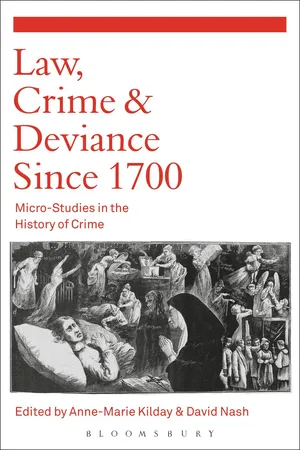 eBook - PDF
Law, Crime and Deviance since 1700
Micro-Studies in the History of Crime
- David Nash, Anne-Marie Kilday, David Nash, Anne-Marie Kilday(Authors)
- 2016(Publication Date)
- Bloomsbury Academic(Publisher)
7 The historical background to the formation and functioning of the ‘Runners’ is first outlined in Section II below in order to contextualize the later sections concerning their appearance in both factual and fictional narratives. II The ‘Runners’ were formed in the winter of 1748/9 by Henry Fielding, novelist and newly appointed Chief Magistrate of Bow Street Court in Westminster. 8 Six ex-parish constables of Westminster (together with a servant of Saunders Welch, High Constable of Holborn) comprised the original force, which Fielding intended as a countermeasure to the perceived increase in serious crime (especially violent robberies) then occurring in the capital. 9 The ‘Runners’ received limited Governmental funding from late 1753 and The Bow Street ‘Runners’ in Factual and Fictional Narrative 153 Henry’s half-brother, Sir John Fielding (who succeeded as Chief Magistrate following Henry’s death in 1754), continued to develop and expand the force to include various uniformed patrols throughout his period in office (1754–80). 10 By the early nineteenth century, the force comprised a small number (between six and eight men) of plain-clothes detective officers (who much preferred to be distinguished from the less senior Bow Street ranks by the term Principal or Senior Officer – the nickname ‘Runner’ being viewed by them as demeaning). There was also a system of both mounted patrols which operated in the outskirts of London including the turnpiked roads that ringed the capital and, a large body of uniformed constables (kitted out in scarlet waistcoats, giving rise to their contemporaneous nickname of ‘Robin Redbreasts’), who followed regular beats within the Metropolis. 11 The total complement of Bow Street personnel at any one time in the first decades of the nineteenth century numbered around 250. eBook - ePub
The Security Society
History, Patriarchy, Protection
- Francis Dodsworth(Author)
- 2019(Publication Date)
- Palgrave Macmillan(Publisher)
2012 : 8, 17, 21–24).The Police Idea
In fact, although he was responsible for the foundation of the Runners, and his name is always the most closely associated with them, Henry Fielding’s failing health and early death in 1754 meant that his contribution to their 90-year history was relatively brief. As the work of John Beattie (2012 ) makes clear, the institution that became so central to the development of the police idea in England was actually and most decisively developed by John Fielding (1721–1780), Henry’s half-brother, who succeeded him as Bow Street magistrate and was responsible for both the practical development and the legitimisation of new systems of surveillance and mechanisms of public protection in the second half of the eighteenth century. It is particularly significant that in 1758 John Fielding began to refer to this system of public protection as a system of ‘police’ (Dodsworth 2008 : 588).The Bow Street Runners , then, began in late 1749 as a group of thief-takers run under the auspices of Henry Fielding , but under the influence of John Fielding , they soon developed into something much more than that. Not only were they state-funded but they also developed a sophisticated system of operation, extending initially to foot, and ultimately mounted patrols of London’s arteries, day and night, with extensive record-keeping and contacts with magistrates all around the country, which Beattie (2012 ) argues made them England’s first de facto detective force. Just like their successors, the Metropolitan Police’s detective branch would do in the later nineteenth century, in their later years the Runners even played an active role outside London where necessary, acting as a kind of national detective service (Cox 2010 ). The Bow Street office also employed ancillary staff, such as clerks to man the office almost constantly and to process the large amounts of information that the office was able to accumulate on crime and criminals in London, making the Bow Street office ‘a clearing house for information about crime across the metropolis’, and, indeed, across the country (Beattie 2012 : 27–28, 30–31, 85–86, quotation at 85). In this sense, the Bow Street magistrate’s office represented a specialised extension of the principle of the Universal Register Office, established by the Fieldings at the same time as the Bow Street Runners (1750) and intended ‘to bring the World, as it were, together into one Place’ (Ogborn 1998 : 201–230, quotation at 211). As we saw in Chap. 2 , this was not novel in and of itself, but what was different in the eighteenth century ‘was the volume of connections and the ways in which they were being made routine, organised, and carefully integrated through new ways of collecting, collating, retrieving and using information’ (Ogborn 1998 : 209). There was a presumption that, as Rosalind Williams puts it ‘Social progress was assumed to depend on [the] construction of connective systems’ (cited in Ogborn 1998 : 213; see also Siskin 2016 ). As Ogborn (1998 : 220–223) notes, this allowed the power
- Paul Lawrence, Janet Clark, Rosalind Crone, Haia Shpayer-Makov(Authors)
- 2021(Publication Date)
- Routledge(Publisher)
The committee discussed the various police establishments in the capital and heard their representatives, paying particular notice to the public offices, as in the previous committee. The document presented here is taken from the minutes of evidence, concentrating on the testimony of Sir Richard Birnie, chief magistrate of the Bow Street court, the most prominent police office in London (see above, p. vii).His evidence sheds light on the nature and code of practice of the detective coterie at Bow Street, numbering eight – approximately the size of the detective squad in each of the other public offices.3 We learn that two Runners were assigned to guarding royalty, a role entrusted to them at the end of the previous century in the wake of the French Revolution and the heightened threat to the lives of kings and queens not only in France but also in England.4 The other six Runners were principally employed in detective work in the provinces.5 In contrast to London, where other public offices were active, provincial Britain was considered to be devoid of home-grown investigative expertise or competence and therefore in need of external assistance. The Bow Street Runners were mainly called upon to inquire into serious crimes due to their reputation as highly skilled detectives, as was later the case with the central detective branch of the Metropolitan Police. In effect, this small cadre operated as a national centre for crime investigation, discharging duties demanded by the Home Office as well.Another issue brought up in Birnie’s testimony, and repeatedly raised in subsequent decades both inside and outside police circles, related to the monetary compensation of police detectives. Although the public officers were considered public servants, their income did not derive solely from public sources. Their formal wages constituted only a portion of their earnings. In addition to a retaining fee and other official payments, they received fees and expenses from the many private people and private and official institutions who hired their services.6 eBook - ePub
- David Cox(Author)
- 2014(Publication Date)
- Routledge(Publisher)
Thief-taker General, p. 226.37 OA 17250524.38 OA 17250524.39 Quoted in J. M. Beattie, Policing and Punishment in London 1660–1750: Urban Crime and the Limits of Terror (Oxford: OUP, 2001), p. 417.40 Staffordshire Advertiser, 3 January 1801.41 The members of the force of detective officers based at Bow Street never referred to themselves as ‘Runners’, considering the term derogatory and demeaning. They always referred to themselves as ‘Principal’ or ‘Senior’ Officers in an attempt to separate themselves from the lower ranks of the Bow Street policing system.42 Francis Sheppard, London 1808–1870: The Infernal Wen (London: Secker & Warburg, 1971), p. 37.43 Quoted in Gilbert Armitage, The History of The Bow Street Runners 1729–1829 (London: Wishart & Co., 1932), p. 57. For accounts of the reputation of Thief-takers and their influence, including the notorious ‘Thief-takers’ Trial’ of 1756, see Anthony Babington, A House in Bow Street: Crime and the Magistracy, London 1740–1881, 2nd edn (London: Macdonald, 1999), pp. 126–30, and Ruth Paley, ‘Thief-takers in London in the Age of the McDaniel Gang c.1745–1754’ in Hay, D., and Snyder, F. (eds), Policing and Prosecution in Britain, 1750–1850 (Oxford: Clarendon, 1989), pp. 301–41.44 Edward Sayer, Observations on the Police or Civil Government of Westminster with a Proposal for Reform (London: Debrett, 1784), p. 25.45 Henry Fielding, An Enquiry into the Causes of the Late Increase of Robbers and Related Writings, ed. Malvin R. Zirker (Oxford: Clarendon Press, 1988), pp. 153–4.46 Beattie, The First English Detectives, p. 131.47 Ibid.48 Patrick Pringle, Hue & Cry: The Birth of the British Police (London: Museum Press, 1956), p. 167.49 Armitage, The History of The Bow Street Runners, p. 129. It appears that the Horse Patrol was not absorbed completely into the Metropolitan Police until September 1837; the Morning Chronicle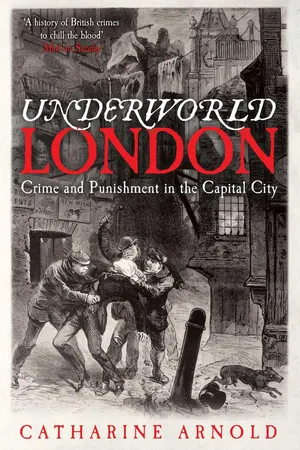 eBook - ePub
Underworld London
Crime and Punishment in the Capital City
- Catharine Arnold(Author)
- 2012(Publication Date)
- Simon & Schuster UK(Publisher)
7
THE LONG ARM OF THE LAW
From Bow Street to Scotland Yard
The story of London and crime so far has concentrated on villains, prisons and executions. Now, moving through the eighteenth century, we arrive at the first great landmarks of law enforcement: Bow Street Magistrates’ Court, with its famed Bow Street Runners, and Scotland Yard, home of the Metropolitan Police. This chapter traces the evolution of London’s crime-fighting force, from De Veil’s Covent Garden mansion to the founding of the Metropolitan Police.These institutions did not spring, fully formed, into being. Instead, these legendary crime-fighting bodies emerged gradually from the barely suppressed anarchy of Hanoverian London. First Thomas De Veil founded Bow Street Magistrates’ Court, and then the Fielding brothers created its eponymous ‘Runners’. Towards the end of the eighteenth century, the visionary reformer Patrick Colquhoun lobbied for the establishment of a professional, city-wide police force, but it would not be until 1829, after The Bow Street Runners foiled the Cato Street conspiracy, that Sir Robert Peel’s Metropolitan Police was finally unleashed against London’s ‘dangerous classes’.Thomas De Veil (1684–1746) was Bow Street’s presiding genius. A former army officer turned magistrate, De Veil had only to look out of the windows of his house at 4 Bow Street to witness the groundswell of felony that lapped about its walls. De Veil’s house was set on the borders of Covent Garden, the fashionable hub of vice from which taverns, theatres, coffee houses and brothels radiated outwards like the spokes on a wheel. Every other house in the street was a gin shop or a brothel, and within a short walk of Inigo Jones’ magnificent piazza stood the stinking tenements and thieves’ kitchens of Seven Dials.Chaotic, violent Hanoverian London was almost impossible to police. The writer Fanny Burney complained that she could not take a walk before breakfast ‘because of the danger of robbers’ and dusk was generally known as ‘the footpad hour’.1 The teeming rookeries of Seven Dials and Saffron Hill were villains’ strongholds, a labyrinth of secret passageways riddled with booby traps. Any constable of the watch foolhardy enough to give chase into the tottering ruins might find himself stumbling headfirst into a cesspool or set upon by an army of thugs. Drink had always played a prominent part in the underworld, but now the traditional flagons of ale and sack had been forsaken and London was floating on a tide of gin, the cheap but potent liquor sold at 15,000 drinking establishments throughout the city, where the public could be ‘drunk for one penny and dead drunk for tuppence’.2 eBook - ePub
Governing Risks in Modern Britain
Danger, Safety and Accidents, c. 1800–2000
- Tom Crook, Mike Esbester, Tom Crook, Mike Esbester(Authors)
- 2016(Publication Date)
- Palgrave Macmillan(Publisher)
Of particular interest are the various schemes for the improved collection and dissemination of information in order to enhance the self-consciously ‘preventive’ capacities of policing. The pioneers are well known, namely the Fielding brothers, Henry and John, who during the 1750s established the Bow Street Magistrates’ office as a kind of hub of crime prevention and justice. The Bow Street office not only functioned as a court room where Londoners could watch justice being dispensed. It also functioned as a bureau of information, which included a register of offenders and a record of all stolen goods, and was the operational home of The Bow Street Runners, London’s first detective force. The Runners became famous for knowing the haunts and proclivities of the city’s more prolific criminals, but they were only one component of a broader culture of prevention and detection that turned on the generation and sharing of information. John Fielding was in regular correspondence with magistrates all over London and the provinces, gathering and collating information on the latest crimes and criminals, and then distributing the latest digests. Indeed, in 1771, he established the journals the Quarterly Pursuit and the Weekly or Extraordinary Pursuit in order to publicize stolen goods, wanted criminals and the rewards available for their capture. These publications later became the Hue and Cry in the 1790s and then the Police Gazette from 1839—a title that is still published today. The Gordon Riots of 1780 served to catalyse further reflection and reforming initiatives. For several days in June, a mob took control of the streets in what turned into a violent protest not only against Catholicism, but more widely against symbols of authority. A number of buildings associated with law and order were destroyed, notably Newgate Prison and Bow Street Magistrates’ office eBook - PDF
Henry Fielding at Work
Magistrate, Buisnessman, Writer
- L. Bertelsen(Author)
- 2000(Publication Date)
- Palgrave Macmillan(Publisher)
These journal and newspaper reports provide the primary sources of firsthand information about Fielding’s activities in Bow Street. 5 They have been approached by scholars in varying ways. Legal historians have extensively mined them L. Bertelsen, Henry Fielding at Work © Lance Bertelsen 2000 12 for examples of magisterial practice, but have paid very little attention to their rhetorical texture or to their function as entertainments and adver- tisements. 6 Social historians and Fielding’s biographers have tended to emphasize the more sensational cases and important administrative inno- vations. Thus the development of The Bow Street Runners has been re- counted again and again. Fielding’s own description of his campaign in the winter of 1753 “to demolish the then reigning gangs, and to put the civil policy into such order, that no such gangs should ever be able, for the future, to form themselves into bodies, or at least to remain any time formidable to the public” has often been cited as an example of his self- sacrifice in the cause of justice. 7 The personal and political ramifications of Fielding’s role in the famous Bosavern Penlez case have been widely discussed, with predictably contentious results. 8 And Fielding’s involve- ment in the extraordinary narrative and continuing mystery of Elizabeth Canning’s alleged kidnapping has fascinated scholars and amateurs for centuries. eBook - PDF
- Michael Birzer, Cliff Roberson, Michael Birzer, Cliff Roberson(Authors)
- 2018(Publication Date)
- Routledge(Publisher)
As cities became more populated, urban problems such as poverty and crime began to escalate. The difficulties of relying on private citizens for law enforcement became obvious, but the solution to this problem was not so clear. As early as the 1600s, men known as “thief takers” could be found (Beattie, 2006). For a reward or fee, these men used their knowledge of criminals and criminal behaviors to nego-tiate between perpetrators and victims for the return of some or all of the stolen property, or they helped bring the perpetrator to justice. Thief takers became far more numerous in the mid-1700s because the monetary rewards for capturing criminals grew larger. These rewards came from both the government and newspapers (Emsley et al., 2011). Beattie (2006, p. 16) wrote that, “Over the quarter century between 1720 and 1745, and again briefly between 1750 and 1752, the reward for the conviction of a robber in London was 140 pounds, a sum that approached three or four years’ income for even a skilled work-man.” Notwithstanding the inevitable corruption that such a system led to, many believed that these methods were to some extent successful, at least compared to the constable and watchmen, who felt little or no responsibility to investigate incidents. BOW STREET RUNNERS Thief takers might take a perpetrator to a local magistrate, and one place to find a magis-trate was at the Bow Street office, which was set up in 1739; however, it was not until Henry Fielding took control in 1748 that a remarkable shift in the activities occurred. Because the area had an extraordinarily high rate of crime, Fielding initiated the practice of having a group of law enforcers be proactive in finding and bringing to justice perpetrators.
Index pages curate the most relevant extracts from our library of academic textbooks. They’ve been created using an in-house natural language model (NLM), each adding context and meaning to key research topics.

