History

The Declaration of the Rights of Man
"The Declaration of the Rights of Man" was a document adopted during the French Revolution in 1789. It outlined the fundamental rights and freedoms of individuals, emphasizing principles of liberty, equality, and fraternity. The declaration served as a key milestone in the development of modern human rights and influenced subsequent constitutional and legal developments around the world.
Written by Perlego with AI-assistance
Related key terms
1 of 5
12 Key excerpts on "The Declaration of the Rights of Man"
 eBook - ePub
- Micah Alpaugh(Author)
- 2021(Publication Date)
- Bloomsbury Academic(Publisher)
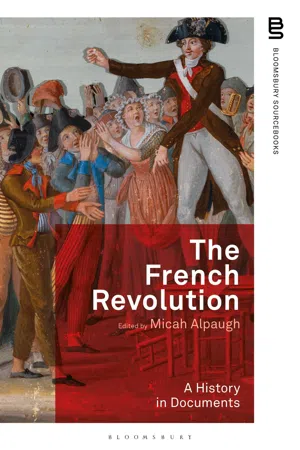
They are very Angry with me for Having supported the Motion Against the Coming of the troops. If they take me up You Must Claim me as an American citizen. . . .Declaration of the Rights of Man and Citizen , August 26, 1789No document embodied the French Revolution’s universalist hopes better than The Declaration of the Rights of Man and Citizen. The first portion of France’s inaugural constitution, designed to provide the principles for its contents, the constitution declared its basis to be not historical precedent (as English and American declarations largely justified themselves) but rather natural right. By declaring “All men are born and remain free and equal in rights,” revolutionaries created a new inclusive ideal of human rights—though one not easily applicable to their colonies, where hundreds of thousand s remained enslaved. Moreover, the document emboldened citizens to defend their rights, making “resistance to oppression” expressly protected should other portions of the document (including free association, speech and press) be infringed. Though buttressed by other articles demanding obedience to the law and submission to the general will, revolutionaries trumpeted the achievement of core rights applicable to all. When the United Nations adopted a global Declaration of Human Rights in 1948, they took France’s 1789 declaration as their model.The French People’s representatives, constituted in the National Assembly, considering that ignorance, forgetting or contempt for the rights of man are the sole causes of public misfortune and the corruption of governments, have resolved to expose in a solemn Declaration, now presented to all the members of the social body, ceaselessly recalling to them their rights and duties, to the end that the acts of the legislative power, and those of the executive power, can be at each instant compared with the goal of all public institutions. Thereby, they will become more respected, to the end that the reclamations of citizens, founded from this point forward on simple and incontestable bases, will always turn to the maintenance of the constitution and the happiness of all. eBook - PDF
Faces of the Enlightenment
Philosophical sketches
- Zbigniew Drozdowicz(Author)
- 2020(Publication Date)
- Peter Lang Group(Publisher)
The French Declaration of the Rights of Man and of the Citizen There have been few documents in history that one may confidently describe as epochal. Where the Enlightenment is concerned, they include various declarations of human and civil rights, and in particular The Declaration of the Rights of Man and of the Citizen adopted by France’s National Constituent Assembly on 26 August 1789. It was not actually the first such epochal achievement (the American statute of 1776 came earlier), or even a totally original achievement (owing certain aspects to the likes of Montesquieu’s The Spirit of the Laws published in 1748). Yet despite its deriv- ative nature and dependence, it was to become initially for the French and later also for those representing other nations an expression of modern thought about man and the citizen, while also constituting a characteristic magna carta for successive generations of liberals (as confirmed, among other things, in its principles being laid out in the manifestos of various liberal parties). It does of course have its bright points and its aspects of a darker hue. I shall attempt to point these out in the first part of these deliberations. In the second, on the other hand, I shall recall the decla- ration from 1793, in which several of the entries either questioned one of the entries of the previous declaration, or at least made significant amendments to them. People tend today to prefer referring to the first of them rather than the second, although in my opinion it is worth talking about both, as each provides much food for thought, while that of 1973 may even constitute a certain kind of warning against using and abusing such words as “the people”, “liberty” and “equality”. eBook - PDF
Freedom of Expression
The Revolutionary Roots of American and French Legal Thought
- Ioanna Tourkochoriti(Author)
- 2021(Publication Date)
- Cambridge University Press(Publisher)
Declaring the rights of man and of the citizen is an act of posing norms that indicates to humanity its ought. The Declaration founded the existence of humanity on the one of citizenship. 26 The ideal foundation of the rights of the citizen, and, through the citizen, of the rights of man, forms a contradiction that affects the very foundation of the rights of man. Recognizing the foundation of the rights upon the rights of the citizen as such, without consideration of the rights of man, makes legitimate greater government intervention in defining their content and their limits as is the case with freedom of expression. The philosophy of the French revolutionaries defines the relations between the individual and the state and the idea of a person in a teleological perspective of humanity. According to this conception of rights as posed by the state and bound to the political obligation of the citizen, they are not a natural privilege that everyone could use and abuse. If the American Founding Era expresses an idea of human dignity founded on the necessity to protect negative liberty, 27 the conception of the rights of man of the period of the French Revolution designates a normative conception of humanity inscribed in Rousseau’s ideal citizen. 28 As an idea of reason that is to be implemented by the state, they led to two antithetical currents of thought in France, and later in all of Europe: individualism and socialism. The debates around the right to property show this tension between jusnaturalism and artificialism, latent in the conception of liberty. These conceptions indicate an attitude toward rights more generally. Locke’s theory of legitimacy of property referring to self-preservation and work was useful in the revolutionary self- understanding of the Americans. As analyzed earlier, they aimed to liberate them- selves from the legislative activity of the British parliament. According to this 22 Zarka, “Notion de droit naturel,” 66.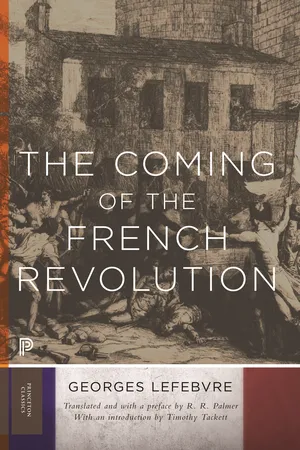 eBook - PDF
- Georges Lefebvre, R. R. Palmer(Authors)
- 2019(Publication Date)
- Princeton University Press(Publisher)
But no such revision ever took place, for in August 1791 , when the debate was resumed, Thouret objected that the Declaration was now so familiar to the people, so clothed in their eyes with a 168 T H E R I G H T S O F M A N A N D C I T I Z E N “religious and sacred character,” that it had become a “sym-bol of political faith” which should be touched with extreme caution. The supplement considered necessary was therefore combined in 1791 with a summary of the Declaration to form a preamble to the Constitution, stating the “fundamental arrangements” which it guaranteed. The Declaration of the Rights of Man and the Citizen, symbol of the Revolution of 1789 , remained as provisionally adopted by the National Assembly on August 26 of that year. Principles Men are born and remain free and equal in rights . This memorable affirmation, standing at the head of Article i , summarizes the accomplishments of the Revolution from July 14 to August 4 , 1789 . The rest of the Declaration is so to speak only an exposition and commen-tary on it. “The aim of all political association is to preserve the nat-ural and imprescriptible rights of man.” Here (in Article ii ) the idea of the social contract, popularized in France by Rousseau, was implicitly adopted. Sieyès and Mounier had also set up “the greatest good of all” and “the general felic-ity” as the aims of social organization; but these phrases are not to be found in the text of the Declaration, though the equiva-lent, the “general happiness,” was to figure in the Constitution of 1793 . The rights of man are said in Article ii to be “liberty, property, security and resistance to oppression.” Seven arti-cles are devoted to liberty. eBook - PDF
The Last Utopia
Human Rights in History
- Samuel Moyn(Author)
- 2011(Publication Date)
- Belknap Press(Publisher)
Far from providing rationale for foreign or “human” claims against states, assertions of rights were at root—and for at least a century—a justification for states to come about. Unlike the founding documents of the Ameri-can states, the Declaration of Independence had no real list of enti-tlements in it, since it aimed primarily to achieve sovereignty exter-nally against European encroachment. 32 As a matter of fact, rights were subordinate features of the creation of both state and nation beginning in this era, for few took the trouble to distinguish them. 33 A mere decade after the Americans declared the autonomy of their new state to the world, the French in their own revolutionary decla-ration of rights insisted “the principle of all sovereignty resides es-sentially in the Nation,” adding for good measure that “no body and no individual may exercise authority which does not emanate ex-pressly from it” (Art. 3). In an era in which American popular unity Humanity before Human Rights 27 coalesced thanks as much to bloody Indian wars as to high princi-ples, it may have been simply true to stereotype for the French to identify their own national identity with universal morality; they saw no conflict in proclaiming the emergence of a sovereign nation of Frenchmen and announcing the rights of man as man at one and the same time. As a result, rights announced in the constitution of the sovereign nation-state—not “human rights” in the contemporary sense—were the great and fateful bequest of the French Revolution to world politics. No doubt, the transition to the world of potentially republican states did not simply reproduce the international affairs of a world in which empire and monarchy set the standard. The French Revolu-tion did have profound implications for the global order, imme-diately making several Enlightenment visions of “perpetual peace” seem within reach to a few. eBook - PDF
- Wayne A. Meeks(Author)
- 1992(Publication Date)
- Yale University Press(Publisher)
2 A SENTIMENTAL DÉCLARATION OF THE RIGHTS OF MAN True principles, rationally determined . . . Human thought cannot be described without emotions. Social insti-tutions like a constitution—and constitutionalism—are emotionally determined. To justify this assertion, we have to look at the role of the emotions in the creation of fundamental constitutional institutions. From the standpoint of modern constitutionalism, the defining documents are the American Constitution and The Declaration of the Rights of Man and of the Citizen from 1789 (henceforth “Declaration”). Anyone discuss-ing constitutionalism or human rights on the continent in the last two hundred years will have used the grammar of the Declaration, the French Constitution of 1791, or the American Constitution of 1787. Subsequent constitutional history has largely been a history of intelligently grounded (and occasionally mechanical) borrowing from French sources, and some-times from American ones. The focus of the present analysis will be the French Declaration. The legal scholar’s response to the constitutional sentiment thesis is that the Declaration’s influence was limited to the debates sur-rounding the 1791 Constitution: namely, reference was made to it in debates on electoral rights, the equality of Protestants and Jews, and the liberation of the slaves. The Declaration, together with the Constitution of 1791, lost all validity as texts applicable in the law within a few months. 1 A SENTIMENTAL DÉCLARATION OF THE RIGHTS OF MAN 88 Perhaps the legal scholar is interested in the creation of the Declaration merely as he considers its history to be an interpretive aid; for him what is important is the final fact of the Declaration, namely its text; as a source of law, it has not existed for nearly two hundred years. The act of the document’s creation is over once the text exists. From this point on, what counts is its supposed meaning. eBook - PDF
The History of Human Rights
From Ancient Times to the Globalization Era
- Micheline Ishay(Author)
- 2008(Publication Date)
- University of California Press(Publisher)
82 THE FRENCH DECLARATION OF THE RIGHTS OF MAN AND OF THE CITIZEN, 1789 . . . The National Assembly recognizes and proclaims, in the presence and un-der the auspices of the Supreme Being, the following rights of man and citizen. 1. Men are born and remain free and equal in rights; social distinctions may be based only upon general usefulness. 2. The aim of every political association is the preservation of the natural and inalienable rights of man; these rights are liberty, property, security, and resist-ance to oppression. 3. The source of all sovereignty resides essentially in the nation; no group, no individual may exercise authority not emanating expressly therefrom. 4. Liberty consists of the power to do whatever is not injurious to others; thus the enjoyment of the natural rights of every man has for its limits only those that assure other members of society the enjoyment of those same rights; such lim-its may be determined only by law. 5. The law has the right to forbid only actions which are injurious to society. Whatever is not forbidden by law may not be prevented, and no one may be con-strained to do what it does not prescribe. 6. Law is the expression of the general will; all citizens have the right to con-cur personally, or through their representatives, in its formation; it must be the same for all, whether it protects or punishes. All citizens, being equal before it, are equally admissible to all public offices, positions, and employments, accord-ing to their capacity, and without other distinction than that of virtues and talents. 7. No man may be accused, arrested, or detained except in the cases deter-mined by law, and according to the forms prescribed thereby. All who solicit, ex-pedite, or execute arbitrary orders, or have them executed, must be punished; but every citizen summoned or apprehended in pursuance of the law must obey immediately; he renders himself culpable by resistance. eBook - PDF
Debating Modern Revolution
The Evolution of Revolutionary Ideas
- Jack R. Censer(Author)
- 2016(Publication Date)
- Bloomsbury Academic(Publisher)
To be fair, the Declaration also used the term “United” as well. The Declaration also invoked specific historical rights on which the Americans had previously relied. In fact, a long list of grievances that detailed the monarch’s abridgment of historical rights followed more general claims. These two justifications held different bases— history and universal rights—but they were cousins in the opposition to the monarch who abused them. In fact, it is likely that the division of these discourses used by modern scholars was little evident to DEBATING MODERN REVOLUTION 16 most Americans or Westerners (with some prominent exceptions such as John Adams), who floated back and forth between these justifications. But, as it was “human rights” that would proliferate globally, we need to understand more about the founders’ document beyond Jefferson’s axiom regarding equality. While much of the piece indicted George III and his government in largely “country terms,” the first long paragraph established a new nation on the basis of natural law and human rights. With a logic that later became familiar, the document, mainly written by Thomas Jefferson, set as axiomatic that the laws of nature and “Nature’s God” (making God a creator more than a current actor), emboldened Americans to dissolve the relationship with England. And Jefferson continued, “all men are created equal” and thus have certain “inalienable Rights,” given by God, to possess “life, liberty, and the pursuit of happiness.” From these rights flowed appropriate governments, whose power came from the “consent of the governed.” If a government violated this bond with its citizens, they could alter it or abandon it in order to benefit from the well-being under a government based on natural law and responsive to its constituents. eBook - PDF
- Pamela Slotte, Miia Halme-Tuomisaari(Authors)
- 2015(Publication Date)
- Cambridge University Press(Publisher)
141. 15 See my Thomas Paine, pp. 179–96, and my ‘Paine and the Religiosity of Rights’, in Rachel Hammersley (ed.), Revolutionary Moments (London: Bloomsbury, 2014), pp. 85–92. 212 pluralities of discourses and rights not require such proof, nor do they need to be seen as deductions from natural rights, though they commence as such. Thus The Declaration of the Rights of Man and of the Citizen proclaimed liberty, property, security and resistance to oppression to be among the ‘natural and imprescriptible rights of man’, and equality before the law, freedom of the press and of religion and so on, as other rights. 16 The extension and proliferation of such rights shortly thereafter – for example the granting of political rights to some free blacks and mulattos in May 1791 – indicates the clearly inventive, declaratory, prescriptive, positive and conventional nature of the new claims. The onward march of rights claims is one of the most striking facets of this phenomenon. Inclusiveness, or universality, was now to be the principle against which rights claims would inexorably be tested for the next two centuries, to the present day, as slaves, Jews, women, non-whites, illegitimate children (and the young generally), and other groups came increasingly to proclaim their desire to be treated like prop- ertied white males (and then came animals and nature). Until the breach with humanity, what underpinned all such claims was the principle of the social equality of all human beings. It was the enormous moral force of this principle that impelled the modern debate about rights to move beyond established constitutional, legal rights to the proclamation of new rights, or the including of new groups under the umbrella of old rights.
- Maurice Wohlgelernter(Author)
- 2019(Publication Date)
- Columbia University Press(Publisher)
This thesis does not imply that human history is primarily the result of intellectual movements. Political institutions are the consequences of many human experiences, struggles for power, and thoughts and passions. Doctrines are often the ration-alizations of what has already happened. They may be ideolog-ical weapons of people trying to maintain or to grasp power. But I assume that ideas—including the idea that ideas are only a superstructure over a material process—have consequences. And I assume that the clarification of ideas has value, both on intrinsic and on utilitarian grounds. Hence my concern is for the idea and the practice of human rights. The Novelty of the Enlightenment It was the triumph of the Enlightenment that it enunciated human rights with an unprecedented power and universality. The Declaration of Independence is a good example of the faith of the Enlightenment. Historians often point out that it repre-sented a wide consensus in its time, and Thomas Jefferson him-self acknowledged that his critics said that the Declaration was largely taken from John Locke. However, if the basic themes of the Declaration were not unusual in their cultural setting, the culture itself was making a novel and radical set of affirmations: We hold these truths to be self-evident, that all men are created equal, that they are endowed by their Creator with certain unalienable Rights, that among these are Life, Liberty and the pursuit of Hap-piness.—That to secure these rights. Governments are instituted among Men, deriving their just powers from the consent of the governed,—That whenever any Form of Government becomes destruc- 296 R O G E R L. S H I N N tive of these ends, it is the Right of the People to alter or to abolish it, and to institute new Government, laying its foundation on such princi-ples and organizing its power in such form, as to them shall seem most likely to effect their Safety and Happiness. eBook - ePub
Revolutionary Ideas
An Intellectual History of the French Revolution from The Rights of Man to Robespierre
- Jonathan Israel(Author)
- 2014(Publication Date)
- Princeton University Press(Publisher)
In the crucial vote on 19 August, 620 deputies voted for Mirabeau’s formulation, 220 for Sieyès’s second draft, and, despite Lally-Tollendal’s pleas to cut the metaphysics, only 45 for Lafayette’s. 52 Finalized on 26 August, the Rights of Man and the Citizen envisaged society’s renewal on a completely fresh basis, not one supposedly inherent in the nation’s legal past (as with the American Declaration). 53 Where the American Declaration declares natural rights inherent in British constitutional liberties, the French Declaration invokes rights enshrined in laws yet to be made. The Assembly, Mirabeau, Condorcet, and Volney felt, had in some degree “disfigured” the outcome by qualifying freedom of thought and the press. 54 Even so, the result was a stunning success for Mirabeau, Sieyès, Volney, Brissot, Condorcet, Destutt de Tracy, Pétion, Rabaut, and, generally, the radical bloc. For the first time in history, equality, individual liberty, the right to equal protection by the state, and freedom of thought and expression were enshrined as basic principles declared inherent in all just and rational societies. The bedrock of democratic modernity was in place. The rights the French adopted for themselves were proclaimed universal rights belonging equally to all of whatever nation, station, faith, or ethnicity. It was undeniably Mirabeau and, outside the Assembly, also Brissot, observed Carra, who eclipsed everyone else in securing the Declaration, the new revolutionary creed: “the nation owes each a fine civic crown.” 55 Of course, most contemporaries had little inkling of the republican, democratic, and Radical Enlightenment motivation that shaped this result. American independence “opened our eyes about the true destiny of peoples,” their “natural rights, and the equality of everyone’s rights,” acknowledged Carra in October, confident the entire world would be transformed by the principle of human rights based on equality eBook - PDF
- Candice E. Proctor(Author)
- 1990(Publication Date)
- Praeger(Publisher)
7 The Rights of Women Learn that one only leaves slavery by a great revolution. Is this revo- lution possible? It is for you alone to say, because it likely depends on your courage. [Choderlos de Laclos, De VEducation des femmes] The French Revolution had proclaimed the dawning of a new era, charac- terized by the reign of liberty and equality for all. In the 1789 Declaration of the Rights of Man and of the Citizen, and again in the 1793 Declara- tion presented by Robespierre, the fundamental principles of this new order were enumerated. The equality of rights was established by nature, and liberty was defined by Robespierre as "the power that belongs to man to exercise, at his pleasure, all his faculties." These rights belonged equally to all men, "whatever might be the difference in their physical or moral forces." They included the right of every individual to the posses- sion of his own property and to be admitted to all public functions. The nation was declared sovereign, and it was stipulated that no portion of the people could be allowed to exercise the power of the population as a whole. However defective the Revolution may have been in the application of these principles to the male population, there was hardly even any attempt to apply them to the female sector of the nation. The discrepancy between the wording of the Declaration and its actual practice in relation to the two sexes is so glaringly maladroit that, in all probability, the authors who drew up The Declaration of the Rights of Man did not even 110 The Rights of Women 111 pause to consider what would have been the incontestable fact that women constituted fully one half of the "people" of France. When they said "man," the authors thought of man the male, not man the human being, simply because the females of their society were always sub- merged, in both thought and reality, beneath the men in their lives.
Index pages curate the most relevant extracts from our library of academic textbooks. They’ve been created using an in-house natural language model (NLM), each adding context and meaning to key research topics.

