History

Thomas Paine Common Sense
"Common Sense" is a pamphlet written by Thomas Paine in 1776, advocating for American independence from British rule. Paine's persuasive and straightforward writing style made the case for independence accessible to the general public, and the pamphlet played a significant role in swaying public opinion in favor of the American Revolution. Paine's work remains a foundational text in American history.
Written by Perlego with AI-assistance
Related key terms
1 of 5

11 Key excerpts on "Thomas Paine Common Sense"
 eBook - ePub
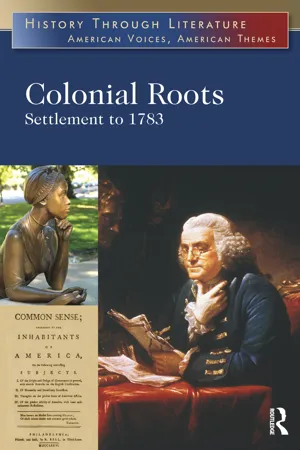
Colonial Roots
Settlement to 1783
- Jeffrey H. Hacker(Author)
- 2014(Publication Date)
- Routledge(Publisher)
Common Sense linked the colonial cause to the ideal of freedom throughout the world, casting the colonists in a millennial struggle between liberty and tyranny. Although freedom found itself “hunted round the globe,” he wrote, “we have it in our power to begin the world over again” and “prepare in time an asylum for mankind.”Common Sense did not lead the colonies on a direct path to independence; no single document could generate the consensus needed for such a momentous decision. What it did accomplish was to further fray the colonists’ ties to the British monarchy, to spark widespread public discussion of independence—a topic that had been largely taboo until that time—and to provide a framework for understanding the events that eventually pushed the colonies to declare their autonomy in July 1776. In short, Common Sense helped transform the imperial crisis from a colonial struggle for greater autonomy within the British Empire into a movement for complete independence.John Craig HammondSee also: Lexington and Concord and the “Shot Heard ’Round the WorldChapter Three, Common Sense (excerpt), 1776Aside from its historical influence in marshaling colonial support for independence, Thomas Paine’s Common Senseholds a place of importance in American literary history for its rhetorical voice and its appeal to the colonial “everyman” in ordinary speech. As such, it is as revolutionary in prose style as it is in political message, eschewing the classical references and flowery Romantic phrasings of European oratory in favor of “plain arguments” and direct appeal. Nowhere is this more apparent than in Chapter Three, excerpted below, in which Paine analyzes “the struggle between England and America” and makes the case for independence. The uniquely America style of political discourse pioneered in eBook - PDF
- Joseph Black, Leonard Conolly, Kate Flint, Isobel Grundy, Wendy Lee, Don LePan, Roy Liuzza, Jerome J. McGann, Anne Lake Prescott, Barry V. Qualls, Jason Rudy, Claire Waters(Authors)
- 2017(Publication Date)
- Broadview Press(Publisher)
The result, Common Sense , became the most widely distributed pamphlet on the topic (with Paine estimating over 150,000 copies distributed in the American colonies), spreading the argument for independence throughout the would-be nation. Paine called on ordinary people to give their energy to a higher purpose—the creation of America—and essentially began the formation of American patriotism. His accessible prose, simple but persuasive style, compelling logic, and gift for dismissing opposing arguments made him the American Revolution’s most adept propagandist. Dubbing Britain a “tyrannical oppressor,” Common Sense explains that government, at best “a necessary evil,” should serve to protect its citizens and preserve their freedom. A subsequent series of letters, entitled The American Crisis (1776–83), continued to muster support for the revolution in the face of military setbacks and public fear and despondency. One such letter’s rousing and powerful rhetoric—“These are times that try men’s souls. […] Tyranny, like hell, is not easily conquered”—was read to Washington’s troops on Christmas Eve to boost their morale. After the American War of Independence concluded, Paine traveled between Britain, France, and America, rather lacking in direction until the publication of Edmund Burke’s conservative pamphlet attacking the French Revolution, Reflections on the Revolution in France (1790), spurred him to publish a rebuttal, based largely on the account of the Revolution he had been working on at the time. Part 1 of Paine’s Rights of Man (1791) came in the midst of a pamphlet storm of replies to 6 Thomas Paine Burke, amongst which one of the most famous was Mary Wollstonecraft’s A Vindication of the Rights of Man. Demonstrating once again his powers of persuasion, and leaning on the weight of his experience in the American Revolution (the work was dedicated to George Washington), Paine challenged Burke’s scathing criticism of the French Revolution. eBook - PDF
- Robert A. Ferguson, Robert A. FERGUSON(Authors)
- 2009(Publication Date)
- Harvard University Press(Publisher)
C H A P T E R T H R E E The Commonalities of Common Sense Historians always note the great impact of Tom Paine’s Common Sense in 1776, and critics agree in calling it “one of the most brilliant pamphlets ever written in the English language.” Yet, despite the fre-quency of these claims, they are rarely brought together as mutually informing insights or controlling premises. 1 On the one side, the twin appeals of the pamphlet—the historical assertion of immediate im-pact and the literary assessment of timeless merit—make it an ex-traordinary source for gauging how Americans think about them-selves and their country, then and now. On the other side, the same unique combination of instant effect and lasting influence welcomes rhetorical analysis, turning Common Sense into a seminal text for thinking about the art of persuasion in American life. What is more, precisely how the pamphlet persuades its readers is an object lesson in the workings of modern democratic culture. The way Americans have absorbed Common Sense into collective memory remains an untold story in ideological formations. There is, in fact, no other written production in American cul-ture quite like Common Sense. No other text by a single author can claim to have so instantly captured and permanently held the national imagination. 2 At a time when the largest colonial newspapers and most important pamphlets had circulations under 2000, Common Sense achieved between 120,000 and 150,000 copies in its first year alone. It was the first truly American best-seller. Hundreds of thou- sands of Americans, perhaps a fifth of the population in all, either read Common Sense or had it read to them during the course of the Revolution.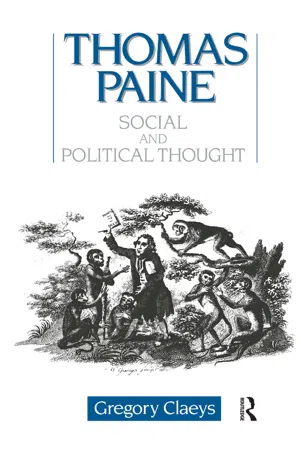 eBook - ePub
Thomas Paine
Social and Political Thought
- Gregory Claeys(Author)
- 2020(Publication Date)
- Routledge(Publisher)
A New Yorker reported that it was ‘eagerly read and much admired’. General Charles Lee called the tract ‘a masterly, irresistible performance’, while one American officer regarded it as equivalent in morale to 5,000 troops. Individual readers were often overwhelmed; one recorded that ‘I could not withhold my assent to the arguments of the victorious author’. Common Sense in fact, had ‘broken the spell’, as Paine later put it, of Britain’s hold over the colonies. It convinced Americans, as Gilbert Vale wrote, ‘that the British constitution was not the best that could be, and that a government of kings, lords, and commons, might not be the essence of all that was excellent in each’. 28 Common Sense effected this ‘sudden and virtually complete revolution in attitude’ towards British rule (in Cecelia Kenyon’s words) by releasing all of the pent-up resentment against the monarch which pervaded colonial America. Loyalty to George III was hard enough by 1776; Paine transformed the king into a tyrant – even ‘killed’ him metaphorically, it has been suggested – and made attachment nearly impossible thereafter. In this sense the tract was central to defining ‘America’ in republican terms. Moreover, Paine appealed to an audience hitherto ignored by political writers. As Gordon Wood has written, some of the ‘awe and consternation’ Common Sense aroused ‘came from its deliberate elimination of the usual elitist apparatus of persuasion and its acknowledged appeal to a wider reading public’. 29 Paine found particular favour in Philadelphia and other large cities where artisans and tradesmen were as anxious to battle the native aristocracies governing their colonial assemblies as to reject British imperial rule eBook - PDF
Howard Fast
A Critical Companion
- Andrew F. Macdonald(Author)
- 1996(Publication Date)
- Greenwood(Publisher)
As Fast points out, Common Sense was biblical in style—that of a "backwoods preacher" in Jefferson's judgment—hammering out a message in easily remembered aphorisms: "These are the times that try men's souls. The summer soldier and the sunshine patriot will, in this crisis, shrink from the service of their coun- try" (145). Through the common run of Americans depicted in the book, we come back to the enormity of Paine's achievement, of his capacity to convey complex new political ideas in the idiom of the ordinary person. The fictional characters we see in the novel are the representatives of many others. The little book with the modest title had possibly 1 million readers, or one out of three colonials, and quite possibly all who could read. (Since Paine virtually gave the book to printers, no royalty records indicate readership; Paine himself had no idea, and pirated editions were legion.) It was read out loud over campfires and around hearths, its stylistic nuggets of revolutionary propaganda easily remembered by il- literate backwoodsmen for whom eighteenth-century intellectual elo- quence was a foreign language. Yet for all his friends and acquaintances, whether high achievers or ordinary folk, the novel most often shows Paine alone. When he is in the company of others, he is even then separate and isolated by his social class or by his perception of his difference. His abuse of alcohol and his carelessness about personal appearance do little to help his social repu- tation, and he rejects women as impediments to his revolutionary vo- cation. At the end of the book he is isolated by age and the change in his reputation, and he dies as he lived, a man set apart. THEMATIC ISSUES Social Class and Opportunity in America The wonderfully conceived introduction to Paine (quoted at the be- ginning of the section on key characters) goes far to define what is good about America. eBook - PDF
- S. Cleary, I. Stabell, S. Cleary, I. Stabell, Kenneth A. Loparo, Kenneth A. Loparo, Short, Quinlan(Authors)
- 2016(Publication Date)
- Palgrave Macmillan(Publisher)
We have it in our power to begin the world over again.” 3 The pamphlet was an immediate success. It galvanized a quarrel- some people, dispirited by early reversals in the war and uncertain about the proper course of action for the future. Nothing could more clearly convey this than to take a quick survey of opinion before its publication. In November, 1775, two months before Common Sense, Thomas Jefferson wrote in a letter to a friend: “There is not in the British Empire a man more cordially loves a union with Great Britain than I do.” Six months later he would pen the radical Declaration of Independence. George Washington toasted King George III at din- ners. Joseph Warren, a Boston radical who was killed at Bunker Hill later in 1776, wrote, “An independence from Great Britain is not our aim. No, our wish is, that Britain and the colonies may like oak and ivy, grow and increase in strength together.” 4 What had moved each to the momentous decision to separate from England and commit to a war for independence, to risk their lives and, in the case of Warren, to give his later at Bunker Hill? There may have been many reasons for each individual, but in no small part it was a reading of Common Sense. Across the colonies, Americans by the thousands learned from their reading of it and made their own choices, many frightened by his words and not in support of independence; many others the opposite. As Washington said to his secretary Colonel Joseph Reed, the book was “working a powerful change there in the minds of men.” 5 With Common Sense and the later American Crisis series of essays, Paine became the first to propose American independence in writ- ing, an accomplishment that is still undervalued for its impact on the course of the revolution or for its implications for his own personal safety when it became known who the author of such a treasonous work was. To Paine also goes the honor of the first published use of eBook - ePub
Common Sense in Early 18th-Century British Literature and Culture
Ethics, Aesthetics, and Politics, 1680–1750
- Christoph Henke(Author)
- 2014(Publication Date)
- De Gruyter(Publisher)
It signals with its very title a claim to a plausible rational truth that should be commonly accepted – by no means a new or original strategy, as there were many other pamphlets and tracts of far lesser political impact before Paine’s text with the same title, but one that was especially effective in combination with Paine’s emotive rhetorical style. 259 The third section of Paine’s sermonic treatise, in which he explicitly argues for America’s independence from Britain, is prefaced by the following much quoted sentence: In the following pages I offer nothing more than simple facts, plain arguments, and common sense; and have no other preliminaries to settle with the reader, than that he will divest himself of prejudice and prepossession, and suffer his reason and his feelings to determine for themselves; that he will put on, or rather that he will not put off, the true character of a man, and generously enlarge his views beyond the present day. (Paine 1995: 20) Paine skilfully employs here well-established elements of common sense discourse (“simple facts, plain arguments” as well as being free “of prejudice and prepossession”) and mixes them with an appeal to his readers’ feelings and their openness to a broader view of things (to “generously enlarge his views beyond the present day”). In this clever rhetorical approach, the usual commonsense appeal becomes Paine’s Trojan horse in order to reveal a proposition going far beyond common consensus, i. e. the independence of the American colonies. While Paine himself, the born and bred “Englishman” (which is the anonymous description of the author on the title page of the first edition), is of course part of English common-sense culture, he subversively uses its rhetoric here in order to declare war on the self-proclaimed homeland of common sense eBook - ePub
My Pen and My Soul Have Ever Gone Together
Thomas Paine and the American Revolution
- Vikki Vickers(Author)
- 2008(Publication Date)
- Routledge(Publisher)
Chapter Three Why Thomas Paine? DOI: 10.4324/9780203959794-4In 1973, as the 200th anniversary of Common Sense loomed, Bernard Bailyn dared to wonder, “What is one to make of this extraordinary document after 200 years? What questions…should one ask of it?”1 Bailyn chose to focus his study on the “uncommon,” or extraordinary elements of Common Sense.2 That same year noted historian Winthrop Jordan also published an essay about Common Sense entitled “Familial Politics: Thomas Paine and the Killing of the King, 1776.”3 Whereas Bailyn chose to focus more on the unique rhetorical aspects of Common Sense, Jordan opted to inquire into “the subliminal sources of political influence” and pondered whether or not such an “arcane” study of a symbolic homicide should even be undertaken.4 This has been the nature of Paine scholarship over the course of the past 200 years: a hodgepodge of theories and assessments ranging from the mundane to the truly esoteric and everything in between. Over the course of the past two centuries, rhetoricians, literary critics, political scientists, historians, and religious scholars have all taken an interest in Paine’s explosive pamphlet.Nearly 200 years of scholarship exists on Thomas Paine and yet there remains no answer to the most important question often posed by historians: “why Thomas Paine?” How was it that this man—a poor, unknown Englishman—wrote Common Sense transforming the nature of political debate on two continents? It is puzzling that after so long a time and after so much research that this is still a mystery. However, a close survey of the historiography of Paine’s life and career reveals the reason for this gulf in Paine studies: improper or nonexistent contextualization. Scholars of rhetoric, history, political science, and religion, have studied Paine within their separate spheres, rather than communicating across disciplines. Nowhere is this schism more apparent than in studies of Common Sense
- Robert Green Ingersoll(Author)
- 2011(Publication Date)
- Perlego(Publisher)
In my judgment Thomas Paine was the best political writer that ever lived. "What he wrote was pure nature, and his soul and his pen ever went together." Ceremony, pageantry, and all the paraphernalia of power, had no effect upon him. He examined into the why and wherefore of things. He was perfectly radical in his mode of thought. Nothing short of the bed-rock satisfied him. His enthusiasm for what he believed to be right knew no bounds. During all the dark scenes of the Revolution, never for one moment did he despair. Year after year his brave words were ringing through the land, and by the bivouac fires the weary soldiers read the inspiring words of "Common Sense," filled with ideas sharper than their swords, and consecrated themselves anew to the cause of Freedom.Paine was not content with having aroused the spirit of independence, but he gave every energy of his soul to keep that spirit alive. He was with the army. He shared its defeats, its dangers, and its glory. When the situation became desperate, when gloom settled upon all, he gave them the "Crisis." It was a cloud by day and a pillar of fire by night, leading the way to freedom, honor, and glory. He shouted to them, "These are the times that try men's souls. The summer soldier, and the sunshine patriot, will, in this crisis, shrink from the service of his country; but he that stands it now deserves the love and thanks of man and woman."To those who wished to put the war off to some future day, with a lofty and touching spirit of self-sacrifice he said: "Every generous parent should say, 'If there must be war let it be in my day that my child may have peace.'" To the cry that Americans were rebels, he replied: "He that rebels against reason is a real rebel; but he that in defence of reason rebels against tyranny has a better title to 'Defender of the Faith' than George the Third."Some said it was not to the interest of the colonies to be free. Paine answered this by saying, "To know whether it be the interest of the continent to be independent, we need ask only this simple, easy question: 'Is it the interest of a man to be a boy all his life?'" He found many who would listen to nothing, and to them he said, "That to argue with a man who has renounced his reason is like giving medicine to the dead." This sentiment ought to adorn the walls of every orthodox church. No longer available |Learn more
Imaginary Dialogues in American Literature and Philosophy
Beyond the Mainstream
- Till Kinzel, Jarmila Mildorf(Authors)
- 2014(Publication Date)
- Universitätsverlag Winter(Publisher)
Jack Fruchtman Jr. The American Dialogues of Thomas Paine Best known as one of the most effective eighteenth-century American pamphleteers and revolutionary theorists, Thomas Paine (1737-1809) spent the first thirty-seven years of his life wandering the British countryside unsuc-cessfully searching for steady work. Out of frustration and anger at his impov-erished condition, he finally immigrated to America in November of 1774, to seek a peaceful, quiet life, uninterrupted by any distractions. America of the New World distinctly contrasted with everything in Britain and Europe: “America,” he wrote, “has now outgrown the st ate of infancy; her strength and commerce make large advances to manhood; and science in all its branches has not only blossomed, but even ripened on the soil.” Even the air was different from the Old World. “There is a happy something in the climate of A merica, which disarms [Europeans] of all their power both of infection and attraction.” 1 Paine wanted to renew his life, to remake himself as a writer, and give up his British background to reinvent his personality and lifestyle. That plan was, however, immediately shaken with the galvanizing event of the British attack on April 19, 1775, on American militiamen at Lexington and Concord, which took place just over four months after his arrival in Philadelphia. “All the plans or prospects of private life (for I am not by nature fond of, or fitted for a public one and feel all occasions of it where I must act personally a burden) all these plans, I say, were immediately disconcerted, and I was at once involved in all the troubles of the country.” 2 As he later t old Benjamin Franklin, he found “it very hard to have the country set on fire about my ears almost the moment I got into it.” 3 Paine’s most widely read work, Common Sense , appeared six months before the Americans declared their independence from the Empire. eBook - ePub
- Kenneth W Burchell(Author)
- 2020(Publication Date)
- Routledge(Publisher)
Thoughts on Government defines one of the great debates in civic republicanism and of American political history: democratic versus elitist power; power centred on a veto-wielding unitary executive or legislative power elected from a broad franchise.The text reproduced here is the first edition of 1776, published anonymously. A second edition, under Adams's name, was published in the same year. Adams, an enthusiastic diarist and correspondent, recorded the publication history:My continual occupations in Congress allowed me no time to write any thing of any length; but I found moments to write a small pamphlet, which Mr. Richard Henry Lee, to whom I showed it, liked so well, that he insisted on my permitting him to publish it. He accordingly got Mr. Dunlap to print it, under the title of 'Thoughts on Government, in a letter from a gentleman to his friend.' Common Sense was published without a name, and I thought it best to suppress my name too. But as Common Sense, when it first appeared, was generally by the public ascribed to me or Mr. Samuel Adams, I soon regretted that my name did not appear. Afterwards I had a new edition of it printed, with my name and the name of Mr. Wythe, of Virginia, to whom the letter was at first intended to be addressed.5The impact of Adams's Thoughts on Government is difficult to quantify due to its nearly universal influence during the period of constitutional formation: it was decisive in his own state of Massachusetts, on the governments of Virginia, North Carolina, New Jersey and New York, and later on the 1789 Federal Constitution itself.Thoughts on Government is so central to the debate around Paine and to the subsequent debates in the Early Republic that its value necessitates inclusion in this collection despite the general editorial principle to focus on rarer works that have generally not been reprinted.6Notes
- 1. J. Adams, Diary and Autobiography,
Index pages curate the most relevant extracts from our library of academic textbooks. They’ve been created using an in-house natural language model (NLM), each adding context and meaning to key research topics.

