History

Whiskey Rebellion
The Whiskey Rebellion was a 1794 uprising in western Pennsylvania in response to a federal excise tax on whiskey. The rebellion was fueled by the resentment of small farmers and distillers towards the tax, which they saw as unfair and burdensome. President George Washington's response, including the mobilization of a federal militia, demonstrated the new government's ability to enforce federal laws and maintain order.
Written by Perlego with AI-assistance
Related key terms
1 of 5
10 Key excerpts on "Whiskey Rebellion"
 eBook - PDF
Revolts, Protests, Demonstrations, and Rebellions in American History
An Encyclopedia [3 volumes]
- Steven L. Danver(Author)
- 2010(Publication Date)
- ABC-CLIO(Publisher)
“The Whiskey Rebellion and the Trans-Appalachian Frontier.” Topic: A Journal of the Liberal Arts 45 (Fall 1994). Slaughter, Thomas P. The Whiskey Rebellion: Frontier Epilogue to the American Revolution. Oxford, UK: Oxford University Press, 1986. President George Washington’s Proclamation against the Whiskey Rebellion (1794) In 1791, the federal government imposed an excise tax on whiskey. In western Pennsylvania, whiskey was a medium of barter and an important source of income. The tax, by virtually elimi- nating any profit to be derived from the sale or trade of whiskey, threatened the very livelihood of many western farmers, who quickly showed their displeasure by rioting, assaulting tax collectors, and destroying the homes and property of federal officials. When a federal marshal was attacked in Allegheny County, Pennsylvania, in July 1794, President George Washington responded to the growing disorder on August 7 by issuing the following proclamation, which imposed martial law, ordered all rioters to return to their homes, and called out the militia to sup- press the insurrection. The Whiskey Rebellion was the first real test of the power of the new federal government to maintain law and order within the states. BY AUTHORITY By the president of the United States of America A Proclamation Whereas, combinations to defeat the execution of the laws laying duties upon spirits distilled within the United States and upon stills have from the time of the commence- ment of those laws existed in some of the western parts of Pennsylvania. eBook - ePub
- Anna Zeide(Author)
- 2023(Publication Date)
- Bloomsbury Academic(Publisher)
This conception of whiskey, along with its critical role in the frontier economy, explains why the conflicts over the whiskey taxes and resulting Whiskey Rebellion became so heated. At the heart of the conflict were also broader disagreements between Jefferson and his rival Alexander Hamilton, which laid the foundation for the first political parties in the new United States. Jefferson and his followers favored farmers and ordinary people, a weak federal government, state banks, and free trade. Hamilton and his Federalist party, in contrast, championed an elite manufacturing society, a strong central government, a national bank, and protective tariffs. Thus, when Hamilton led Congress in passing “an excise on distilled spirits” in 1791 in order to raise revenue to pay down the national debt, he was not only taxing whiskey but also enacting his political views in leveraging the power of the federal government to bring the backcountry frontiersmen who produced whiskey in line with a modern manufacturing economy. But the westerners targeted by this tax fought back—again, not only to protect their whiskey, but to protect their own political views and ways of life. This event and the frontier in which it took place were key to early American politics.The “Whiskey Rebellion” and Its AftermathIn calling this episode in US history the “Whiskey Rebellion,” scholars have followed the lead of Alexander Hamilton himself who was understandably antagonistic toward the rebels. Historian Terry Bouton argues that this term diminishes the frontiersmen’s position, making us think of them as “drunken, gun-wielding hillbillies, frightening but too comical to be taken seriously.” Instead, he argues that it should more appropriately be called the “Pennsylvania Regulations,” to place the events into the context of other “regulations,” or prior efforts in the backcountry to regulate the government and influence political leaders.21 Contemporaries who supported the insurrectionists put forward similar claims, as with Henry Brackenridge, whose 1794 book is titled History of the Western Insurrection, with only a reference to the common (but less accurate) name of the “Whiskey Insurrection” in the subtitle (Figure 3 ). And indeed, the actions of western Pennsylvanians had precedents in earlier agrarian protests and in efforts to combat taxes that Americans saw as unjust. In fact, the entire American Revolution might be seen as one such precedent. In the hit Broadway musical Hamilton, Thomas Jefferson’s character makes this connection when he raps, “Look, when Britain taxed our tea, we got frisky. Imagine what gon’ happen when you try to tax our whisky.”22 In this way, the “Whiskey Rebellion” was akin to the Boston Tea Party itself, only with Hamilton on the other side. Hamilton and the Federalists, for their part, denied this comparison, arguing that, in this case, the taxation followed fair elected representation in Congress—taxation with No longer available |Learn more
- (Author)
- 2014(Publication Date)
- The English Press(Publisher)
mail. Both were pardoned by President Washington. Legacy The Washington administration's suppression of the Whiskey Rebellion met with widespread popular approval. The episode demonstrated that the new national government had the willingness and ability to suppress violent resistance to its laws. It was therefore viewed by the Washington administration as a success, a view that has generally been endorsed by historians. The whiskey excise remained difficult to collect, however, having been largely unenforceable outside of western Pennsylvania, and even there never having been collected with much success. The events contributed to the formation of political parties in the United States, a process already underway. The whiskey tax was repealed after Thomas Jefferson's Republican Party, which opposed Hamilton's Federalist Party, came to power in 1800. The Whiskey Rebellion raised the question of what kinds of protests were permissible under the new Constitution. Legal historian Christian G. Fritz argued that, even after ratification of the Constitution, there was not yet a consensus about sovereignty in United States. Federalists believed that the government was sovereign because it had been established by the people, and so radical protest actions, which were permissible during the American Revolution, were no longer legitimate. But the Whiskey Rebels and their defenders believed that the Revolution had established the people as a collective sovereign, and so the people had the collective right to change or challenge the government through extra-constitutional means. Historian Steven Boyd argued that the suppression of the Whiskey Rebellion prompted anti-Federalist westerners to finally accept the Constitution, and to seek change by voting for Republicans rather than resisting the government. Federalists, for their part, came to accept that the people could play a greater role in governance. eBook - ePub
Power in Modernity
Agency Relations and the Creative Destruction of the King’s Two Bodies
- Isaac Ariail Reed(Author)
- 2020(Publication Date)
- University of Chicago Press(Publisher)
48 I hazard that it did so in a way that remains to be clarified and grasped.The neoprogressive historian Terry Bouton finds in the rebellion’s conclusion a crushing defeat for the very possibility of American democracy and the betrayal of the promise of what he terms, in defiance of Alexander Hamilton and the Federalists, “the Pennsylvania Regulation of 1794.” Neem, a neo-Tocquevillian, emphasizes that the exit from the rebellion’s violence bequeathed at least the possibility of peaceful, voluntary associations in a pluralist democracy. But within and through these arguments, we can glimpse an implicit recognition that the rebellion evidenced a shift in the sinews of power. What was this shift? My hypothesis is that it was a shift in the representation of the authorship of right action and a recrafting of how chains of power were constructed and maintained.The shift entailed both creation and destruction. On the one hand, the King’s second body was destroyed, and the President, installed as supreme executive, was endowed with a second body, but of ambiguous and difficult status and meaning, subject to a new set of disputes about its figuration. Did Washington have a second body? Yes—and his separation from “the people” was, in many ways, how he sought to establish and maintain it; the eight-day procession for his installation as President would find itself at home in the pages of Ernst Kantorowicz’s book,49 and we know well the importance of elites’ love of Washington’s rectitude in their acceptance of a strong executive in the Constitution. But the investment of the second body in Washington was only partly successful—the Whiskey rebels made fun of him in their meetings (even though many of them had fought for him in the Revolutionary War), mocking his doddering old age and wooden teeth, and noting with bitter sarcasm his (supposed) affection for Indian “savages.”50 eBook - ePub
Commons Democracy
Reading the Politics of Participation in the Early United States
- Dana D. Nelson(Author)
- 2015(Publication Date)
- Fordham University Press(Publisher)
federal imposition, buoyed by recent state success, was especially robust.Westerners fought this tax because of the particular hardship it imposed on the poorest inhabitants, who didn’t have a profitable way to transport wheat (a product not excised) beyond their own region except by converting it to whiskey. Literally, as the inhabitants west of the Alleghenies understood, this tax—the first federal excise—was one that directly and disproportionately favored easterners over westerners, and the wealthy over the poor. Hamilton’s legislation package for funding the state war bonds as a national debt may have been too complicated for most in Congress to follow when they passed it in 1791, but its aims did not escape those whom the tax most burdened.Whiskey had become not just a product, but also a fundamental means of finance in the West: where wheat was used by tenants to pay their rent and labor was paid in wheat, where transportation across the mountains to market was prohibitively expensive, distilling wheat to whiskey (often in communal stills) was the only way to convert it to profit. As historian William Hogeland summarizes, a “liquid commodity both literally and figuratively, the drink democratized local economies, offering even tenants and sharecropping laborers a benefit . . . The product connected popular finance theories with small-scale commercial development that, though marginal, had potential to free rural people of debt and dependency” (Whiskey Rebellion , 67). Westerners knew that large producers could afford the excise, which had to be paid before the sale of the whiskey (which couldn’t legally be sold without federal stamps on casks). The majority of producers, however, were smallholders who lived on slim profit margins and who usually didn’t have cash until they sold their whiskey. And these small operators knew that even if they could pay the excise in advance of sale, marking up the price of their whiskey to recuperate the difference, large distillers would simply cut their prices and undercut small operator sales. The enforcement of the excise would thus force tenuously solvent smallholders to give up this key source of revenue, without which they would have to sell out to the large landholders. As Hogeland summarizes it elsewhere, “Hamilton wrote the tax law to amplify the advantages of big, industrial distillers throughout the country; to put seasonal distillers out of business; and to defeat the democratic effects of whiskey economics in the west” (Founding Finance eBook - ePub
Between Sovereignty and Anarchy
The Politics of Violence in the American Revolutionary Era
- Patrick Griffin, Robert G. Ingram, Peter S. Onuf, Brian Schoen, Patrick Griffin, Robert G. Ingram, Peter S. Onuf, Brian Schoen(Authors)
- 2015(Publication Date)
- University of Virginia Press(Publisher)
18In many ways, it was the responses to the Whiskey Rebellion that were more novel than the uprising itself, beginning with the Washington administration’s surprising turn to overwhelming force against what were essentially traditional resistance tactics. The “Watermelon Army” sent into western Pennsylvania to put down the largely dispersed Whiskey rebels numbered some twelve thousand men, a far larger force than previous military responses to far more serious domestic insurrections. The British Empire itself had managed no force so imposing before or during the Revolutionary War. Shays’ Rebellion in 1786 had threatened a federal arsenal but attracted only a fraction of the response. The Shaysites had even gotten some of their demands met, to boot.19In the 1790s, Federalist visions of violence provided sanction for greatly heightened applications of real, disproportionate force. The only gun battles of the Whiskey Rebellion proper occurred when hated federal revenue collector John Neville fired into the angry crowd besieging his “Bower Hill” plantation and killed a man, and then again after Neville brought in troops from Fort Pitt to protect his house. In both cases, the only dead were among the protesters. The Watermelon Army never found anyone to fight, and none of the captured rebels were executed in the end, but bloodthirstiness was the order of the day for many Federalists who got even a slight taste of their visions becoming reality. The reaction of Pittsburgh area Federalists to the deaths at Neville’s house was to “lament that so few of the insurgents fell.” Pittsburgh landowner and commercial distiller Isaac Craig was certain that “such disorders can only be cured by copious bleedings.”20 eBook - PDF
American Politics in the Early Republic
The New Nation in Crisis
- Cathy Song(Author)
- 1993(Publication Date)
- Yale University Press(Publisher)
Polarizat ion of the Elite, 1 792-1798 of continuity from the Stamp Act crisis through and beyond the anti-excise disorders of the 1 7gos:' For the new government to pass an odious excise tax forcefully reminded the whiskey rebels of revolution-ary opposition to the hated Stamp Act and convinced them tha t their revolution had been betrayed. 24 The Whiskey Rebellion and ensuing debate clearly had colonial antecedents. They were also tied to the American Revolution with its undermining of all constituted authority. But most important, the uprising was part of the American struggle to come to grips with republicanism and the nature of representative government. The ratification of the Constitution had not ended the debate. Americans in 1794, and afterwards, continued to hold different and conflict ing notions.25 The whiskey rebels, as well as other aggrieved minor it ies of the time, failed to understand that compromise was essential in orde r for representative government to work. As historian Edmund Morgan points out in his discussion of the development of the concept of representation in the Anglo-American world, the maintenance of a rep resentative system requires that different communit ies rep resented be able and wil ling most of the time and on most issues to perceive their own local interests as being involved in, if not identical with, the interests of the large r society.26 II I The Democratic-Republican societies were closely tied to the Penn-sylvania unrest in the minds of Washingto n, Hamilton, and most of their supporters. And although they undoubtedly magnified the ex-tent of the con nection, they did so with some justifica tion. eBook - ePub
- Brion McClanahan(Author)
- 2017(Publication Date)
- Regnery History(Publisher)
CHAPTER FIVE THE REBELLIONW ith the bank and the assumption of state debts fully realized, Hamilton set his sights on securing enough revenue for the general government. This would not be easy. The Constitution authorized the general government, “To lay and collect Taxes, Duties, Imposts and Excises, to pay the Debts and provide for the common Defense and general Welfare of the United States; but all Duties, Imposts and Excises shall be uniform throughout the United States . . .” Hamilton’s financial plan offered both a tariff for raising revenue and an excise tax targeting distilled liquor. The whiskey tax, as it soon was called, would lead to one of the most important events of the Washington administration, the so-called Whiskey Rebellion of 1794. This event was not only a political crisis; the response favored by Hamilton and partly adopted by Washington represented a real shift in constitutional interpretation, one that Hamilton had advanced since 1787.The bill to establish an excise tax was first presented in Congress in May 1790 as a piggyback to the assumption scheme. If the United States government was to be on the hook for millions of dollars in debt, it had to establish a method of raising revenue to retire that debt, and quickly, if possible. No records of the debate over the bill exist, but it fell by five votes. It was reintroduced without the excise clause on June 14, and again failed, this time by an even larger margin. The House cast one final vote on the original bill on June 21. The twelve-vote majority against the bill reflected other underlying political issues, namely the potential relocation of the federal capital. Members of the Pennsylvania and Southern delegations developed a solid front, ostensibly to force the delegations from the New England states to alter their conduct and support relocation. Hamilton’s schemes required a substantial amount of delicacy and manipulation to get them through an increasingly hostile Congress. Still, Hamilton and his congressional allies were confident that the tax would pass in the next session once the dust had settled on assumption and a deal had been struck on the capital. They were right, but it required Hamilton to issue another report and to backtrack on promises he had made in 1787 during the ratification of the Constitution.1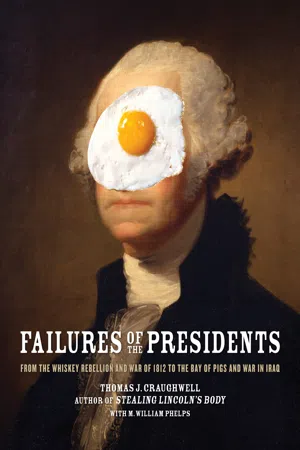 No longer available |Learn more
Failures of the Presidents
From the Whiskey Rebellion and War of 1812 to the Bay of Pigs and War in Iraq
- Thomas J. Craughwell, M. William Phelps(Authors)
- 2008(Publication Date)
- Fair Winds Press(Publisher)
Treasury Secretary Hamilton, ever watchful for an opportunity to exert the authority of the federal government, declared that in such a crisis “an immediate resort to military force” was a necessity, and he recommended that the military target the whiskey rebels in Pennsylvania. Both Hamilton and Washington remembered Shays’ Rebellion in western Massachusetts only a few years before, in 1786 and 1787, an uprising against taxes that had shown the need for a strong central government if the new nation were to enforce its federal laws. Washington conceded that “anarchy and confusion” had the upper hand in western Pennsylvania, but still he held back from calling out the militia to suppress the rebellion. Instead, Washington decided to send three peace commissioners to reason with the rebels in Pennsylvania.Five days after the cabinet meeting, Attorney General William Bradford (no relation to rabble-rouser David Bradford), Pennsylvania Supreme Court Justice Jasper Yeates, and Senator James Ross set out on their mission. They were authorized to grant amnesty to everyone who had interfered with the collection of the whiskey tax and attacked government officials, but Washington instructed them not to promise that the whiskey tax would be repealed. In return for amnesty, Washington demanded that the rebels promise to make no further attempts to obstruct the lawful collection of the whiskey tax, nor to harm or threaten any government officials. Passage contains an image
DURING THE AMERICAN REVOLUTION, HENRY “LIGHT HORSE HARRY” LEE PROVED HIMSELF TO BE A BRILLIANT CAVALRYMAN. WASHINGTON PUT HIM IN COMMAND OF THE MILITIA WITH ORDERS TO SUPPRESS THE Whiskey Rebellion.
Passage contains an image
To greet the peace commissioners, a band of rebels raised a liberty pole. In the years before the American Revolution, liberty poles—tall flagstaffs with a liberty cap perched on the top, or flying a flag—had been a favorite emblem of the Sons of Liberty, who erected them in town squares to show their defiance of British authority. The message was perfectly clear to Washington’s delegates: The western Pennsylvania rebels were equating themselves with the Sons of Liberty, and the federal government with the British Crown that had once run roughshod over American liberties. Every day Bradford, Yeates, and Ross encountered angry, violent bands of rebels who cried out for the overthrow of the federal government.Hoping to appease these men, the peace commissioners exceeded their authority. They promised, on the government’s behalf—contrary to President Washington’s instructions—to make “beneficial arrangements” for those who were delinquent in paying their taxes. But nothing could satisfy the rebels. On August 23, Bradford wrote to Hamilton that the rebels were beyond the reach of reason. The commissioners concluded that the president must send a large force of militia to western Pennsylvania “to overawe the disaffected individuals.” Within a day or two of receiving Bradford’s letter, Washington and Hamilton began planning a military expedition to crush the Whiskey Rebellion.
Passage contains an image
DURING THE AMERICAN REVOLUTION, HENRY “LIGHT HORSE HARRY” LEE PROVED HIMSELF TO BE A BRILLIANT CAVALRYMAN. WASHINGTON PUT HIM IN COMMAND OF THE MILITIA WITH ORDERS TO SUPPRESS THE Whiskey Rebellion.
Passage contains an image
To greet the peace commissioners, a band of rebels raised a liberty pole. In the years before the American Revolution, liberty poles—tall flagstaffs with a liberty cap perched on the top, or flying a flag—had been a favorite emblem of the Sons of Liberty, who erected them in town squares to show their defiance of British authority. The message was perfectly clear to Washington’s delegates: The western Pennsylvania rebels were equating themselves with the Sons of Liberty, and the federal government with the British Crown that had once run roughshod over American liberties. Every day Bradford, Yeates, and Ross encountered angry, violent bands of rebels who cried out for the overthrow of the federal government.Hoping to appease these men, the peace commissioners exceeded their authority. They promised, on the government’s behalf—contrary to President Washington’s instructions—to make “beneficial arrangements” for those who were delinquent in paying their taxes. But nothing could satisfy the rebels. On August 23, Bradford wrote to Hamilton that the rebels were beyond the reach of reason. The commissioners concluded that the president must send a large force of militia to western Pennsylvania “to overawe the disaffected individuals.” Within a day or two of receiving Bradford’s letter, Washington and Hamilton began planning a military expedition to crush the Whiskey Rebellion.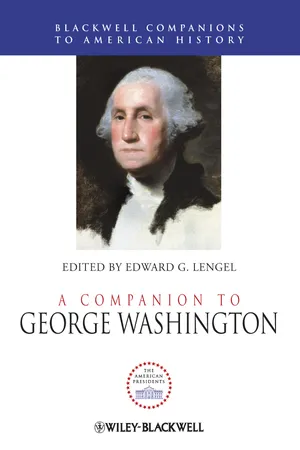 eBook - ePub
- Edward G. Lengel(Author)
- 2012(Publication Date)
- Wiley-Blackwell(Publisher)
Nearly three months later on 1 January 1795 Washington issued a proclamation in which he urged religious denominations and societies to gather on the 19th of February to give thanks “to the great ruler of Nations” for the suppression of the insurrection and abundant blessings, including a constitutional government that united the people under liberty and order (Washington, 1795). But Washington found a growing level of disorder in the nation’s political affairs. He remained popular as a president, but faced stronger partisan opposition for the rest of his term (Elkins and McKitrick, 1993; Wood, 2009). Part of that response sprung from the massive militia force called to crush the insurrection which prompted fears, particularly among Republicans, that the executive could easily create a standing army to reinforce his authority. Washington’s decision to target the Democratic-Republican societies for their opposition to his administration prompted accusations that he desired to restrict freedom of speech (Ellis and Wildavsky, 1991; Koschnik, 2001; Neem, 2003). The abrupt nature of arrests, interrogations and incarcerations of accused insurgents, as well as the subsequent treason trials in Philadelphia, created a negative image of the administration for many citizens. Although Washington pardoned the two convicted individuals, his action did not completely redeem that image in the eyes of all Americans (Ifft, 172–173, 176; Slaughter, 1986).In spite of the partisan reaction, Washington’s decision to enforce the excise laws through military coercion enabled him to send strong messages to the nation. Washington demonstrated the energy of the federal government and its authority to enforce execution of congressional laws. He made it clear that if any individual or groups desired to change the laws, they must do so in an orderly and constitutional manner. Concerns and issues of national importance took priority over those of any group or state. Washington clearly demonstrated to Americans and the world that a republican form of government did not doom the country to anarchy (Washington, 1794). But most importantly, Washington’s response to the Whiskey Insurrection helped shape the nature of the presidency and redefined the office as a powerful arbitrator of the nation’s affairs for generations to come.LIST OF FURTHER READINGSCooke, J. E., (1963), “The Whiskey Insurrection: A Re-evaluation”, Pennsylvania History , [e-journal] 30: 316–346, Available through JSTOR [Accessed 7/12/2010).Dallek, R. (1996), Hail to the Chief: The Making and Unmaking of American Presidents . Oxford.Ellis, R. and Wildavsky, A. (1991), Dilemmas of Presidential Leadership: From Washington through Lincoln . New Brunswick, NJ.Findley, W. (1796), History of the Insurrection, in the Four Western Counties of Pennsylvania , in the year 1794 [e-book] Philadelphia; Samuel Harrison Smith.Foner, P. S., ed., (1976), The Democratic-Republican societies, 1790–1800: A Documentary Sourcebook of Constitutions, Declarations, Addresses, Resolution, and Toasts
Index pages curate the most relevant extracts from our library of academic textbooks. They’ve been created using an in-house natural language model (NLM), each adding context and meaning to key research topics.

