History

Bacon's Rebellion
Bacon's Rebellion was a 1676 uprising in colonial Virginia led by Nathaniel Bacon, a wealthy planter. The rebellion was fueled by grievances against the colonial government's perceived favoritism towards Native Americans and lack of protection for frontier settlers. It resulted in the burning of Jamestown and highlighted tensions between the wealthy elite and poorer settlers, as well as the role of indentured servants and slaves in the colony.
Written by Perlego with AI-assistance
Related key terms
1 of 5
3 Key excerpts on "Bacon's Rebellion"
 eBook - ePub
The Southern Colonies in the Seventeenth Century, 1607--1689
A History of the South
- Wesley Frank Craven(Author)
- 2015(Publication Date)
- LSU Press(Publisher)
CHAPTER XBACON’S REBELLION
W ITH the establishment of Carolina the initial settlement of the Southern colonies, Georgia excepted, had been completed, and as the southward extension of English imperialism clashed with Spain’s outer defenses in Florida to bring into the story new diversities of interest and geography, life in the older provinces took on a new complexity. Indeed, in considering the general significance of the last years falling within the scope of this volume the historian is frequently tempted to resort to some favored oversimplification. He must follow developments within communities where few if any men could remember the hardships of the first years; at the same time he must trace anew the experience of men in other communities who were engaged in the work of original settlement. It is necessary to take notice of new problems in the white man’s relations with the Indian, problems arising from the expanding area of European activity, and this must be done without neglect of the fate overtaking those tribes who first smoked a pipe of peace with the English settler. It becomes no less necessary to trace, at least in outline, the growth of a new imperial policy and its effect on problems of control as old and as new as settlement itself; nor can there be overlooked in this connection one of the most important chapters in England’s political history. It is significant that the curtain rises on Bacon’s Rebellion, a popular uprising in Virginia which many have seen as a forerunner of the American Revolution, and that it falls on a revolution in England to which the leaders of our own Revolution repeatedly harked back.In such a context one finds a certain appropriateness in the necessity for observing at the outset that no simple answer can be found for the complex problem of Bacon’s Rebellion. The irascibility of an old man who had outlived his usefulness, the temperament of a young man whose career suggests more of spirit than of balance, an accumulation of economic and political grievances, and a tragic inability to cope with the fundamental problem of Indian relations—all have their place in the narrative. Authorities differ as to the weight to be assigned these several factors, but on one point agreement can be had: the trouble started in a dispute over Indian policy. Thus the discussion immediately comes to a focus on one of the major failures of early American history, a failure emphasized no less forcefully by the outbreak of King Philip’s War in New England than by the almost simultaneous pillage and massacre which in Virginia precipitated Bacon’s Rebellion. eBook - ePub
Settler Memory
The Disavowal of Indigeneity and the Politics of Race in the United States
- Kevin Bruyneel(Author)
- 2021(Publication Date)
- The University of North Carolina Press(Publisher)
43 These types of laws are created out of and reproduce the notion of innocent white victims facing racialized threats to their settler domestic realms, and thus these laws immunize homeowners in their use of violence to defend property and patriarchy. These laws are subject to critique in our time, and in that light one might consider how telling the story of Bacon’s Rebellion differently offers ways for students, scholars, and activists to imagine and theorize how to enact coalitions and collaborations in opposing such legalized defenses of white supremacy, capitalism, colonialism, and patriarchy. A differently told memory of Bacon’s Rebellion may be able to help with theorizing convergent sites of resistance rather than divergent sites that, say, construct political interests and subjectivities around primarily labor for Black and white people and around land for Indigenous peoples, with a disengagement from the role of heteropatriarchy.The lesson of a reimagined Bacon’s Rebellion that does not “drop Indians” is that one cannot split off land from labor when the human bodies that are laboring as enslaved people, as gendered subjects, and as exploited wage workers or indentured laborers are produced through their relationships to lands dispossessed from Indigenous peoples, just as the meaning of the land is defined in relationship with and through the meaning making by human beings in law, politics, economics, and culture. Remembering the rebellion differently provides a vehicle for reshaping contemporary imaginaries, possibilities, and critiques in a world in which scholars and activists are constantly searching for ways to assess and refigure the terms and practices of solidarity, collaboration, and coalition and the accompanying lines of antagonism.Reconsidering America’s Original Sin(s)
I close with a ready example of reimagining U.S. collective memory, with the words of Michelle Alexander from 2016. Like Winthrop Jordan, she, too, had an epiphany about “dropping Indians.” On her Facebook page in February 2016, Alexander recommended an article about the history of the incarceration of Indigenous people that featured a photograph of the late nineteenth-century handcuffs used on Indigenous children who were dragged away from their families and sent to boarding schools to be, in the language of the time, “civilized.” In her recommendation, Alexander said the following: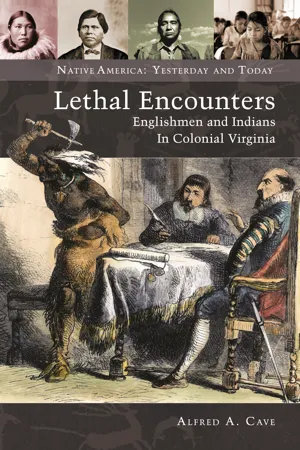 eBook - PDF
Lethal Encounters
Englishmen and Indians in Colonial Virginia
- Alfred A. Cave(Author)
- 2011(Publication Date)
- Praeger(Publisher)
Chapter 8 Bacon’s Rebellion and Its Aftermath In 1676, the royal governor of Virginia was deposed by a self-styled “General of the Volunteers” who demanded the destruction of all the Indian communi- ties in Virginia. Although Bacon’s rebellion had deep roots in the social tensions, political resentments, and economic deprivations that plagued the colony, the immediate chain of events that culminated in that surprising development began with an altercation the year before over some stolen hogs. Some 30 years after the event, Thomas Mathew, the Northumberland County planter at the center of the initial quarrel, seeking to endow his conflict with Indians with cosmic overtones, recalled that 1675 was marked with three portentous and frightening omens that foretold “Disasters.” The first was a “large Comet . . . Streaming like a Horsetail westward” to the horizon. The second was a flight of pigeons covering a quarter of the sky and having “no visible End.” The birds were so numerous that they broke down the branches of large trees when they roosted at night. The old Planters were alarmed by their appearance, because the previous time such flights were seen, the Indians “Committed the last Massacre.” Finally, there was an infestation of flies “about an Inch long, and as big as the Top of a Man’s little finger, rising out of Spigot Holes in the Earth.” The swarm ate “the New Sprouted Leaves from the tops of Trees,” then departed after a month. The meaning of those “three Prodigies” became clear, Mathew suggested, when “on a Sabbath day morning in the summer Anno 1675, People in their Way to Church” found Robert Hen, the overseer of his plantation at Stafford on the upper Potomac River lying th’wart on his Threshold and an Indian without the Door, both Chopton their Heads, Arms and other Parts, as if done with Indian Hatchetts. The Indian was dead, but Hen when ask’d who did that? Answered ‘Doegs Doegs,’ and soon
Index pages curate the most relevant extracts from our library of academic textbooks. They’ve been created using an in-house natural language model (NLM), each adding context and meaning to key research topics.

