Languages & Linguistics

Diglossia
Diglossia refers to a sociolinguistic situation where two distinct varieties of a language are used in different social contexts. One variety is typically used in formal or official settings, while the other is used in informal or everyday communication. This phenomenon is often characterized by a clear division of functions and prestige between the two language varieties.
Written by Perlego with AI-assistance
Related key terms
1 of 5
11 Key excerpts on "Diglossia"
 eBook - PDF
Immigrant Dialects and Language Maintenance in Australia
The Case of the Limburg and Swabian Dialects
- Anne Pauwels(Author)
- 2010(Publication Date)
- De Gruyter Mouton(Publisher)
Only a few years after Ferguson's article on Diglossia, the term had become common property among (socio)linguists and other social scientists, each affixing their own interpretation to the term. The original term Diglossia was applied to a speech community in which two varieties of (the same) language existed side by side with each having a definite role to play (after Ferguson 1959:325). The two varieties were refer-red to as H (high) or the superposed variety and the L (low) variety/ies, the so-called regional dialect(s). Ferguson selected varieties of four languages to exemplify Diglossia -Arabic, Modern Greek, Swiss German, Haitian Creole -. The description of nine features: function, prestige, literary heritage, acquisition, standardiza-tion, stability, grammar and lexicon as well as phonology, led to the following definition of Diglossia: Diglossia is a relatively stable language situation in which, in addition to the primary dialects of the language (which may include a standard or regional standards), there is a very divergent, highly codified (often grammatically more complex) superposed variety, the vehicle of a large and respected body of written literature either of an earlier period or in another speech community, which is learned largely by formal education and is used for most written and formal spoken purposes but is not used by any sector of the community for ordinary conversation. (Ferguson 1959:336) The later descriptions and definitions of Diglossia often failed to take into account all nine features listed by Ferguson, so that the term became applica-ble to a wide range of language situations.
- Ulrich Ammon(Author)
- 2012(Publication Date)
- De Gruyter(Publisher)
According to Ferguson the term Diglossia is defined as: (...) a relatively stable language situation in which, in addition to the primary dialects of the language (which may include a standard or regional standards), there is a very divergent, highly codified (often grammatically more complex) Diglossia and Functional Heterogeneity 593 superposed variety, the vehicle of a large and respected body of written literature, either of an earlier period or in another speech community, which is learned largely by formal education and is used for most written and formal spoken purposes but is not used by any sector of the community for ordinary conversation. In the taxonomical matrix of language standardization, Diglossia as a package has been treated as a unique phenomenon, distinct from other universal processes of standardization found in many modern languages (such as in English) which promote assimilatory trends among primary dialects in favour of a single standard. At the same time, in the absence of any hierarchical ordering of these features in the package, one comes across many varied accounts claiming Diglossia based on a partial observance of one or more of these characteris-tics. With the result, many investigations in subsequent years have stretched the concept 'Diglossia' to the extent that these formulations make the study of geographical or social dialects under dialectology redundant on the one hand, and tend to step over into the arena of bilingualism on the other (for a detailed critique of the concept, cf. Khubchandani 1985). A serious issue debated in these studies has been the status of language, dialect, variety, code as such. eBook - PDF
Multidisciplinary Perspectives on Multilingualism
The Fundamentals
- Simona Montanari, Suzanne Quay, Simona Montanari, Suzanne Quay(Authors)
- 2019(Publication Date)
- De Gruyter Mouton(Publisher)
Another exam-ple of diglossic bilingualism was in pre-war 20th century Europe where Jewish males communicated in both Hebrew (H) and Yiddish (L). Diglossia is the canonical instance of language allocation in a multilingual society. It is important to recognize that the concept is neither new nor unfamil-iar in the history of multilingualism. For example, Lipin ѕ ki (1997: 75) notes that in th е ѕ ixth c е ntury, oral poetry was delivered (only) in proto-Classical Arabic but discussed in Arabic vernaculars, a quite different variety. The expression Diglossia (Greek διγλωσσία digl ō ssia ) designates bilingual-ism itself, as first coined in the 19th century by the illustrious polyglot Greek writer Emmanuel Rhoides. The term entered French as diglossie and was in cur-rency among Arabists, in particular William Ambroise Marçais who used the term to characterize the linguistic situation in Arabic-speaking countries, “ la concurrence entre une langue savante écrite et une langue vulgaire parfois ex-clusivement parlée ” (Feghali 1928: 59). Dante Alighieri (1265 – 1321) described the concept pertaining to Diglossia in his work on sociolinguistic theory, De 6 Diglossia in Multilingual Communities 105 vulgari eloquentia . In this work, he contrasted the role of global literary Latin, the “ grammatical language ” of the elite, and the less prestigious vernaculars. Dante ’ s work on this “ illustrious vernacular ” resulted in the formation of Italian. The concept began to emerge forcefully in the explication of classical Arabic versus the vulgate (Marçais 1902). Charles Ferguson popularized the English equivalent Diglossia in 1959. Whilst doing fieldwork on Arabic in the Middle East in the 1950s, he noticed unequivocally that in any community (or “ speech com-munity ” as he called it), two varieties of a language existed coterminously throughout the community with each having a role to play (Ferguson 1959; see also Chapter 2, this volume).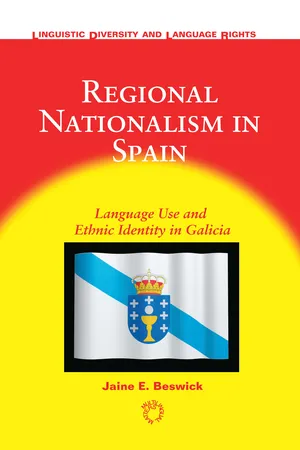 eBook - PDF
Regional Nationalism in Spain
Language Use and Ethnic Identity in Galicia
- Jaine E. Beswick(Author)
- 2007(Publication Date)
- Multilingual Matters(Publisher)
Introduction 13 Contact, Competition and Conflict: Diglossia One significant concept in sociolinguistic theory and, in particular, bilingualism that has had a direct bearing upon this apportionment of language use is that of Diglossia. Ferguson’s initial definition of Diglossia (1959) pertained to the separate uses and roles, within a given speech community, of similar varieties of one language. However, linguists such as Gumperz (1968: 381–386) and especially Fishman (1971: 74–75), recognised the usefulness of the term to refer to situations where two or more languages exist side by side within a bilingual society, as had Weinreich (1953) early on in his structural – functional hypothesis (the functional differentiation of languages in contact prevents interference phenomena). Fishman’s four-way pattern of linguistic alternation, which I delineate as bilingual / diglossic, bilingual / non-diglossic, non-bilingual / diglossic, non-bilingual / non-diglossic (1989: 181–189), is well known and, therefore, I do not propose to offer a lengthy discussion of the general categorisation. 10 However, certain points are outlined here, due to their relevance to the Galician situation. Fishman points out that Diglossia are a ‘societal arrangement where individual bilingualism is widespread and institutionally buttressed’ (Fishman, 1989: 185). Theoretically, then, languages coexist with clearly marked domains of usage. That is, the selection of these varieties within a community has both social and cultural relevance, with each serving a specialised function. Fishman retains Ferguson’s terms H (High) and L (Low) (1959: 336) to characterise the varieties according to their func-tional demarcation, but alters the definitions slightly to encompass domains more relevant to separate languages that are both used in a spoken form. eBook - ePub
- Raymond Hickey(Author)
- 2020(Publication Date)
- Wiley-Blackwell(Publisher)
and other separate languages, as is the case today in many parts of North Africa, the Middle East, and South Asia. These include questions about the direction of lexical and structural influence between all varieties involved and the implications for language maintenance, language shift, and the emergence of new varieties.1.1 Definitions
1.1.1 Classical Diglossia
The term “Diglossia” in its early uses (Krumbacher 1902 ; Psichari 1928 ; Marçais 1930 ) and in the definition presented by Ferguson (1959 ), which brought the concept to the forefront of sociolinguistic theory, refers to the existence of two varieties of the same historical language. One variety is standardized and often used in written form and in formal domains, the High variety (H), and another variety that is not standardized and is not used in education or formal domains, the Low variety (L). This type of situation where two varieties of the same language are in a functional distribution within the same community is referred to in the field as classical, genetic or endoglossic Diglossia.Ferguson (1959) presents a theory of Diglossia that lists several features of situations that can be described as diglossic. The most salient feature is the functional distribution that limits the L variety’s use to informal contexts and extemporaneous communication, while the H variety is reserved for formal domains and written communication. A second feature describes a positive attitude by the speakers towards the H variety and a much less positive attitude toward the L variety, which is often described as a “deteriorated” version of the “original” language. The third feature refers to the existence of an established body of literature in the H variety that harkens back to its early history, while the literature produced in the L variety is often transmitted orally and rarely recorded in written form. In this last case, the situation has changed rapidly with the spread of literacy and digital communication. For example, it is becoming increasingly common to find electronic publications and digital private and quasi‐private communication recorded in vernacular Arabic varieties (Høigilt and Mejdell 2017 ; Sayahi 2019 eBook - PDF
Singapore English
Structure, Variation, and Usage
- Jakob R. E. Leimgruber(Author)
- 2013(Publication Date)
- Cambridge University Press(Publisher)
Furthermore, the definition is limited to situations where H and L are ‘vari- eties of the same language’, with the ‘analogous situation where two distinct (related or unrelated) languages are used side by side’ being expressly ex- empted from it (1959: 325). 11 Diglossia characterises a ‘language situation’ (1959: 336), i.e. a property of the speech community, typically exempli- fied by those of Haiti (H: French, L: Haitian Creole), German Switzerland (H: Standard German, 12 L: Swiss German dialects), and Egypt (H: Clas- sical Arabic, L: Egyptian Arabic). Important components of Ferguson’s 10 The first of these, the vernacular, is called the ‘low’ variety, or L, and the latter, ‘high’ or H. 11 This is a point revisited by Fishman (1967), who argues that there is nothing preventing unrelated languages from being in a diglossic relationship. In fact, he stresses that in the case of related languages, these need to be ‘sufficiently different from one another that, without schooling [H] cannot be understood’ by L speakers (attributed to Fishman 1980: 4 in Wardhaugh 2002: 94). This has been referred to as ‘broad’ Diglossia (Fasold 1984: 53, Winford 2003: 112–13, see below), two flagship examples being those of Alsace (H: French, L: German) and Paraguay (H: Spanish, L: Guaran´ ı). 12 Switzerland’s Standard German is however endonormative, in that it differs from Standard High German in several ways (much in the way that SSE does from StBE): examples in phonology (initial devoicing), the lexicon (wischen for fegen ‘to sweep’), and spelling (ss for ß) abound (see e.g. Rash 1998: 150–79). eBook - PDF
The Rise and Fall of the Ethnic Revival
Perspectives on Language and Ethnicity
- Joshua A. Fishman, Michael H. Gertner, Esther G. Lowy, William G. Milán, Silvia Burunat, David E. Fishman, Ofelia García, Itzek Gottesman, Phyllis Koling, Rena Mayerfeld, Carole Riedler-Berger, Mark J. Steele(Authors)
- 2013(Publication Date)
- De Gruyter Mouton(Publisher)
The above picture is, of course, at least somewhat idealized. Diglossie societies are marked not only by compartmentalization conventions but by varying degrees of access restriction. Similarly, in addition, Hness (whether in lexical, phonological or grammatical respects) does creep into L interactions (particularly among the more educated strata of society), viz., the case of Middle Arabic and Learned Yiddish, and, contrariwise, Lness does creep in-to H interactions (particularly where access restrictions are minimal; note, for example, the completely Yiddish phonology of Ashkenazi Loshn koydesh). Nevertheless, the perceived ethnocultural legitimacy of two languages as our own (i.e., neither of them being considered foreign, even though one or the other might, in point of historical reality, be such), and the normative functional complementarity of both languages, each in accord with its own institutionally congruent behaviors and values, remains relatively undisturbed. (b) Diglossia without Bilingualism (cell 3) Since Diglossia applies to societal arrangements, political arrangements may certainly be included under this rubric. Given this fact we must recognize political or governmental Diglossia whereby two or more differently monolin-gual entities are brought together under one political roof. Not only were various empires of old characterized by Diglossia without bilingualism (except for small commercial, military and civil service elites) but various modern states may be so classified: Switzerland, Belgium, Canada, and, at least in terms of early Leninist idealism, the USSR. This is Diglossia in accord with the ter-ritoriality principle (McRae, 1975). It requires that we set aside our earlier intra-societal notion of widespread bilingualism and extend it to the political recog-nition and institutional protection thereof on an /«/ersocietal-politywide basis. eBook - ePub
- Saba Soomekh(Author)
- 2015(Publication Date)
- Purdue University Press(Publisher)
Ferguson’s theory of Diglossia, along with Fishman’s extended Diglossia, should be considered when dealing with language description and typology as well as historical linguistics. Given that languages are often in contact with one another within and across nations, Diglossia may serve as an appropriate theoretical model in exploring the multidimensional sociolinguistic patterns within a speech community. Related fields, such as bilingualism or contact linguistics, complement the theory of Diglossia, varying, however, in both their approach and end goal. While bilingualism may be present in a diglossic community, it is used to describe the linguistic behavior and knowledge of a speaker. Diglossia, however, serves to describe the linguistic organization at the socio-cultural level. Diglossia is often related to bilingualism as various languages or language varieties/repertoires are involved. Exploring a particular speech community will reveal the degree of bilingualism among speakers, the sociolinguistic situation of Diglossia, and whether or not these two phenomena are intertwined.Turkish and Greek as Secret Languages
Many Sephardim report that their parents hardly spoke in Judeo-Spanish, and that they learned whatever they know from their grandparents, from dichas (sayings) to konsejas (stories). Those who do recall their parents speaking in Judeo-Spanish note that their parents only spoke it when they did not want them—their children—to understand what they were saying. Tracy Harris accounts for this phenomenon in her research, stating that many youth understood more than their parents thought they did (167). This is one of the domains that Harris suggests Judeo-Spanish inhabits today, as the “secret language” of the Sephardim. Although the participants in my study are all highly proficient in Judeo-Spanish, they have slightly different narratives, still relating to this concept. MLA 85—born in New York City, residing in Los Angeles during his adult life, and whose parents were born in Salonika—comments that his parents spoke in Turkish, Greek, or Bulgarian when they didn’t want him to understand what they were saying. He notes that for his parents, having lived in the Balkans, this was a natural way of life and communication for them. Similarly, participant MNY eBook - PDF
- Guus Extra, Ludo Verhoeven, Guus Extra, Ludo Verhoeven(Authors)
- 2011(Publication Date)
- De Gruyter Mouton(Publisher)
Bilingualism is a concept on the individual level, so that the term refers in some sense to the extent to which members of the community are proficient in two languages or varieties of language. Diglossia + -1 2 3 4 Figure 1: Fishman's four-celled matrix showing possible relationships between Diglossia and bilingualism Fishman 's theory of Diglossia and bilingualism 305 Not only is this matrix intended as a taxonomy of language contact, but Fishman also indicates at least indirectly that there is a natural progression through time from the traditional societies often found in quadrant 3 through the unstable quadrant 2 to the more stable quadrant 1. Because the taxonomy can be applied to speech communities using not only two languages by two or more varieties of language, communities belonging in quadrant 4 are rare, according to Fishman. Williams (1992) has written very critically about the evolutionary language in which these ideas are presented. He is also critical of the negative terms with which Fishman describes the traditional societies in quadrant 3, as compared with the positive ones used about those in quadrant 1. Williams argues that there is no necessary connection between modernization and language shift. What we believe we all find appealing in this taxonomy is that it is simple and functional. Overlap in the function of two linguistic varieties or languages is the result of changing norms, and a precursor of language shift. Separation of functions is an indicator of stability, according to Fishman. This type of reasoning we recognize from structuralist phonology and morphology. Complementary distribution between variants is traditionally considered more stable than 'free variation'. But, as Labov and others have shown, variation need not be a sign of instability. As we will see below, the same seems to be true of language use.
- Cinzia Russi(Author)
- 2016(Publication Date)
- De Gruyter Open Poland(Publisher)
This also implies that there is not necessarily a prestige or power difference between H and L. Furthermore, the H-variety typically has no mother tongue-speakers, but is only acquired at a later age, which is one reason why diglossic repertoires are often quite stable over time. For the same reason, when changes to the sociolinguistic situation do occur, L is more likely to displace H. In cases of societal multilingualism, on the other hand, H often correlates with power or prestige and is more likely to displace L. The supposed change from Diglossia to diaglossia involves “advergence to the standard” (Auer, 2005: 22), i.e., a development from L towards H, and may lead to dialect loss or loss of L. This would be an atypical result of Diglossia. In historical sociolinguistics, it is customary to attach great value to the informal written language of less-privileged people, for example private letters written by farmers, sailors, soldiers and their wives (cf. Elspaß ,2005; Rutten and Sociolinguistic space past and present 197 van der Wal, 2014, among many others). If we assume that such texts, dating back to the seventeenth, eighteenth and nineteenth centuries and therefore predating the emergence of diaglossia, were written in a diglossic situation, we should be able to decide whether they represent the L or the H variety. In diglossic situations, H is often the only variety used for writing, and it has even been argued that the very introduction of writing and literacy into a speech community constitutes one, if not the main impetus for Diglossia to emerge (Coulmas, 2002). From that perspective, the sole fact that the sources investigated by historical sociolinguists are written should qualify them as instances of the H-variety. eBook - PDF
- Joseph Gafaranga(Author)
- 2007(Publication Date)
- Palgrave Macmillan(Publisher)
88 Talk in Two Languages For example, we now know that Haitian Creole and French are two different languages, but, then, they were not considered to be. One may also wonder how stable the situation has to be and for how long. In this respect, Ferguson (2000: 70) cites three factors which may lead to a different sociolinguistic structure. They are as follows: (i) more widespread literacy (ii) broader communication among different segments of the population (iii) desire for political sovereignty Although, as I have said above, Ferguson intended his model to describe very specific cases of monolingualism, it attracted attention from a variety of researchers, including those with interest in bilin- gualism. Top among the latter was the sociolinguist Fishman (1967) 2 • Up until the early 1960s, research in bilingualism had mainly focused on the psycholinguistic dimension. Departing from this tradition, Fishman felt that there was a need to reconcile psychological and sociological accounts of bilingualism in one framework and the notion of Diglossia offered itself as capable ofrealising that connection (2000: 81). Thus, he kept the term 'bilingualism' for the psychological dimension (compet- ence in two or more languages) and adopted Diglossia to designate the patterned use of two or more languages. Building on Ferguson's ideas and those of other researchers who had followed in Ferguson's tradition, he saw Diglossia as a universal phenomenon. Diglossia exists not only in multilingual societies which recognise several languages and not only in societies that utilise vernacular and classical varieties, but also in societies which employ separate dialects, registers, or functionally differentiated language varieties of whatever kind. (Fishman, 2000: 82) (my emphasis) In working out the different possibilities in which bilingualism could relate to Diglossia, Fishman came up with four possibilities as shown in Table 5.3 (2000: 82).
Index pages curate the most relevant extracts from our library of academic textbooks. They’ve been created using an in-house natural language model (NLM), each adding context and meaning to key research topics.

