Languages & Linguistics

Code Switching
Code switching refers to the practice of alternating between two or more languages or dialects within a single conversation or interaction. It is a common phenomenon in multilingual communities and can serve various social and communicative functions. Code switching allows speakers to navigate different linguistic and cultural contexts, often reflecting their identity and social relationships.
Written by Perlego with AI-assistance
Related key terms
1 of 5
12 Key excerpts on "Code Switching"
 eBook - PDF
Multidisciplinary Perspectives on Multilingualism
The Fundamentals
- Simona Montanari, Suzanne Quay, Simona Montanari, Suzanne Quay(Authors)
- 2019(Publication Date)
- De Gruyter Mouton(Publisher)
A common phenomenon in multilingual language choices, codeswitching, refers to the alternate use of two or more languages in the same utterance or conversation (Auer 2005; Montanari 2009; Poplack 1980; Quay 2001; Stavans and Swisher 2006). It is not surprising that people take advantage of the unique ability to combine elements from the languages in their linguistic repertoire (Green and Li, 2014; Muysken 2013). Just like multilingualism, codeswitching is fast becoming the norm rather than the exception. Increased migration and globalization are creating more multilingual societies. More than half of the world ’ s population is bilingual and less than a quarter of the world ’ s population Anat Stavans and Ronit Porat, Beit Berl College, Kfar Saba, Israel https://doi.org/10.1515/9781501507984-007 is trilingual (Grosjean 2010: 13 – 16; see also De Bot 1992 and statistics in Europe by European Commission 2012). From a tender age, multilinguals develop awareness of different social situations and are more sensitive and responsive to the context of communication (Stavans 1990). Codeswitchers use the different forms of language to perform sociolinguistic functions, such as role-playing, re-porting what others are saying, and affiliating with a speech community to cre-ate empathy and inclusion (Barnes 2006; Lanza 1997; Montanari 2009; Quay 2001). In what follows, we present different perspectives drawing on state-of-the -art work on what makes codeswitching a multilingual ’ s trademark. We start with definitions and theories, patterns of codeswitching, and their discursive forms and functions in different personal and social situations. 7.2 Definitions and theories 7.2.1 Codeswitching as a language contact phenomenon Codeswitching is defined as a communication strategy typically used by multilin-guals, in which they alternate between languages, in the context of a single con-versation. eBook - ePub
- Shahrzad Mahootian(Author)
- 2019(Publication Date)
- Routledge(Publisher)
Although, at one time, it was believed these mixes occurred randomly, over the last six decades studies have shown that language mixing (codeswitching) is a systematic rule-governed linguistic behavior. Switching may be conscious and intentional or unconscious and unintentional. Intentional switching may be used to indicate shifts in topic, or to redirect the conversation to a different person (interlocutor) in the conversation. Speakers may also switch languages intentionally to signal a change in interpersonal or social relationships, to make the conversation more intimate or to make it more formal. It may also be used to position oneself as an insider or an outsider with respect to a social or ethnic community, to index and communicate identity, and to enhance social and political statements. Much of the time, however, switching between languages/dialects is unintentional, a result of psycho- and sociolinguistic variables that the speaker is not consciously aware of, involving processing issues and the tendency of speakers to adapt their speech style to the interlocutor’s style and/or community norms and expectations. Although switching has at times been associated with the loss of one language, many researchers believe that codeswitching is a natural consequence of ability and competence in more than one language and, accordingly, should not automatically be regarded as language deficit, loss, or shift. As discussed in previously, language shift or loss is a result of multiple social variables (i.e., lack of support for the speech community, lack of valorization of the language, etc.). In this chapter, we learn more about using multiple-language discourse, choosing between languages, and the social and grammatical rules that guide switches and choices.3.1 Managing Multiple Languages
We know that all languages have grammars, rules that guide speakers to produce well-structured, acceptable sentences and steer them away from generating unacceptable utterances. Some of these rules are overtly taught, but most are learned as we progress through the various stages of language acquisition that begin in infancy. So what happens when the brain has more than one grammatical system to manage? To start our investigation, let’s begin with some fundamental terms, definitions, and examples.Code —In the context of bilingualism, code refers to languages and their varieties. Therefore, Japanese is a code as is Hebrew, French, Thai, and so on.Codeswitching —Codeswitching, also written as code-switching, refers to the act of changing from one language or dialect to another. It can be defined as the systematic use of two or more languages or varieties of the same language during oral or written discourse. It’s a common speech behavior, most often used in informal, casual contexts. Codeswitching can occur intrasententially , within a sentence, including the switching of a single word, prefix, or suffix. It can also occur intersententially eBook - ePub
Bilingualism in Schools and Society
Language, Identity, and Policy, Second Edition
- Sarah J. Shin(Author)
- 2017(Publication Date)
- Routledge(Publisher)
This would sometimes entail the use of features that are perceived by some speakers as unusual, such as “pizza mo two minutes coming”. Researchers argue that this type of language mixing does not have any local meaning, as traditional code-switching studies have tried to show. In this type of spontaneous, frequent, high-density language contact, it is not possible to predict whether someone will code-switch at any given point or whether two people with similar code-switching habits will both code-switch on the same occasion (Auer, 1999; He, 2013; Li, 2011). There is no discernible cognitive, contextual, and conversational-sequential motivation behind the switches. In other words, code-switching takes place for no apparent reason. Agnes He’s (2013) data from Chinese heritage language speakers show that the switches are: 1) not guided by any external principle or source, 2) unplanned, evolving as the interaction unfolds, and 3) always different and unpredictable. She observes that the switches are “a collage and calibration of holistic resources (phonemic, morpho-phonemic, syntactic, prosodic, episodic, sequential) from the entire linguistic repertoire simultaneously accessible to Chinese heritage language speakers, resulting in innovative and invigorating multi-performances that are based on their multi-competence” (He, 2013: 314). Overall, the recent rise of new terms celebrating multilingual performance is a welcome development given that bilingual students have too long been penalized for what they cannot do, rather than praised for what they can do. Terms like “translanguaging” and “flexible bilingualism” help educators see the importance of drawing from multiple languages and modalities in the classroom and encourage teachers to take a holistic approach that takes into account all of the languages in the learner’s linguistic repertoire eBook - ePub
Modern Arabic Sociolinguistics
Diglossia, variation, codeswitching, attitudes and identity
- Abdulkafi Albirini(Author)
- 2016(Publication Date)
- Routledge(Publisher)
Chapter 7 Codeswitching In sociolinguistic terms, codeswitching (CS) describes the speech of bilinguals/ multilinguals or bidialectals/multidiaectals who juxtapose elements from two or more language varieties in a single utterance or piece of discourse. Although CS is as old as language contact and has been documented as early as the fourteenth century (Argenter, 2001), formal studies of this phenomenon have not found their way into bilingual literature until the past century. Early studies on bilingual communities have presented CS as a language deficiency resulting from certain gaps in speakers’ lexicon or morphosyntax (Bloomfield, 1927; Weinreich, 1968). The systematic study of CS in the past few decades, however, has brought to scholarly attention the regularized nature of CS in terms not only of its structure, but also its sociolinguistic functions and the meanings it holds within discourse. The study of CS has been approached from three main perspectives: syntactic/grammatical, psycholinguistic, and sociolinguistic. A grammatical approach examines the structural aspects of CS, its goal being to determine the syntactic and morphosyntactic constraints on language alternation, and to discover whether CS conforms to certain universal principles of grammar. 1 A psycholinguistic approach deals with the cognitive aspect of CS for the purpose of pinpointing the mechanism through which language codes are organized in the brains of bilinguals and how this organization affects their language acquisition and production. Studies in second language acquisition often adopt the psycholinguistic framework in order to describe the learners’ language abilities and practices. A sociolinguistic approach is concerned with the role of social and pragmatic factors in CS, the aim being to determine the social meaning and function of CS within discourse eBook - PDF
- Rodney H. Jones, Christiana Themistocleous(Authors)
- 2022(Publication Date)
- Cambridge University Press(Publisher)
CHAPTER 5 Code Mixing, Crossing, and Translanguaging PREVIEW In Chapter 2 we saw that people often creatively use different kinds of resources to communicate different meanings at different times and with different people, and in Chapter 3 we considered different ‘varieties’ of language associated with different groups of people. In this chapter we will focus on people’ s practices of mixing together more than one ‘language’ , ‘dialect’ , or register when they communicate and some of the reasons for these practices. We will provide an overview of the different ways these practices of ‘mixing resources’ have been conceptualised in sociolinguistics, including Code Switching, crossing, and translanguaging. The focal topic for this chapter is language in education, where we will explore issues around mixing and switching linguistic resources in classrooms. KEY TERMS code mixing Code Switching conversation analysis crossing double-voicing linguistic purism markedness model metaphorical Code Switching translanguaging situational Code Switching we-code/they-code 5.1 Introduction At around lunchtime at the school complex Alter Postweg in Augsburg hundreds of pupils pour into the tram. A multilingual jumble of voices arises. What reaches my ears is not only German, Turkish, Greek, Russian and other languages, but I can also hear mixed conversations in German and Turkish, German and Greek, or German and Russian, in which languages are switched at breathtaking speed. I listen, amazed by the pupils’ virtuosity, until my research interest takes me back to academic soberness, knowing that these adolescents’ and kids’ linguistic productions are hardly valued, and not at all respected, in the school classes they have just left. Monolingualism and German alone is what counts there. However, the conversations outside the official lessons’ discourse literally do speak another language; one that is varied and diverse, mixed, polyphonic and multilingual. eBook - ePub
Code-Switching in Conversation
Language, Interaction and Identity
- Peter Auer(Author)
- 2013(Publication Date)
- Routledge(Publisher)
1 The increasing lexicalisation of the expression (from ‘switching code’ to ‘code-switching’) indexes its central place in academic fields dealing with so-called bilingual behaviour. However, throughout its history, it is not unlikely that ‘code-switching’ has lost part of its original meanings at the expense of producing a profitable object for research, one amenable to easy handling as an emblem of disciplinary identity.In a sense, ‘code-switching’ research seems to be at a crossroads. On the one hand, ample research has shown that the alternate use of recognisably distinct speech varieties in discourse may have accountable meanings and effects. In this line, speech varieties have been mechanistically associated with ‘codes’. On the other hand, some research has shown the impossibility or inappropriateness of assigning specific meanings to some types of variety alternation, and has thus implicitly started to question whether ‘meaningless code-switching’ can be called code-switching at all (Auer 1989 ; Alvarez-Cáccamo 1990 ; Stroud 1992 ; Swigart 1992 ). That is, if codes do not contrast, can we maintain that they are indeed distinct codes? Given the different natures of ‘unmarked’ and ‘marked’ code-switching, are we witnessing two distinct phenomena? Or is something missing in the way ‘code-switching’ is currently conceptualised?In this chapter I attempt to shed some light on the issue, by tracing back the origin and development of the notion of ‘code-switching’ from its earliest formulations as connected to information theory, structural phonology and bilingual contact studies, to current conversational and anthropological work on the phenomenon. Briefly, I argue that ‘code-switching’ may now subsume and globalise a number of possibly unrelated phenomena while excluding others which are clear candidates for being considered switches in communicative codes. The connecting thread in this work is the need to return to a communicative view of codes, here regarded as systems of transduction between two sets of signals: at the one end, communicative intentions, and at the other end, linguistic-discursive forms amenable to interpretation eBook - PDF
- Rodolfo Jacobson(Author)
- 2011(Publication Date)
- De Gruyter Mouton(Publisher)
Long perceived as intrusive and detrimental to developing communicative competence in the foreign language. In fact, teachers who become aware that they alternate codes feel ill at ease and guilty about it, as this is not considered good practice. These switches, in turn, have generated a considerable amount of research recently as borne out by the International Conference on Codeswitching held in St. Cloud, on the outskirts of Paris in France, in February 1997, gathering scholars from several countries. Of the four specialized language journals 1 of proceedings published on this occasion, one in particular deals exclusively with codeswitching in the classroom (Castellotti and Moore 1997) as it contributes to the process of learning, offering a frank reversal of perspective on the role of codeswitching in foreign language teaching and learning. The foreign language classroom 313 2. Research methodology 2.1. A review of the literature: From quantitative studies to an ethnographic approach In an excellent critical review of the literature on codeswitching in the classroom, Marilyn Martin-Jones (1990 and 1995) traces the surge of interest in this field back to the mid 1970's and 1980's when educational interest was stimulated in the United States by the educational needs of the linguistic minority children including Spanish speakers of Cuban, Mexican and Puerto Rican origin who had to master English. Investigation of codeswitching in bilingual and multilingual classrooms such as these aimed at showing educational outcomes of linguistic distribution to fuel educational debate. These studies were largely of a quantitative nature in response to questions about the place occupied respectively by each of the languages present, its use for speech acts and its relevance to the management of interaction. During a second phase, research focused on what teachers do with language revealing the nature of discourse functions associated with the choice of code. eBook - ePub
- Jeff MacSwan(Author)
- 2022(Publication Date)
- Multilingual Matters(Publisher)
From earlier observationally adequate understandings of code-switching, the field came into its own with Blom and Gumperz’s (1972) work on codeswitching between two Norwegian dialects, local Ranamål and standard literary Bokmål, yielding two descriptive categories: situational codeswitching and metaphorical codeswitching. Codeswitching, as Gumperz would note later (1982), ‘signals contextual information equivalent to what in monolingual settings is conveyed through prosody or other syntactic or lexical processes. It generates the presuppositions in terms of which the content of what is said is decoded’ (1982: 98). Accordingly, codeswitching serves as a contextualization cue, providing the hearer with information beyond the referential content of the utterance – how the utterance must be understood! The insights in Gumperz’s work on codeswitching spurred interest in codeswitching among scholars of multilingualism, along at least three sociolinguistic tropes: the social–psychological (Markedness) model (Myers-Scotton, 1993; Myers-Scotton & Bolonyai, 2001), political–economic approaches (Gal, 1987; Heller, 1988b, 1995) and conversational–analytic approaches (Auer, 1984, 1998; Li, 1998).While these three approaches to codeswitching differ from each other in terms of their paradigmatic stances, they do however share one important sociolinguistic–theoretic insight: that codeswitching is a skilled and strategic performance that exploits the discreteness of languages while seeming to flout it (Gal, 1987: 639; Heller, 1995: 167; Myers-Scotton, 1993: 47). Codeswitching, as a sociolinguistic practice, is understood uniformly under these three approaches as ‘the alternate use of [elements of] two or more languages in the same utterance or interaction’ (Grosjean, 1982: 145; cf. also Auer, 1984: 1; Bhatt, 2008: 182; Bhatt & Bolonyai, 2011: 523; Bolonyai, 2005: 8; Demirçay & Backus, 2014: 31; Di Pietro, 1977: 3; Gumperz, 1982: 59; Heller, 1988a: 1; Hymes, 1971; Kharkhurin & Li, 2015: 153; Milroy & Muysken, 1995: 7; Muysken, 2000: 1; Myers-Scotton, 1993: vii; Myers-Scotton & Ury, 1977: 5; Valdés-Fallis, 1976: 53). These uniform understandings (i) produced a rich array of descriptive generalizations in terms of the social–indexical functions that codeswitching serves, and (ii) provided sociolinguistically significant insights into bilinguals’ creativity.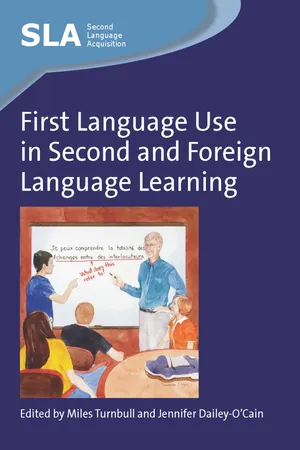
- Miles Turnbull, Jennifer Dailey-O'Cain, Miles Turnbull, Jennifer Dailey-O'Cain(Authors)
- 2009(Publication Date)
- Multilingual Matters(Publisher)
Chapter 3Codeswitching in Computer-mediated Communication: Linguistic and Interpersonal Dimensions of Cross-National Discourse between School Learners of French and English
MICHAEL EVANSIntroduction
It is understandable, given that the study of codeswitching has its roots in the analysis of bilingual speech within the framework of the discipline of sociolinguistics, that the study of language learner codeswitching has mostly focused on oral production in the classroom. The rare studies that have been conducted on codeswitching in written discourse have examined occurrence of the phenomenon in exchanges of personal letters between students (e.g. Montes-Alcalá, 2005). What has been almost entirely neglected so far by researchers (with the exception of Kötter, 2003), both in the fields of codeswitching research and of computer-related discourse analysis, is a consideration of this phenomenon in the textual exchanges of language learners communicating within the e-learning environment. Yet the acknowledged hybrid nature (e.g. Belz & Reinhardt, 2004: 349–350) of this medium is potentially generative of codeswitching as a feature of communicative interaction. In his study of real-time negotiation of meaning and codeswitching by university students in Germany and the United States using synchronous computer-mediated communication (CMC), Kötter found that most of the participants ‘were willing to find a solution to the dilemma of wanting to use their second language, having to use their first language, and the challenge of having to achieve a stable balance between these competing goals over the course of the project’ (Kötter, 2003: 24–25). The aim of this chapter is to interpret the practice of codeswitching by younger language learners than those in most existing studies by defining its characteristics and functions in the CMC exchanges of pupils learning each other’s language.
- Gerald Stell, Kofi Yakpo, Gerald Stell, Kofi Yakpo(Authors)
- 2015(Publication Date)
- De Gruyter(Publisher)
Code-switching between cognition and socio-pragmatics dp n="26" folio="18" ? dp n="27" folio="19" ? Passage contains an image
Ad Backus, Tilburg University
Passage contains an image
Ad Backus, Tilburg University
A usage-based approach to code-switching: The need for reconciling structure and function
Abstract: This chapter argues that the field of code-switching studies could be reinvigorated by the introduction of a usage-based approach. The perspective this approach brings to the study of linguistic competence allows a fresh look at the debate about how to distinguish between code-switching and borrowing, and also stimulates further unification of contact linguistics. Specifically, it calls for a unified account of code-switching, loan translation and structural borrowing. The outlines of such a unified model are sketched. Its chief feature is that all contact effects are seen as aspects of a general process of language change, some emphasizing a synchronic perspective and others a diachronic one. Both perspectives, however, are indispensable for a general account of change, itself a basic design feature of language. It is argued, finally, that adopting a usage-based approach also entails adopting new methodologies into contact research.1 Introduction: Code-switching and its explanation
For many linguists, the goal of linguistics is to describe the mental representation of linguistic knowledge in the minds of individual speakers. While there is nothing wrong with that at all, I wish to draw attention to what I see as two problems with the way linguistic theorizing is generally conducted, and the specific shape they take in the code-switching literature. First, the concept of “knowledge” is often understood in a needlessly limited way, excluding knowledge about language use and practice, about the social life of language, and about its functions. I will argue that a broader concept of knowledge is not just more ecologically valid, but also allows asking questions which now rarely rise to the surface, or only do so in separate fields that don’t communicate much with each other. Second, the concept of “language” with which linguistics operates is relatively unclear. While linguistic knowledge resides in the individual speaker, we normally conceptualize language at higher levels of aggregation: what we generally describe is not really the knowledge of the individual speaker but the knowledge of clusters of speakers (e.g. the speakers of a particular dialect or language). Both problems are tackled by the currently ascendant usage-based approach in linguistics, and I will argue that adopting this approach in code-switching research can give the field a much-needed boost. eBook - PDF
Bilingualism in the Community
Code-switching and Grammars in Contact
- Rena Torres Cacoullos, Catherine E. Travis(Authors)
- 2018(Publication Date)
- Cambridge University Press(Publisher)
9 Code-switching without Convergence 9.1 Cognitive Accounts of Contact-induced Change Proposed explanations of contact-induced change should be consonant with known mechanisms of language change. A leading hypothesis is that code- switching (CS), loosely defined as the use of two or more languages in a single discourse event, is an impetus of structural convergence (e.g., Gumperz and Wilson 1971). The reasoning is that, when switching, bilinguals favor struc- tures that are common to the languages, toward “cross-language compromise” (Thomason and Kaufman 1988: 154). However, the mechanisms – the why and how CS begets convergence – remain nebulous (as noted by Winford 2005). The widely entertained idea is that the use of two languages is somehow cognitively costly. Convergence has been viewed as a consequence of bilin- guals (unconsciously) adjusting how they use the structures of one language to better match patterns of the other. Such modulation may follow from strategies of bilingual optimization (Muysken 2013) or syncretization (Matras and Sakel 2007: 832) for “easing of tensions” (Erker and Otheguy 2016: 144) or “light- ening the cognitive load of having to remember and use two different linguistic systems” (Silva-Corvalán 1994: 6). Decisive psycholinguistic evidence for a bilingual cognitive load is still elusive, however. In lab-based studies, competition across two languages appears costly for speed and accuracy in vocabulary-related tasks, such as lexical decision experiments, but may be beneficial to the development of cognitive processes for controlling behavior such as directing attention and inhibiting previously perceived information (for a review of evidence and accounts of the cognitive consequences of bilingualism, see Kroll, Dussias, Bice, and Perrotti 2015). As to blanket processing costs of CS itself, the jury is still out. eBook - PDF
- R.J. Harris(Author)
- 1992(Publication Date)
- North Holland(Publisher)
444 A. Bentahila and E.E. Davies There is no space here for an evaluation of the various positions in this debate, hut we feel it safe to say that, whether or not these further distinctions prove to be justified on independent grounds, it must be acknowledged that the patterns found in many communities’ mixed language utterances are not well captured by any of these constraints. The reason why the search for universal constraints has not been more successful, we suspect, is that it has tended to focus almost exclusively on the syntactic dimension of code-switching, treating switching patterns as purely structural phenomena rather than setting them within a social and psychological context. This tendency to attribute all features of code-switched discourse to the influence of syntactic principles seems reminiscent of the Generative Semantics movement of the late sixties and early seventies, which began from the assumption that all aspects of the meaning o f a string must be derivable from its underlying structure. With the development of pragmatics, this approach has of course long been forsaken by theoretical linguists, and in our opinion exclusively syntactic treatments of code- switching must go the same way. In their place should come accounts which, while recognizing that syntactic principles do have a part to play in determining which types of switch are likely to occur, treat them as only one among a number o f variables which might influence this issue. In particular, we feel that more attention should be paid to potentially influential aspects of the users of code-switching, which might include their degree of proficiency in each of the languages, the extent to which and domains in which they use each language, their attitudes towards their languages and towards mixing them, and the functions each language tends to fulfill in their everyday life and discourse.
Index pages curate the most relevant extracts from our library of academic textbooks. They’ve been created using an in-house natural language model (NLM), each adding context and meaning to key research topics.

