Languages & Linguistics

Fricatives
Fricatives are a class of consonant sounds produced by forcing air through a narrow channel in the vocal tract, creating friction. This results in a hissing or buzzing sound. Examples of fricatives in English include the sounds represented by the letters "f," "v," "s," "z," "sh," and "th." Fricatives are characterized by their high degree of turbulence in the airflow.
Written by Perlego with AI-assistance
Related key terms
1 of 5
10 Key excerpts on "Fricatives"
 eBook - ePub
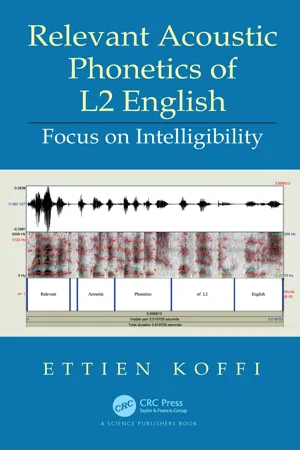
Relevant Acoustic Phonetics of L2 English
Focus on Intelligibility
- Ettien Koffi(Author)
- 2021(Publication Date)
- CRC Press(Publisher)
There is unanimity in the L2 English community that the Fricatives [θ] and [ð] are extremely difficult to acquire. For this reason, various proposals have been made. One recent proposal that is not without controversy was made in Jenkins (2000:138). She proposed that [θ] be taught as [f], and [ð] as [v]. This chapter is not a critique of Jenkins’ position, but rather an assessment of the intelligibility of [s, z, f, v, θ, ð, ʃ, h] on the basis of 3350 tokens produced by 67 L2 talkers whose native languages are Arabic, Japanese, Korean, Mandarin, Slavic, Somali, and Spanish To this end, these segments are analyzed instrumentally and compared and contrasted with identical Fricatives produced by 10 native speakers of GAE._______________32 Maddieson (1984:41) does not include /h/ in the fricative count. Many phoneticians do not include [h] in their study of GAE Fricatives because it does not qualify as a fricative in a strict definitional sense. There is no constriction when it is produced; as air molecules flow freely without meeting any obstacle. It is, however, included in the study of Fricatives in this chapter because the ways in which it is produced or not produced can interfere with intelligibility.6.1 Definitions and Overview of English Fricatives
Fricatives are defined as speech sounds produced when airwaves encounter an obstacle. The obstacle is caused when one or several of the movable articulators and the immovable articulators come so close together as to narrow the passage of air molecules. The movable articulators are the lower lip, the tip of the tongue, the blade of the tongue, the root of the tongue, and the uvula. The immovable articulators are the upper lip, the teeth, the alveolar ridge, the hard palate, the velum, and the pharyngeal wall. In the production of stops, a moveable articulator and an immovable articulator seal off, albeit momentarily, outgoing (or incoming) air molecules. However, in the production of Fricatives, there is no complete obstruction. The articulators simply come into a very close proximity to each other so as to narrow the air passage by varying degrees. As a result of these synchronized articulatory gestures, a hissing sound is made when Fricatives are produced. It has been noted that Fricatives call for the type of articulatory precision not commonly found in the production of other consonants. Ladefoged and Maddieson (1996:137) observe that “a variation of one millimeter in the position of the target for the crucial part of the vocal tract makes a great difference. There has to be a very precisely shaped channel for a turbulent airstream to be produced.” Table 6-1 eBook - ePub
Phonetics
The Science of Speech
- Martin J Ball, Joan Rahilly(Authors)
- 2014(Publication Date)
- Routledge(Publisher)
However, a division of Fricatives in terms of their sound quality is often encountered, and this includes a wider range of places of articulation. Sibilant Fricatives are those with a higher pitch and greater acoustic energy than non-sibilant Fricatives. Sibilants include [ s, z, ʃ, ʒ,ʂ,ʐ,ɕ,ʑ ] while non-sibilants include [ ɸ, β, f, v, θ,ð,ç,ʝ, x, ɣ, χ, ʁ,ħ, ʕ ]. Phonologists often divide Fricatives into ‘strident’ and ‘non-strident’ (that is to say, greater versus lesser acoustic noise), with [ θ, ð ] in the non-strident group and [ f, v, s, z, ʃ, ʒ ] in the strident group. Phoneticians do not all agree with this last analysis, as it cuts across both the production and perception divisions of slit/grooved and sibilant/non-sibilant described earlier. Lateral Fricatives As we noted in Chapter 3, Fricatives can be pronounced with both central and lateral airflow. The Fricatives we have described up to now have been all central, but both voiced and voiceless alveolar lateral Fricatives are relatively common sounds in natural language. As noted in Chapter 3, a lateral fricative is formed when there is a closure made between the central part of the tongue and the roof of the mouth (e.g. the tip of the tongue and the alveolar ridge), but air is allowed to escape down one or other side of the tongue (and for some speakers both sides of the tongue). However, this lateral gap for the air to flow through is kept narrow, so that the air escapes with turbulence. Lateral Fricatives can be both voiceless and voiced, and may be part of laterally released affricates. They are most common at the alveolar place of articulation, though unofficial symbols exist for both palatal and velar lateral Fricatives (see Table 4.5). Trills and taps ——————————————————— Trills and taps can be considered as varieties of stops, but they have traditionally been listed as separate classes of obstruents eBook - PDF
Phonetics
Transcription, Production, Acoustics, and Perception
- Henning Reetz, Allard Jongman(Authors)
- 2020(Publication Date)
- Wiley-Blackwell(Publisher)
Sounds with a full or partial obstruction in the vocal tract, made by the tongue and lips, are called consonants . These are categorized in a two‐ dimensional grid by the manner of articulation , that is, the extent of the obstruc-tion, and by the place of articulation , where the obstruction is made. Important for this categorization is the tongue, which is segmented into tongue tip, blade, body (front, center, back), and tongue root . Places of articulation are ordered from the front of the mouth along the roof of the mouth down to the pharynx, yielding for Articulatory Phonetics 2 10 Articulatory Phonetics English labial, labio‐dental, dental, alveolar, postalveolar, palatal, labial‐velar, velar, and glottal . Ordering manner of articulation in terms of the degree of obstruction yields an (oral) stop (or plosive ) , nasal (stop), fricative, affricate, and approximant . Stops have a complete closure of the vocal tract, where nasals have an open nasal tract. For Fricatives, the articulators come close together to create a narrow channel and airflow through this passage produces a hissing sound. Affricates are a combination of a plosive immediately followed by a fricative. And approximants are marked by a somewhat wider opening of the oral tract, so that no hissing sound is produced. When the articulators are even further apart, vowels are produced. Vowels are also categorized in basically three dimensions: a horizontal dimension depending on the frontness or backness of the tongue, a vertical dimension depending on the height of the tongue, resulting in labels such as high , mid , or low , and a third dimension, which expresses whether the lips are rounded or unrounded . For some vowels, tense and lax varieties exist, which differ in qualities that will be described in Section 3.3. Additionally, the nasal tract is open when producing nasal or nasal-ized vowels. eBook - ePub
- William F. Katz(Author)
- 2013(Publication Date)
- For Dummies(Publisher)
P roducing speech is a tricky business and the exact way in which consonants are made can result in vast differences in how these sounds are heard. In this chapter, I walk you through some different types of consonant manners (stops, Fricatives, affricates, and approximants), zeroing in on those mouth and throat details that make big perceptual differences in the English language.Stopping Your AirflowStop consonants (sounds made by completely blocking oral airflow) are part of a larger group called obstruents , which are sounds formed by shaping airflow via obstruction (this group also includes Fricatives and affricates). Fricatives are made when air is blown through a space tight enough to cause friction (or hissiness). Affricates are sounds that begin as a stop, then release into a fricative. Refer to Chapters 4 and 5 for more information on these types of sounds. When airflow is completely stopped, several different things can happen:Air can be released into the vocal tract in different ways.Air can flow into different regions when the sound is released.The duration of the closure itself can last for longer or shorter periods.Some of these puzzling mechanics are revealed in the following sections. Huffing and puffing: Aspiration when you need itAspiration is the airy event that takes place just after the burst of the articulators blasting open and before the voicing of the vowel. Aspirated voiceless stop consonants are made with an audible puff of breath. Aspiration, represented by the raised letter “h” ([ʰ eBook - ePub
- Bruce M. Rowe, Diane P. Levine(Authors)
- 2022(Publication Date)
- Routledge(Publisher)
Fricatives are produced by an incomplete obstruction of the airstream. Instead of the completed obstruction that produces the stops, the airstream is only partially obstructed, creating turbulence (friction) beyond the constriction. The result is a hissing sound similar to the first sound you hear coming from a whistling tea kettle. In English, Fricatives are produced in the following positions: labiodental [f] and [v], dental [θ] and [ð], alveolar [s] and [z], and palatal [š] and [ž]. The first of each set of sounds is voiceless, the second voiced. Unlike stops, it is possible to prolong a fricative sound for as long as you can exhale.Affricates are each, in a sense, two sounds. The affricate starts out as a stop but ends up as a fricative. Notice that in forming the initial and final sound in church, there is a momentary stop followed by a hissing (fricative) sound. The sound is phonetically represented as [č]. The only other affricate in English is [ ǰ ], the initial sound in Jell-O and gin.Liquids are distinguished from the other classes of sounds in that they involve only minimal obstruction of the airstream and friction is not produced. As with affricates, only two liquids, [l] and [r], exist in English. The [l] and [r] are produced in significantly different ways. Articulating the tip of the tongue with the central portion of the alveolar ridge forms the [l] as in limb. This articulation occurs so as not to stop the airstream completely and allows the air to pass along one or both sides of the tongue. Because of this lateral (side) movement of air, the [l] is called a lateral liquid.The [r] sound in English is usually formed by curling the tip of the tongue up behind the alveolar ridge and by bringing the tongue forward and upward toward the alveolar ridge without touching the ridge. Because of the curling of the tongue, such sounds are often called retroflex (retro = back or behind, flex = to bend). The initial sound in Ralph is a liquid retroflex sound.Glides No longer available |Learn more
- Carlos Gussenhoven, Haike Jacobs(Authors)
- 2017(Publication Date)
- Routledge(Publisher)
In the case of obstruents, an acoustic source is actually created at the point of articulation: either a popping sound is produced (for plosives), or friction is produced at that spot (for Fricatives and affricated plosives). The auditory quality of sonorants relies exclusively on the different shapes the vocal tract is given, i.e. on the resulting modifications of the acoustic characteristics of the sound produced by phonation in the larynx.Obstruents are subdivided into plosives (also called stops ), Fricatives and affricates .Plosives
These are formed by creating a complete closure at some point in the speech tract, behind which the air from the lungs is compressed until the closure is abruptly released so that the air explodes outwards. Since the soft palate is raised, the air cannot escape through the nasal cavity. Examples are French voiceless [p t k], as in [pip] ‘pipe’, [tip] ‘type’, [ekip] ‘crew’. Voiced plosives occur in French [bide] ‘bidet’ and [gã] ‘glove’. Plosives have a very brief friction burst when they are released, which is not usually heard as friction but is responsible for the popping quality of plosive releases.Fricatives
These are formed by narrowing the speech tract to such a degree that audible friction is produced when air passes through. English has the voiceless labiodental fricative [f] in fee , the voiceless dental fricative [θ] in thigh , the voiceless alveolar [s] in sigh and the voiceless palatoalveolar [ʃ] in shy. The voiced counterparts [v ð z ӡ] occur in vie, that, zoo and measure , respectively. (At the beginning of the syllable, English [v ð] are frequently pronounced without friction.)Affricates
Affricates are plosives whose release is slow instead of sudden, causing a longer phase of turbulence. The affricates [pf] and [ts] occur in German [ˈpfaifə] ‘pipe’ and [tsait] ‘time’, and the palatoalveolar affricates [tʃ] and [dӡ] occur in English cheer and jeer , respectively.Sonorants
These divide into nasals and approximants .Nasals
For nasals the soft palate is lowered, and the oral cavity is blocked completely at some point. A slow, deliberate pronunciation of morning eBook - PDF
Acoustic Theory of Speech Production
With Calculations based on X-Ray Studies of Russian Articulations
- Gunnar Fant(Author)
- 2012(Publication Date)
- De Gruyter Mouton(Publisher)
2.6 Fricatives, AFFRICATES, AND STOPS 2.61 Fricatives and Affricates The previous sections have been devoted to the study of the vocal tract response to a voice source. Whispered liquids and vowels should theoretically differ from voiced variants mainly by the random fine structure and more high frequency emphasized spectrum envelope of the source, owing to the glottis noise source. However, the production of these vocalic sounds may also involve noise produced at a supraglottal constriction. Such noise is not a necessary attribute but may add noticeably to the sound spectrum in, for instance, a stressed [i], [1], or [r]. The first part of a liquid following an unvoiced consonant may assimilate the lack of voicing and thus becomes aspirated 1 or even fricative, with reference to noise generation at a narrow supraglottal passage, as discussed in Sections 1.11 and A.22. Acoustically, the common denominator of all sounds produced from a resonator system of a prescribed configuration is the particular set of formant frequencies of the vocal tract, i.e., the F-pattern. The differences in location of the source and the spectrum envelope of the source will only influence the relative intensity levels of the formants. It is to be expected that the cavities in front of and in the vicinity of a source will be of major importance for the spectral shape of any sound. One complication that must be taken into account is the influence of the glottis-opening on formant frequencies and formant damping. The first formant is raised in frequency and highly damped when the glottis area is large. These general relations are common to all sounds that are produced in part or solely from a supraglottal source, thus also to stops, affricates, and Fricatives. eBook - ePub
- Jethro Bithell(Author)
- 2018(Publication Date)
- Routledge(Publisher)
tu? ə].The semi-consonants are sub-members respectively of the phonemes [j] and [w], and they are intermediary between these consonants and the vowels [i] and [u]. The difference between consonant and semi-consonant is that their frictional quality varies; in North Germany they are articulated with more friction than in South Germany. Pronunciation of the semi-consonants is faulty if there is too much friction; the degree of friction is graded by the narrowness of the constriction and the energy of the articulation. Equally faulty is the pronunciation of the consonants [j] and [w] as semi-consonants, that is with too little friction; e.g. of jung as iung [ĭuŋ]. How colloquial pronunciation tends to the change of semi-consonant to fricative consonant can be heard in adjes [adl je s], vulgar for adieu [adĭtø ], or in the historical change of i to j in je<M.H.G. ie (see p. 93).FRICATIVESFricatives are formed when two speech organs approach each other, but without contact, so that the air is expelled through a chink or constriction (Reibeenge). Since there is an opening, though it is a narrow one, Fricatives are sometimes called ‘open consonants’, in contrast with ‘stopped consonants’.For r and l as Fricatives, see p. 133.LABIAL FRICATIVESThe Lippenzähnereibelaute [f] and [v] are formed by friction of the air along the edges of a lip-chink formed, in standard N.G.DENTAL FRICATIVES SIBILANTSSibilants (Zischlaute) are produced by raising the front part of the tongue together with the tip against the hard palate near the upper alveoli and against the upper teeth, here forming a constriction through which the air is forced so energetically that it rubs against its edges, thus producing the hissing which is the characteristic of these sounds.(θ) and [ð]. For the voiceless dental fricative [ð] and the voiced dental fricative [δ] the tip of the tongue is (1) pushed just under the upper front teeth, and the air expelled through a chink made by tip and teeth—in which case we have interdental th (das Zahnrand-th) eBook - PDF
Turbulent Sounds
An Interdisciplinary Guide
- Susanne Fuchs, Martine Toda, Marzena Zygis, Susanne Fuchs, Martine Toda, Marzena Zygis(Authors)
- 2010(Publication Date)
- De Gruyter Mouton(Publisher)
This means that stops, affricates and Fricatives – those sounds formed with more radical constrictions than the glides – are considered to be obstruents, i.e. [–sonorant], whereas vowels, glides, nasals and liquids are sonorant, i.e. [+sonorant]. 1 The reader is referred to the Appendix for a list of the features we discuss in the present article. 2 According to a second definition (Halle and Clements 1983: 6) sonorant sounds “are produced with a vocal tract configuration sufficiently open [so] that the air pressure inside and outside the mouth is approximately equal. Obstruent sounds are produced with a vocal tract configuration sufficient to increase the air pressure inside the mouth significantly over that of the ambient air.” Apparently both the latter definition and the one from SPE make the same predictions concerning natural classes. Since the Halle and Clements’s (1983) definition of [sonorant] seems to be the most widely accepted one among phonologists, it is the definition we adopt in the present study. 3 It is usually assumed that the definition for obstruents correlates with their phonological behaviour in the sense that sounds like /p t k/, etc., are obstruents from the point of view of phonetics (i.e. they fit one or both of An overview of the phonology of obstruents 3 the definitions given above), but also from the point of view of phonology by patterning as [–sonorant] segments. A number of linguists have pointed to segments in various languages in which this correlation does not hold. One logical possibility involves sounds which are phonetically obstruents but which nevertheless pattern phonologically as if they were sonorants, while the mirror image situation obtains if phonetic sonorants pattern phonologically as obstruents. In the remainder of this section we briefly discuss examples illustrating the former case. Examples of phonetic obstruents patterning with sonorants are discussed by Rice (1993), who dubs such sounds ‘sonorant obstruents’. eBook - PDF
- Alan Cruttenden(Author)
- 2014(Publication Date)
- Routledge(Publisher)
Hindi. Second, where they do involve the body of the tongue, the articulations represent only brief glides to a following vowel: thus [j] in yet is a glide starting from the [i] region and [w] in wet is a glide starting from the [u] region. 4.3.5 Obstruents and sonorants It is sometimes found useful to classify categories of sounds according to their noise component. Those in whose production the constriction impeding the air- flow through the vocal tract is sufficient to cause noise are known as OBSTRUENTS. This category comprises plosives, Fricatives and affricates. SONORANTS are those voiced sounds in which there is no noise component i.e. voiced nasals, approximants and vowels. 4.3.6 Fortis and lenis A voiceless/voiced pair such as English Is,zl are distinguished not only by the presence or absence ofvoice but also by the degree ofbreath and muscular effort involved in their articulation. Those English consonants which are usually voiced tend to be articulated with relatively weak energy (they are LENIS), whereas those which are always voiceless are relatively strong (they are FORTIS). Indeed, we shall see that in certain situations, the so-called voiced consonants may have very little voicing, so that the energy of articulation becomes a significant factor in distinguishing the voiced and voiceless series. 32 Language and speech 4.3.7 Classifieation of consonants The chart of the International Phonetic Alphabet (IPA)3 (see Table 1) shows manner of articulation on the vertical axis; place of articulation on the horizontal axis; and a pairing within each box thus created shows voiceless consonants on the left and voiced consonants on the right. 4.3.8 Ingressive pu/monie consonants Consonants of this type, made as we are breathing in, sometimes occur in lan- guages as variants of their egressive pulmonic equivalents.
Index pages curate the most relevant extracts from our library of academic textbooks. They’ve been created using an in-house natural language model (NLM), each adding context and meaning to key research topics.

