Languages & Linguistics

King James Bible
The King James Bible, also known as the Authorized Version, is an English translation of the Christian Bible. It was first published in 1611 and has had a significant impact on English literature and language. Its language and linguistic style have influenced many subsequent works and have contributed to the development of modern English.
Written by Perlego with AI-assistance
Related key terms
1 of 5

10 Key excerpts on "King James Bible"
 eBook - PDF
- Alexander Bergs, Laurel J. Brinton, Alexander Bergs, Laurel J. Brinton(Authors)
- 2012(Publication Date)
- De Gruyter Mouton(Publisher)
which closely followed the Latin text, providing Latin or Latinized terms wherever they felt a common vernacular term would not embody the perceived theological and eccle-siastical sense. As a result, the text is extremely Latinate in terms of lexis, syntax, and idiom. But it seems that the translators of the King James Bible took the Rheims New Testament into consideration and in a number of instances adopted its Latinisms. 2 . 4 The King James Bible ( 1611 ) When King James I ascended the throne, he found a country which was mainly divided between Anglicans proper and Puritans, a division which not only posed a potential threat to the unity of the nation but which also reflected the disparity between the unpopular Bishops’ Bible and the fashionable Geneva Bible . Thus, the project of a new Bible translation was for James a sudden opportunity to regain religious peace and to abolish the unloved Calvinist translation. The rules regulating the development of the King James Bible show that it was very much a product restrained by committee work and guided by a downright conservative attitude. The translation was to be divided up between six panels (two at Westminster, two at Oxford, two at Cambridge). Among these panels specific regulations were set up on how to co-referee the translation work and to reach agreements over contested translations. When the first drafts were completed, twelve delegates from the panels would review and revise the entire work. This revised version was then to be improved by the bishops of Winchester and Gloucester, and, in the end, to be presented to the Privy Council and “authorized” by the king (which, despite the designation Authorized Version , does not seem to have happened). The basic conservative orientation of the work was secured by the regulation that the translators were to follow the Bishops’ Bible wherever possible.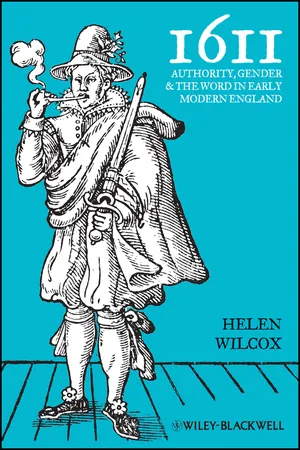 eBook - ePub
1611
Authority, Gender and the Word in Early Modern England
- Helen Wilcox(Author)
- 2013(Publication Date)
- Wiley-Blackwell(Publisher)
v ). The translation may never have officially been given the adjective ‘authorised’, despite the fact that it has been familiarly known as the Authorised Version in many parts of the English-speaking world ever since, but it certainly bore the marks of James's interventions as well as his original decree that it should be prepared. As the title page asserts, the translation was undertaken ‘by his Majesties speciall Commandement’.The King James Bible was a work of formidable scholarship in the best humanist tradition. It is presented as having been ‘Newly Translated out of the Originall tongues’ (title page), a claim that is borne out by the enormous learning in ancient languages embodied in the more than 50 scholars engaged on the project. They worked in six ‘companies’, two each from Oxford, Cambridge and Westminster, dividing up the books of the Bible between them but regularly reading and listening to one another's work in order to ensure continuity and clarity. Among the members of the translating companies whom we have encountered so far in this study, Lancelot Andrewes chaired the first Westminster company that was responsible for the first books of the Old Testament from Genesis to the second book of Kings. Andrewes was familiar with 15 modern and 6 ancient languages (Buckeridge, 18) and would certainly not have taken lightly the obligation to work with those ‘Originall tongues’ in order to render the sacred word accurately and responsibly. Miles Smith, author of the prefatory epistle from ‘The Translators to the Reader’, was one of the first Oxford company; George Abbot, who became Archbishop of Canterbury during 1611, was in the second Oxford company, and the preacher of A Silver Locke, Francis Dillingham, was a member of the first Cambridge company. As the KJV title page goes on to explain, the ‘former Translations’ of the Bible into English were ‘diligently compared and revised’; indeed, the scholars working on the task for nearly 7 years preferred to be known as ‘revisers’ rather than translators. With a mixture of humility and pragmatism, they drew on the inspired work of ‘many worthy men who went before us’ as they explained in their dedication to the King (KJV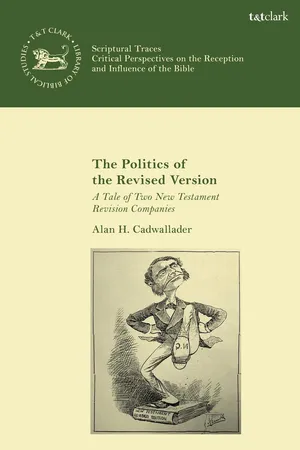 eBook - ePub
The Politics of the Revised Version
A Tale of Two New Testament Revision Companies
- Alan Cadwallader(Author)
- 2018(Publication Date)
- T&T Clark(Publisher)
Chapter 1 THE CONTESTED PLACE OF THE KING JAMES VERSION IN THE NINETEENTH CENTURYThe English Bible known as the King James Bible, aka ‘the Authorized Version’, was neither a translation nor authorized. Stephen Prickett recognizes that the homogenization of language in the King James Bible – what he dubs the ‘steamroller’ effect – was due to the fact that the work of the translators that became the 1611 publication was both the result of the evaluating scrutiny of committee supervision,1 and the heavy borrowing (enforced by the commissioning edict of King James in 1604) from previous translations – the Geneva Bible, the Bishops’ Bible, the Coverdale, Matthew, Whitchurch and Tyndale translations.2 In a neat twist of history, the ‘heretic’ William Tyndale left a powerful legacy in precisely the Bible attributed by name to royal imprimatur. The King James revisers themselves were keen to accent that their work was simply an improvement. One of their number (Miles Smith), doubtless aware of the muskets levelled at the work, wrote a long explanatory preface (often dropped in later printings of the text) in which full flights of forensic rhetoric defended the efforts: ‘Truly (good Christian Reader) we never thought from the beginning that we should need to make a new translation . . . but to make a good one better, or out of many good ones, one principal good one, not justly to be excepted against.’3 Nonetheless, the shift away from the prescribed benchmark, the Bishops’ Bible, and even to include reference to versions not listed in the guidelines (such as the Rheims Version – a work of English Catholics)4 were sufficient to bring Westcott’s sober verdict ‘that the revisers did not hold themselves to be closely bound by the instructions which were given them . . . If indeed they had not interpreted liberally the license of judgment which was given them, they could not have accomplished their task’.5 Written in 1868, the words had a prescience of the revision to come – and perhaps, with that historical consciousness, a permission to sacrifice the letter of regulation to the goal of accuracy.6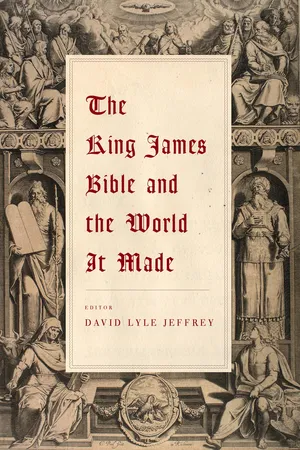 eBook - PDF
- David Lyle Jeffrey(Author)
- 2011(Publication Date)
- Baylor University Press(Publisher)
It, too, aimed for a dignified style and so sometimes followed the text of the King James Bible closely. At other times it lapsed into academic abstraction, as when Psalm 94:20 was ren-dered “Shall sanctimonious calumny call thee partner?” 89 Many deemed it little more intelligible to the general public than the Authorized Ver-sion. Although the Revised Standard Version and the New English Bible The King James Bible in Britain from the Late Eighteenth Century 63 were both approved for use in the Anglican communion service in 1965, the Authorized Version was still thought to be on almost every lectern ten years later. 90 In 1984 a careful survey of Scottish churches showed that 40 percent of them remained attached to the King James Bible. 91 The later twentieth century saw an onslaught on the previous dominance of the King James Version, but not its immediate collapse. The delay in capitulation to modern versions was a consequence of resistance by two distinct parties. One consisted of members of the cul-tural elite, engaging in defense of the national way of life against what they saw as vandalism. T. S. Eliot, who had declined to act as a literary adviser to the translators of the New English Bible, set the tone for these people when, in reviewing its New Testament in 1961, he dismissed the work as “an active agent of decadence.” The latest translation, he insisted, lacked the “verbal beauty” of the Authorized Version, which was “a mas-terpiece of literature.” 92 Those who thought like Eliot watched with dis-may as the Church of England engaged in liturgical experiments over the next two decades. The Prayer Book, they believed, was being supplanted by modern vulgarity. The result of this process, The Alternative Service Book of 1980, actually showed many signs of the continuing influence of the King James Bible. It included words such as “beseech” and “ever-more,” which had long dropped out of regular usage.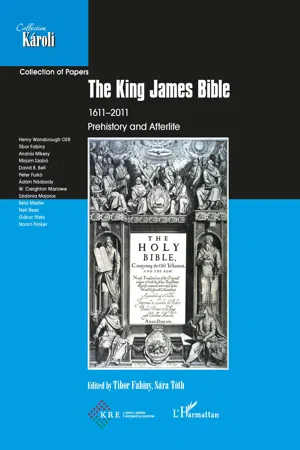 eBook - ePub
The King James Bible 1611-2011
Prehistory and Afterlife
- Fabiny Tibor, Sarah Toth(Authors)
- 2017(Publication Date)
- Harmattan Hongrie(Publisher)
PART I THE King James Bible Passage contains an image
THE KING JAMES VERSION, A BIBLE OF UNITY
HENRY WANSBROUGH OSB A HIGH POINT OF ENGLISH LITERATUREThe King James Version of the Bible was one of the greatest achievements of English literature. It was produced at an unrivalled period of English culture and learning. During the years in which this version was being created an astonishing constellation of great writers was at work. Poets like John Donne (1572–1631), dramatists like William Shakespeare (1564–1625), Ben Jonson (1573–1637), essayists like Francis Bacon (1561–1626), homilists like Launcelot Andrewes (1555–1626) were at the height of their powers, writing with vigor, drama and confidence. The contemporary standard of learning may be judged from the remark in the Preface to the KJB, “the Syrian translation of the New Testament (NT) is in most learned men’s libraries […], and the Psalter in Arabic is with many.” (Qtd. in DANIELL 780.)The process of preparing the translation of the King James Version would put the translators of many Bibles to shame. The KJB was prepared by six panels 3 of translators, two at Oxford, two at Cambridge, two at Westminster. In all, at least fifty scholars were involved. All of these were under the close control of the King himself, the first four being presided by Regius Professors, who owed their jobs to him, the last two being located in the royal peculiar of Westminster, near London (now of course engulfed in London). The final revision took place over a period of nine months at the Stationers’ Hall in London. A panel of sixteen scholars sat round, each with a di fferent Bible in one of the principal European languages, while the prepared version was read out. If they wished they could intervene. The notes taken by a scholar named John Bois on the discussion of the eBook - ePub
The Bible in Translation
Ancient and English Versions
- Bruce M. Metzger(Author)
- 2001(Publication Date)
- Baker Academic(Publisher)
[7]In the nineteenth century, the board of managers of the American Bible Society expressed concern that their English Bibles be correctly printed. In 1847 the board charged a committee to investigate the matter and prepare a standard text for the society. The committee’s report pointed out that although there were twenty-four thousand variations among the half-dozen copies obtained from well-known printers, “there is not one, which mars the integrity of the text, or affects any doctrine or precept of the Bible.” After lengthy discussions, in 1861 various kinds of changes (chiefly orthographic) were introduced into the society’s editions of the King James Bible. Further changes were made in 1932 to conform the orthography to American usage, and pronunciation marks were placed over most proper names. No further changes were made until the Reference Bible of 1962, in which the text was arranged in paragraph form, section headings were inserted, pronunciation marks simplified, a few changes in punctuation and orthography introduced, and a new system of references prepared.[8]The most recent effort made by a Bible publisher to modernize the language of the King James Bible was undertaken in the last third of the twentieth century by the Thomas Nelson Corporation, Nashville, Tennessee. The New Testament of the New King James Version was issued in 1979 and the entire Bible in 1982, the work of “119 scholars, editors and church leaders” (so the dust jacket states).In older editions of the King James Version, the frequency of the connective and far exceeded the limits of present-day English usage. Biblical linguists agree that the Hebrew and Greek original words for this conjunction may commonly be translated otherwise, depending on the immediate context. Therefore, the Nelson NKJV frequently replaces and with alternatives such as but, however, now, so, then, and thus, No longer available |Learn more
Understanding Language
A Basic Course in Linguistics
- Elizabeth Grace Winkler, Elizabeth Winkler(Authors)
- 2012(Publication Date)
- Continuum(Publisher)
However, perhaps wisely, he did not. In fact, he declared laws that made English the national language of his united kingdoms. James is also responsible for the spread of a writ-ten variety of English across Britain. First, he decreed that English would be the language spoken in all churches and schools throughout the nation. Then, in 1611, he commissioned a new version of the Bible to be written by a committee. His intent for this Bible is reported to have been to make it a more poetic yet more readable Bible than previous versions, especially for the increasingly literate middle class. This was a particularly difficult task. At this time, Britain was fiercely divided along religious lines between Catholics and Anglicans (the church created by Henry VIII, Elizabeth’s father). James’ own mother was Catholic, but though he had been baptized Catholic, after his mother’s imprisonment in the Tower of London, he was raised in the Scottish Anglican church. With his Bible, James was trying to find a middle road between Catholics, who wanted a flowery Bible in the Latin tradition, which would have been difficult for common people to read, and Puritans, who wanted a Bible for common people, but devoid of the passion of previous The History of English 177 versions. It is a fair testament to James’ success that this Bible is still found in many homes and churches, and sold throughout the world hundreds of years later. Once written, James ordered this Bible to be placed in all churches in all the united territories, and decreed that only this version could be read from in church. Obviously, this ruling had the effect of spreading the dialect of English in which this, the King James Version of the Bible, was written. Of course, the decrees of James I did not wipe out other languages in Scotland, Wales and Ireland, nor did the written word eliminate the diver-gent accents of the ‘Englishes’ spoken in these areas. Local preachers would have read the Bible in their own accents.
- Arthur L. Farstad(Author)
- 2014(Publication Date)
- Thomas Nelson(Publisher)
PART ONEACCURACY“He spoke and taught accurately the things of the Lord” (Acts 18:25).Surveys among Bible buyers and readers indicate that the leading concern of those who love God’s Word is that a version of the Scriptures be a translation that is accurate. If a Bible isn’t presenting exactly what God communicated to His people through the forty or so writers whom He graciously inspired to write His Word, to that degree it is a failure.Clearly, on the one hand, it is difficult to enjoy a rendering of the Bible that rigidly ignores English idiom and good style—resembling the translation on a page of an interlinear Testament. On the other hand, we readily reject any professed translation of God’s Word that takes such liberties that it is more truly a paraphrase or commentary than a translation. As the late Dr. Harry Sturz, textual scholar and beloved member of the NKJV New Testament Executive Review Committee, used to say, “We want a Bible that gives us what the text says, not what some scholar thinks it means!”The NKJV, following firmly in the footsteps of the Authorized or King James Version, is just such a desired Bible. The following chapters will make this evident:1. A Firm Foundation. In this first chapter we present the excellent contributions of the English translations from the fourteenth to the early seventeenth centuries that culminated in one of the most highly esteemed Bibles in any language, the Authorized Version.2. A Royal Legacy: The King James Version. Chapter 2 gives a brief survey of how this great Bible came to be, how it is actually a revision of previous works, and has itself been revised a number of times.3. Rewiring the House. Building on a metaphor from J. B. Phillips, Chapter 3 examines how and why the New King James was designed to keep the tradition current as we face the twenty-first century.4. Finishing Touches. eBook - ePub
The Greatest English Classic
A Study of the King James Version of the Bible and Its Influence on Life and Literature
- Cleland Boyd McAfee(Author)
- 1999(Publication Date)
- Perlego(Publisher)
[22] And that gives point to the word already quoted from Hallam that the English of the King James version is not the English of James I.Four things helped to determine the simplicity and pure English—unornamented English—of the King James version, made it, that is, the English classic. Two of these things have been dealt with already in other connections. First, that it was a Book for the people, for the people of the middle level of language; a work by scholars, but not chiefly for scholars, intended rather for the common use of common people. Secondly, that the translators were constantly beholden to the work of the past in this same line. Where Wiclif's words were still in use they used them. That tended to fix the language by the use which had already become natural.The other two determining influences must be spoken of now. The third lies in the fact that the English language was still plastic. It had not fallen into such hard forms that its words were narrow or restricted. The truth is that from the point of view of pure literature the Bible is better in English than it is in Greek or Hebrew. That is, the English of the King James version as English is better than the Greek of the New Testament as Greek. As for the Hebrew there was little development for many generations; Renan thinks there was none at all. The difference comes from the point of time in the growth of the tongue when the Book was written. The Greek was written when the language was old, when it had differentiated its terms, when it had become corrupted by outside influence. The English version was written when the language was new and fresh, when a word could be taken and set in its meaning without being warped from some earlier usage. The study of the Greek Testament is always being complicated by the effort to bring into its words the classical meaning, when so far as the writers of the New Testament were concerned they had no interest in the classical meaning, but only in the current meaning of those words. In the English language there was as yet no classical meaning; it was exactly that meaning that these writers were giving the words when they brought them into their version.[23]
- Richard Marsden, E. Ann Matter(Authors)
- 2012(Publication Date)
- Cambridge University Press(Publisher)
At the level of polemic and justification, it was most evident when the compilers of the King James Version early in the sev- enteenth century took up the time-honoured ideas in their own preface. More fundamental, but rather less easy to quantify, is linguistic continuity. As the Bible became englished during the medieval period, so the English language itself became profoundly biblicised. It is unlikely that there was yet any concept of ‘biblical English’ as we know it today, but exposure to much-repeated scrip- tural excerpts, circulating in the mass of paraphrased and derived literature which we have described, must have given English-speakers familiarity with a large stock of biblical idiom. Expressions such as ‘in the twinkling of an eye’ and ‘death, where is thy sting?’ (1 Cor. 15:52, 55), ‘the patience of Job’ (Jas. 5:11), ‘it rained fire and brimstone from heaven’ (Gen. 19:24), ‘if the blind lead the blind’ (Luke 6:39) – among many others – were well established in the language long before later translators such as William Tyndale used them. 56 Some familiar biblical idiom (including a range of hebraisms, such as those using the cognate accusative construction) had certainly been adopted as early as the Anglo- Saxon period, but the huge changes which occurred as the older language became Middle English after the Norman Conquest, with a drastic loss of old vocabulary and much syntactical change, make specific continuities hard to identify. It is something of an irony that the makers of the first ever complete English translation of scripture, the Wycliffite Bible, more often than not eschewed these familiar idioms (especially in the earlier version; the later revision acknowledged some of them). The explanation seems to be that the Lollard translators deliberately distanced themselves from the largely periphrastic and amplified biblical literature of the thirteenth and fourteenth centuries, wherein Bible-specific English had evolved and become naturalised.
Index pages curate the most relevant extracts from our library of academic textbooks. They’ve been created using an in-house natural language model (NLM), each adding context and meaning to key research topics.

