Law

Manslaughter
Manslaughter refers to the unlawful killing of another person without the element of premeditation or malice aforethought. It is considered a criminal offense, falling between murder and accidental death. Manslaughter can be categorized as voluntary, which involves intent but not premeditation, or involuntary, which occurs unintentionally but due to reckless behavior or criminal negligence.
Written by Perlego with AI-assistance
Related key terms
1 of 5
11 Key excerpts on "Manslaughter"
 eBook - PDF
Lacey, Wells and Quick Reconstructing Criminal Law
Text and Materials
- Celia Wells, Oliver Quick(Authors)
- 2010(Publication Date)
- Cambridge University Press(Publisher)
The extracts below neatly summarise the common law and identify the philosophical problem of carving out culpability for unintended consequences. The difficulties of this task are reflected in the Commission’s revision of its recommendations in its homicide report a decade later, which follow below. Law Commission 1996 Report No 237, Involuntary Manslaughter (HMSO), paras. 1.22, 2.1, 2.3–2.8, 2.14, 2.16, 2.22, 2.23, 2.26, 2.27, 3.1, 4.2–4.6, 4.11, 4.12–4.14, 4.17–4.20, 4.43, 5.6, 5.13, 5.16, 5.17, 5.34, 5.45, 5.69 1.22 In 1989 we published our report on a Criminal Code for England and Wales. This represented the culmination of eight years of work which had the central purpose of making the criminal law more accessible, comprehensible, consistent and certain. . . . 2.1 As we have observed, ‘involuntary Manslaughter’ is the name given to those uninten- tional killings that are criminal at common law: causing death in the course of doing an unlawful act, and causing death by gross negligence or recklessness. ‘Involuntary Manslaughter’ is not recognised as a separate crime in its own right: it is simply a label used to describe certain ways of committing the very broad common law crime of Manslaughter. [The Report considered unlawful act Manslaughter first.] 2.3 The basis of this type of Manslaughter is that the defendant caused the death of another by or in the course of performing an act which would have been unlawful whether or not death was caused. As Lord Parker CJ put it: A man is guilty of involuntary Manslaughter when he intends an unlawful act and one likely to do harm, to the person and death results which was neither foreseen nor intended. It is the accident of death resulting which makes him guilty of Manslaughter as opposed to some lesser offence. eBook - PDF
- Joel Samaha(Author)
- 2016(Publication Date)
- Cengage Learning EMEA(Publisher)
All Rights Reserved. May not be copied, scanned, or duplicated, in whole or in part. Due to electronic rights, some third party content may be suppressed from the eBook and/or eChapter(s). Editorial review has deemed that any suppressed content does not materially affect the overall learning experience. Cengage Learning reserves the right to remove additional content at any time if subsequent rights restrictions require it. 366 CHAPTER 9 • CRIMES AGAINST PERSONS I all crimes of criminal conduct causing criminal harm, involuntary Manslaughter also includes the elements of causation and resulting harm (death here). We won’t repeat our discussion of causation from Chapter 4 here. (See the Elements of Involuntary Manslaughter illustration.) All states have punished involuntary Manslaughter from their earliest days, but they didn’t define it, and if they did, they did so vaguely. For example, most statutes used terms like “culpable negligence,” “criminal negligence,” or “gross negligence” but left in doubt the meaning of the terms. Most comprehensive modern criminal codes have adopted at least some of the Model Penal Code (MPC) homicide sections in the nearby Criminal Law in Focus box, “Model Penal Code Homicide Sections” (LaFave 2003, 794–95). ELEMENTS OF INVOLUNTARY Manslaughter Actus Reus (Voluntary Act) Voluntary act of killing another person Mens Rea (General Intent) 1. Extremely recklessly or 2. Extremely negligently Circumstance 1. Conscious creation of substantial and unjustifiable risk of death or serious bodily injury or 2. Unconscious creation of substantial and unjustifiable risk of death or serious bodily injury or 3. Death occurs during the commission of a qualifying unlawful act Criminal Harm Provocation Jury Instruction V oluntary Manslaughter. An individual who kills in response to legally adequate provocation is guilty of voluntary Manslaughter rather than murder. eBook - PDF
- Lawrence Atsegbua, Violet Aigbokhaevbo, Sunday Daudu(Authors)
- 2022(Publication Date)
- Malthouse Press(Publisher)
According to Smith and Hogan, involuntary Manslaughter occurs where a person causes death under such circumstance that he did not intend to kill and did not foresee death as a probable consequence of his conduct but there is some blameworthiness, such as some negligence in his conduct. It may also occur where death is the result of an unlawful act which involves the risk of harm to another. It should be noted that there can be no conspiracy to commit the offence of Manslaughter, neither could there be an attempt to commit the offence. This is so because the offence of Manslaughter is an unintentional killing of another by the accused person. So, the accused person lacked the necessary mens rea. However, his culpability lies on the actus reus, which occurs independently of his will. Section 24 of the Criminal Code provides to the effect that a person shall not be criminally liable for acts or omissions which occurred independently of his will. However, culpability in Manslaughter finds expression in the fact that the acts of the accused caused the eventual death of the deceased. Reckless Manslaughter Reckless Manslaughter Reckless Manslaughter Reckless Manslaughter Reckless Manslaughter is a new offence of causing death by dangerous driving. The offence of causing death by dangerous Homicide 135 driving is created and punished by section 4 of the Federal Highways Act No. 4 of 1971. Section 4 of the Act provides: Any person who causes the death of another person by the driving of motor vehicle on federal highway recklessly, or at a speed or in a manner which is dangerous to the public having regard to all the circumstances of the case, including the nature, condition and the use of the federal highway, and the amount of traffic which is actually at the time or which might reasonably be expected to be on the federal highway, shall be guilty of an offence and liable on conviction to imprisonment for a term of seven years. eBook - PDF
- Raneta Mack(Author)
- 1999(Publication Date)
- Greenwood(Publisher)
Critics of assisted suicide argue that vulnerable populations such as the elderly, the mentally ill or the poor might be attracted to such radical and extreme solutions in lieu of seeking other practical or therapeutic alternatives. Thus, the practice of assisted suicide could eventually be widely used by and against certain “undesirable” and “burdensome” populations. For this reason, opponents of assisted suicide contend that defining this conduct as murder and thereby increasing the potential for murder charges and convictions in these cases would necessarily enhance deterrence and prevent this potential abuse. Murder and Voluntary Manslaughter The distinguishing factor between murder and Manslaughter is the concept of malice aforethought. Murder is an unlawful killing with malice aforethought, while Manslaughter is defined as an unlawful killing without malice aforethought. As discussed earlier in the chapter, there are two species of Manslaughter: voluntary and involuntary. Voluntary Manslaughter involves intentional conduct and, in many instances, closely resembles the conduct necessary for intentional murder. That is, the defendant intentionally commits an unlawful killing. However, in cases of voluntary Manslaughter, depending upon the factual circumstances, the defendant will not Page 59 be guilty of the greater crime of murder because the criminal law recognizes that human beings may occasionally be driven to act ‘‘in the heat of passion.” As explored in this chapter, these special circumstances are fairly limited and the defendant’s conduct must be reasonable under the circumstances. Because of the fine line between intentional murder and voluntary Manslaughter, juries deciding these cases are usually presented with difficult choices and some very novel defense theories. On August 20, 1989, Lyle and Erik Menendez brutally shot their parents to death in the family’s mansion in Beverly Hills.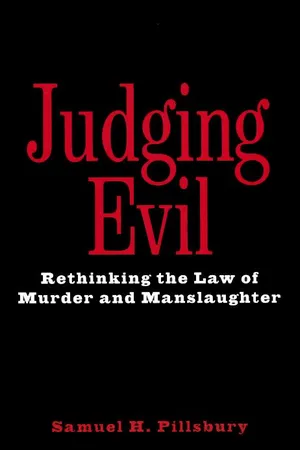 eBook - ePub
Judging Evil
Rethinking the Law of Murder and Manslaughter
- Samuel H. Pillsbury(Author)
- 2000(Publication Date)
- NYU Press(Publisher)
PART IIDefining Murder and Manslaughter
 Passage contains an image
6From Principles to RulesAn Introduction to Mens Rea
Now we move from principles of deserved punishment to rules of law, from generalities about blameworthiness to defining and grading different categories of homicidal conduct. In a sense we move to more familiar territory, for the basic considerations involved in defining homicide offenses are the same as we use in everyday human interaction—considerations of intent, awareness and motive, calculation and accident, passion and dispassion. But here we also enter the realm of lawyers and the particular traditions of Anglo-American criminal law. We enter a linguistic thicket, in which special historical and legal meanings about terms like malice, premeditation and provocation, must be considered. Almost as troublesome, though, will be the ordinary language of blameworthiness, which for all its suggestive power contains many traps for the conceptually unwary.My task in this chapter is threefold: (1) to introduce the concept of mens rea as it applies to murder and Manslaughter; (2) to introduce some of the competing criteria for mens rea rules; and (3) to defend basic mens rea analysis against two fundamental objections, one arising out of new work in cognitive science, and another that comes from a common misconception about how we understand and judge each other’s choices.As a preliminary matter, we need to canvass the variety of different rules that come under the heading of mens rea—all the different principles involving intent to harm and awareness of harm, culpable risk taking, motive, and quality of decision making that form the core of the law of murder and Manslaughter. Once these basics are in hand we turn briefly to considerations of rule drafting. Not only must we decide what kinds of culpable conduct an offense should cover, but we also must decide how to express our judgment in mens rea rules. This proves to be a matter of both substance and style. The broadest and most nuanced rules tend to be those in which aspects of mens rea are defined by allusion to character traits. But these same allusive forms of mens rea suffer most from the ills of vagueness, threatening to violate the criteria for rule drafting set out in the previous chapter. Meanwhile, analytic forms of mens rea, whose definitions rest on states of awareness or desire, often prove underinclusive, that is, too narrow. Finally, we consider briefly the politics of rule drafting, which favor overinclusive rather than underinclusive rules.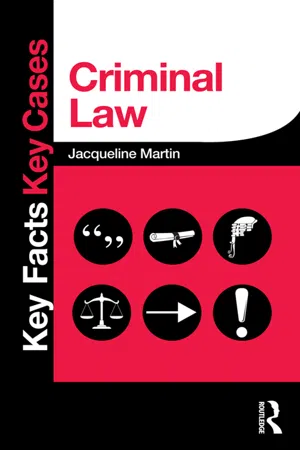 eBook - ePub
- Jacqueline Martin(Author)
- 2014(Publication Date)
- Routledge(Publisher)
10 HomicideHomicide is the unlawful killing of a human being. There are different offences depending on the mens rea of the defendant and whether there is a special defence available to the defendant.10.1Actus reus of homicide1 This is the killing of a human being (reasonable creature in being).• A homicide offence cannot be charged in respect of the killing of a foetus. However, if the foetus is injured and the child is born alive but dies afterwards as a result of the injuries this can be the actus reus for murder or Manslaughter (Attorney-General’s Reference (No 3 of 1994) (1997)).• A person who is ‘brain dead’ is not considered a ‘reasonable creature in being’. This is important as it allows doctors to switch off life-support machines without being liable for homicide (Malcherek and Steel (1981)).• In Airedale NHS Trust v Bland (1993) there were obiter dicta statements that brain-stem death was the test. Doctors were allowed to withdraw all artificial means (including feeding by tubes) of keeping the victim alive.2 The death must be caused by the defendant’s act or omission (see 2.4 for the rules on causation).3 There used to be a rule that death must have occurred within a year and a day, but this was abolished by the Law Reform (Year and a Day Rule) Act 1996.4 There is now no time limit on when the death may occur after the unlawful act, but, where it is more than three years later, the consent of the Attorney-General is needed for the prosecution.10.2 Murder1 There is no statutory definition of murder.2 The accepted definition is based on that in Lord Coke’s Institutes. This is that murder is ‘unlawfully killing a reasonable person who is in being and under the King’s Peace with malice aforethought, express or implied’.3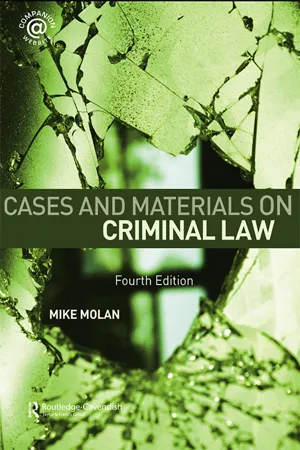 eBook - ePub
Cases & Materials on Criminal Law
Fourth Edition
- Mike Molan(Author)
- 2009(Publication Date)
- Routledge-Cavendish(Publisher)
Andrews v DPP [1973] AC 576 which was a case of Manslaughter through dangerous driving of a motor car. In a speech with which all the other members of this House who sat agreed, Lord Atkin said at 581–82:… of all crimes Manslaughter appears to afford most difficulties of definition, for it concerns homicide in so many and so varying conditions. From the early days when any homicide involved penalty the law has gradually evolved ‘through successive differentiations and integrations’ until it recognises murder on the one hand, based mainly, though not exclusively, on an intention to kill, and Manslaughter on the other hand, based mainly, though not exclusively, on the absence of intention to kill but with the presence of an element of ‘unlawfulness’ which is the elusive factor. In the present case it is only necessary to consider Manslaughter from the point of view of an unintentional killing caused by negligence, that is, the omission of a duty to take care …Lord Atkin then referred to the judgment of Lord Hewart CJ [in R v Bateman] from which I have already quoted and went on at 583:Here again I think with respect that the expressions used are not, indeed they were probably not intended to be, a precise definition of the crime. I do not myself find the connotations of mens rea helpful in distinguishing between degrees of negligence, nor do the ideas of crime and punishment in themselves carry a jury much further in deciding whether in a particular case the degree of negligence shown is a crime and deserves punishment. But the substance of the judgment is most valuable, and in my opinion is correct. In practice it has generally been adopted by judges in charging juries in all cases of Manslaughter by negligence, whether in driving vehicles or otherwise. The principle to be observed is that cases of Manslaughter in driving motor cars are but instances of a general rule applicable to all charges of homicide by negligence. Simple lack of care such as will constitute civil liability is not enough: for purposes of the criminal law there are degrees of negligence: and a very high degree of negligence is required to be proved before the felony is established. Probably of all the epithets that can be applied ‘reckless’ most nearly covers the case. It is difficult to visualise a case of death caused by reckless driving in the connotation of that term in ordinary speech which would not justify a conviction for Manslaughter: but it is probably not all-embracing, for ‘reckless’ suggests an indifference to risk whereas the accused may have appreciated the risk and intended to avoid it and yet shown such a high degree of negligence in the means adopted to avoid the risk as would justify a conviction. If the principle of Bateman’s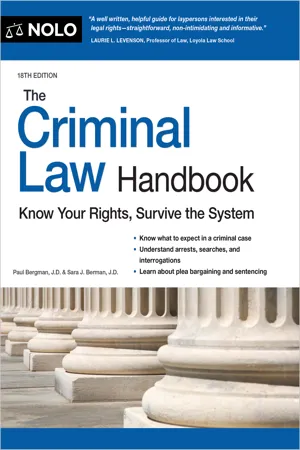 No longer available |Learn more
Criminal Law Handbook, The
Know Your Rights, Survive the System
- Paul Bergman, Sara J. Berman(Authors)
- 2024(Publication Date)
- NOLO(Publisher)
As a result, the heat of passion reduces their moral blameworthiness. 270 | THE CRIMINAL LAW HANDBOOK: KNOW YOUR RIGHTS, SURVIVE THE SYSTEM The common example of voluntary Manslaughter involves a husband who comes home unexpectedly to find his wife committing adultery. If the husband is provoked into such a heat of passion that he kills the paramour right then and there, a judge or jury might very well consider the killing to be voluntary Manslaughter. A killing can constitute involuntary Manslaughter when a person’s reckless disregard of a substantial risk results in another’s death. Because involuntary Manslaughter involves carelessness and not purposeful killing, it is a less serious crime than murder or voluntary Manslaughter. The subtleties between the degrees of murder and Manslaughter reach their peak with involuntary Manslaughter. Suppose that Rosencrantz is driving a car and runs over and kills Guildenstern. Rosencrantz might be: • Not guilty of a crime at all. If Guilden- stern’s family sues Rosencrantz in a civil case, Rosencrantz might have to pay damages to Guildenstern’s heirs if Rosencrantz was negligent—that is, if Rosencrantz failed to use ordinary care. • Convicted of involuntary Manslaughter. This might happen if Rosencrantz recklessly disregarded a substantial risk, meaning that Rosencrantz was more than ordinarily negligent. For example, a judge or jury might convict Rosencrantz of involuntary Manslaughter if Rosencrantz killed Guildenstern while driving under the influence of alcohol. • Convicted of second-degree murder. If Rosencrantz’s behavior demonstrated such an extreme reckless disregard for human life that a judge or jury decides that it shows malice aforethought, he might be convicted of second-degree murder. eBook - ePub
- Tony Storey, Natalie Wortley, Jacqueline Martin(Authors)
- 2022(Publication Date)
- Routledge(Publisher)
6Homicide (other than murder)DOI: 10.4324/9781003326793-6AIMS AND OBJECTIVES
After reading this chapter you should be able to:- Understand the law of involuntary Manslaughter (constructive, gross negligence and reckless Manslaughter)
- Understand the elements of certain statutory homicide offences
- Understand the circumstances in which a company may be liable for Manslaughter
- Analyse critically the law on homicide, including reform proposals
- Apply the law to factual situations to determine whether there is liability for murder or Manslaughter
6.1 Involuntary Manslaughter
‘Involuntary Manslaughter’ refers to any form of common law homicide where there is no proof of malice aforethought. There are three forms of involuntary Manslaughter:- constructive Manslaughter
- gross negligence Manslaughter
- reckless Manslaughter.
6.1.1 Constructive Manslaughter
D will be guilty of constructive Manslaughter if he kills by an unlawful and dangerous act. The following elements must be proven to exist:constructive ManslaughterThe appropriate charge where D commits an unlawful and dangerous act that results in V’s death- D must commit an unlawful act (i.e. a criminal offence).
- The act must be ‘dangerous’.
- D must have intended to do the unlawful act.
- That act must have caused death.
The requirement of an unlawful act
At one time it was thought that it was sufficient if D committed a civil wrong (a tort). In Fenton [1830] 1 Lew CC 179, for example, D was convicted of Manslaughter on the basis that he had committed the unlawful act of trespass to property. This approach quickly changed, and the law now requires the unlawful act to be a criminal offence. In Franklin (1883) 15 Cox CC 163, the court stated that ‘The mere fact of a civil wrong committed by one person against another ought not to be used as an incident which is a necessary step in a criminal case.’ If there is no criminal offence, then there is no possibility of a Manslaughter conviction (regardless of how ‘dangerous’ D’s act may have been). The leading case is Lamb eBook - PDF
- Clifton D. Bryant(Author)
- 2003(Publication Date)
- SAGE Publications, Inc(Publisher)
Further refinemen t of the law is certain to occur, given the expressed communit y need to reexamine legal concepts such as heat of passion. In this context , one judicial procedure that requires rééval- uation is whethe r the court should favor certain offenders whil e denyin g similar consideration for others. Manslaughter laws should reflect a deep understanding of anger, violence , and other issues relating to the family , given the extensiv e r e s e a r ch in these a r e a s. Th e investiga- tion of child abuse and neglect can protect infants and save children's lives. If children a re harmed due to accident or neglect, the state should assure its citizen s that the appro- priate immediat e cause of death will be a c c u r a t e ly certified and that every effort will be made to determine culpability. Youthfu l victim s of homicid e cannot speak for themselves , and the state holds an obligation to protect the rights of all of its citizens . Wit h respect to involuntary Manslaughter and negligent homicides , the law should establish clear guidelines. Althoug h som e states a l r e a dy have the important murder, voluntary Manslaughter, and involuntary Manslaughter provisions in place, other state laws fail to provide clear guidelines to address the degree of crime appropriate for emergent forms of Manslaughter and involuntary homicide . A s states mov e to broaden the categories of behavior for whic h culpability for Manslaughter and negligent homi - cide will be found, it is important to mak e sure that consti- tutional p a r a m e t e rs of basic statutory construction and application a re met . Law s need to clearly indicate what behavior is lawful or unlawful; the statutory law cannot be vague or overbroad, or violate equal protection principles. REFERENCES Almgren , Gunnar, Avery Guest, and George Immerwahr. 1998. "Joblessness, Family Disruption, and Violen t Death in Chicago, 1970-90." Social Forces 76:1465-93. eBook - PDF
The Concept of Mens Rea in International Criminal Law
The Case for a Unified Approach
- Mohamed Elewa Badar(Author)
- 2013(Publication Date)
- Hart Publishing(Publisher)
83 However, recklessness is a sufficient fault element for some serious crimes other than murder such as unlawful wounding, and some less serious crimes such as common law assault. G The Meaning of Intention in the Criminal Law of Ireland In Ireland, there are ongoing attempts by the Law Reform Commission to expand the definition of murder in a way that would capture situations such as when an accused fired a gun at a moving vehicle but claims that he neither intended to kill or cause serious injury to anyone, nor foresaw death as a probable consequence of his actions. In so doing, the Commission recommended that murder should encapsulate the American Model Penal Code definition of recklessness which amounts to extreme indifference to human life. 84 81 Law Commission Report, Murder, Manslaughter and Infanticide , Project 6 of the Ninth Programme of Law Reform: Homicide (Law Com No 304) para 3.13, 58–59, 28 November 2006, available at: www. lawcom.gov.uk. 82 R v Woollin [1998] 4 All ER 103. See also Law Reform Commission (Ireland), Report on Homicide: Murder and Involuntary Manslaughter (LCR 87-2008) 26, para 2.05; AJ Ashworth, ‘United Kingdom’ in KJ Heller and MK Dubber, The Handbook of Comparative Criminal Law (Stanford: Stanford University Press, 2010) 531–62, 547. 83 Law Reform Commission (Ireland), Report on Homicide , above (n 82) 26, para 2.05. 84 See Law Reform Commission (Ireland), Consultation Paper on Homicide: The Mental Element in Murder (LRC CP 17-2001) ch 4, 43–74; Law Reform Commission (Ireland), Report on Homicide , above (n 82) ch 3, 51–74, para 3.78. Mens Rea in Common Law Jurisdictions 44 Irish Courts recognise two forms of intent, namely, direct intent and oblique intent. 85 As for direct intent, two authoritative judgments can assist in clarifying its meaning. The first reported case to discuss the meaning of intention was People v Murray (1977).
Index pages curate the most relevant extracts from our library of academic textbooks. They’ve been created using an in-house natural language model (NLM), each adding context and meaning to key research topics.

